Page 243 of 440
Gear Ranges For Continuously Variable
Automatic Transaxle (CVT)
DO NOT race the engine when shifting from PARK or
NEUTRAL positions into another gear range.
ªPº Park
Supplements the parking brake by locking the transmis-
sion. The engine can be started in this range. Never use P
(Park) while the vehicle is in motion. Apply the parking
brake when leaving the vehicle in this range. Always
apply the parking brake first, and then place the selector
in P (Park) position.
WARNING!
Unintended movement of a vehicle could injure
those in and near the vehicle. As with all vehicles,
you should never exit a vehicle while the engine is
running. Before exiting a vehicle, you should always
shift the vehicle into P (Park), remove the key from
the ignition, and apply the parking brake. Once the
key is removed from the ignition, the transmission
shift lever is locked in the P (Park) position, securing
the vehicle against unwanted movement. Further-
more, you should never leave children unattended
inside a vehicle.
The following indicators should be used to ensure that
you have engaged the transmission shift lever into the P
(Park) position:
242 STARTING AND OPERATING
Page 244 of 440
²When shifting into P (Park), firmly move the lever all
the way forward until it stops.
²Look at the shift indicator window on the console to
ensure it is in the P (Park) position.
²You must depress the brake pedal to move the shift
lever out of the P (Park) position.
CAUTION!
Before moving the shift lever out of P (Park), you
must turn the ignition from LOCK to ON so the
steering wheel and shift lever are released. Other-
wise, damage to the steering column or shifter could
result. You must also depress the brake pedal.
ªRº Reverse
Shift into this range only after the vehicle has come to a
complete stop.
ªNº Neutral
Engine may be started in this range.
ªDº
This should be used for most driving and provides the
best ratio for optimum driveability, fuel economy, and
performance.
ªLº Low
This range should be used for maximum engine braking
when descending steep grades. In this range, the trans-
axle will ratio up only to prevent transaxle damage or
engine over speed while ratioing down will occur as
early as possible
STARTING AND OPERATING 243
5
Page 271 of 440
WARNING!
Abrasive material in any part of the brakes may cause
excessive wear or unpredictable braking. You might
not have full braking power when you need it to
prevent an accident. If you have been operating your
vehicle in dirty conditions, get your brakes checked
and cleaned as necessary. Failure to do so may result
is serious injury.
PARKING BRAKE
When the parking brake is applied with the
ignition on, the Brake Light in the instrument
cluster will come on.
NOTE:This light only shows that the parking brake is
on. It does not show the degree of brake application.If the parking brake is applied while the vehicle is
moving, a chime will sound to alert the driver. The chime
will sound up to 10 times or until the vehicle has
returned to a stop.
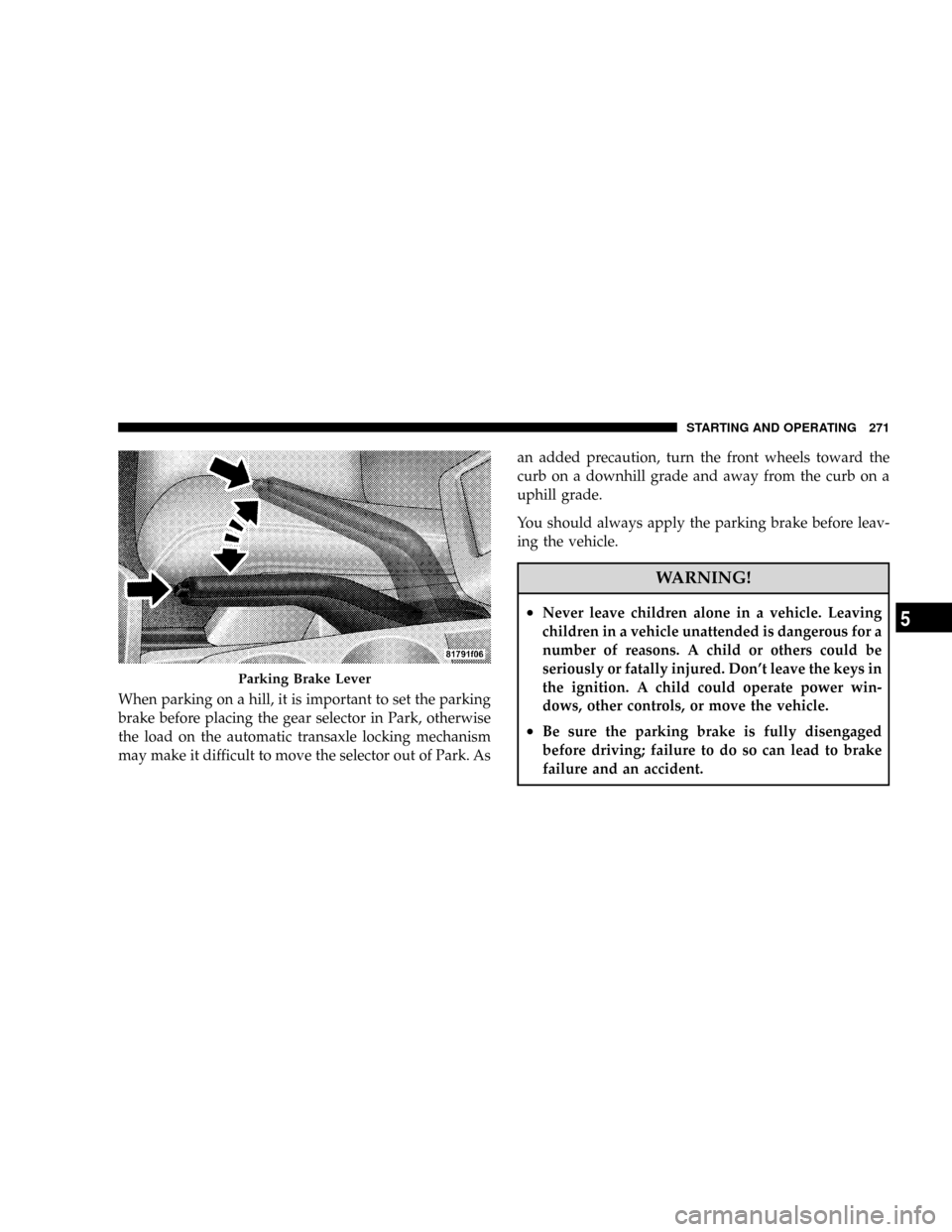
Before leaving the vehicle, make sure that the parking
brake is set. To set the parking brake, pull up firmly on
the lever. Also place the gear selector in the Park position
(automatic transaxle) or Reverse (manual transaxle). To
release the parking brake, apply the brake pedal, pull up
slightly on the lever, then depress the button on the end
of the lever and push the lever fully down toward the
floor.
NOTE:The parking brake lever will not release unless
the lever is pulled up slightly past its applied position.
270 STARTING AND OPERATING
Page 272 of 440
When parking on a hill, it is important to set the parking
brake before placing the gear selector in Park, otherwise
the load on the automatic transaxle locking mechanism
may make it difficult to move the selector out of Park. Asan added precaution, turn the front wheels toward the
curb on a downhill grade and away from the curb on a
uphill grade.
You should always apply the parking brake before leav-
ing the vehicle.
WARNING!
²Never leave children alone in a vehicle. Leaving
children in a vehicle unattended is dangerous for a
number of reasons. A child or others could be
seriously or fatally injured. Don't leave the keys in
the ignition. A child could operate power win-
dows, other controls, or move the vehicle.
²Be sure the parking brake is fully disengaged
before driving; failure to do so can lead to brake
failure and an accident.
Parking Brake Lever
STARTING AND OPERATING 271
5
Page 275 of 440
WARNING!
²Anti-lock system (ABS) cannot prevent the natural
laws of physics from acting on the vehicle, nor can
it increase braking or steering efficiency beyond
that afforded by the condition of the vehicle
brakes and tires or the traction afforded.
²The ABS cannot prevent accidents, including
those resulting from excessive speed in turns,
following another vehicle too closely, or hydro-
planing. Only a safe, attentive, and skillful driver
can prevent accidents.
²The capabilities of an ABS equipped vehicle must
never be exploited in a reckless or dangerous
manner which could jeopardize the user's safety
or the safety of others.The ABS light monitors the Anti-Lock Brake
System. The light will come on when the
ignition switch is turned to the ON position
and may stay on for as long as four seconds.
If the ABS light remains on or comes on while driving, it
indicates that the Anti-Lock portion of the brake system
is not functioning and that service is required. However,
the conventional brake system will continue to operate
normally if the BRAKE warning light is not on.
If the ABS light is on, the brake system should be serviced
as soon as possible to restore the benefits of Anti-Lock
brakes. If the ABS light does not come on when the
Ignition switch is turned to the ON position, have the
bulb repaired as soon as possible.
If both the Brake Warning Light and the ABS Light
remain on, the Anti-Lock brakes (ABS) and Electronic
Brake Force Distribution (EBD) systems are not function-
ing. Immediate repair to the ABS system is required.
274 STARTING AND OPERATING
Page 297 of 440

Premium System ± If Equipped
The Tire Pressure Monitor System (TPMS) uses wireless
technology with wheel rim mounted electronic sensors to
monitor tire pressure levels. Sensors, mounted to each
wheel as part of the valve stem, transmit tire pressure
readings to the Receiver Module.
NOTE:It is particularly important, for you to check the
tire pressure in all of your tires regularly and to maintain
the proper pressure.
The TPMS consists of the following components:
²Receiver Module
²4 Tire Pressure Monitoring Sensors
²3 Trigger Modules (mounted in three of the four wheel
wells)
²Various Tire Pressure Monitoring System Messages,
which display in the Electronic Vehicle Information
Center (EVIC)
²Yellow Tire Pressure Monitoring Telltale Light
Tire Pressure Monitoring Low Pressure Warnings
The Tire Pressure Monitoring Telltale Lamp will illumi-
nate in the instrument cluster, and an audible chime will
be activated when one or more of the four active road tire
pressures are low. The audible chime will sound once
every ignition cycle for each condition that it detects. In
addition, the Electronic Vehicle Information Center
(EVIC) will display a graphic of the pressure value(s)
with the low tire(s) flashing.
296 STARTING AND OPERATING
Page 299 of 440
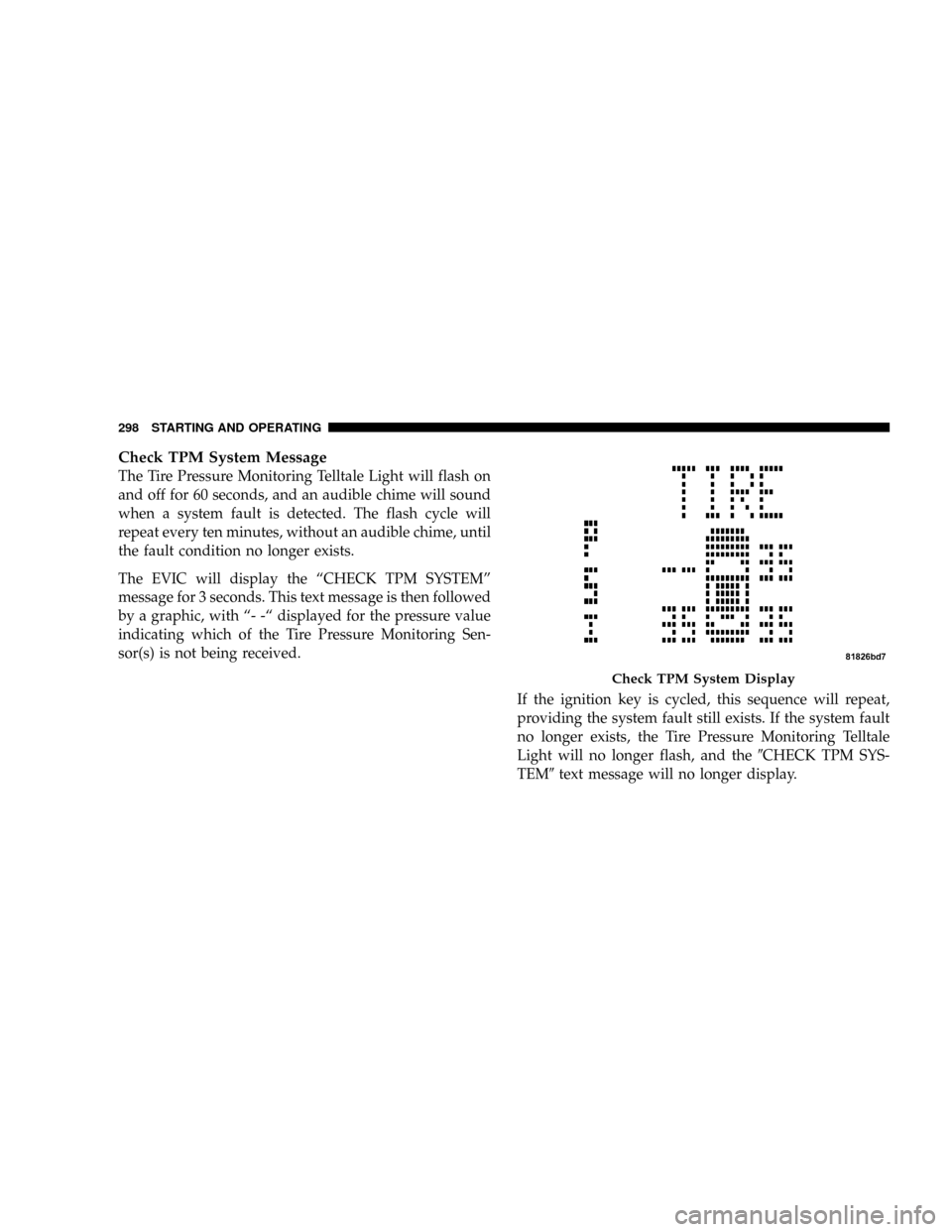
Check TPM System Message
The Tire Pressure Monitoring Telltale Light will flash on
and off for 60 seconds, and an audible chime will sound
when a system fault is detected. The flash cycle will
repeat every ten minutes, without an audible chime, until
the fault condition no longer exists.
The EVIC will display the ªCHECK TPM SYSTEMº
message for 3 seconds. This text message is then followed
by a graphic, with ª- -ª displayed for the pressure value
indicating which of the Tire Pressure Monitoring Sen-
sor(s) is not being received.
If the ignition key is cycled, this sequence will repeat,
providing the system fault still exists. If the system fault
no longer exists, the Tire Pressure Monitoring Telltale
Light will no longer flash, and the9CHECK TPM SYS-
TEM9text message will no longer display.
Check TPM System Display
298 STARTING AND OPERATING
Page 300 of 440

Display Settings
²Your system can be set to display pressure units in PSI,
kPa, or BAR.
NOTE:These display settings may not be available due
to Regulatory Authorities. In this case, the display will
only show approved units.
NOTE:If your vehicle is equipped with a compact spare
wheel and tire assembly that does not have a tire pressure
monitoring sensor. Therefore, it will not be monitored by
the Tire Pressure Monitor System (TPMS). In the event
that the compact spare tire is swapped with a low
pressure road tire, the next ignition key cycle will still
show the ªTire Pressure Monitoring Lampº to be ON, a
chime to sound, and the Electronic Vehicle Information
Center (EVIC) will still show the low tire pressure value
flashing on the graphic display. However, driving the
vehicle for up to 10 minutes above 15 mph (25 km/h) will
display a ªCHECK TPM SYSTEMº text message on theEVIC. This text message will then be followed by a
graphic, with ª- -ª in place of the flashing low pressure
value. For every subsequent key cycle, the ªTire Pressure
Monitoring Lampº will be ON, a chime will sound, a
ªCHECK TPM SYSTEMº text message will be display in
the EVIC, and the graphic display will have ª- -ª in place
of the pressure value of the spare tire location. Once the
original road tire has been properly repaired, and put
back onto the vehicle in place of the compact spare tire.
The TPMS will update the graphic display on the EVIC
with a new tire pressure value instead of ª- -ª, and the
ªTire Pressure Monitoring Lampº will be OFF as long as
none of the road tire(s) are below the low pressure
warning threshold. The vehicle may need to be driven for
up to 10 minutes above 15 mph (25 km/h) to receive this
information.
STARTING AND OPERATING 299
5