Page 264 of 440
avoid damage to the environment. You should know
your vehicles abilities and be able to recover it if some-
thing goes wrong. You should never stop or shut a
vehicle off when crossing deep water unless you ingested
water into the engine air intake. If the engine stalls do not
attempt to restart it. Determine if it has ingested water
first. The key to any crossing is low and slow. You want
to use low (L Off-Road) with the 4WD Lock engaged and
proceed very slowly with a constant slow speed {3-5 mph
(5±8 km/h) maximum} and light throttle. Keep the ve-
hicle moving; do not try to accelerate through the cross-
ing. After crossing any water higher than the bottom of
the axle differentials, you should inspect all of the vehicle
fluids for signs of water ingestion.CAUTION!
Water ingestion into the axles, transmission, transfer
case, engine or vehicle interior can occur if you drive
too fast or through too deep of water. Water can cause
permanent damage to engine, driveline or other
vehicle components and your brakes will be less
effective once wet and/or muddy.
STARTING AND OPERATING 263
5
Page 265 of 440
²Before You Cross Any Type Of Water± As you
approach any type of water you need to determine if
you can cross it safely and responsibly. If necessary, get
out and walk through the water or probe it with a
stick. You need to be sure of its depth, approach angle,
current and bottom condition. Be careful of murky or
muddy waters, check for hidden obstacles. Make sure
you will not be intruding on any wildlife and you can
recover the vehicle if necessary. The key to a safe
crossing is the water depth, current and bottom con-
ditions. On soft bottoms the vehicle will sink in,
effectively increasing the water level on the vehicle. Be
sure to consider this when determining the depth and
the ability to safely cross
²Crossing Puddles, Pools, Flooded Areas Or Other
Standing Water± Puddles, pools, flooded or other
standing water areas normally contain murky or
muddy waters. These water types normally contain
hidden obstacles and make it difficult to determine anaccurate water depth, approach angle, and bottom
condition. Murky or muddy water holes are where
you want to hook up tow straps prior to entering. This
makes for a faster, cleaner and easier vehicle recovery.
If you are able to determine you can safely cross, than
proceed using the low and slow method.
CAUTION!
Muddy waters can reduce the cooling system effec-
tiveness by depositing debris onto the radiator.
²Crossing Ditches, Streams, Shallow Rivers Or Other
Flowing Water± Flowing water can be extremely
dangerous. Never attempt to cross a fast running
stream or river even in shallow water. Fast moving
water can easily push your vehicle downstream
sweeping it out of control. Even in very shallow water,
a high current can still wash the dirt out from around
264 STARTING AND OPERATING
Page 272 of 440
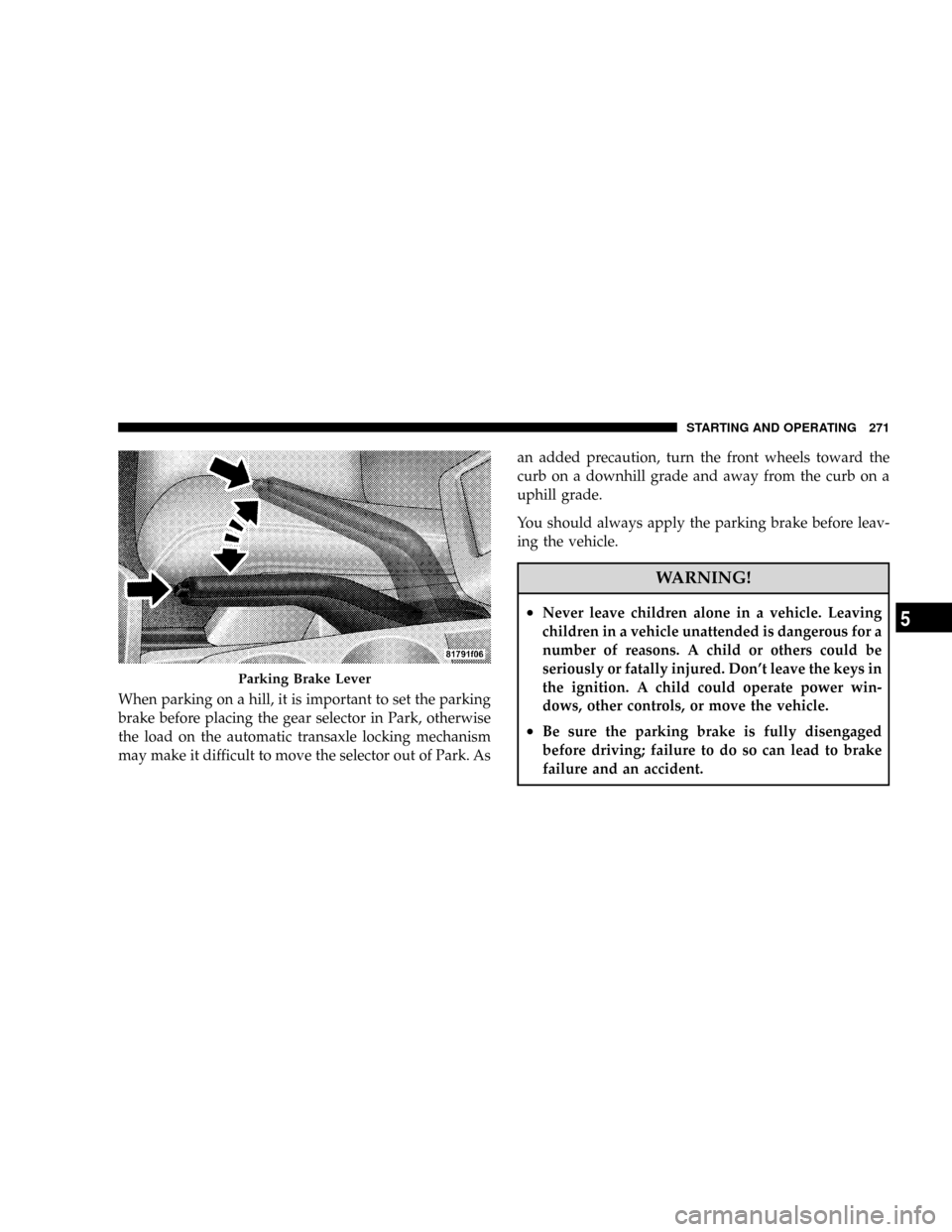
When parking on a hill, it is important to set the parking
brake before placing the gear selector in Park, otherwise
the load on the automatic transaxle locking mechanism
may make it difficult to move the selector out of Park. Asan added precaution, turn the front wheels toward the
curb on a downhill grade and away from the curb on a
uphill grade.
You should always apply the parking brake before leav-
ing the vehicle.
WARNING!
²Never leave children alone in a vehicle. Leaving
children in a vehicle unattended is dangerous for a
number of reasons. A child or others could be
seriously or fatally injured. Don't leave the keys in
the ignition. A child could operate power win-
dows, other controls, or move the vehicle.
²Be sure the parking brake is fully disengaged
before driving; failure to do so can lead to brake
failure and an accident.
Parking Brake Lever
STARTING AND OPERATING 271
5
Page 299 of 440
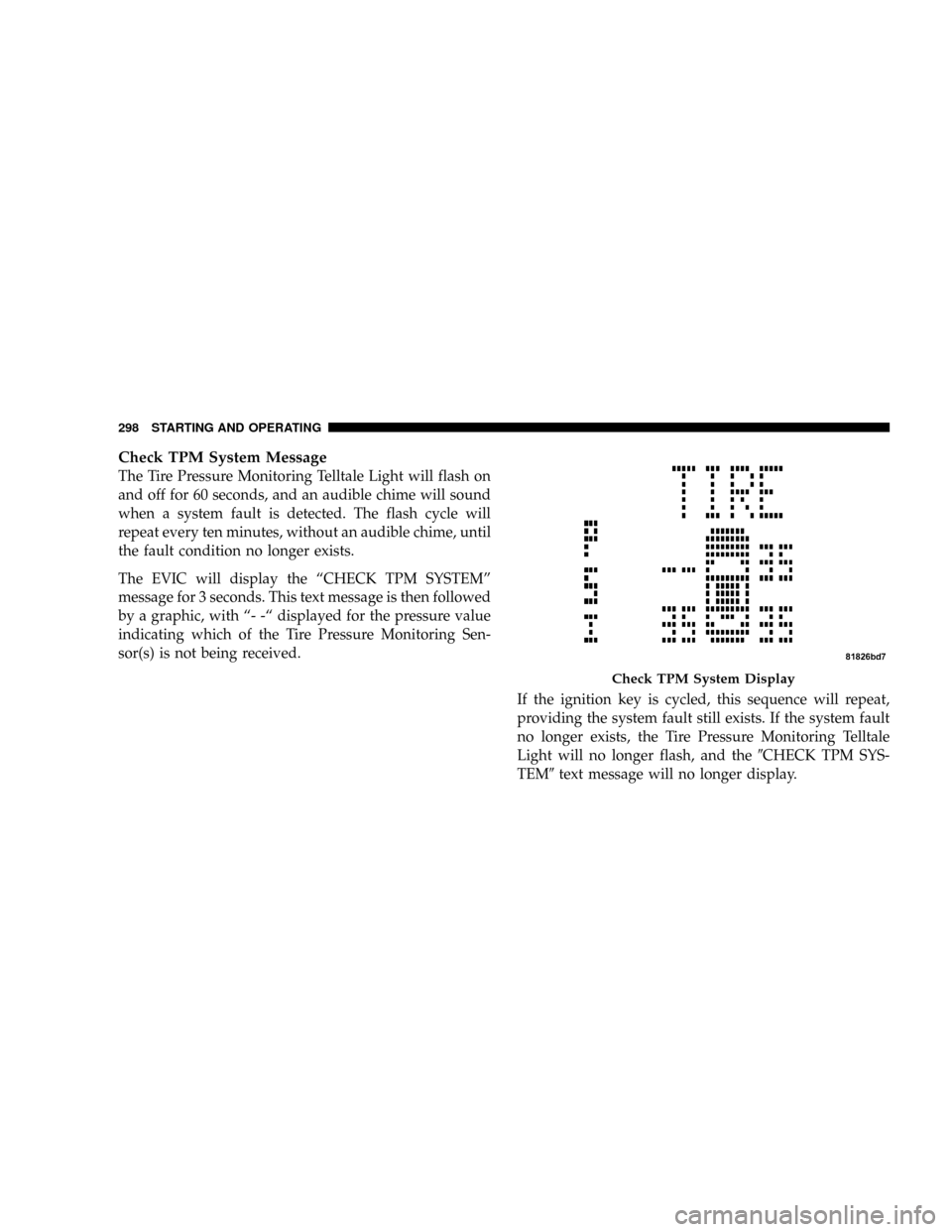
Check TPM System Message
The Tire Pressure Monitoring Telltale Light will flash on
and off for 60 seconds, and an audible chime will sound
when a system fault is detected. The flash cycle will
repeat every ten minutes, without an audible chime, until
the fault condition no longer exists.
The EVIC will display the ªCHECK TPM SYSTEMº
message for 3 seconds. This text message is then followed
by a graphic, with ª- -ª displayed for the pressure value
indicating which of the Tire Pressure Monitoring Sen-
sor(s) is not being received.
If the ignition key is cycled, this sequence will repeat,
providing the system fault still exists. If the system fault
no longer exists, the Tire Pressure Monitoring Telltale
Light will no longer flash, and the9CHECK TPM SYS-
TEM9text message will no longer display.
Check TPM System Display
298 STARTING AND OPERATING
Page 300 of 440

Display Settings
²Your system can be set to display pressure units in PSI,
kPa, or BAR.
NOTE:These display settings may not be available due
to Regulatory Authorities. In this case, the display will
only show approved units.
NOTE:If your vehicle is equipped with a compact spare
wheel and tire assembly that does not have a tire pressure
monitoring sensor. Therefore, it will not be monitored by
the Tire Pressure Monitor System (TPMS). In the event
that the compact spare tire is swapped with a low
pressure road tire, the next ignition key cycle will still
show the ªTire Pressure Monitoring Lampº to be ON, a
chime to sound, and the Electronic Vehicle Information
Center (EVIC) will still show the low tire pressure value
flashing on the graphic display. However, driving the
vehicle for up to 10 minutes above 15 mph (25 km/h) will
display a ªCHECK TPM SYSTEMº text message on theEVIC. This text message will then be followed by a
graphic, with ª- -ª in place of the flashing low pressure
value. For every subsequent key cycle, the ªTire Pressure
Monitoring Lampº will be ON, a chime will sound, a
ªCHECK TPM SYSTEMº text message will be display in
the EVIC, and the graphic display will have ª- -ª in place
of the pressure value of the spare tire location. Once the
original road tire has been properly repaired, and put
back onto the vehicle in place of the compact spare tire.
The TPMS will update the graphic display on the EVIC
with a new tire pressure value instead of ª- -ª, and the
ªTire Pressure Monitoring Lampº will be OFF as long as
none of the road tire(s) are below the low pressure
warning threshold. The vehicle may need to be driven for
up to 10 minutes above 15 mph (25 km/h) to receive this
information.
STARTING AND OPERATING 299
5
Page 324 of 440
WHAT TO DO IN EMERGENCIES
CONTENTS
mHazard Warning Flasher..................324
mIf Your Engine Overheats.................324
mAutomatic Transaxle Overheating...........326
mJacking And Tire Changing................326
NJack Location........................327
NSpare Tire Stowage....................327
NPreparations For Jacking................327
NJacking Instructions....................328mJump-Starting Procedures Due To A Low
Battery..............................331
mDriving On Slippery Surfaces..............334
NAcceleration.........................334
NTraction............................334
mFreeing A Stuck Vehicle..................335
mTowing A Disabled Vehicle................336
NWith Ignition Key.....................336
NWithout The Ignition Key...............337
6
Page 325 of 440
HAZARD WARNING FLASHER
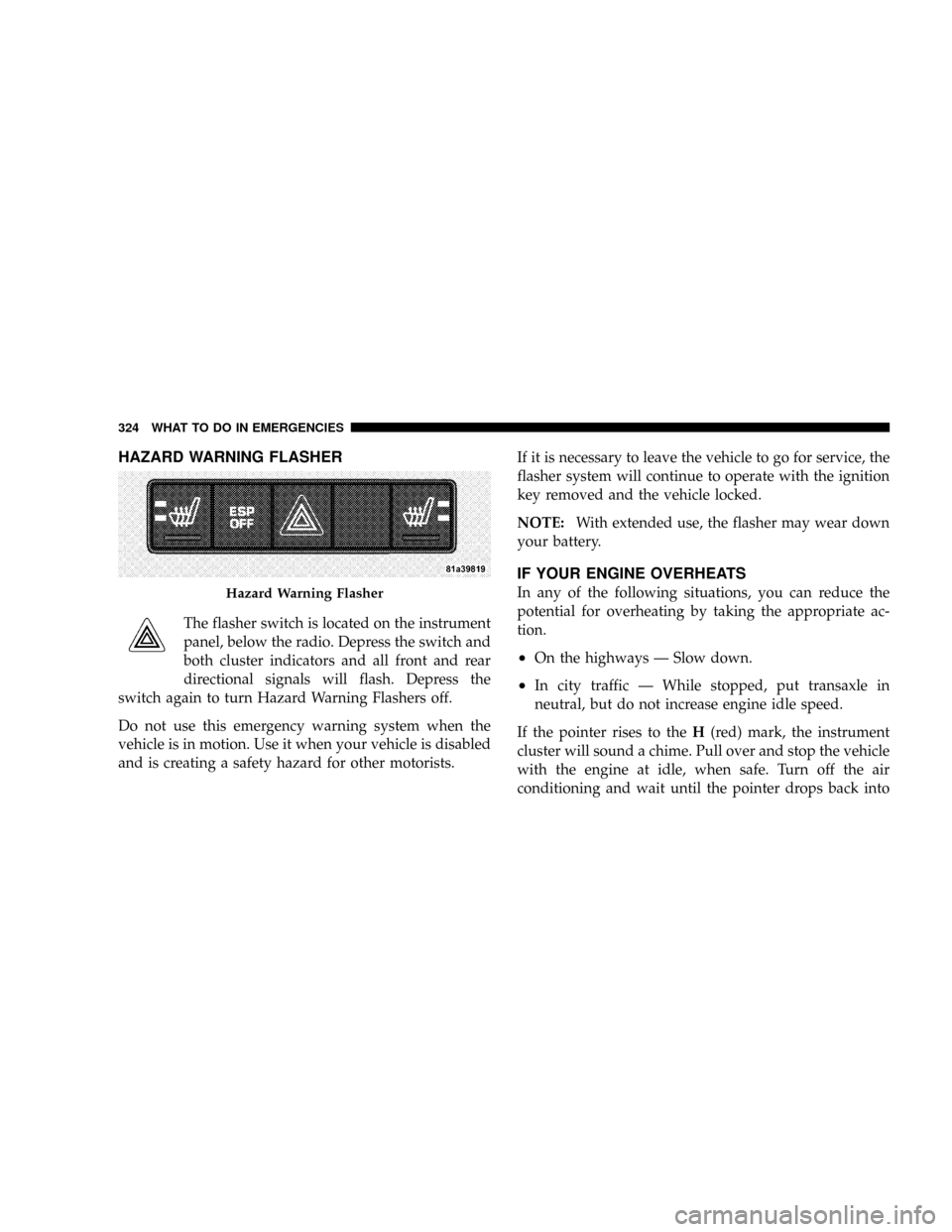
The flasher switch is located on the instrument
panel, below the radio. Depress the switch and
both cluster indicators and all front and rear
directional signals will flash. Depress the
switch again to turn Hazard Warning Flashers off.
Do not use this emergency warning system when the
vehicle is in motion. Use it when your vehicle is disabled
and is creating a safety hazard for other motorists.If it is necessary to leave the vehicle to go for service, the
flasher system will continue to operate with the ignition
key removed and the vehicle locked.
NOTE:With extended use, the flasher may wear down
your battery.
IF YOUR ENGINE OVERHEATS
In any of the following situations, you can reduce the
potential for overheating by taking the appropriate ac-
tion.
²On the highways Ð Slow down.
²In city traffic Ð While stopped, put transaxle in
neutral, but do not increase engine idle speed.
If the pointer rises to theH(red) mark, the instrument
cluster will sound a chime. Pull over and stop the vehicle
with the engine at idle, when safe. Turn off the air
conditioning and wait until the pointer drops back into
Hazard Warning Flasher
324 WHAT TO DO IN EMERGENCIES
Page 334 of 440
5. Connect one end of a jumper cable to the positive
terminal of the booster battery. Connect the other end of
the jumper cable to the positive terminal of the dis-
charged battery.
WARNING!
Battery fluid is a corrosive acid solution; do not allow
battery fluid to contact eyes, skin or clothing. Don't
lean over battery when attaching clamps or allow the
clamps to touch each other. If acid splashes in eyes or
on skin, flush the contaminated area immediately
with large quantities of water.
A battery generates hydrogen gas which is flam-
mable and explosive. Keep flame or spark away from
the vent holes. Do not use a booster battery or any
other booster source with an output that exceeds 12
volts.6. Connect the other cable, first to the negative terminal
of the booster battery and then to the negative terminal of
the discharged battery. Make sure you have a good
contact.
7. If the vehicle is equipped with Sentry Key Immobi-
lizer, turn the ignition switch to the ON position for 3
seconds before moving the ignition switch to the START
position.
8. Start the engine in the vehicle that has the booster
battery, let the engine idle a few minutes, then start the
engine in the vehicle with the discharged battery.
9. When removing the jumper cables, reverse the se-
quence exactly. Be careful of the moving belts and fan.
WHAT TO DO IN EMERGENCIES 333
6