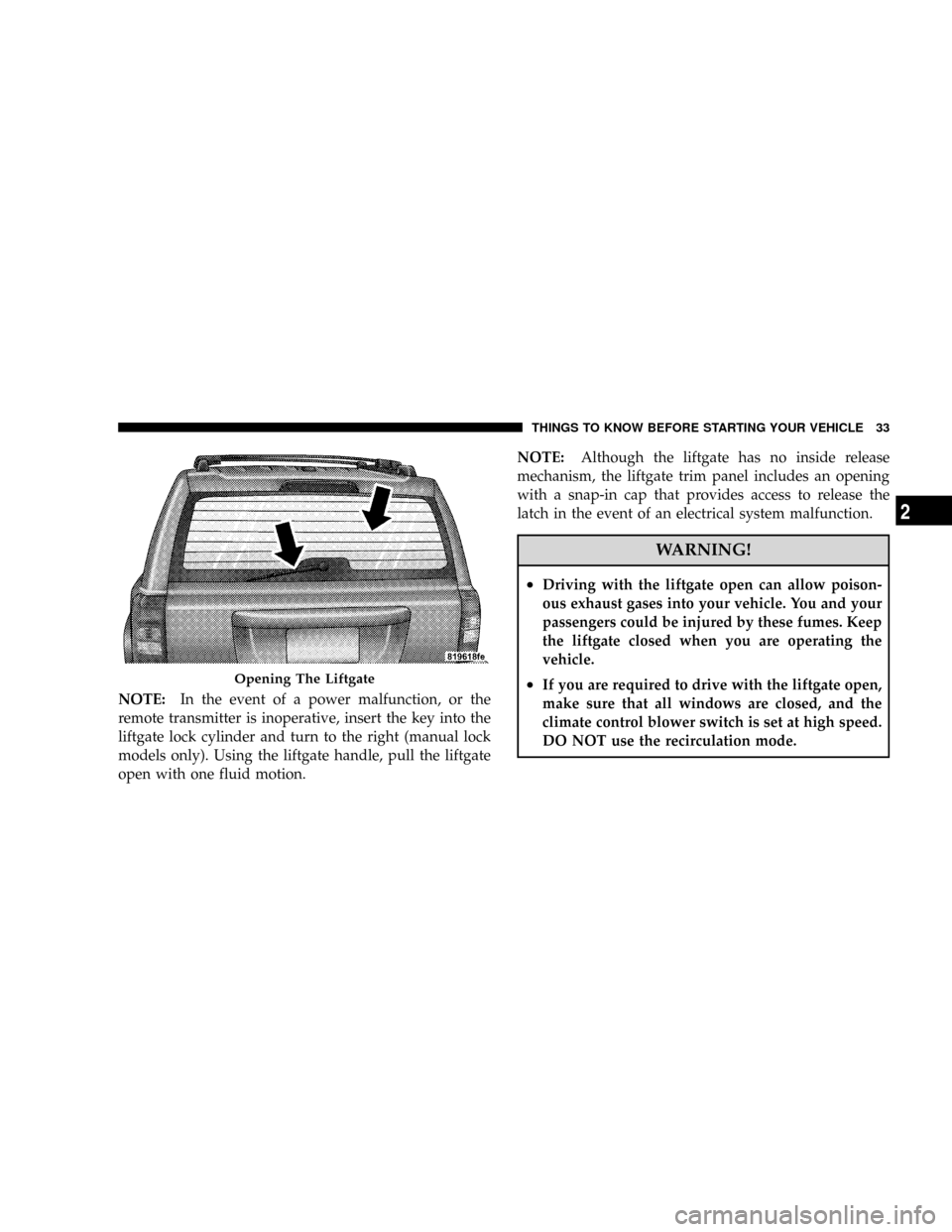
NOTE:In the event of a power malfunction, or the
remote transmitter is inoperative, insert the key into the
liftgate lock cylinder and turn to the right (manual lock
models only). Using the liftgate handle, pull the liftgate
open with one fluid motion.NOTE:Although the liftgate has no inside release
mechanism, the liftgate trim panel includes an opening
with a snap-in cap that provides access to release the
latch in the event of an electrical system malfunction.
WARNING!
²Driving with the liftgate open can allow poison-
ous exhaust gases into your vehicle. You and your
passengers could be injured by these fumes. Keep
the liftgate closed when you are operating the
vehicle.
²If you are required to drive with the liftgate open,
make sure that all windows are closed, and the
climate control blower switch is set at high speed.
DO NOT use the recirculation mode.Opening The Liftgate
THINGS TO KNOW BEFORE STARTING YOUR VEHICLE 33
2
WARNING!
²Relying on the airbags alone could lead to more
severe injuries in a collision. The airbags work
with your seat belt to restrain you properly. In
some collisions, the airbags won't deploy at all.
Always wear your seat belts even though you have
airbags.
²Being too close to the steering wheel or instrument
panel during airbag deployment could cause seri-
ous injury. Airbags need room to inflate. Sit back,
comfortably extending your arms to reach the
steering wheel or instrument panel.
²If the vehicle has side curtain airbags, they also
need room to inflate. Do not lean against the door
or window. Sit upright in the center of the seat.
Air Bag System Components
The airbag system consists of the following:
²Occupant Restraint Controller (ORC)
²Side Remote Acceleration Sensors (if equipped)
²Airbag Warning Light
²Driver Airbag
²Front Passenger Airbag
²Supplemental Side Curtain Airbags above Side Win-
dows (if equipped)
²Steering Wheel and Column
²Instrument Panel
²Interconnecting Wiring
²Seatbelt Reminder Light
²Knee Impact Bolsters
THINGS TO KNOW BEFORE STARTING YOUR VEHICLE 53
2