Page 314 of 472
CAUTION!
Damage to the fuel system or emission control
system could result from using an improper fuel cap
(gas cap). A poorly fitting cap could let impurities
into the fuel system. Also, a poorly fitting after-
market cap can cause the MIL (Malfunction Indica-
tor Light) to illuminate, due to fuel vapors escaping
from the system.
CAUTION!
A poorly fitting gas cap may cause the Malfunction
Indicator Light to turn on.
CAUTION!
To avoid fuel spillage and overfilling, do not “top
off” the fuel tank after filling.
NOTE:When the fuel nozzle “clicks” or shuts off, the
fuel tank is full.
WARNING!
•Never have any smoking materials lit in or near
the vehicle when the gas cap is removed or the
tank filled.
•Never add fuel when the engine is running. This
is in violation of most state and federal fire
regulations and will cause the malfunction indi-
cator light to turn on.
314 STARTING AND OPERATING
Page 315 of 472

NOTE:Tighten the gas cap about 1/4 turn until you
hear one click. This is an indication that cap is properly
tightened.
If the gas cap is not tighten properly, the Malfunction
Indicator Light will come on. Be sure the gas cap is
tightened every time the vehicle is refueled.
WARNING!
A fire may result if gasoline is pumped into a
portable container that is inside of a vehicle. You
could be burned. Always place gas containers on the
ground while filling.
Loose Fuel Filler Cap Message
If the vehicle diagnostic system determines that the fuel
filler cap is loose, improperly installed, or damaged, a
“CHECK GASCAP” message will be displayed in theEVIC (Electronic Vehicle Information Center). Refer to
“Electronic Vehicle Information Center” in Section 4 of
this manual. Tighten the fuel filler cap until a “clicking”
sound is heard. This is an indication that the fuel filler
cap is properly tightened. Refer to “Onboard Diagnostic
System — OBDII” in Section 7 of this manual for more
information.
CAUTION!
Damage to the fuel system or emission control
system could result from using an improper fuel
tank filler cap (gas cap). A poorly fitting cap could let
impurities into the fuel system.
STARTING AND OPERATING 315
5
Page 322 of 472
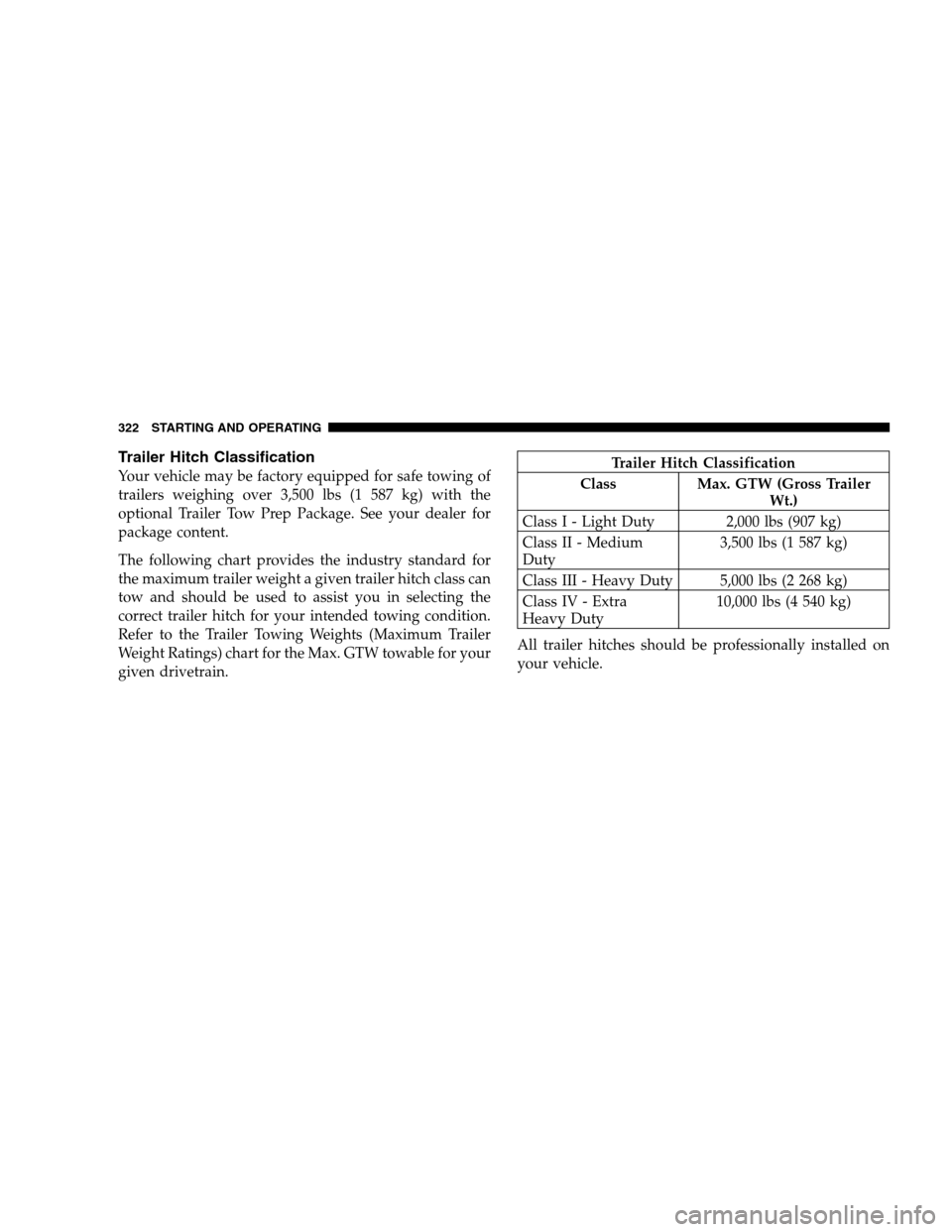
Trailer Hitch Classification
Your vehicle may be factory equipped for safe towing of
trailers weighing over 3,500 lbs (1 587 kg) with the
optional Trailer Tow Prep Package. See your dealer for
package content.
The following chart provides the industry standard for
the maximum trailer weight a given trailer hitch class can
tow and should be used to assist you in selecting the
correct trailer hitch for your intended towing condition.
Refer to the Trailer Towing Weights (Maximum Trailer
Weight Ratings) chart for the Max. GTW towable for your
given drivetrain.Trailer Hitch Classification
Class Max. GTW (Gross Trailer
Wt.)
ClassI-LightDuty 2,000lbs(907 kg)
Class II - Medium
Duty3,500 lbs (1 587 kg)
Class III - Heavy Duty 5,000 lbs (2 268 kg)
Class IV - Extra
Heavy Duty10,000 lbs (4 540 kg)
All trailer hitches should be professionally installed on
your vehicle.
322 STARTING AND OPERATING
Page 329 of 472

CAUTION!
If the trailer weighs more than 1,000 lbs (454 kg) loaded,
it should have its own brakes and they should be of
adequate capacity. Failure to do this could lead to
accelerated brake lining wear, higher brake pedal ef-
fort, and longer stopping distances.
WARNING!
Do not connect trailer brakes to your vehicle’s hydrau-
lic brake lines. It can overload your brake system and
cause it to fail. You might not have brakes when you
need them and could have an accident.
Towing any trailer will increase your stopping distance.
When towing you should allow for additional space
between your vehicle and the vehicle in front of you.
Failure to do so could result in an accident.
Towing Requirements — Trailer Lights & Wiring
Whenever you pull a trailer, regardless of the trailer size,
stop lights and turn signals on the trailer are required for
motoring safety.
The Trailer Tow Package may includea4and7pin
wiring harness. Use a factory approved trailer harness
and connector.
The electrical connections are all complete to the vehicle
but you must mate the harness to a trailer connector.
Refer to the following illustrations.
STARTING AND OPERATING 329
5
Page 331 of 472

Towing Tips — Automatic Transmission
The “D” range can be selected when towing. However, if
frequent shifting occurs while in this range, the ”Tow/
Haul” mode (if equipped) or a lower gear range should
be selected.
NOTE:Using the ”Tow/Haul” mode (if equipped) or a
lower gear range while operating the vehicle under
heavy operating conditions will improve performance
and extend transmission life by reducing excessive shift-
ing and heat build up. This action will also provide better
engine braking.
The automatic transmission fluid and filter should be
changed if you REGULARLY tow a trailer for more than
45 minutes of continuous operation. Refer to “Mainte-
nance Schedule B” in Section 8 of this manual for
transmission fluid change intervals.
NOTE:Check the automatic transmission fluid level
before towing.
Towing Tips — Electronic Speed Control (If
Equipped)
Don’t use in hilly terrain or with heavy loads.
When using the speed control, if you experience speed
drops greater than 10 mph (16 km/h), disengage until
you can get back to cruising speed.
Use speed control in flat terrain and with light loads to
maximize fuel efficiency.
Towing Tips — Cooling System
To reduce potential for engine and transmission over-
heating, take the following actions:
City Driving
When stopped for short periods of time, put transmission
in neutral and increase engine idle speed.
Highway Driving
Reduce speed.
STARTING AND OPERATING 331
5
Page 344 of 472
5. Raise the vehicle by turning the jack screw clockwise.
Raise the vehicle only until the tire just clears the surface
and enough clearance is obtained to install the spare tire.
Minimum tire lift provides maximum stability.
WARNING!
Raising the vehicle higher than necessary can make
the vehicle less stable. It could slip off the jack and
hurt someone near it. Raise the vehicle only enough
to remove the tire.
6. Remove the lug nuts and wheel.
7. Position the spare wheel/tire on the vehicle and install
the lug nuts with the cone-shaped end toward the wheel.
Lightly tighten the nuts. To avoid the risk of forcing the
vehicle off the jack, do not tighten the nuts fully until the
vehicle has been lowered.
8. Lower the vehicle by turning the jack screw counter
clockwise, and remove the jack and wheel blocks.
9. Finish tightening the lug nuts. Push down on the
wrench while tightening for increased leverage. Alternate
Rear Jacking Location
344 WHAT TO DO IN EMERGENCIES
Page 352 of 472

▫Maintenance-Free Battery................370
▫Air Conditioner Maintenance.............371
▫Power Steering Fluid Check..............372
▫Body Lubrication.....................374
▫Windshield Wiper Blades................374
▫Windshield Washers — Front And Rear.....374
▫Exhaust System......................375
▫Cooling System.......................376
▫Hoses And Vacuum/Vapor Harnesses.......381
▫Fuel System Connections................382
▫Brake System........................382
▫Front/Rear Axle Fluid..................385
▫Transfer Case........................385▫Automatic Transmission................386
▫Appearance Care And Protection From
Corrosion...........................389
�Fuse Panel...........................393
▫Interior Fuses........................393
▫Underhood Fuses (Power Distribution
Center)............................396
▫Underhood Fuses (Integrated Power
Module)............................399
�Vehicle Storage........................400
�Replacement Bulbs......................401
�Bulb Replacement......................402
▫Head Light..........................402
▫Front Turn Signal.....................403
352 MAINTAINING YOUR VEHICLE
Page 353 of 472
▫FrontFogLight ......................404
▫Rear Tail, Stop, Turn Signal, And
Back-Up Lights.......................404
▫Center High Mounted Stop Light (CHMSL) . . . 406
�Fluids And Capacities...................407�Fluids, Lubricants, And Genuine Parts........408
▫Engine.............................408
▫Chassis............................409
MAINTAINING YOUR VEHICLE 353
7