Page 334 of 408

Coolant Checks
Check engine coolant (antifreeze) protection every 12
months (before the onset of freezing weather, where
applicable). If coolant is dirty or rusty in appearance, the
system should be drained, flushed and refilled with fresh
coolant. Check the front of the A/C condenser for any
accumulation of bugs, leaves, etc. If dirty, clean by gently
spraying water from a garden hose vertically down the
face of the condenser.
Check the coolant recovery bottle tubing for brittle rub-
ber, cracking, tears, cuts and tightness of the connection
at the bottle and radiator. Inspect the entire system for
leaks.
Cooling System — Drain, Flush and Refill
At the intervals shown on the Maintenance Schedules,
the system should be drained, flushed and refilled.
If the solution is dirty or contains a considerable amount
of sediment, clean and flush with a reliable cooling
system cleaner. Follow with a thorough rinsing to remove
all deposits and chemicals. Properly dispose of old
antifreeze solution.
Selection Of Coolant
Use only the manufacturers recommended coolant, refer
to Fluids, Lubricants and Genuine Parts for correct
coolant type.
334 MAINTAINING YOUR VEHICLE
Page 339 of 408

Inspect all hose connections such as clamps and cou-
plings to make sure the are secure and no leaks are
present.
Components should be replaced immediately if there is
any evidence of degradation that could cause failure.
Fuel System Connections
Electronic Fuel Injection high pressure fuel systems are
designed with tubes and special connects, connections
and clamps which have unique material characteristics to
provide adequate sealing and resist attack by deterio-
rated gasoline.
You are urged to use only the manufactures-specified
tubes, connections and clamps, or their equivalent in
material and specification, in any fuel system servicing.
Brake System
In order to assure brake system performance, all brake
system components should be inspected periodically.
Suggested service intervals can be found in the Mainte-
nance Section.
WARNING!
Riding the brakes can lead to brake failure and
possibly an accident. Driving with your foot resting
or riding on the brake pedal can result in abnormally
high brake temperatures, excessive lining wear, and
possible brake damage. You wouldn’t have your full
braking capacity in an emergency.
Brake And Power Steering System Hoses
When servicing the vehicle for scheduled maintenance,
inspect the surface of the hoses and nylon tubing for
evidence of heat and mechanical damage. Hard and
MAINTAINING YOUR VEHICLE 339
7
Page 343 of 408

Fluid and Filter Changes
Refer to the “Maintenance Schedule located if section 8 of
this manual for the correct change interval for your type
of driving.
Special Additives
Do not add any materials (other than leak detection dyes)
to Automatic Transmission Fluid (ATF). ATF is an engi-
neered product and its performance may be impaired by
supplemental additives.
Manual Transaxle
Lubricant Selection
Use only manufacturers recommended transmission
fluid. Refer to Fluids, Lubricants and Genuine Parts for
correct fluid type.
Fluid Level Check
Check the fluid level by removing the fill plug. The fluid
level should be between the bottom of the fill hole and a
point not more that 3/16” (4.7 mm) below the bottom of
the hole.
Add fluid, if necessary, to maintain the proper level.
Frequency Of Fluid Change
Under normal operating conditions, the fluid installed at
the factory will give satisfactory lubrication for the life of
the vehicle. Fluid changes are not necessary unless the
following conditions exist:
•The lubricant has become contaminated with water. If
contaminated with water, the fluid should be changed
immediately.
•If severe usage has occurred, refer to Maintenance
Schedule “B” in Section 8 of this manual.
MAINTAINING YOUR VEHICLE 343
7
Page 344 of 408

Rear Drive Assembly (RDA )– AWD/4WD Models
Only
Lubricant Selection
Use only manufacturers recommended fluid. Refer to
Fluids, Lubricants and Genuine Parts for correct fluid
type.
Fluid Level Check
Visually inspected the unit at each oil change for leakage.
If leakage is detected, Check the fluid level by removing
the fill plug. The fluid level should be maintained be-
tween the bottom of the fill hole to 1/8 inch (4 mm)
below the fill hole.
Add fluid, if necessary, to maintain the proper level.
Frequency Of Fluid Change
Refer to the “Maintenance Schedule located if section 8 of
this manual for the correct change interval for your type
of driving.
Power Transfer Unit (PTU) – AWD/4WD Models
Only
Lubricant Selection
Use only manufacturers recommended fluid. Refer to
Fluids, Lubricants and Genuine Parts for correct fluid
type.
Fluid Level Check
Visually inspected the unit at each oil change for leakage.
If leakage is detected, Check the fluid level by removing
the fill plug. The fluid level should be maintained be-
tween the bottom of the fill hole to 1/8 inch (4 mm)
below the fill hole.
Add fluid, if necessary, to maintain the proper level.
Frequency Of Fluid Change
Refer to the “Maintenance Schedule located if section 8 of
this manual for the correct change interval for your type
of driving.
344 MAINTAINING YOUR VEHICLE
Page 365 of 408
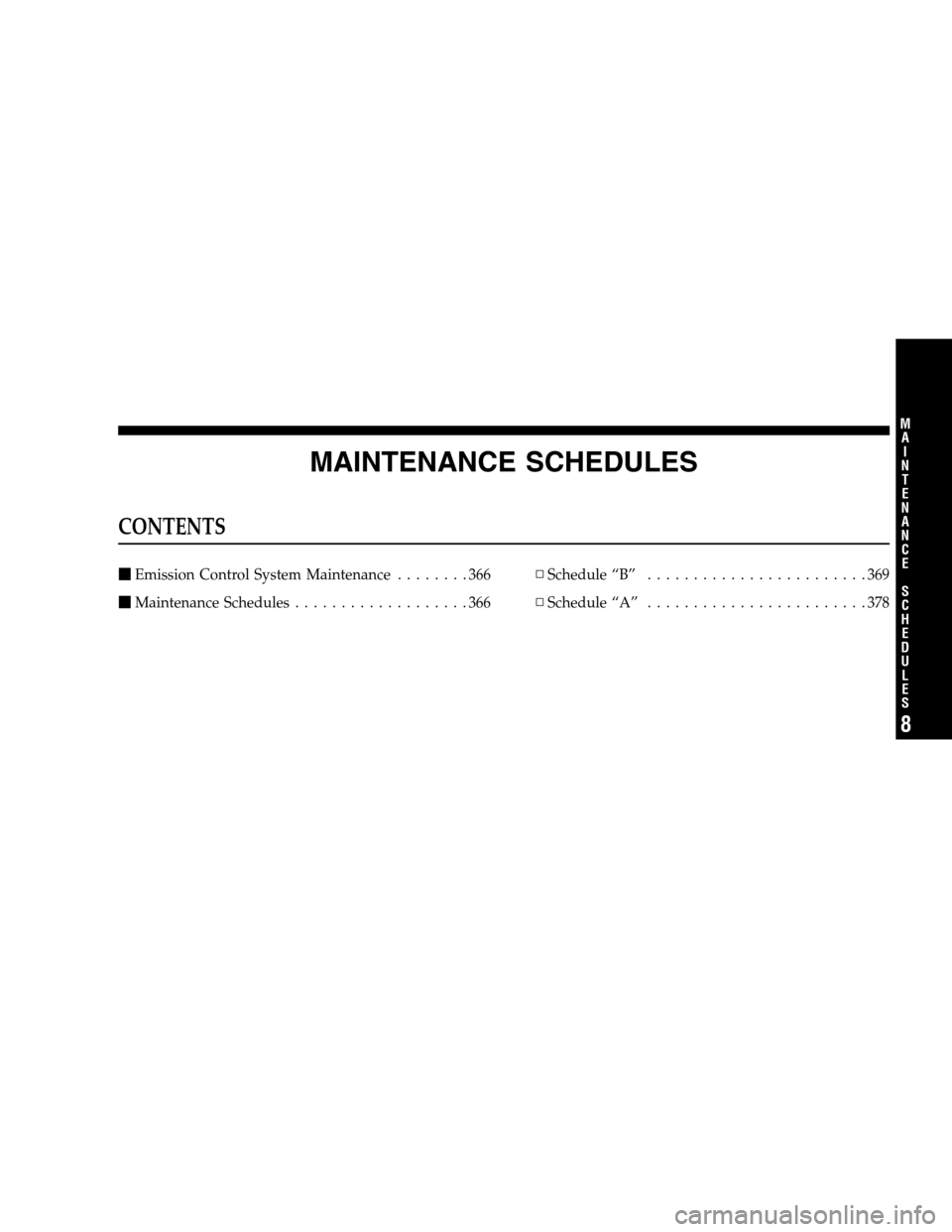
MAINTENANCE SCHEDULES
CONTENTS
�Emission Control System Maintenance........366
�Maintenance Schedules...................366▫Schedule “B”........................369
▫Schedule “A”........................378
8
M
A
I
N
T
E
N
A
N
C
E
S
C
H
E
D
U
L
E
S
Page 366 of 408

EMISSION CONTROL SYSTEM MAINTENANCE
The “Scheduled” maintenance services, listed inbold
typemust be done at the times or mileages specified to
assure the continued proper functioning of the emission
control system. These, and all other maintenance services
included in this manual, should be done to provide best
vehicle performance and reliability. More frequent main-
tenance may be needed for vehicles in severe operating
conditions such as dusty areas and very short trip
driving.
Inspection and service also should be done any time a
malfunction is suspected.
NOTE:Maintenance, replacement, or repair of the emis-
sion control devices and systems on your vehicle may be
performed by any automotive repair establishment or
individual using any automotive part, which has been
certified pursuant to U.S. EPA or, in the State of Califor-
nia, California Air Resources Board regulations.
MAINTENANCE SCHEDULES
There are two maintenance schedules that show the
requiredservice for your vehicle.
First is Schedule“B”. It is for vehicles that are operated
under the conditions that are listed below and at the
beginning of the schedule.
•Day or night temperatures are below 32° F (0° C).
•Stop and go driving.
•Extensive engine idling.
•Driving in dusty conditions.
•Short trips of less than 10 miles (16 km).
•More than 50% of your driving is at sustained high
speeds during hot weather, above 90° F (32° C).
•Trailer towing.
•Taxi, police, or delivery service (commercial service).
366 MAINTENANCE SCHEDULES
8
M
A
I
N
T
E
N
A
N
C
E
S
C
H
E
D
U
L
E
S
Page 367 of 408

•Off-road or desert operation.
•Heavy Loading
NOTE:IfANYof these apply to you then change your
engine oil every 3,000 miles (5 000 km) or 3 months,
whichever comes first and follow schedule “B” of the
�Maintenance Schedules�section of this manual.
NOTE:IfANYof these apply to you then change your
coolant every 102,000 miles (170 000 km) or 60 months,
whichever comes first and follow schedule “B” of the
�Maintenance Schedules�section of this manual.
Second is Schedule“A”. It is for vehicles that are not
operated under any of the conditions listed under Sched-
ule�B�.
Use the schedule that best describes your driving condi-
tions. Where time and mileage are listed, follow the
interval that occurs first.NOTE:Under no circumstances should oil change in-
tervals exceed 6000 miles (10 000 km) or 6 months
whichever comes first.
CAUTION!
Failure to perform the required maintenance items
may result in damage to the vehicle.
At Each Stop for Fuel
•Check the engine oil level about 5 minutes after a fully
warmed engine is shut off. Checking the oil level while
the vehicle is on level ground will improve the accu-
racy of the oil level reading. Add oil only when the
level is at or below the ADD or MIN mark.
•Check the windshield washer solvent and add, if
required.
MAINTENANCE SCHEDULES 367
8
M
A
I
N
T
E
N
A
N
C
E
S
C
H
E
D
U
L
E
S
Page 368 of 408
Once a Month
•Check tire pressure and look for unusual wear or
damage.
•Inspect the battery and clean and tighten the terminals
as required.
•Check the fluid levels of coolant reservoir, brake/
clutch master cylinder, and manual transaxle and add
as needed.
•Check all lights and all other electrical items for correct
operation.
At Each Oil Change
•Change the engine oil filter.
•Inspect the exhaust system.
•Inspect the brake hoses.
•Inspect the CV joints (if equipped) and front suspen-
sion components.
•Check the manual transmission fluid level (if
equipped).
•Check the coolant level, hoses, and clamps.
CAUTION!
Do not check the automatic transaxle fluid. It must
be check by a trained service technician every 15,000
miles and if required only the recommended fluid
be added. Refer to the section “Fluids, Lubricants
And Genuine Parts” for the proper fluid.
368 MAINTENANCE SCHEDULES
8
M
A
I
N
T
E
N
A
N
C
E
S
C
H
E
D
U
L
E
S