Page 179 of 408

Compass/Temperature/Audio
Press and release the EVIC button to display one of eight
compass headings to indicate the direction the vehicle is
facing, the outside temperature and the current radio
station.
For additional information regarding the compass, refer
to Personal Settings (Customer Programmable Features)
in this section.
Average Fuel Economy
Shows the average fuel economy since the last reset.
When the fuel economy is reset, the display will read
“RESET” or show dashes for two seconds. Then, the
history information will be erased, and the averaging will
continue from the last fuel reading before the reset.
Distance To Empty (DTE)
Shows the estimated distance that can be travelled with
the fuel remaining in the tank. This estimated distance is
determined by a weighted average of the instantaneous
and average fuel economy, according to the current fuel
tank level. This is not resettable.
NOTE:Significant changes in driving style or vehicle
loading will greatly affect the actual drivable distance of
the vehicle, regardless of the DTE displayed value.
When the DTE value is less than 30 miles estimated
driving distance, the DTE display will change to a text
display of�LOW FUEL�. This display will continue until
the vehicle runs out of fuel. Adding a significant amount
of fuel to the vehicle will turn off the�LOW FUEL�text
and a new DTE value will be displayed, based on the
current values in the DTE calculation and the current fuel
tank level.
UNDERSTANDING YOUR INSTRUMENT PANEL 179
4
Page 222 of 408

NOTE:There is a difference in temperature between the
upper and lower outlets for added comfort. The warmer
air goes to the floor outlets. This feature gives improved
comfort during sunny but cool conditions.
Floor
Air is directed through the floor outlets and side
window demist outlets with a small amount
through the defrost outlet.
Mix
Air is directed through the floor, defrost and side
window demist outlets. This setting works best in
cold or snowy conditions that require extra heat at
the windshield. This setting is good for maintaining
comfort while reducing moisture on the windshield.Defrost
Air is directed through the windshield and side
window demist outlets. Use this mode with maxi-
mum fan and temperature settings for best windshield
and side window defrosting.
NOTE:The air conditioning compressor operates in
both Mix and Defrost or a blend of these modes even if
the Air Conditioning Snowflake button is not pressed.
This dehumidifies the air to help dry the windshield. To
improve fuel economy, use these modes only when
necessary.
Air Outlets
The airflow from each of the instrument panel outlets can
be adjusted for direction and turned on or off to control
air flow.
222 UNDERSTANDING YOUR INSTRUMENT PANEL
Page 231 of 408

�Snow Tires...........................276
�Tire Rotation Recommendations............276
�Fuel Requirements......................277
▫Gasoline Engines.....................277
▫Reformulated Gasoline.................278
▫Gasoline/Oxygenate Blends..............278
▫MMT In Gasoline.....................279
▫Materials Added To Fuel................279
▫Fuel System Cautions..................279
▫Carbon Monoxide Warnings..............280
�Adding Fuel..........................281
▫Fuel Filler Cap (Gas Cap)...............281
▫Loose Fuel Filler Cap Message............283�Vehicle Loading........................284
▫Gross Vehicle Weight Rating (GVWR).......284
�TrailerTowing .........................284
▫Common Towing Definitions.............284
▫Trailer Hitch Classification...............287
▫Trailer Towing Weights
(Maximum Trailer Weight Ratings).........288
▫Trailer And Tongue Weight..............289
▫Towing Requirements..................290
▫TowingTips .........................294
�Recreational Towing (Behind Motorhome, Etc.) . . 296
▫Towing This Vehicle Behind Another Vehicle
(Flat Towing With All Four Wheels On The
Ground)............................296
STARTING AND OPERATING 231
5
Page 233 of 408

Manual Transaxle
Before starting the engine fully apply the parking brake,
press the clutch pedal to the floor and place the gear
selector in NEUTRAL.
NOTE:The engine will not start unless the clutch pedal
is pressed to the floor.
NOTE:If key won’t turn and steering wheel is locked,
rotate the wheel in either direction to relieve pressure on
the locking mechanism and then turn the key.
Normal Starting
Normal Starting of either a cold or a warm engine does
not require pumping or depressing the accelerator pedal.
Simply turn the ignition switch to the “START’” position
and release when the engine starts. If the engine fails to
start within 15 seconds, turn the ignition switch to the
“OFF” position, wait 10 to 15 seconds, then repeat the
normal starting procedure.
WARNING!
Do not attempt to push or tow your vehicle to get it
started. Vehicles equipped with an automatic trans-
axle cannot be started this way. Unburned fuel could
enter the catalytic converter and once the engine has
started, ignite and damage the converter and vehicle.
If the vehicle has a discharged battery, booster cables
may be used to obtain a start from another vehicle.
This type of start can be dangerous if done improp-
erly, so follow the procedure carefully. See section 6
of this manual for jump starting instructions.
Extremely Cold Weather (below�20°F or�29°C)
To insure reliable starting at these temperatures, use of an
externally powered electric engine block heater (available
from your dealer) is recommended.
STARTING AND OPERATING 233
5
Page 234 of 408
If Engine Fails to Start
If the engine fails to start after you have followed the
“NORMAL STARTING” procedure, it may be flooded.
Push the accelerator pedal all the way to the floor and
hold it there. Crank the engine for no more than 15
seconds. This should clear any excess fuel in case the
engine is flooded. Leave the ignition key in the ON
position, release the accelerator pedal and repeat the
“NORMAL STARTING” procedure.
WARNING!
Never pour fuel or other flammable liquid into the
throttle body air inlet opening in an attempt to start
the vehicle. This could result in flash fire causing
serious personal injury.
CAUTION!
To prevent damage to the starter, do not crank the
engine for more than 15 seconds at a time. Wait 10 to
15 seconds before trying again.
After Starting
The idle speed will automatically decrease as the engine
warms up.
234 STARTING AND OPERATING
Page 238 of 408

The following indicators should be used to ensure that
you have engaged the transmission shift lever into the P
(Park) position:
•When shifting into P (Park), firmly move the lever all
the way forward until it stops.
•Look at the shift indicator window on the console to
ensure it is in the P (Park) position.
•You must depress the brake pedal to move the shift
lever out of the P (Park) position.
CAUTION!
Before moving the shift lever out of P (Park), you
must turn the ignition from LOCK to ON so the
steering wheel and shift lever are released. Other-
wise, damage to the steering column or shifter could
result. You must also depress the brake pedal.
“R” Reverse
Shift into this range only after the vehicle has come to a
complete stop.
“N” Neutral
Engine may be started in this range.
“D”
This should be used for most driving and provides the
best ratio for optimum driveability, fuel economy, and
performance.
“L” Low
This range should be used for maximum engine braking
when descending steep grades. In this range, the trans-
axle will ratio up only to prevent transaxle damage or
engine over speed while ratioing down will occur as
early as possible
238 STARTING AND OPERATING
Page 242 of 408
For most city driving you will find it easier to use only
the lower gears. For steady highway driving with light
accelerations, 5th gear is recommended.
Never drive with your foot resting on the clutch pedal, or
try to hold the vehicle on a hill with the clutch pedal
partially engaged. This will cause abnormal wear on the
clutch.
Never shift into REVERSE until the vehicle has come to a
complete stop.
NOTE:During cold weather, until the transaxle lubri-
cant is warm, you may experience slightly higher shift
efforts. This is normal and not harmful to the transaxle.
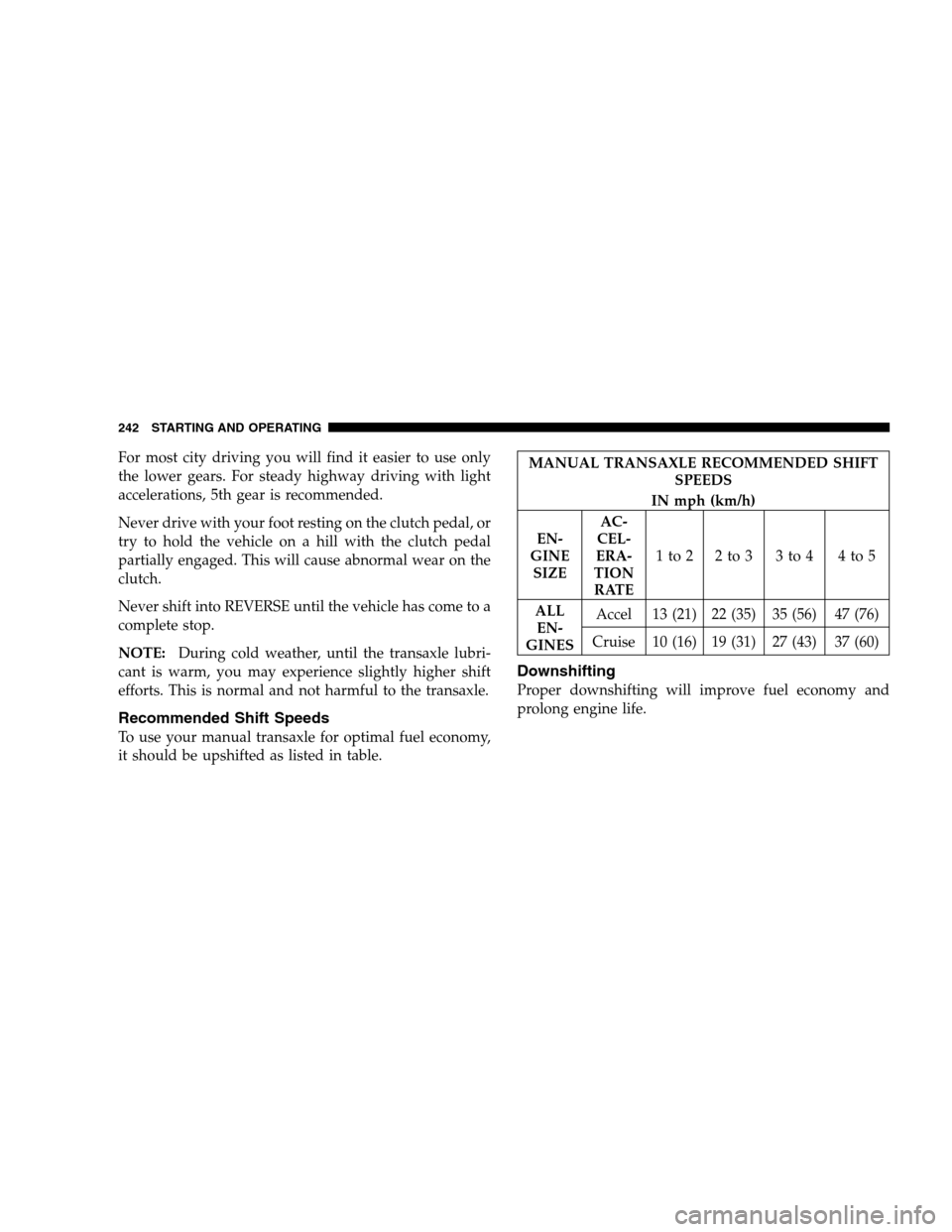
Recommended Shift Speeds
To use your manual transaxle for optimal fuel economy,
it should be upshifted as listed in table.
MANUAL TRANSAXLE RECOMMENDED SHIFT
SPEEDS
IN mph (km/h)
EN-
GINE
SIZEAC-
CEL-
ERA-
TION
RATE1to2 2to3 3to4 4to5
ALL
EN-
GINESAccel 13 (21) 22 (35) 35 (56) 47 (76)
Cruise 10 (16) 19 (31) 27 (43) 37 (60)
Downshifting
Proper downshifting will improve fuel economy and
prolong engine life.
242 STARTING AND OPERATING
Page 260 of 408
2. Economy—
Improper inflation pressures can cause uneven wear
patterns to develop across the tire tread. These abnormal
wear patterns will reduce tread life resulting in a need for
earlier tire replacement. Under inflation, also increases
tire rolling resistance and results in higher fuel consump-
tion.
3. Ride Comfort and Vehicle Stability—
Proper tire inflation contributes to a comfortable ride.
Over inflation produces a jarring and uncomfortable ride.
Tire Inflation Pressures
The proper cold tire inflation pressure is listed either on
the face of the driver’s door or on the driver’s side “B”
pillar.Some vehicles may have Supplemental Tire Pressure
Information for vehicle loads that are less than the
maximum loaded vehicle condition. These pressure con-
ditions will be found in the “Supplemental Tire Pressure
Information” section of this manual.
Tire Placard Location
260 STARTING AND OPERATING

