2007 HYUNDAI TUCSON service
[x] Cancel search: servicePage 248 of 306
6
DO-IT-YOURSELF MAINTENANCE
13
!
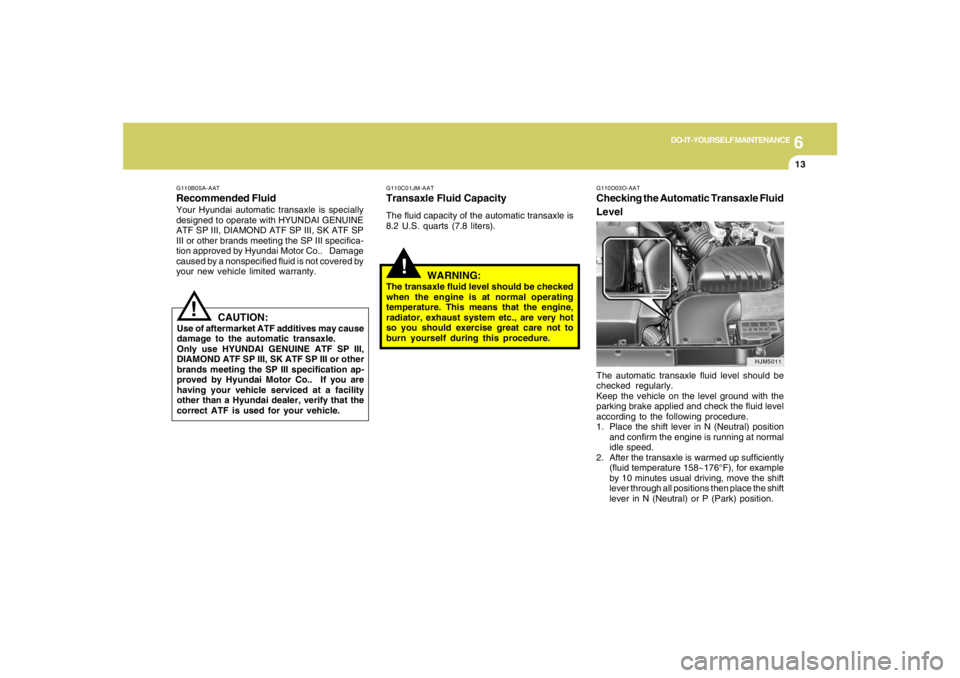
G110D03O-AATChecking the Automatic Transaxle Fluid
LevelThe automatic transaxle fluid level should be
checked regularly.
Keep the vehicle on the level ground with the
parking brake applied and check the fluid level
according to the following procedure.
1. Place the shift lever in N (Neutral) position
and confirm the engine is running at normal
idle speed.
2. After the transaxle is warmed up sufficiently
(fluid temperature 158~176°F), for example
by 10 minutes usual driving, move the shift
lever through all positions then place the shift
lever in N (Neutral) or P (Park) position.
G110C01JM-AATTransaxle Fluid CapacityThe fluid capacity of the automatic transaxle is
8.2 U.S. quarts (7.8 liters).
WARNING:
The transaxle fluid level should be checked
when the engine is at normal operating
temperature. This means that the engine,
radiator, exhaust system etc., are very hot
so you should exercise great care not to
burn yourself during this procedure.
HJM5011
!
G110B05A-AATRecommended FluidYour Hyundai automatic transaxle is specially
designed to operate with HYUNDAI GENUINE
ATF SP III, DIAMOND ATF SP III, SK ATF SP
III or other brands meeting the SP III specifica-
tion approved by Hyundai Motor Co.. Damage
caused by a nonspecified fluid is not covered by
your new vehicle limited warranty.
CAUTION:
Use of aftermarket ATF additives may cause
damage to the automatic transaxle.
Only use HYUNDAI GENUINE ATF SP III,
DIAMOND ATF SP III, SK ATF SP III or other
brands meeting the SP III specification ap-
proved by Hyundai Motor Co.. If you are
having your vehicle serviced at a facility
other than a Hyundai dealer, verify that the
correct ATF is used for your vehicle.
Page 251 of 306
6
DO-IT-YOURSELF MAINTENANCE
16
!
G130B02A-AATTo Replace the FluidRecommended brake fluid conforming to DOT
3 or DOT 4 specification should be used. The
reservoir cap must be fully tightened to avoid
contamination from foreign matter or moisture.NOTE:Do not allow any other liquids to contami-
nate the brake fluid. Seal damage will result.
WARNING:
Use caution when handling brake fluid. It
can damage your vision if you get it in your
eyes. It will also damage your vehicle's
paint if spilled on it and not removed imme-
diately.
AIR CONDITIONING CAREG140A01A-AATKeeping the Condenser CleanThe air conditioning condenser (and engine
radiator) should be checked periodically for
accumulation of dirt, dead insects, leaves, etc.
These can interfere with maximum cooling ef-
ficiency. When removing such accumulations,
brush or hose them away carefully to avoid
bending the cooling fans.
HJM5007
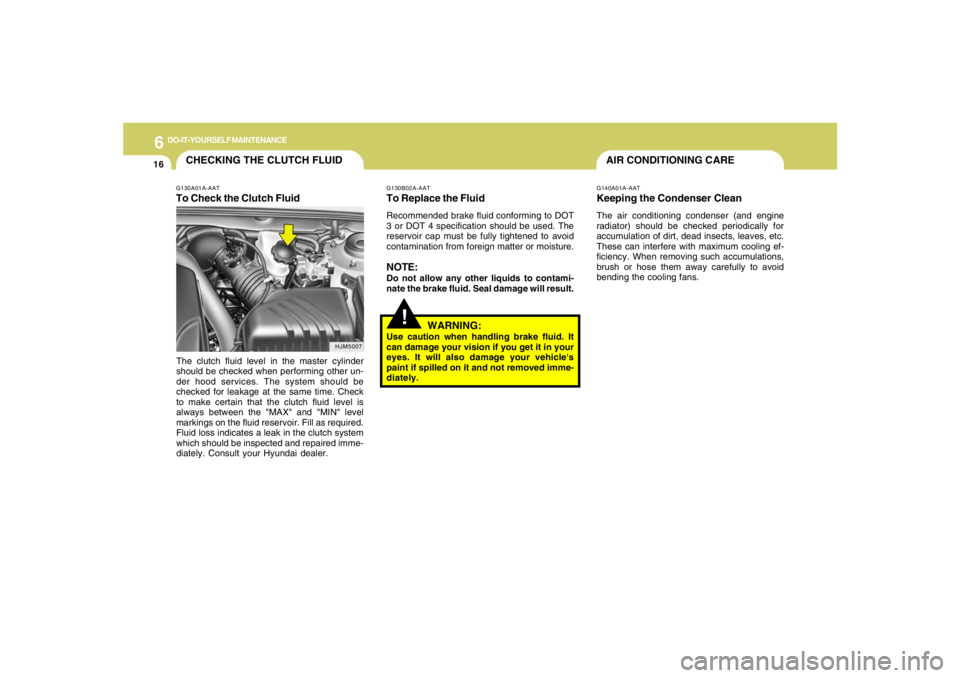
CHECKING THE CLUTCH FLUIDG130A01A-AATTo Check the Clutch FluidThe clutch fluid level in the master cylinder
should be checked when performing other un-
der hood services. The system should be
checked for leakage at the same time. Check
to make certain that the clutch fluid level is
always between the "MAX" and "MIN" level
markings on the fluid reservoir. Fill as required.
Fluid loss indicates a leak in the clutch system
which should be inspected and repaired imme-
diately. Consult your Hyundai dealer.
Page 291 of 306
8
CONSUMER INFORMATION, REPORTING SAFETY DEFECTS & BINDING ARBITRATION OF WARRANTY CLAIMS
15
I130B04A-AATTire Quality Grading
Department of Transportation quality
grades - All passenger vehicle tires
must conform to Federal Safety Stan-
dards in addition to these grades. These
quality grades are molded on the
sidewall.
Treadwear - The treadwear grade is a
comparative rating based on the wear
rate of the tire when tested under con-
trolled conditions on a specified gov-
ernment test course. For example, a
tire graded 150 would wear one and a
half (1 - 1/2) times as well on the
government course as a tire graded
100. The relative performance of tires
depends upon the actual conditions of
their use, however, and may depart
significantly from the norm due to varia-
tions in driving habits, service prac-
tices and differences in road character-
istics and climate.
Traction AA, A, B, C - The traction
grades, from highest to lowest, are AA,
A, B, and C. Those grades represent
the tire's ability to stop on wet pave-
ment as measured under controlled
conditions on specified government test
surfaces of asphalt and concrete. A tire
marked C may have poor traction per-
formance.
!
WARNING:
The traction grade assigned to this
tire is based on straight-ahead brak-
ing traction tests, and does not in-
clude acceleration, cornering, hy-
droplaning, or peak traction charac-
teristics.
CONSUMER INFORMATIONI130A01A-AATThis consumer information has been prepared
in accordance with regulations issued by the
National Highway Traffic Safety Administration
of the U.S. Department of Transportation. It
provides the purchasers and/or prospective
purchasers of Hyundai automobiles with infor-
mation on uniform tire quality grading. Your
Hyundai dealer will help answer any questions
you may have as you read this information.
Page 302 of 306
10
INDEX
4
H
Hazard Warning System ..................................................................1-62
Heating and Cooling Control .............................................................1-88
Heating and Ventilation
Air flow control..............................................................................1-90
Air intake control switch ...............................................................1-89
Bi-level heating.............................................................................1-94
Defrosting / Defogging .................................................................1-94
Fan speed control (Blower control) .............................................1-89
Temperature control....................................................................1-93
High-Mounted Rear Stop Light .........................................................1-80
Hood Release....................................................................................1-82
Horn.................................................................................................1-85
How to Use Luggage Room.............................................................1-77
I
Ignition Switch ...................................................................................... 2-5
Instrument Cluster and Indicator Lights...........................................1-46
Instrument Panel Light Control (Rheostat).......................................1-64
Interior Light.......................................................................................1-69
J
Jump Starting...................................................................................... 3-3
K
Keys................................................................................................... 1-3
If you lose your keys ...................................................................3-19
Positions......................................................................................... 2-5L
Light Bulbs Replacement..................................................................6-27
Luggage Compartment Light ............................................................1-77
Luggage Net ......................................................................................1-79
M
Maintenance Intervals
Explanation of scheduled maintenance items ............................... 5-7
Maintenance under severe usage conditions............................... 5-6
Scheduled maintenance................................................................ 5-4
Service requirements.................................................................... 5-2
Mirrors
Automatic Dimming Rear View Mirror With Compass ................1-73
Day-night inside rearview mirror .................................................1-73
Outside rearview mirror ...............................................................1-71
Outside rearview mirror Heater ..................................................
1-72
O
Odometer / Trip Odometer ...............................................................1-54
Occupant Classification System ......................................................1-38
P
Parking Brake....................................................................................1-75
Power Outlet......................................................................................1-65
Power Steering Fluid Level ...............................................................6-24
Page 306 of 306

Seoul KoreaPrinting: DEC. 14, 2006
Publication No.: A2EO-EU6DF
Printed in Korea
SERVICE STATION INFORMATION
FUEL:UNLEADED gasoline only
Pump Octane Rating of 87 (Research Octane Number 91) or higher.FUEL TANK CAPACITYUS.gal (Imp.gal., liter) 2.7L: 17 (14.3, 65), 2.0L: 15 (12.8, 58)TIRE PRESSURE:See the label on the driver's side of the center pillar outer panel.OTHER TIRE INFORMATION:See pages 8-3 through 8-14.HOOD RELEASE:Pull handle under left side of dash.ENGINE OIL:API grade SJ, SL or ABOVE / ILSAC grade GF-3 or ABOVE and fuel
efficient oil. Use SAE 5W-20, 5W-30 or 10W-30 if normal temperatures
are above 0°F (-18°C). For other viscosity recommendations, see page 6-
5 or 9-4.
MANUAL TRANSAXLE:HYUNDAI GENUINE PARTS MTF 75W/85 (API GL-4) Oil level
should be up to filler-bolt hole in housing beside differential.AUTOMATIC TRANSAXLE:Apply the parking brake, with the engine running, shift the selector lever
through all ranges and return to “N” (Neutral) position. Then check the level
of fluid on the dipstick. Use only HYUNDAI GENUINE ATF SP III,
DIAMOND ATF SP III, SK ATF SP III or other brands meeting the SP III
specification approved by Hyundai Motor Co..QUICK INDEXo Car will not start ....................................................................... 3-2
o Flat tire ..................................................................................... 3-6
o Warning light/chime comes on ...................................... 1-48 ~ 1-52
o Engine overheats....................................................................... 3-4
o Towing of your vehicle ........................................................... 3-16
o Starting the engine ..................................................................... 2-4
o Driving tips for first 1,200 miles (2,000 km) ............................ 1-3
o Scheduled maintenance ............................................................ 5-4
o Reporting safety defects ......................................................... 8-17