2007 Hyundai Tiburon engine
[x] Cancel search: enginePage 209 of 269

6
DO-IT-YOURSELF MAINTENANCE
9
!
WARNING:
The cooling fan is controlled by engine
coolant temperature and may sometimes
operate even when the engine is not run-
ning. Use extreme caution when working
near the blades of the coolant fan so that
you are not injured by a rotating fan blade.
As the engine coolant temperature de-
creases, the fan will automatically shut off.
This is a normal condition.
CAUTION:
o Engine coolant can damage the finish of
your car. If you spill engine coolant on
the car, wash it off thoroughly with clean
water.
o The engine in your vehicle has alumi-
num engine parts and must be protected
by an ethylene-glycol base coolant to
prevent corrosion and freezing.
Do not use hard water. Hard water can
cause engine damage from corrosion,
overheating or freezing.
!
CHANGING THE AIR CLEANER
FILTERG070A01E-AATTo change the filter, unsnap the clips around the
cover. When this is done, the cover can be lifted
off, the old filter removed and the new filter put
in its place. Genuine Hyundai Replacement
Parts are recommended.
CAUTION:
o Operating your vehicle without a proper
air filter in place can result in excessive
engine wear.
o When removing the air cleaner filter, be
careful that dust or dirt does not enter
the air intake. These may result in dam-
age to the air cleaner filter.
HGK5010
!
WINDSHIELD WIPER BLADESG080A03A-AATThe wiper blades should be carefully inspected
from time to time and cleaned to remove accu-
mulations of road film or other debris. To clean
the wiper blades and arms, use a clean sponge
or cloth with a mild soap or detergent and water.
If the wipers continue to streak or smear the
glass, replace them with Genuine Hyundai
Replacement Parts or their equivalent.
G080A02GK
!
CAUTION:
o Do not operate the wipers on dry glass.
This can result in more rapid wear of the
wiper blades and may scratch the glass.
o Keep the blade rubber out of contact
with petroleum products such as engine
oil, gasoline etc.
gkflhma-6.p659/12/2006, 3:22 PM 9
Page 211 of 269

6
DO-IT-YOURSELF MAINTENANCE
11
!
G100A05GK-AATTransaxle lubricant in the manual transaxle
should be checked at those intervals specified
in the vehicle maintenance schedule in Section
5.
HGK5009
Filler plug
Drain plug
CHECKING THE TRANSAXLE OIL
(MANUAL)
CAUTION:
o Radiator anti-freeze (engine coolant)
should not be used in the washer system
because it will damage the car’s finish.
o The washer should not be operated if
the washer reservoir is empty. This can
damage the washer fluid pump.
o In areas where water freezes in winter,
use windshield washer antifreeze.
!
FILLING THE WASHER RESERVOIRG090A03A-AATThe washer fluid reservoir supplies fluid to the
windshield washer system.
A good quality washer fluid should be used to fill
the washer reservoir. The fluid level should be
checked more frequently during inclement
weather or whenever the washer system is in
more frequent use.
The capacity of the washer reservoir is 3.2 U.S.
quarts (3.0 Liters).
HGK5014
WARNING:
o Windshield washer fluid agents contain
some amounts of alcohol and can be
flammable under certain circumstances.
Do not allow sparks or flame to contact
the washer fluid or the washer fluid
reservoir. Damage to the vehicle or its
occupants could occur.
o Windshield washer fluid is poisonous to
humans and animals. Do not drink wind-
shield washer fluid. Serious injury or
death could occur.
gkflhma-6.p659/12/2006, 3:22 PM 11
Page 212 of 269

6
DO-IT-YOURSELF MAINTENANCE
12
!
WARNING:
The transaxle fluid level should be checked
when the engine is at normal operating
temperature. This means that the engine,
radiator, exhaust system etc., are very hot.
Exercise great care not to burn yourself
during this procedure.
!
WARNING:
It is always better to check the transaxle oil
level when the engine is cool or cold. If the
engine is hot, you should exercise great
caution to avoid burning yourself on hot
engine or exhaust parts.
CHECKING THE TRANSAXLE
FLUID (AUTOMATIC)G110A02E-AATTransaxle fluid in the automatic transaxle should
be checked at those intervals specified in the
vehicle maintenance schedule in Section 5.NOTE:Automatic transaxle fluid is basically red
color. As driving distance increases, the
fluid color turns darkish red gradually. It is
a normal condition and you should not
judge the need to replace based upon the
changing color.
You must replace the automatic transaxle
fluid in accordance with intervals specified
in the vehicle maintenance schedule in
section 5.
NOTE:It is recommended that the manual transaxle
fluid should be checked by an authorized
Hyundai dealer.
CAUTION:
Use of aftermarket ATF additives may cause
damage to the automatic transaxle. Only
use HYUNDAI GENUINE ATF SP III, DIA-
MOND ATF SP III, SK ATF SP III or other
brands meeting the SP III specification ap-
proved by Hyundai Motor Co. If you are
having your vehicle serviced at a facility
other than a Hyundai dealer, verify ATF is
used for your vehicle.
!
gkflhma-6.p659/12/2006, 3:22 PM 12
Page 213 of 269
6
DO-IT-YOURSELF MAINTENANCE
13
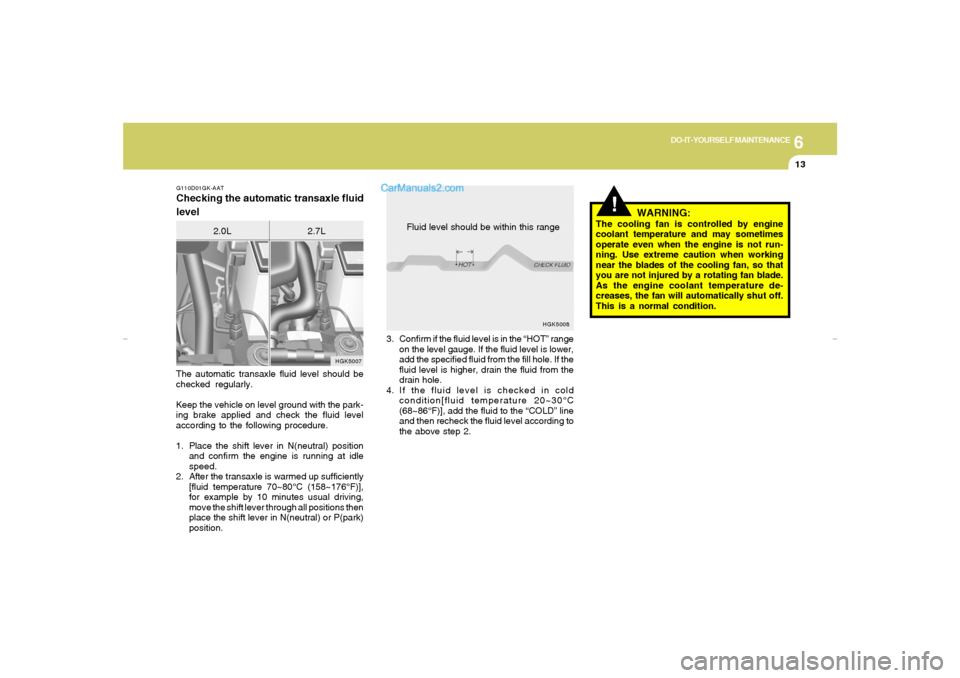
3. Confirm if the fluid level is in the “HOT” range
on the level gauge. If the fluid level is lower,
add the specified fluid from the fill hole. If the
fluid level is higher, drain the fluid from the
drain hole.
4. If the fluid level is checked in cold
condition[fluid temperature 20~30°C
(68~86°F)], add the fluid to the “COLD” line
and then recheck the fluid level according to
the above step 2.
G110D01GK-AATChecking the automatic transaxle fluid
levelThe automatic transaxle fluid level should be
checked regularly.
Keep the vehicle on level ground with the park-
ing brake applied and check the fluid level
according to the following procedure.
1. Place the shift lever in N(neutral) position
and confirm the engine is running at idle
speed.
2. After the transaxle is warmed up sufficiently
[fluid temperature 70~80°C (158~176°F)],
for example by 10 minutes usual driving,
move the shift lever through all positions then
place the shift lever in N(neutral) or P(park)
position.
HGK5007
2.0L 2.7L
!
HGK5008
Fluid level should be within this range
WARNING:
The cooling fan is controlled by engine
coolant temperature and may sometimes
operate even when the engine is not run-
ning. Use extreme caution when working
near the blades of the cooling fan, so that
you are not injured by a rotating fan blade.
As the engine coolant temperature de-
creases, the fan will automatically shut off.
This is a normal condition.
gkflhma-6.p659/12/2006, 3:22 PM 13
Page 216 of 269
6
DO-IT-YOURSELF MAINTENANCE
16
CHANGING THE CLIMATE CON-
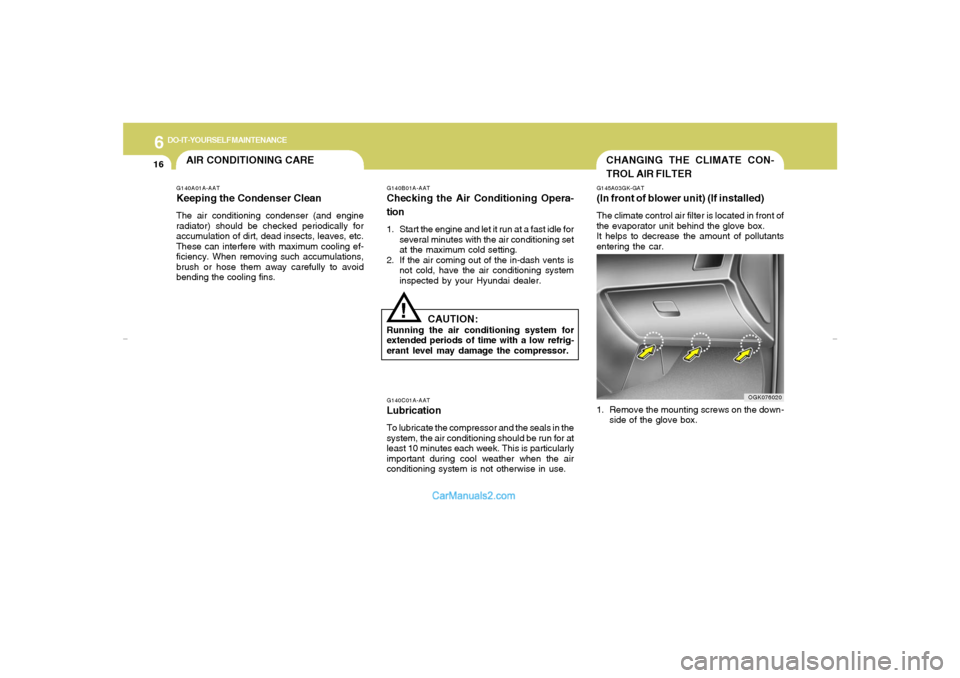
TROL AIR FILTERG145A03GK-GAT(In front of blower unit) (If installed)The climate control air filter is located in front of
the evaporator unit behind the glove box.
It helps to decrease the amount of pollutants
entering the car.
1. Remove the mounting screws on the down-
side of the glove box.
OGK076020
AIR CONDITIONING CAREG140A01A-AATKeeping the Condenser CleanThe air conditioning condenser (and engine
radiator) should be checked periodically for
accumulation of dirt, dead insects, leaves, etc.
These can interfere with maximum cooling ef-
ficiency. When removing such accumulations,
brush or hose them away carefully to avoid
bending the cooling fins.
!
G140C01A-AATLubricationTo lubricate the compressor and the seals in the
system, the air conditioning should be run for at
least 10 minutes each week. This is particularly
important during cool weather when the air
conditioning system is not otherwise in use.G140B01A-AATChecking the Air Conditioning Opera-
tion1. Start the engine and let it run at a fast idle for
several minutes with the air conditioning set
at the maximum cold setting.
2. If the air coming out of the in-dash vents is
not cold, have the air conditioning system
inspected by your Hyundai dealer.
CAUTION:
Running the air conditioning system for
extended periods of time with a low refrig-
erant level may damage the compressor.
gkflhma-6.p659/12/2006, 3:22 PM 16
Page 221 of 269

6
DO-IT-YOURSELF MAINTENANCE
21
!
CHECKING ELECTRIC COOLING
FANS!
G220A01A-AAT
WARNING:
The cooling fan is controlled by engine
coolant temperature and may sometimes
operate even when the engine is not run-
ning. Use extreme caution when working
near the blades of the coolant fan, so that
you are not injured by a rotating fan blade.
As the engine coolant temperature de-
creases the fan will automatically shut off.
This is a normal condition. If electrolyte gets on your skin,
thoroughly wash the contacted
area.
If you feel a pain or a burning
sensation, get medical attention
immediately.
Wear eye protection when charg-
ing or working near a battery.
Always provide ventilation when
working in an enclosed space.
o When lifting a plastic-cased battery, ex-
cessive pressure on the case may cause
battery acid to leak, resulting in personal
injury. Lift with a battery carrier or with
your hands on opposite corners.
o Never attempt to charge the battery when
the battery cables are connected.
o The electrical ignition system works with
high voltage.
Never touch these components with the
engine running or the ignition switched
on.
WARNING:
G220C01A-AATChecking Condenser Cooling FanThe condenser coolant fan should come on
automatically whenever the air conditioning is in
operation.G220B01A-AATChecking Engine Cooling FanThe engine cooling fan should come on auto-
matically if the engine coolant temperature is
high.
POWER STEERING FLUID LEVELG230A04A-AATThe power steering fluid level should be checked
regularly. To check the power steering fluid
level, be sure the engine is "OFF", then check
to make certain that the power steering fluid
level is between the "MAX" and "MIN" level
markings on the fluid reservoir.NOTE:o Grinding noise from the power steering
pump may be heard immediately after
the engine is started in extremely cold
conditions (below - 4°F). If the noise
stops during warm up, there is no abnor-
mal function in the system. It is due to a
power steering fluid characteristic in
extremely cold conditions.
o Do not start the engine when the power
steering oil reservoir is empty.
HGK5011
gkflhma-6.p659/12/2006, 3:23 PM 21
Page 223 of 269

6
DO-IT-YOURSELF MAINTENANCE
23
G290B02GK-AATAdjustment After Headlight Assembly
ReplacementIf the vehicle has had front body repair and the
headlight assembly has been replaced, the
headlight aiming should be checked using an
aiming screen as shown in the illustration. Turn
on the headlight switch.
1. Adjust headlights so that main axis of light is
parallel to center line of the body and is
aligned with point "P" shown in the illustration.
2. Dotted lines in the illustration show the center
of headlights.
G290B01HR-1A
L
W
H
H
Cut-off line
Ground line
Horizontal lineVertical line
!
1. Keep all tires inflated to the correct pressure.
2. Place the vehicle on level ground and press
the front bumper & rear bumper down sev-
eral times. Place vehicle at a distance of 118
in. (3m) from the test wall.
3. See that the vehicle is unloaded (except for
full levels of coolant, engine oil and fuel, and
spare tire, jack, and tools).
4. Clean the head light lenses and turn on the
headlights.
5. Open the hood.
6. Draw the vertical line (through the center of
each headlight beam pattern) and the hori-
zontal line (through the center of each head-
light beam pattern) on the aiming screen.
7. Adjust each cut-off line of the low beam to the
parallel line with a phillips screwdriver -
VERTICAL AIMING.
WARNING:
Never attempt to adjust the horizontal align-
ment of your headlights. Horizontal aiming
must be adjusted by an authorized Hyundai
dealer to avoid incorrect alignment that will
reduce the effectiveness of your headlights.
SPECIFICATION:"H"
Horizontal center line of headlights from ground:
Low Beam: 27.2 in. (690mm)
High Beam: 26.5 in. (672mm)
"W"
Distance between each headlight center :
Low Beam: 52.6 in. (1,336mm)
High Beam: 43.2 in. (1,098mm)
"L"
Distance between the headlights and the wall
that the lights are tested against : 118 in. (3,000
mm)
gkflhma-6.p659/12/2006, 3:23 PM 23
Page 224 of 269

6
DO-IT-YOURSELF MAINTENANCE
24
OGK076047
5. Turn the plastic cover counterclockwise
and remove it.
G270A01GK-AATHeadlight and Front Turn Signal Light1. Allow the bulb to cool. Wear eye protection.
2. Open the engine hood.
3. Always grasp the bulb by its plastic base,
avoid touching the glass.4. Disconnect the power cord from the bulb
base in the back of the headlight.
OGK076066N
REPLACEMENT OF LIGHT BULBS!
G260A01MC-AATBefore attempting to replace a light bulb, be sure
the switch is turned to the "OFF" position.
The next paragraph shows how to reach the
light bulbs so they may be changed. Be sure to
replace the burned-out bulb with one of the
same number and wattage rating.
See page 6-27 for the wattage descriptions.
CAUTION:
o Keep the lamps out of contact with
petroleum products, such as oil, gaso-
line, etc.
o If you don't have necessary tools, the
correct bulbs and the expertise, consult
your authorized Hyundai dealer.
OGK076048
6. Disconnect the connector from the bulb
base in the back of the headlight.
gkflhma-6.p659/12/2006, 3:23 PM 24