2007 Hyundai Tiburon ECU
[x] Cancel search: ECUPage 36 of 269

1FEATURES OF YOUR HYUNDAI24
!
WARNING:
o A child can be seriously injured or killed
in a collision if the child restraint is not
properly anchored. Always follow the
child seat manufacturer’s instructions
for installation and use.
o Never mount more than one child re-
straint to a single tether or to a single
lower anchorage point. The increased
load caused by multiple seats may cause
the tethers or anchorage points to break,
causing serious injury or death.
B230E01GK
Covering shelf
Front of Vehicle
Tether strap hookBlanking covers
Rear luggage compartment floor
3. Remove the blanking covers on the cover-
ing shelf.
4. Connect the tether strap hook to the child
restraint hook holder through the hole on the
covering shelf and tighten to secure the seat.
Child Restraint
Hook Holders
To install the child restraint seat:
For mania pack1. Remove the front board on the luggage
copartment floor.
2. Route the child restraint seat strap over the
seatback.
For vehicles with adjustable headrests, route
the tether strap under the headrest and
between the headrest posts, otherwise route
the tether strap over the top of the seatback.
3. Remove the blanking covers on the cover-
ing shelf.
4. Connect the tether strap hook to the child
restraint hook holder through the hole on the
covering shelf and tighten to secure the seat.
OGK016900L
gkflhma-1a.p659/12/2006, 3:15 PM 24
Page 37 of 269

1
FEATURES OF YOUR HYUNDAI
25
!
WARNING:
o There is no center rear seat position.
o A child can be seriously injured or killed
in a collision if the child restraint is not
properly anchored. Always follow the
child seat manufacturer’s instructions
for installation and use.
o Never install a child restraint using the
ISOFIX anchors at the center position of
the rear seat. In a crash, the ISOFIX
anchors may break if a car seat is improp-
erly placed in the center position result-
ing in serious or fatal injuries. Only place
a ISOFIX or ISOFIX-compatible child seat
in the left or right out-board rear seating
positions (as shown) to the appropriate
ISOFIX anchors provided.
o Never mount more than one child re-
straint to a single tether or to a single
lower anchorage point. The increased
load caused by multiple seats may cause
the tethers or anchorage points to break,
causing serious injury or death.o When using the vehicle’s “ISOFIX” sys-
tem to install a child restraint system in
the rear seat, all unused vehicle rear seat
belt metal latch plates or tabs must be
latched securely in their seat belt buck-
les and the seat belt webbing must be
retracted behind the child restraint to
prevent the child from reaching and tak-
ing hold of unretracted seat belts.
Unlatched metal latch plates or tabs may
allow the child to reach the unretracted
seat belts which may result in strangu-
lation and a serious injury or death to the
child in the child restraint.
B230D04GK-AATSecuring the child Restraint seat with
the "ISOFIX" systemSome child seat manufacturers make child
restraint seats that are labeled as ISOFIX or
ISOFIX-compatible child restraint seats. These
seats include two rigid or webbing mounted
attachments that connect to two ISOFIX an-
chors at specific seating positions in your ve-
hicle. This type of child restraint seat eliminates
the need to use seat belts to attach the child
seat.
ISOFIX anchors have been provided in your
vehicle. The ISOFIX anchors are located in the
left and right outboard rear seating positions.
Their locations are shown in the illustration.
B230F01GK
gkflhma-1a.p659/12/2006, 3:15 PM 25
Page 39 of 269

1
FEATURES OF YOUR HYUNDAI
27
!
WARNING:
o If the retractor is not in the Automatic
Locking mode, the child restraint can
move when your vehicle turns or stops
suddenly. A child can be seriously in-
jured or killed if the child restraint is not
properly anchored to the car, including
setting the retractor to the Automatic
Locking mode.
o Do not install any child restraint system
in the front passenger seat. Should an
accident occur and cause the passenger
side airbag to deploy, it could severely
injure or kill an infant or child seated in
an infant or child seat. Therefore, only
use a child restraint system in the rear
seat of your vehicle. If the retractor is in the automatic locking mode,
the belt will be locked. After installation of the
child restraint system, try to move it in all
directions to be sure the child restraint system
is securely installed. If you need to tighten the
belt, pull more webbing toward the retractor.
When you unbuckle the seat belt and allow it to
retract, the retractor will automatically revert
back to its normal seated passenger emer-
gency locking usage condition.
NOTE:o Before installing the child restraint sys-
tem in any seating position, read the
instructions supplied by the child re-
straint system manufacturer.
o If the seat belt does not operate as de-
scribed, have the system checked imme-
diately by your authorized Hyundai
dealer.
B230G02O-AATChild Restraint System Installation on
outboard Rear SeatsTo install a child restraint system in the outboard
rear seats, extend the shoulder/lap belt entirely
from its retractor until a "click" is felt. This will
engage the seat belt retractor automatic locking
feature, which allows the seat belt to retract but
not extend. Install the child restraint system,
buckle the seat belt and allow the seat belt to
take up any slack. Make sure that the lap portion
of the belt is tight around the child restraint
system and the shoulder portion of the belt is
positioned so that it can not interfere with the
child's head or neck. Also, double check to be
sure that the retractor has engaged the auto-
matic locking feature by trying to extend web-
bing out of the retractor.On outboard rear seats
HGK1010
gkflhma-1a.p659/12/2006, 3:15 PM 27
Page 53 of 269

1
FEATURES OF YOUR HYUNDAI
41
!
!
CAUTION:
If the occupant classification system is not
working properly, the SRS air bag warning
light
on the instrument panel will illumi-
nate because the passenger's front air bag
is connected with the occupant classifica-
tion system. If there is a malfunction of the
occupant classification system, the "PAS-
SENGER AIR BAG OFF" indicator will illu-
minate and the passenger's front air bag
will not inflate in frontal impact crashes
even if there is adult occupant in the front
passenger's seat. If the SRS air bag warning
light does not illuminate when the ignition
key is turned to the "ON" position, remains
illuminated after approximately 6 seconds
when the ignition key is turned to the "ON"
position, or if it illuminates while the vehicle
is being driven, have an authorized Hyundai
dealer inspect the occupant classification
system and the SRS air bag system as soon
as possible.
!
WARNING:
o Even though your vehicle is equipped
with the occupant classification sys-
tem, never install a child restraint system
in the front passenger's seat. A deploy-
ing air bag can forcefully strike a child
resulting in serious injuries or death.
Any child under 13 years of age should
ride in the rear seat. Children too large
for child restraints should use the avail-
able lap/shoulder belts. No matter what
type of crash, children of all ages are
safer when restrained in the rear seat.
o If the "PASSENGER AIR BAG OFF" indi-
cator is illuminated when the front
passenger's seat is occupied by an adult
and he/she sits properly (sitting upright
with the seatback in an upright position,
centered on the seat cushion with their
seat belt on, legs comfortably extended
and their feet on the floor), have that
person sit in the rear seat.
o Do not modify or replace the front pas-
senger seat. Don't place anything on or
attach anything such as a blanket or
after market seat heater to the front
passenger seat. This can adversely af-
fect the occupant classification system.o Do not sit on sharp objects such as tools
when occupying the front passenger
seat. This can adversely affect the occu-
pant classification system.
o Do not use accessory seat covers on the
front seats.
o Accident statistics show that children
are safer if they are restrained in the rear,
as opposed to the front seat. It is recom-
mended that child restraints be secured
in a rear seat, including an infant riding
in a rear-facing infant seat, a child riding
in a forward-facing child seat and an
older child riding in a booster seat.
o Air bags can only be used once – have an
authorized Hyundai dealer replace the
air bag immediately after deployment.
o A smaller-stature adult who is not seated
correctly (for example: seat excessively
reclined, leaning on the center console,
or hips shifted forward in the seat) can
cause a condition where the advanced
frontal air bag system senses less seated
pressure than if the occupant were
seated properly (sitting upright with the
seatback in an upright position, cen-
tered on the seat cushion with their seat
belt on, legs comfortably extended and
their feet on the floor).
WARNING:
gkflhma-1a.p659/12/2006, 3:16 PM 41
Page 86 of 269

1FEATURES OF YOUR HYUNDAI74
WARNING:
o Gasoline vapors are dangerous. Before
refueling, always stop the engine and
never smoke or allow sparks and open
flames near the filler area.
o Never operate your vehicle without a
filler cap properly installed, flammable
vapors and gasoline could leak out in
dangerous situations such as a collision
or rollover. If the filler cap must be
replaced, only use genuine Hyundai re-
placement parts.
o After refueling, make sure the fuel cap is
installed securely to prevent fuel spill-
age in the event of an accident.
o Tighten the cap until it clicks, otherwise
the "
"light will illuminate.
!
OGK046014
REMOTE FUEL-FILLER LID
RELEASEB560A02MC-AATThe fuel-filler lid may be opened from inside the
vehicle by pulling up on the fuel-filler lid opener
located on the front floor area on the left side of
the car.NOTE:If the fuel-filler lid will not open because ice
has formed around it, tap lightly or push on
the lid to break the ice and release the lid. Do
not pry on the lid. If necessary, spray around
the lid with an approved deicer fluid (do not
use radiator anti-freeze) or move the ve-
hicle to a warm place and allow the ice to
melt.
OGK046013
!
When closing the hood, slowly close the hood
and make sure it locks into place.
WARNING:
o Always double check to be sure that the
hood is firmly latched before driving
away. If it is not latched, the hood could
open while the vehicle is being driven,
causing a total loss of visibility, which
might result in an accident.
o Do not move the vehicle with the hood
in the raised position, as vision is ob-
structed and the hood could fall or be
damaged.
gkflhma-1a.p659/12/2006, 3:17 PM 74
Page 87 of 269

1
FEATURES OF YOUR HYUNDAI
75
o If you open the fuel filler cap during high
ambient temperatures, a slight "pres-
sure sound" may be heard. This is nor-
mal and not a cause for concern. When-
ever you open the fuel filler cap, turn it
slowly.
o Do not "top off" after the nozzle auto-
matically shuts off when refueling.
o Automotive fuels are flammable/explo-
sive materials. When refueling, please
note the following guidelines carefully.
Failure to follow these guidelines may
result in severe personal injury, severe
burns or death by fire or explosion.
- Before refueling always note the loca-
tion of the Emergency Gasoline Shut-
Off, if available, at the gas station
facility.
- Before touching the fuel nozzle or fuel
filler cap, you should eliminate poten-
tially dangerous static electricity dis-
charge by touching another metal part
of the front of the vehicle, a safe dis-
tance away from the fuel filler neck,
nozzle, or other gas source.
- Do not get back into a vehicle once
you have begun refueling. Do not
touch, rub or slide against any item or
fabric (polyester, satin, nylon, etc.)
!
WARNING:
!
WARNING:
capable of producing static electric-
ity. Static electricity discharge can
ignite fuel vapors resulting in explo-
sion.
If you must re-enter the vehicle, you
should once again eliminate poten-
tially dangerous static electricity dis-
charge by touching a metal part of the
vehicle, away from the fuel filler neck,
nozzle or other gasoline source.
- When using a portable fuel container
be sure to place the container on the
ground prior to refueling. Static elec-
tricity discharge from the container
can ignite fuel vapors causing a fire.
Once refueling has begun, contact
with the vehicle should be maintained
until the filling is complete. Use only
portable fuel containers designed to
carry and store gasoline.
- Do not use cellular phones around a
gas station or while refueling any ve-
hicle. Electric current and/or electronic
interference from cellular phones can
potentially ignite fuel vapors causing
a fire. If you must use your cellular
phone use it in a place away from the
gas station.
!
WARNING:
- When refueling always shut the en-
gine off. Sparks produced by electri-
cal components related to the engine
can ignite fuel vapors causing a fire.
Always insure that the engine is OFF
before and during refueling. Once re-
fueling is complete, check to make
sure the fuel filler cap and door are
securely closed, before starting the
engine.
- Do not light any fire around a gas
station. DO NOT use matches or a
lighter and DO NOT SMOKE or leave a
lit cigarette in your vehicle while at a
gas station especially during refuel-
ing. Automotive fuel is highly flam-
mable and can, when ignited, result in
explosion by flames.
- If a fire breaks out during refueling,
leave the vicinity of the vehicle, and
immediately contact the manager of
the gas station or contact the police
and local fire department. Follow any
safety instructions they provide.
gkflhma-1a.p659/12/2006, 3:17 PM 75
Page 88 of 269
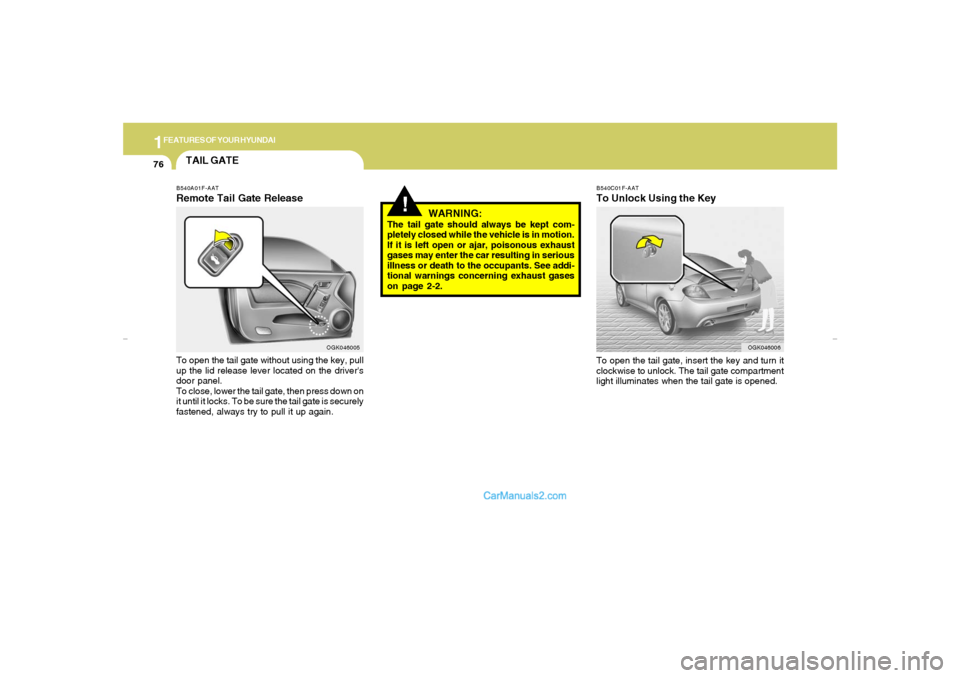
1FEATURES OF YOUR HYUNDAI76
B540C01F-AATTo Unlock Using the KeyTo open the tail gate, insert the key and turn it
clockwise to unlock. The tail gate compartment
light illuminates when the tail gate is opened.
OGK046006
!
WARNING:
The tail gate should always be kept com-
pletely closed while the vehicle is in motion.
If it is left open or ajar, poisonous exhaust
gases may enter the car resulting in serious
illness or death to the occupants. See addi-
tional warnings concerning exhaust gases
on page 2-2.
TAIL GATEB540A01F-AATRemote Tail Gate ReleaseTo open the tail gate without using the key, pull
up the lid release lever located on the driver's
door panel.
To close, lower the tail gate, then press down on
it until it locks. To be sure the tail gate is securely
fastened, always try to pull it up again.
OGK046005
gkflhma-1a.p659/12/2006, 3:17 PM 76
Page 143 of 269

2
DRIVING YOUR HYUNDAI
3
BEFORE STARTING THE ENGINEC020A02A-AATBefore you start the engine, you should always:
1. Look around the vehicle to be sure there are
no flat tires, puddles of oil, water or other
indications of possible trouble.
2. After entering the car, check to be sure the
parking brake is engaged.
3. Check that all windows, and lights are clean.
4. Check that the interior and exterior mirrors
are clean and in position.
5. Check your seat, seatback and headrest to
be sure they are in their proper positions.
6. Close all the doors.
7. Fasten your seat belt and be sure that all
other occupants have fastened theirs.
8. Turn off all lights and accessories that are
not needed.
9. When you turn the ignition switch to "ON",
check that all appropriate warning lights are
operating and that you have sufficient fuel.
10.Check the operation of warning lights and all
bulbs when key is in the "ON" position.
TO START THE ENGINEC030A01A-AATCombination Ignition Switcho If your Hyundai is equipped with a manual
transaxle, place the shift lever in neutral and
depress the clutch pedal fully.
o If your Hyundai has an automatic transaxle,
place the shift lever in "P" (park).
o To start the engine, insert the ignition key and
turn it to the "START" position. Release it as
soon as the engine starts. Do not hold the
key in the "START" position for more than 15
seconds.NOTE:o For safety, the engine will not start if the
clutch pedal is not depressed fully
(Manual transaxle) or the shift lever is
not in "P" or "N" Position (Automatic
transaxle).
o The ignition key cannot be turned from
"ACC" position to "LOCK" position un-
less the shift lever is in the "P" (Park)
position or the negative battery terminal
is disconnected from the battery. To
remove the key, always confirm that the
shift lever is securely positioned in "P"
(Park) (For Automatic transaxle)
!
WARNING:
o All passengers must be properly belted
whenever the vehicle is moving. Refer to
pages: 1-16 through 1-20 for more infor-
mation on their proper use.
o Always check the surrounding areas near
your vehicle for people, especially chil-
dren, before putting a car into 'drive.'
o Always wear appropriate shoes when
operating your vehicle.
Unsuitable shoes (high heels, ski boots,
etc.) may interfere with your ability to
use the brake and accelerator pedal, and
the clutch (if installed).
gkflhma-2.p659/12/2006, 3:20 PM 3