2007 Hyundai Santa Fe inside warning system
[x] Cancel search: inside warning systemPage 11 of 355
F9
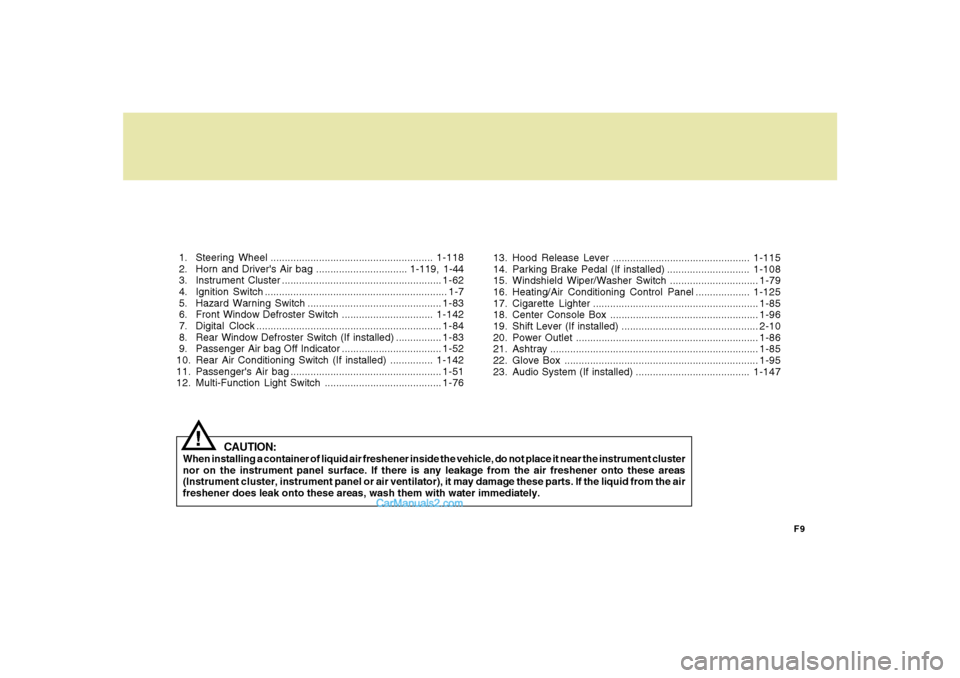
1. Steering Wheel .........................................................1-118
2. Horn and Driver's Air bag ................................ 1-119, 1-44
3. Instrument Cluster ........................................................1-62
4. Ignition Switch ................................................................ 1-7
5. Hazard Warning Switch ...............................................1-83
6. Front Window Defroster Switch ................................1-142
7. Digital Clock .................................................................1-84
8. Rear Window Defroster Switch (If installed) ................1-83
9. Passenger Air bag Off Indicator ...................................1-52
10. Rear Air Conditioning Switch (If installed) ...............1-142
11. Passenger's Air bag .....................................................1-51
12. Multi-Function Light Switch .........................................1-7613. Hood Release Lever ................................................1-115
14. Parking Brake Pedal (If installed) .............................1-108
15. Windshield Wiper/Washer Switch ...............................1-79
16. Heating/Air Conditioning Control Panel ...................1-125
17. Cigarette Lighter ..........................................................1-85
18. Center Console Box ....................................................1-96
19. Shift Lever (If installed) ................................................2-10
20. Power Outlet ................................................................1-86
21. Ashtray.........................................................................1-85
22. Glove Box ....................................................................1-95
23. Audio System (If installed) ........................................1-147
CAUTION:
When installing a container of liquid air freshener inside the vehicle, do not place it near the instrument cluster
nor on the instrument panel surface. If there is any leakage from the air freshener onto these areas
(Instrument cluster, instrument panel or air ventilator), it may damage these parts. If the liquid from the air
freshener does leak onto these areas, wash them with water immediately.
!
Page 22 of 355

1FEATURES OF YOUR HYUNDAI10
B070F01CM-AATKeyless Entry System (If installed)
NOTE:This device complies with Part 15 of the
FCC rules. Operation is subject to the
following two conditions:
(1) This device may not cause harmful
interference, and (2) this device must
accept any interference received, in-
cluding interference that may cause
undesired operation.
Locking doors1. Close all doors.
2. Push the "LOCK (
)" button on the
transmitter.
3. At the same time all doors lock, the turn
signal lights will blink once to indicate
that the system is armed.
Unlocking doors1. Push the "UNLOCK (
)" button on
the transmitter.
2. At the same time the driver's door un-
locks, the turn signal lights will blink
twice to indicate that the system is dis-
armed.
NOTE:If you wish to unlock all doors, press the
"UNLOCK" button on the transmitter
again within 4 seconds.
CAUTION:
Changes or modifications not expressly
approved by the party responsible for
compliance could void the user's au-
thority to operate the equipment.
!
!
WARNING:
o Be careful not to pull the inside door
handle while driving. If you pull the
inside door handle, the door can be
opened and you may be ejected from
the vehicle and can be injured or killed.
o If the door is locked/unlocked multiple
times in rapid succession with either
the vehicle key or door lock switch,
the system may stop operating tem-
porarily in order to protect the circuit
and prevent damage to system com-
ponents. o The driver's and front passenger's
doors can be opened by pulling the
inside door handle even if the front
portion of the driver's or front
passenger's central door locking
switch has been depressed to lock
the doors.
Page 46 of 355
1FEATURES OF YOUR HYUNDAI34
!
o Never hold a child in your arms or lap
when riding in a vehicle. The violent
forces created during a crash will tear
the child from your arms and throw
the child against the car’s interior.
o Never put a seat belt over yourself
and a child. During a crash, the belt
could press deep into the child caus-
ing serious internal injuries.
o Never leave children unattended in a
vehicle – not even for a short time.
The car can heat up very quickly,
resulting in serious injuries to chil-
dren inside. Even very young chil-
dren may inadvertently cause the
vehicle to move, entangle themselves
in the windows, or lock themselves or
others inside the vehicle.
o Never allow two children, or any two
persons, to use the same seat belt.
o Children often squirm and reposition
themselves improperly. Never let a
child ride with the shoulder belt under
their arm or behind their back. Al-
ways properly position and secure
children in rear seat.
WARNING:
!
o Children may be seriously injured or
killed by an inflating air bag. All chil-
dren, even those too large for child
restraints, must ride in the rear seat.
!
WARNING:
To reduce the chance or serious or fatal
injuries:
o Children of all ages are safer when
restrained in the rear seat. A child
riding in the front passenger seat can
be forcefully struck by an inflating air
bag resulting in serious or fatal inju-
ries.
o Always follow the instructions for in-
stallation and use of the child restraint
maker.
o Always make sure the child seat is
secured properly in the car and your
child is securely restrained in the child
seat.
WARNING:
!
WARNING:
o A child restraint system must be
placed in the rear seat. Never install
a child or infant seat on the front
passenger's seat. Should an accident
occur and cause the passenger side
air bag to deploy, it could severely
injure or kill an infant or child seated
in an infant or child seat. Thus only use
a child restraint in the rear seat of
your vehicle.
o A safety belt or child restraint system
can become very hot if it is left in a
closed vehicle on a sunny day, even
if the outside temperature does not
feel hot. Be sure to check the seat
cover and buckles before placing a
child there.
o When the child restraint system is not
in use, store it in the luggage compart-
ment or fasten it with a safety belt so
that it will not be thrown forward in the
case of a sudden stop or an accident.
Page 47 of 355
1
FEATURES OF YOUR HYUNDAI
35
!
WARNING:
o Never allow a child to stand-up or
kneel on the seat or floorboard of a
moving vehicle. During a collision or
sudden stop, the child can be violently
thrown against the vehicles interior,
resulting in serious injury.
o Never use an infant carrier or a child
safety seat that "hooks" over a
seatback, it may not provide adequate
security in an accident.
o Seat belts can become very hot, es-
pecially when the car is parked in
direct sunlight. Always check seat
belt buckles before fastening them
over a child.
o Always store or secure a child seat,
even when it is not in use. During a
collision or sudden stop, the child seat
could be thrown inside the vehicle.
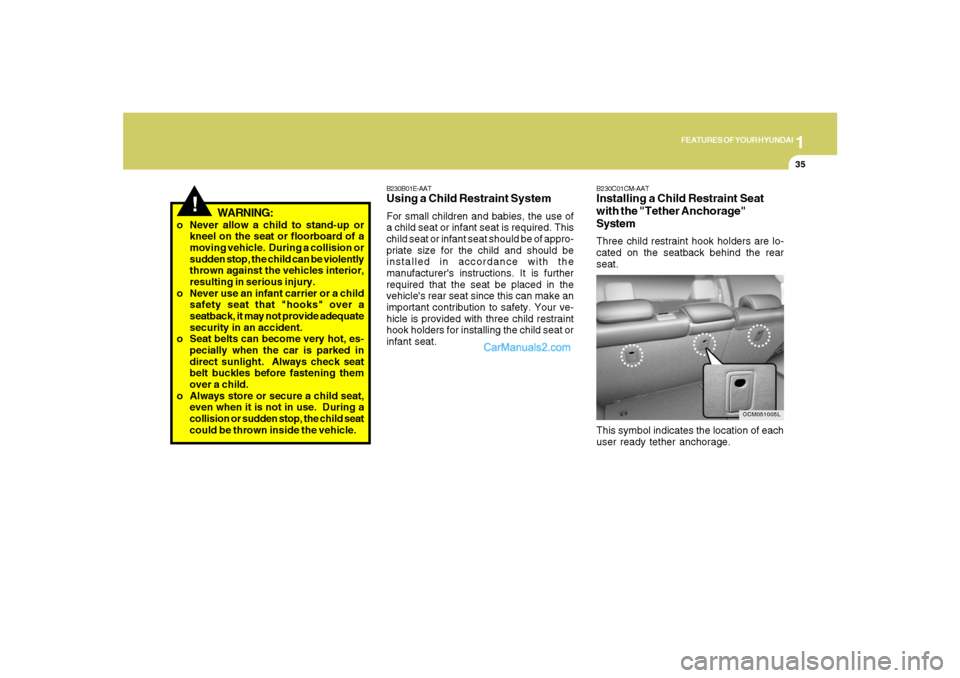
B230C01CM-AATInstalling a Child Restraint Seat
with the "Tether Anchorage"
SystemThree child restraint hook holders are lo-
cated on the seatback behind the rear
seat.
This symbol indicates the location of each
user ready tether anchorage.
OCM051005L
B230B01E-AATUsing a Child Restraint SystemFor small children and babies, the use of
a child seat or infant seat is required. This
child seat or infant seat should be of appro-
priate size for the child and should be
installed in accordance with the
manufacturer's instructions. It is further
required that the seat be placed in the
vehicle's rear seat since this can make an
important contribution to safety. Your ve-
hicle is provided with three child restraint
hook holders for installing the child seat or
infant seat.
Page 53 of 355
1
FEATURES OF YOUR HYUNDAI
41
OMG035300
Your Hyundai vehicle is equipped with
driver's and front passenger's pre-tensioner
seat belts. The purpose of the pre-tensioner
is to make sure that the seat belts fit tightly
against the occupant's body in certain fron-
tal collisions. The pre-tensioner seat belts
can be activated together with the air bags.B180B01CM-AATPre-tensioner Seat Belt
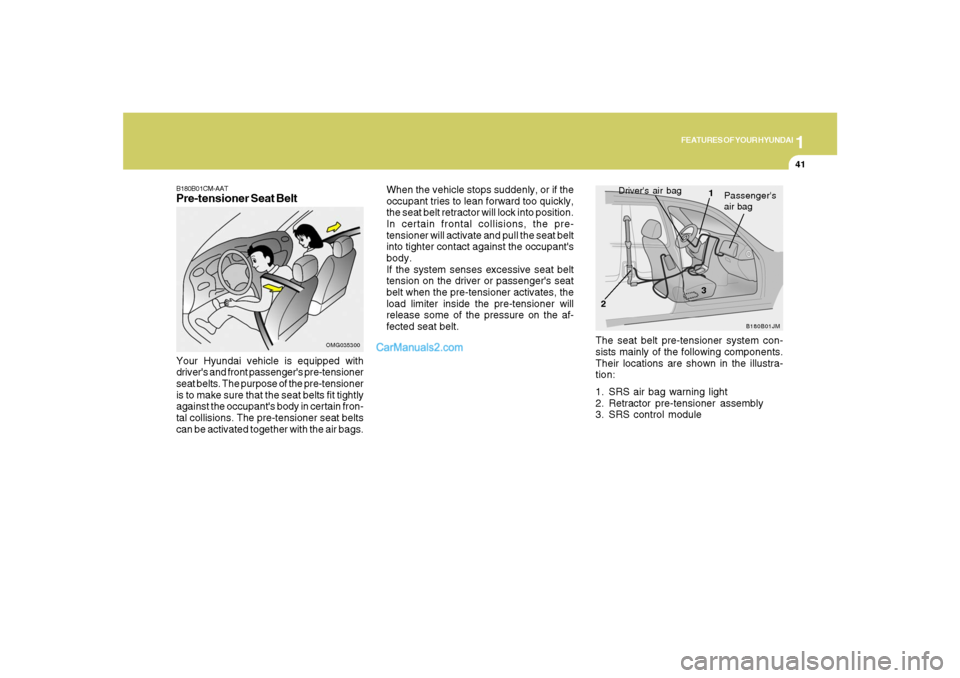
The seat belt pre-tensioner system con-
sists mainly of the following components.
Their locations are shown in the illustra-
tion:
1. SRS air bag warning light
2. Retractor pre-tensioner assembly
3. SRS control module
B180B01JM
Driver's air bag
1
2
Passenger's
air bag
3
When the vehicle stops suddenly, or if the
occupant tries to lean forward too quickly,
the seat belt retractor will lock into position.
In certain frontal collisions, the pre-
tensioner will activate and pull the seat belt
into tighter contact against the occupant's
body.
If the system senses excessive seat belt
tension on the driver or passenger's seat
belt when the pre-tensioner activates, the
load limiter inside the pre-tensioner will
release some of the pressure on the af-
fected seat belt.
Page 73 of 355

1
FEATURES OF YOUR HYUNDAI
61
!
WARNING:
o Sitting improperly or out of position
can cause occupants to be shifted too
close to a deploying air bag, strike the
interior structure or be thrown from
the vehicle resulting in serious injury
or death.
o Always sit upright with the seatback
in an upright position, centered on the
seat cushion with your seat belt on,
legs comfortably extended and your
feet on the floor.
B240D02JM-AATAdditional Safety PrecautionsoNever let passengers ride in the cargo
area (trunk) or on top of a folded-down
back seat. All occupants should sit
upright, fully back in their seats with
their seat belts on and their feet on the
floor.
oPassengers should not move out of or
change seats while the vehicle is mov-
ing. A passenger who is not wearing a
seat belt during a crash or emergency
stop can be thrown against the inside of
the vehicle, against other occupants, or
out of the vehicle.
oEach seat belt is designed to restrain
one occupant. If more than one person
uses the same seat belt, they could be
seriously injured or killed in a collision.
oDo not use any accessories on seat
belts. Devices claiming to improve oc-
cupant comfort or reposition the seat
belt can reduce the protection provided
by the seat belt and increase the chance
of serious injury in a crash.
oPassengers should not place hard or
sharp objects between themselves
and the air bags. Carrying hard or sharp
objects on your lap or in your mouth can
result in injuries if an air bag inflates.oKeep occupants away from the air
bag covers. All occupants should sit
upright, fully back in their seats with
their seat belts on and their feet on the
floor. If occupants are too close to the air
bag covers, they could be injured if the
air bags inflate.
oDo not attach or place objects on or
near the air bag covers. Any object
attached to or placed on the front or side
impact air bag covers could interfere
with the proper operation of the air bags.
oDo not modify the front seats. Modifi-
cation of the front seats could interfere
with the operation of the supplemental
restraint system sensing components
or side impact air bags.
oDo not place items under the front
seats. Placing items under the front
seats could interfere with the operation
of the supplemental restraint system
sensing components and wiring har-
nesses.
oNever hold an infant or child on your
lap. The infant or child could be seri-
ously injured or killed in the event of a
crash. All infants and children should
be properly restrained in appropriate
child safety seats or seat belts in the rear
seat.
Adding Equipment to or Modifying
Your Air bag-Equipped Vehicle.If you modify your vehicle by changing
your vehicle's frame, bumper system, front
end or side sheet metal or ride height, this
may affect the operation of your vehicle's
air bag system.
Page 77 of 355

1
FEATURES OF YOUR HYUNDAI
65
!
WARNING:
Significantly low tire pressure makes
the vehicle unstable and can contribute
to loss of vehicle control and increased
braking distances.
Continued driving on low pressure tires
may cause the tires to overheat and fail. Avoid hard braking and overcorrecting at
the steering wheel. Inflate the tires to the
proper pressure as indicated on the
vehicle’s tire information placard.
If you have a flat tire, the Low tire Pressure
and Position Telltales will illuminate.
Replace the flat tire with the spare tire(see
page 3-12)
Each wheel is equipped with a tire pres-
sure sensor mounted inside the tire be-
hind the valve stems. You must use TPMS
specific wheels. IT is recommended that
you always have tires serviced by your
Hyundai dealer or qualified technician.
After you replace the flat tire, the Low Tire
Pressure and Position Telltales remain
illuminated. This is normal; the system is
not monitoring the spare tire pressure.
Check the spare tire pressure to make sure
it is correct.
B260W01CM-AAT
Low tire pressure telltale
Low tire pressure
position telltale
The low tire pressure and position telltales
illuminate for 3 seconds after the ignition
key is turned to the "ON" position.
If the warning lights do not illuminate, or
remain illuminate after the 3-second lamp
check when you turned the ignition key to
the "ON" position, the Tire Pressure Moni-
toring System is not working properly. If
this occurs, have your vehicle checked by
an authorized Hyundai dealer as soon as
possible.
This warning lights will also illuminate if
one or more of your tires is significantly
under-inflated. The low tire pressure posi-
tion telltale light will indicate which tire is
significantly under-inflated by illuminating
the corresponding position light.
You should stop and check your tires as
soon as possible. If the warning lights
illuminate while driving, reduce vehicle
speed immediately and stop the vehicle.
B260T01O-GAT
AWD (All Wheel Drive)
System Warning Light
(If installed)
When the key is turned to the "ON" position,
the AWD(All Wheel Drive) system warning
light will illuminate and then go off in a few
seconds.
CAUTION:
If the AWD system warning light ( )
blinks while driving, this indicates that
there is a malfunction in the AWD sys-
tem. If this occurs, have your vehicle
checked by an authorized Hyundai dealer
as soon as possible.
!
CAUTION:
Never use a puncture-repair agent in a
flat tire. If used, the tire pressure sensor
will be damaged and will require replace-
ment. Have the flat tire repaired by a
Hyundai dealer or qualified technician
as soon as possible.
!
Page 213 of 355
2
DRIVING YOUR HYUNDAI
2
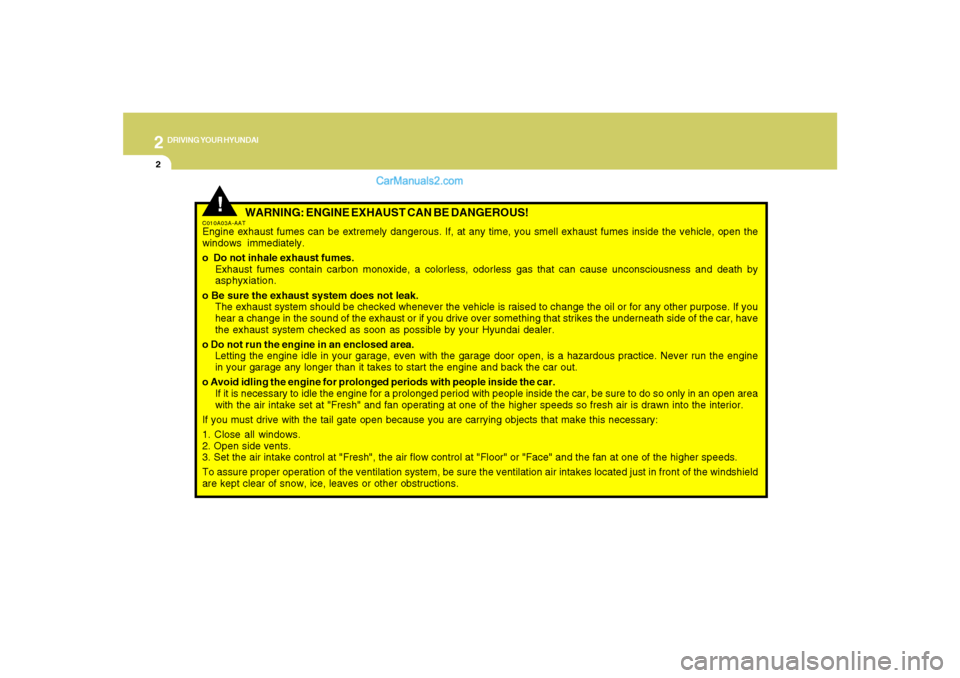
WARNING: ENGINE EXHAUST CAN BE DANGEROUS!
C010A03A-AATEngine exhaust fumes can be extremely dangerous. If, at any time, you smell exhaust fumes inside the vehicle, open the
windows immediately.
o Do not inhale exhaust fumes.
Exhaust fumes contain carbon monoxide, a colorless, odorless gas that can cause unconsciousness and death by
asphyxiation.
o Be sure the exhaust system does not leak.
The exhaust system should be checked whenever the vehicle is raised to change the oil or for any other purpose. If you
hear a change in the sound of the exhaust or if you drive over something that strikes the underneath side of the car, have
the exhaust system checked as soon as possible by your Hyundai dealer.
o Do not run the engine in an enclosed area.
Letting the engine idle in your garage, even with the garage door open, is a hazardous practice. Never run the engine
in your garage any longer than it takes to start the engine and back the car out.
o Avoid idling the engine for prolonged periods with people inside the car.
If it is necessary to idle the engine for a prolonged period with people inside the car, be sure to do so only in an open area
with the air intake set at "Fresh" and fan operating at one of the higher speeds so fresh air is drawn into the interior.
If you must drive with the tail gate open because you are carrying objects that make this necessary:
1. Close all windows.
2. Open side vents.
3. Set the air intake control at "Fresh", the air flow control at "Floor" or "Face" and the fan at one of the higher speeds.
To assure proper operation of the ventilation system, be sure the ventilation air intakes located just in front of the windshield
are kept clear of snow, ice, leaves or other obstructions.
!