2007 Hyundai Matrix brake
[x] Cancel search: brakePage 72 of 490
1FEATURES OF YOUR HYUNDAI
60
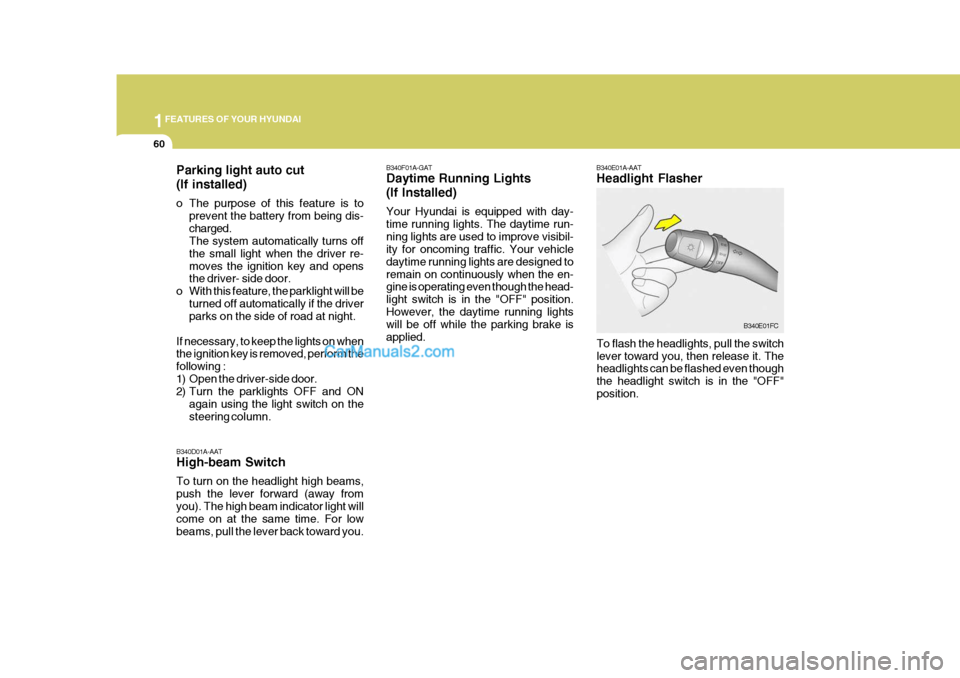
B340E01A-AAT Headlight Flasher
To flash the headlights, pull the switch lever toward you, then release it. The headlights can be flashed even though the headlight switch is in the "OFF"position. B340E01FC
B340D01A-AAT High-beam Switch To turn on the headlight high beams, push the lever forward (away fromyou). The high beam indicator light will come on at the same time. For low beams, pull the lever back toward you. B340F01A-GAT Daytime Running Lights (If Installed) Your Hyundai is equipped with day- time running lights. The daytime run-ning lights are used to improve visibil- ity for oncoming traffic. Your vehicle daytime running lights are designed toremain on continuously when the en- gine is operating even though the head- light switch is in the "OFF" position.However, the daytime running lights will be off while the parking brake is applied.
Parking light auto cut (If installed)
o The purpose of this feature is to
prevent the battery from being dis- charged. The system automatically turns off the small light when the driver re-moves the ignition key and opens the driver- side door.
o With this feature, the parklight will be turned off automatically if the driverparks on the side of road at night.
If necessary, to keep the lights on whenthe ignition key is removed, perform the following :
1) Open the driver-side door.
2) Turn the parklights OFF and ON again using the light switch on the steering column.
Page 80 of 490

1FEATURES OF YOUR HYUNDAI
68PARKING BRAKE
B530A02A-AAT The parking brake must always be set when the vehicle is to be left unattended. When the parking brake is applied, andthe ignition key is at the "ON" position, the parking brake warning lamp will be illuminated. Before driving the vehicle,the parking brake must be fully released and the warning lamp extinguished.
o To engage the parking brake, first
apply the foot brake and then without pressing the release button in, pull theparking brake lever up as far as pos- sible. B530A01FC
REAR SEAT ARM REST
B611A02FC-AAT (If Installed) The rear seat arm rest is located in the center of the rear seat back with a storage box. The drink holder in the box can be usedby opening the lid of the arm rest. B610A01FC
WARNING:
o Do not place objects other than cups or cans on the drink holder. Such objects can be thrown out in the event of a sudden stop oran accident, possibly injuring the passengers in the vehicle.
o Be careful not to injure your fin-
gers when you open the lid of thearm rest.
!
In addition it is recommended that when parking the vehicle on a gradi-ent, the shift lever should be posi- tioned in the appropriate low gear on manual transaxle vehicles or in thePark position on automatic transaxle vehicles.
o To release the parking brake, first apply the foot brake and pull up theparking brake lever slightly. Sec- ondly, depress the release buttonand lower the parking brake lever while holding the button.
CAUTION:
Driving with the parking brake ap- plied will cause excessive brake pad (or lining) and brake rotor wear.
!
Page 88 of 490

1FEATURES OF YOUR HYUNDAI
76HOOD RELEASE
B570A01FC-GAT
1. Pull the release knob to unlatch the hood. HFC2018
HFC203HIGH-MOUNTED REAR STOP LIGHT
B550A01S-GAT (If installed) In addition to the lower-mounted rear stop lights on either side of the car, the high mounted rear stop light in thecenter of the rear window or inserted in the rear spoiler also lights when the brakes are applied. B550A02FCFOLD-UP TRAY
B810A01FC-GAT
For your convenience, it may be used as a table holding a book, cup or can. WARNING:
To avoid the possibility of injury in case of an accident or a suddenstop, the fold-up tray should be place its original position while the vehicle is moving.
!
HFC2070
2. Push the secondary latch leversidewards and lift the hood.
Page 147 of 490

2
BEFORE STARTING THE ENGINE ........................... 2-3
KEY POSITIONS ......................................................... 2-4STARTING................................................................... 2-5
OPERATING THE MANUAL TRANSAXLE ................ 2-7
AUTOMATIC TRANSAXLE ......................................... 2-9ANTI-LOCK BRAKE SYSTEM (ABS)......................... 2-13
BRAKE TRACTION CONTROL SYSTEM (BTCS) .... 2-14
ELECTRONIC STABILITY PROGRAM (ESP) ...........2-16
DRIVING FOR ECONOMY .................... ....................2-18
SMOOTH CORNERING ............................................. 2-19
WINTER DRIVI NG ...................................................... 2-20
TRAILER OR VEHICLE TOWING.............................. 2-23
DRIVING YOUR HYUNDAI
2
Page 149 of 490

2
DRIVING YOUR HYUNDAI
3
!
TO START THE ENGINEBEFORE STARTING THE ENGINE
C020A02O-GAT Before you start the engine, you should always:
1. Look around the vehicle to be sure
there are no flat tires, puddles of oil, water or other indications of pos- sible trouble.
2. After entering the car, check to be sure the parking brake is engaged.
3. Check that all windows and lights are clean.
4. Check that the interior and exterior
mirrors are clean and in position.
5. Check your seat, seatback and headrest to be sure they are in theirproper positions.
6. Lock all the doors.
7. Fasten your seat belt and be sure
that all other occupants have fas- tened theirs.
8. Turn off all lights and accessories
that are not needed. C030A01A-GAT COMBINATION IGNITION SWITCH Before starting the engine:
o If your Hyundai is equipped with a
manual transaxle, place the shift lever in neutral and depress theclutch pedal fully.
o If your Hyundai has an automatic
transaxle, place the shift lever in "P"(park).
o To start the engine, insert the igni-
tion key and turn it to the "START"position. Release it as soon as the engine starts. Do not hold the key in the "START" position for more than15 seconds.
NOTE: For safety, the engine will not start if the shift lever is not in "P" or "N"Position (Automatic Transaxle).
WARNING: (DIESEL ENGINE)
To ensure that sufficient vacuum exists within the brake system dur- ing cold weather start-up condi-tions, it is necessary to run the engine at idle for several seconds after starting the engine.
9. When you turn the ignition switch to
"ON", check that all appropriatewarning lights are operating and that you have sufficient fuel.
10.Check the operation of warning lights and all bulbs when key is inthe "ON" position.
!WARNING:
Always wear appropriate shoes when operating your vehicle. Unsuitable shoes (high heels, ski boots, etc.) may interfere with yourability to use the brake and accelera- tor pedal, and the clutch (if installed).
Page 154 of 490

2 DRIVING YOUR HYUNDAI
8
C070D02O-AAT Good Driving Practices
o Never take the car out of gear andcoast down a hill. This is extremely hazardous. Always leave the car in gear.
o Don't "ride" the brakes. This can cause them to overheat and mal-function. Instead, when you are driv- ing down a long hill, slow down andshift to a lower gear. When you do this, engine braking will help slow the car.
o Slow down before shifting to a lower gear. This will help avoid over-rev-ving the engine, which can causedamage.
o Slow down when you encounter
cross winds. This gives you muchbetter control of your car.
o Be sure the car is completely stopped
before you attempt to shift into re-verse. The transaxle can be dam- aged if you do not. To shift into reverse, depress the clutch, movethe shift lever to neutral, wait three seconds, then shift to the reverse position.
C070E03A-GAT RECOMMENDED SHIFT POINTS The shift points as shown above are recommended for optimum fueleconomy and performance.
C070B02A-AAT Using the Clutch The clutch should be pressed all the way to the floor before shifting, thenreleased slowly. The clutch pedal should always be used after fully re- leased while driving. Do not rest yourfoot on the clutch pedal while driving. This can cause unnecessary wear. Do not partially engage the clutch to holdthe car on an incline. This causes unnecessary wear. Use the parking brake to hold the car on an incline. Donot operate the clutch pedal rapidly and repeatedly.
Shift
from-to 1-2 2-33-4 4-5 Recommended
20 km/h (15 mph)40 km/h (25 mph) 55 km/h (35 mph)75 km/h (45 mph)
Page 156 of 490

2 DRIVING YOUR HYUNDAI
10
C090D02A-AAT o N (Neutral): In the "N" position, the transaxle is in neutral position, which means that no gears are engaged. The engine can be started with the shift lever in "N" posi- tion, although this is not recommendedexcept if the engine stalls while the car is moving.
C090B02A-AAT The Function of Each Position Is As Follows: o P (Park): Use to hold the vehicle in place when parking or while starting the engine.Whenever parking the car, apply the parking brake and shift the selector lever to the "P" (Park) position.
CAUTION:
Never place the selector lever in the"P" (Park) position unless the ve- hicle is fully stopped. Failure to observe this caution will cause se-vere damage to the transaxle.
! C090C01A-AAT o R (Reverse): Use for backing up the vehicle. Bring the car to a complete stop before shift-ing the selector lever to "R" position.
!
NOTE: Depress the brake pedal and push the button when shift-ing. Push the button when shift- ing.The selector lever can be shifted freely.
For optimum fuel economy, acceler-ate gradually. The transaxle will auto- matically shift to the second, third andoverdrive gears.CAUTION:
Never shift into "R" or "P" position while the vehicle is moving.
Page 157 of 490

2
DRIVING YOUR HYUNDAI
11
C090E01A-GAT o D (Drive): Use for normal driving. The transaxle will automatically shift through a four-gear sequence. Never downshift manu- ally to "2" position or "L" position when vehicle speed is more than 95 km/h(60 mph).
C090F01A-AAT o 2 (Second gear): Use for driving on a slippery road, hill climbing or engine braking downhill."2" automatically shifts between first and second gears. This means that no shift-up to 3rd gearis performed. However, the shift-up to third gear is done when the car speed exceeds a certain value to prevent theengine from over-revving. Manually move the selector to "D" returning to normal driving condition. C090H01A-GAT NOTE:
o For smooth and safe operation,
depress the brake pedal when shifting from "N"(Neutral) posi-tion or "P"(Park) position to a forward or "R"(Reverse) gear.
o The brake pedal fully depressed in order to move the shift leverfrom the "P" (Park) position to any of the other positions.
o It is always possible to shift from "R", "N", "D", "2", "3"(1.8DOHC),"L" position to "P" position. Thevehicle must be fully stopped to avoid transaxle damage.
C090G01S-GAT o L (Low gear): Use for driving up a very steep grade or for engine braking when descendingsteep hills. When downshifting to "L", the transaxle will temporarily remain in second gear until the vehicle hasslowed enough for low gear to engage. Do not exceed 50 km/h (30 mph) in low gear."L" shifts to 1st gear only. However, shift up to 2nd is performed when the car exceeds a certain speed and, asspeed increases, the transaxle will shift up to 3rd gear to prevent over-revving the engine.