2007 HYUNDAI ENTOURAGE belt
[x] Cancel search: beltPage 102 of 398
Features of your vehicle86 3
Occupant classification systemYour vehicle is equipped with an occu-
pant classification system in the front
passenger's seat.
The occupant classification system is
designed to detect the presence of a
properly-seated front passenger and
determine if the passenger's front air bag
should be enabled (may inflate) or not.
The driver's front air bag is not affected
or controlled by the occupant classifica-
tion system.If the front passenger seat is occupied by
a person that the system determines to
be of adult size, and he/she sits properly
(sitting upright with the seatback in an
upright position, centered on the seat
cushion with their seat belt on, legs com-
fortably extended and their feet on the
floor), the "PASSENGER AIR BAG OFF"
indicator will be turned off and the front
passenger's air bag will be able to inflate,
if necessary, in frontal crashes.
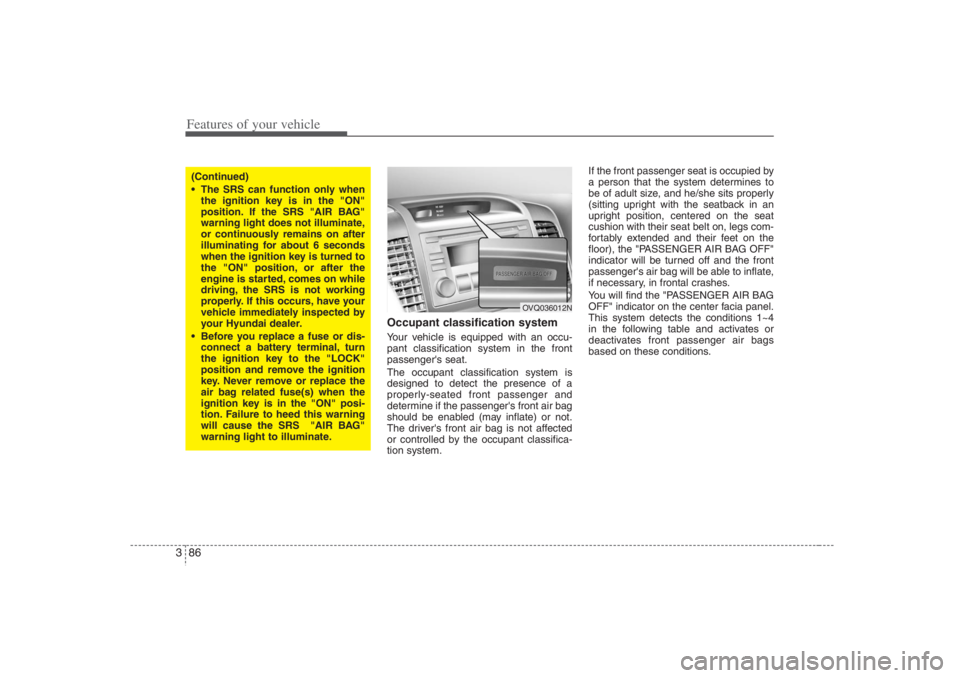
You will find the "PASSENGER AIR BAG
OFF" indicator on the center facia panel.
This system detects the conditions 1~4
in the following table and activates or
deactivates front passenger air bags
based on these conditions.
(Continued)
The SRS can function only when
the ignition key is in the "ON"
position. If the SRS "AIR BAG"
warning light does not illuminate,
or continuously remains on after
illuminating for about 6 seconds
when the ignition key is turned to
the "ON" position, or after the
engine is started, comes on while
driving, the SRS is not working
properly. If this occurs, have your
vehicle immediately inspected by
your Hyundai dealer.
Before you replace a fuse or dis-
connect a battery terminal, turn
the ignition key to the "LOCK"
position and remove the ignition
key. Never remove or replace the
air bag related fuse(s) when the
ignition key is in the "ON" posi-
tion. Failure to heed this warning
will cause the SRS "AIR BAG"
warning light to illuminate.
OVQ036012N
Page 105 of 398

389
Features of your vehicle
When an adult is seated in the front pas-
senger seat, if the "PASSENGER AIR
BAG OFF" indicator is on, turn the igni-
tion key to "LOCK" and ask the passen-
ger to sit properly (sitting upright with the
seat back in an upright position, centered
on the seat cushion with their seat belt
on, legs comfortably extended and their
feet on the floor). Restart the engine and
have the person remain in that position
for about 30 seconds. This will allow the
system to detect the person and to
enable the passenger air bag. If the
"PASSENGER AIR BAG OFF" indicator
is still on, turn the ignition key to "LOCK"
and ask the passenger to sit properly
and restart the engine again.If the "PASSENGER AIR BAG OFF" indi-
cator is still on, ask the passenger to
move to the rear seat.
✽ ✽
NOTICEThe "PASSENGER AIR BAG OFF"
indicator illuminates for about 4 sec-
onds after the ignition key is turned to
the "ON" position or after the engine is
started. If the front passenger seat is
occupied, the occupant classification
sensor will then classify the front pas-
senger within approximately 10 seconds
after the ignition is turned on.
B990A01O
Proper position
WARNING
Do not allow a passenger to ride in
the front seat when the “PASSEN-
GER AIR BAG OFF” indicator is illu-
minated, because the air bag will
not deploy in the event of a crash. If
the "PASSENGER AIR BAG OFF"
indicator remains illuminated after
the passenger repositions them-
selves properly and the car is
restarted, Hyundai recommends
that passenger move to the rear
seat because the passenger's front
air bag will not deploy.
The “PASSENGER AIR BAG OFF”
indicator will not change according
to the occupants posture after the
vehicle has been running for 30
seconds. Front seat passengers
must stay properly seated to avoid
serious injury from a deploying air
bag. For more information see
page 3-86.
WARNING
Do not put a heavy load in the front
passenger seatback pocket or on
the front passenger seat. Do not
hang onto the front passenger seat.
Do not hang any items such as
seatback table on the front passen-
ger seatback. Do not place feet on
the front passenger seatback. Do
not place any items under the front
passenger seat. Any of these could
interfere with proper sensor opera-
tion.
Page 106 of 398

Features of your vehicle90 3
CAUTION
If the occupant classification sys-
tem is not working properly, the
SRS air bag warning light on the
instrument panel will illuminate
because the passenger's front air
bags are connected with the occu-
pant classification system. If there
is a malfunction of the occupant
classification system, the "PAS-
SENGER AIR BAG OFF" indicator
will not illuminate and the passen-
ger's front air bags will inflate in
frontal impact crashes even if there
is no occupant in the front passen-
ger's seat. If the SRS air bag warn-
ing light does not illuminate when
the ignition key is turned to the
"ON" position, remains illuminated
after approximately 6 seconds
when the ignition key is turned to
the "ON" position, or if it illuminates
while the vehicle is being driven,
have an authorized Hyundai dealer
inspect the occupant classification
system and the SRS air bag system
as soon as possible.
(Continued)
If you change the weight on the
front passenger seat just after sit-
in or restart of the engine, the
"PASSENGER AIR BAG OFF"
indicator may be turned on or off
for a few seconds, disabling or
enabling the passenger air bags.
After the initial stage of about 30
seconds, the "PASSENGER AIR
BAG OFF" indicator will not tog-
gle.
Do not modify or replace the front
passenger seat. Don't place any-
thing on or attach anything such
as a blanket or after market seat
heater to the front passenger
seat. This can adversely affect the
occupant classification system.
Do not sit on sharp objects such
as tools when occupying the front
passenger seat. This can adverse-
ly affect the occupant classifica-
tion system.
Do not use accessory seat covers
on the front seats.
(Continued)
WARNING
Even though your vehicle is
equipped with the occupation
classification system, never
install a child restraint system in
the front passenger's seat. A
deploying air bag can forcefully
strike a child resulting in serious
injuries or death. Any child under
13 years of age should ride in the
rear seat. Children too large for
child restraints should use the
available lap/shoulder belts. No
matter what type of crash, chil-
dren of all ages are safer when
restrained in the rear seat.
If the "PASSENGER AIR BAG
OFF" indicator is illuminated
when the front passenger's seat
is occupied by an adult and
he/she sits properly (sitting
upright with the seatback in an
upright position, centered on the
seat cushion with their seat belt
on, legs comfortably extended
and their feet on the floor), have
that person sit in the rear seat.
(Continued)
Page 107 of 398

391
Features of your vehicle
Side impact air bag (if equipped)Your Hyundai is equipped with a side
impact air bag in each front seat. The
purpose of the air bag is to provide the
vehicle's driver and/or the front passen-
ger with additional protection than that
offered by the seat belt alone.
(Continued)
Accident statistics show that chil-
dren are safer if they are
restrained in the rear, as opposed
to the front seat. It is recommend-
ed that child restraints be
secured in a rear seat, including
an infant riding in a rear-facing
infant seat, a child riding in a for-
ward-facing child seat and an
older child riding in a booster
seat.
Air bags can only be used once –
have an authorized Hyundai deal-
er replace the air bag immediately
after deployment.
A smaller-stature adult who is not
seated correctly (for example:
seat excessively reclined, leaning
on the center console, or hips
shifted forward in the seat) can
cause a condition where the
advanced frontal air bag system
senses less weight than if the
occupant were seated properly
(sitting upright with the seatback
in an upright position, centered
on the seat cushion with their
seat belt on, legs comfortably
extended and their feet on the
floor).
(Continued)
(Continued)
This condition can result in an
adult potentially being misclassi-
fied and illumination of the "PAS-
SENGER AIR BAG OFF" indicator.
OVQ036310NOVQ036900N
Page 108 of 398

Features of your vehicle92 3The side impact air bags are designed to
deploy only during certain side-impact
collisions, depending on the crash sever-
ity, angle, speed and point of impact. The
side impact air bags are not designed to
deploy in all side impact situations.
(Continued)
Do not install any accessories on
the side or near the side impact
air bag.
Do not place any objects over the
air bag or between the air bag and
yourself.
Do not place any objects (an
umbrella, bag, etc.) between the
front door and the front seat.
Such objects may become dan-
gerous projectiles and cause
injury if the supplemental side
impact air bag inflates.
To prevent unexpected deploy-
ment of the side impact air bag
that may result in personal injury,
avoid impact to the side impact
sensor when the ignition key is
on.
WARNING
The side impact air bag is supple-
mental to the driver's and the pas-
senger's seat belt systems and is
not a substitute for them.
Therefore your seat belts must be
worn at all times while the vehicle
is in motion. The air bags deploy
only in certain side impact condi-
tions severe enough to cause sig-
nificant injury to the vehicle occu-
pants.
For best protection from the side
impact air bag system and to
avoid being injured by the deploy-
ing side impact air bag, both front
seat occupants should sit in an
upright position with the seat belt
properly fastened. The driver's
hands should be placed on the
steering wheel at the 9:00 and
3:00 positions. The passenger's
arms and hands should be placed
on their laps.
Do not use any accessory seat
covers.
Use of seat covers could reduce
or prevent the effectiveness of
the system.
(Continued)
1VQA2079/1VQA2323
Side impact sensor
Page 109 of 398

393
Features of your vehicle
Curtain air bag (if equipped)Curtain air bags are located along both
sides of the roof rails above the front and
rear doors.
They are designed to help protect the
heads of the front seat occupants and
the rear outboard seat occupants in cer-
tain side impact collisions.The curtain air bags are designed to
deploy only during certain side impact
collisions, depending on the crash sever-
ity, angle, speed and impact. The curtain
air bags are not designed to deploy in all
side impact situations, collisions from the
front or rear of the vehicle or in most
rollover situations.
OVQ036093NOVQ036017N
WARNING
In order for side air bags (side
and curtain air bags) to provide
its best protection, both front seat
occupants and both outboard
rear occupants should sit in an
upright position with the seat
belts properly fastened.
Importantly, children should sit in
a proper child restraint system in
the rear seat.
(Continued)
(Continued)
When children are seated in the
rear outboard seats, they must be
seated in the proper child
restraint system. Make sure to put
the child restraint system as far
away from the door side as possi-
ble, and secure the child restraint
system in a locked position.
Do not allow the passengers to
lean their heads or bodies onto
doors, put their arms on the
doors, stretch their arms out of
the window, or place objects
between the doors and passen-
gers when they are seated on
seats equipped with side air
bags.
Never try to open or repair any
components of the side curtain
air bag system. This should only
be done by an authorized Kia
dealer.
Failure to follow the above men-
tioned instructions can result in
injury or death to the vehicle occu-
pants in an accident.
Page 111 of 398
395
Features of your vehicle
Additional safety precautionsNever let passengers ride in the
cargo area or on top of a folded-
down back seat.All occupants should
sit upright, fully back in their seats with
their seat belts on and their feet on the
floor.
Passengers should not move out of
or change seats while the vehicle is
moving.A passenger who is not wear-
ing a seat belt during a crash or emer-
gency stop can be thrown against the
inside of the vehicle, against other
occupants, or out of the vehicle.
Each seat belt is designed to
restrain one occupant.If more than
one person uses the same seat belt,
they could be seriously injured or killed
in a collision.
Do not use any accessories on seat
belts.Devices claiming to improve
occupant comfort or reposition the seat
belt can reduce the protection provided
by the seat belt and increase the
chance of serious injury in a crash.
Passengers should not place hard
or sharp objects between them-
selves and the air bags.Carrying
hard or sharp objects on your lap or in
your mouth can result in injuries if an
air bag inflates.Keep occupants away from the air
bag covers.All occupants should sit
upright, fully back in their seats with
their seat belts on and their feet on the
floor. If occupants are too close to the
air bag covers, they could be injured if
the air bags inflate.
Do not attach or place objects on or
near the air bag covers.Any object
attached to or placed on the front or
side impact air bag covers could inter-
fere with the proper operation of the air
bags.
Do not modify the front seats.
Modification of the front seats could
interfere with the operation of the sup-
plemental restraint system sensing
components or side impact air bags.
Do not place items under the front
seats.Placing items under the front
seats could interfere with the operation
of the supplemental restraint system
sensing components and wiring har-
nesses.
Never hold an infant or child on your
lap.The infant or child could be seri-
ously injured or killed in the event of a
crash. All infants and children should
be properly restrained in appropriate
child safety seats or seat belts in the
rear seat.
Adding equipment to or modify-
ing your air bag-equipped vehi-
cle.If you modify your vehicle by changing
your vehicle's frame, bumper system,
front end or side sheet metal or ride
height, this may affect the operation of
your vehicle's air bag system.
WARNING
Sitting improperly or out of posi-
tion can cause occupants to be
shifted too close to a deploying
air bag, strike the interior struc-
ture or be thrown from the vehicle
resulting in serious injury or
death.
Always sit upright with the seat-
back in an upright position, cen-
tered on the seat cushion with
your seat belt on, legs comfort-
ably extended and your feet on
the floor.
Page 114 of 398

Features of your vehicle98 3Side impact air bags (if equipped)
Side impact air bags (side and/or curtain
air bags) are designed to inflate when an
impact is detected by side collision sen-
sors depending on the strength, speed or
angles of impact resulting from a side
impact collision or rollover.Although the front air bags (driver’s and
front passenger’s air bags) are designed
to inflate only in frontal collisions, they
also may inflate in other types of colli-
sions if the front impact sensors detect a
sufficient impact. Side impact air bags
(side and/or curtain air bags) are
designed to inflate only in side impact
collisions, but they may inflate in other
collisions if the side impact sensors
detect a sufficient impact.
If the vehicle chassis is impacted by
bumps or objects on unimproved roads
or sidewalks, air bags may deploy. Drive
carefully on unimproved roads or on sur-
faces not designed for vehicle traffic to
prevent unintended air bag deployment.
To protect occupants, front air bags or
pre-tensioner seat belts may deploy in
certain side impact collisions.
Air bag non-inflation conditions In certain low-speed collisions the air
bags may not deploy. The air bags are
designed not to deploy in such cases
because they may not provide benefits
beyond the protection of the seat belts
in such collisions.
OVQ036018NOVQ036016N
1VQA2086