Page 76 of 228
Apply the parking brake. The
convertible top will not operate
unless the parking brake is f ully
engaged.
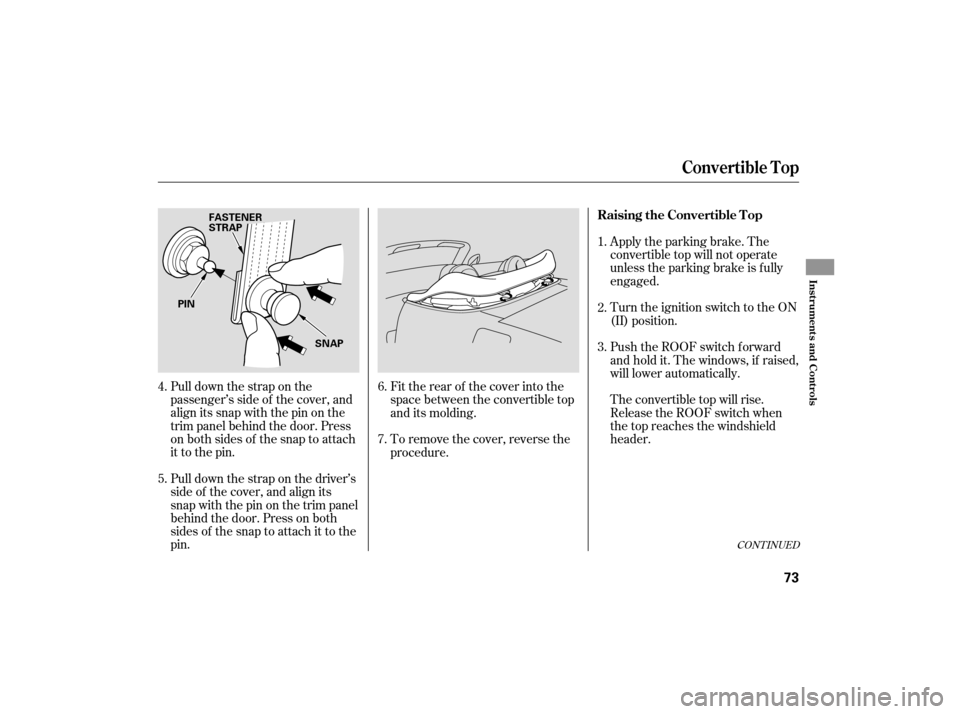
Pull down the strap on the
passenger’s side of the cover, and
align its snap with the pin on the
trim panel behind the door. Press
on both sides of the snap to attach
it to the pin.
Pull down the strap on the driver’s
side of the cover, and align its
snap with the pin on the trim panel
behind the door. Press on both
sides of the snap to attach it to the
pin. Fit the rear of the cover into the
space between the convertible top
and its molding.
To remove the cover, reverse the
procedure.
Turn the ignition switch to the ON
(II) position.
Push the ROOF switch f orward
and hold it. The windows, if raised,
will lower automatically.
The convertible top will rise.
Release the ROOF switch when
the top reaches the windshield
header.
5. 6.1.
2.
3.
4.
7.
CONT INUED
Raising the Convertible T op
Convertible Top
Inst rument s and Cont rols
73
PINSNAP
FASTENER
STRAP
Page 79 of 228
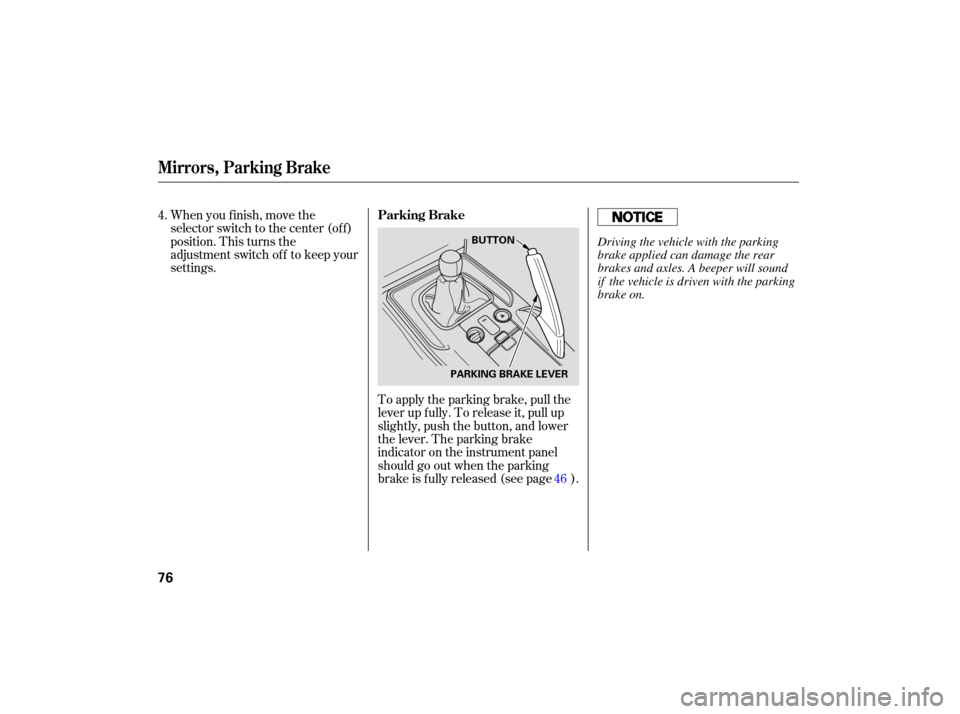
To apply the parking brake, pull the
lever up fully. To release it, pull up
slightly, push the button, and lower
the lever. The parking brake
indicator on the instrument panel
should go out when the parking
brake is f ully released (see page ).
When you f inish, move the
selector switch to the center (off)
position. This turns the
adjustment switch of f to keep your
settings.
4.
46
Parking Brake
Mirrors, Parking Brake
76
BUTTON
PARKING BRAKE LEVERDriving the vehicle with the parking
brake applied can damage the rear
brakes and axles. A beeper will sound
if the vehicle is driven with the parking
brake on.
Page 115 of 228
Park the vehicle, and set the
parking brake. Pull the hood
release handle located under the
lower left corner of the dashboard.
The hood will pop up slightly.
Screw
the fuel fill cap back on
until it clicks at least once. If you
do not properly tighten the cap,
the malfunction indicator lamp
maycomeon(seepage ).You
will also see a ‘‘CHECK FUEL
CAP’’ message on the inf ormation
display.
Push the f uel f ill door closed until
it latches.
Put your f ingers under the f ront
edge of the hood near the center.
Slide your hand to the lef t until
you f eel the hood latch handle.
Push this handle to the lef t to
release the hood. Lif t up the hood.
If the hood latch handle moves
stif f ly, or if you can open the hood
without lifting the handle, the
mechanism should be cleaned and
lubricated.
1.
2.
5.
6.
187
Service Station Procedures
Opening and Closing the Hood
112
RELEASE HANDLE
Page 124 of 228
This section gives you tips on
starting the engine under various
conditions, and how to operate the
manual transmission. It also includes
important inf ormation on parking
your vehicle and the braking system.........................
Driving Guidelines .122
........................
Preparing to Drive .123
.......................
Starting the Engine .124
...................
Manual Transmission . 125
...........................................
Parking .127
.............................
Braking System .127
...............
Anti-lock Brakes (ABS) . 128
Vehicle Stability Assist (VSA) ........................................
System .130
...........................
Towing a Trailer .131
Driving
Driving
121
Page 127 of 228
Apply the parking brake.
In cold weather, turn off all
electrical accessories to reduce
the drain on the battery.
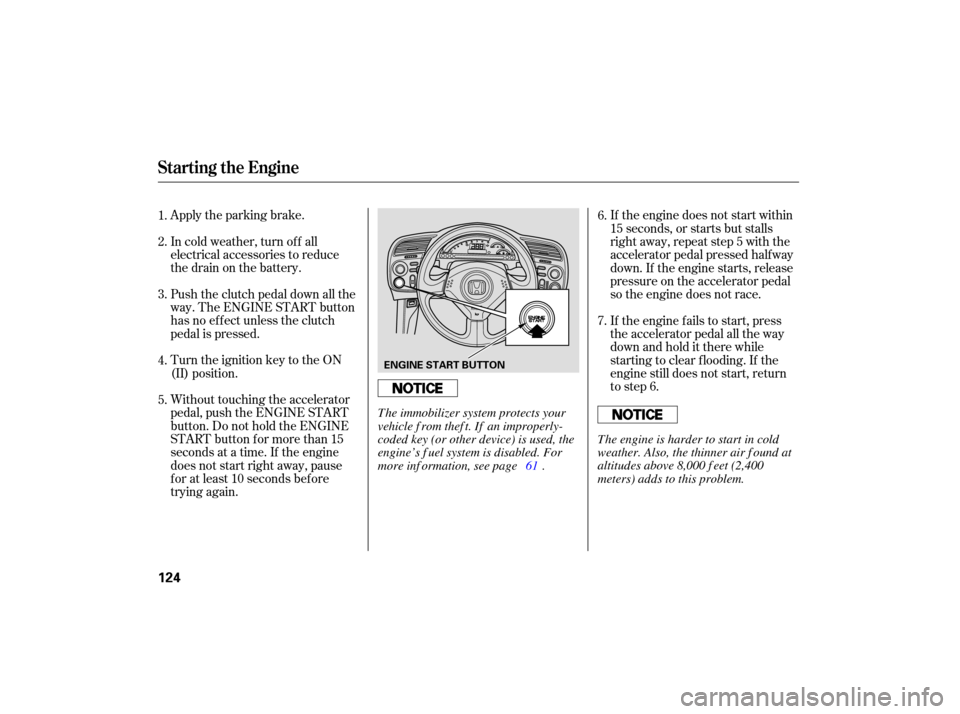
Push the clutch pedal down all the
way. The ENGINE START button
has no effect unless the clutch
pedal is pressed.
Turn the ignition key to the ON
(II) position.
Without touching the accelerator
pedal, push the ENGINE START
button. Do not hold the ENGI NE
START button for more than 15
seconds at a time. If the engine
does not start right away, pause
for at least 10 seconds before
trying again. If
the engine fails to start, press
the accelerator pedal all the way
downandholdittherewhile
starting to clear flooding. If the
engine still does not start, return
to step 6.
Iftheenginedoesnotstartwithin
15
seconds, or starts but stalls
right away, repeat step 5 with the
accelerator pedal pressed halfway
down. If the engine starts, release
pressu re on the accelerator pedal
so the engine does not race.
1.
2.
3.
4.
5. 6.
7.
Starting
theEngine
124
ENGINE START BUTTON
The engine is harder to start in cold
weather. Also, the thinner air found at
altitudes above 8,000 feet (2,400
meters) adds to this problem.
The
immobilizer system protects your
vehicle f rom thef t. If an improperly-
coded key (or other device) is used, the
engine’s f uel system is disabled. For
more inf ormation, see page . 61
Page 130 of 228

Make sure the convertible top and
the windows are closed.
Turn of f the lights.
Place any packages, valuables, etc.,
in the trunk or take them with you.
Lock the doors.
Never park over dry leaves, tall
grass, or other f lammable
materials. The hot three way
catalytic converter could cause
these materials to catch on fire.If the vehicle is f acing uphill, turn
the front wheels away from the
curb, and put the transmission in
f irst gear.
If the vehicle is f acing downhill,
turn the front wheels toward the
curb, and put the transmission in
reverse gear.
Make sure the parking brake is
f ully released bef ore driving away.
Driving with the parking brake
partially set can overheat or
damage the rear brakes.
Resting your f oot on the pedal keeps
the brakes applied lightly, builds up
heat, and reduces their ef f ectiveness.
It also keeps your brake lights on all
the time, conf using drivers behind
you.
Constant application of the brakes
when going down a long hill builds
up heat and reduces their ef f ective-
ness. Use the engine to assist the
brakes by taking your f oot of f the
accelerator and downshif ting to a
lower gear. Your vehicle is equipped with disc
brakes at all f our wheels. A power
assist helps reduce the ef f ort needed
on the brake pedal. The anti-lock
brake system (ABS) helps you retain
steering control when braking very
hard.
Always use the parking brake when
you park your vehicle. Make sure
the parking brake is set f irmly, or
your vehicle may roll if it is parked
on an incline.
CONT INUED
Parking
Parking T ips Braking System
Parking, Braking System
Driving
127
Page 137 of 228

To eliminate potential hazards, read
the instructions bef ore you begin,
and make sure you have the tools
and skills required. All service items not detailed in this
section should be perf ormed by a
certif ied technician or other qualif ied
mechanic.Make sure your vehicle is parked
on level ground, the parking brake
is set, and the engine is of f .
To clean parts, use a commercially
available degreaser or parts
cleaner, not gasoline.
To reduce the possibility of f ire or
explosion, keep cigarettes, sparks,
and flames away from the battery
and all f uel-related parts.
Wear eye protection and
protective clothing when working
with the battery or compressed air. Do
not run the engine unless
instructed to do so.
Some of the most important saf ety
precautions are given here.
However, we cannot warn you of
every conceivable hazard that can
arise in performing maintenance.
Only you can decide whether or
not you should perf orm a given
task.
Let the
engine and exhaust system cool
down bef ore touching any parts. Be sure
there is adequate ventilation
whenever you operate the
engine.
Maintenance Saf ety
Important Saf ety Precautions Injury f rom moving parts.
Burns f rom hot parts. Carbon Monoxide poison
f rom engine exhaust.
Potential Vehicle Hazards
134
Failure to properly follow
maintenance instructions and
precautions can cause you to
be seriously hurt or killed.
Always follow the procedures
and precautions in this owner’s
manual.
Improperly maintaining this
vehicle, or failing to correct a
problem before driving can
cause a crash in which you can
be seriously hurt or killed.
Always follow the inspection
and maintenance
recommendations and
schedules in this owner’s
manual.
Page 144 of 228

�µ�µ
�Ì �µ�µ�µ
U.S.
Vehicles:
Youshouldcheckthefollowing
items at the specified interval s. If
you are unsure of how to perform
any check, turn to the appropriate
page listed.
Engine oil level Check every
time you fill the fuel tank. See
page . Lights
Check the operation of
the headlights, parking lights,
taillights, high-mount brake light,
and license plate lights monthly.
See page .
According to state and federal
regulations, failure to perform
maintenance on the items marked
with will not void your emissions
warranties. However, all
maintenance services should be
pe rformed in accordance with the
intervals indicated by the
info rmation display. Tires Check the tire pressu re
monthly. Examine the tread for
wear and foreign objects. See page
.
Brakes
and clutch Check the
fluid level monthly. See page .
Engine
coolant level Check the
radiator reserve tank every time
youfillthefueltank.Seepage .
113
114
154
164 155
CONT INUED
Maintenance, replacement, or
repair of emissions control
devices and systems may be done
by any automotive repair
establishment or individual using
parts that are ‘‘certif ied’’ to EPA
standards.
Owner’s Maintenance Checks
Maintenance Minder
Maint enance
141