Page 137 of 228
To eliminate potential hazards, read
the instructions bef ore you begin,
and make sure you have the tools
and skills required. All service items not detailed in this
section should be perf ormed by a
certif ied technician or other qualif ied
mechanic.Make sure your vehicle is parked
on level ground, the parking brake
is set, and the engine is of f .
To clean parts, use a commercially
available degreaser or parts
cleaner, not gasoline.
To reduce the possibility of f ire or
explosion, keep cigarettes, sparks,
and flames away from the battery
and all f uel-related parts.
Wear eye protection and
protective clothing when working
with the battery or compressed air. Do
not run the engine unless
instructed to do so.
Some of the most important saf ety
precautions are given here.
However, we cannot warn you of
every conceivable hazard that can
arise in performing maintenance.
Only you can decide whether or
not you should perf orm a given
task.
Let the
engine and exhaust system cool
down bef ore touching any parts. Be sure
there is adequate ventilation
whenever you operate the
engine.
Maintenance Saf ety
Important Saf ety Precautions Injury f rom moving parts.
Burns f rom hot parts. Carbon Monoxide poison
f rom engine exhaust.
Potential Vehicle Hazards
134
Failure to properly follow
maintenance instructions and
precautions can cause you to
be seriously hurt or killed.
Always follow the procedures
and precautions in this owner’s
manual.
Improperly maintaining this
vehicle, or failing to correct a
problem before driving can
cause a crash in which you can
be seriously hurt or killed.
Always follow the inspection
and maintenance
recommendations and
schedules in this owner’s
manual.
Page 172 of 228
Check the condition of the battery
monthlybylookingatthetest
indicator window. The label on the
battery explains the test indicato r’s
colors. Check
the terminals for corrosion (a
white or yellowish powder). To
remove it, cover the terminals with a
solution of baking soda and water. It
will bubble up and turn brown. When
this stops, wash it off with plain
water. Dry off the battery with a
cloth or paper towel. Coat the
terminals with grease to help prevent
future corrosion. If
your vehicle’s battery is
disconnected, or goes dead, the
clock setting in the instrument panel
will be canceled. To reset the time,
see page .
If your vehicle’s battery is
disconnected, or goes dead, the
audio system will disable itsel f. The
nexttimeyouturnontheradio,you
may see ‘‘CODE’’ (U.S. model) or
‘‘Code’’ (Canadian model) in the
f requency display. Use the preset
buttons to enter the code (see page ). 54
105
CONT INUED
Checking the Battery
Maint enance
169
TEST INDICATOR WINDOW
Page 173 of 228
�µ
If additional battery maintenance is
needed, see your dealer or a
qualif ied technician.
Battery posts,
terminals, and related accessories
contain lead and lead compounds. If you need to connect the battery to
a charger, disconnect both cables to
prevent damaging your vehicle’s
electrical system. Always disconnect
the negative ( ) cable first, and
reconnect it last.
Checking the Battery
WARNING:
Wash your hands af ter handling.
170
The battery gives off explosive
hydrogen gas during normal
operation.
A spark or flame can cause the
battery to explode with enough
force to kill or seriously hurt you.
Wear protective clothing and a
face shield, or have a skilled
technician do the battery
maintenance.
Page 174 of 228

If you need to park your vehicle f or
an extended period (more than 1
month), there are several things you
should do to prepare it f or storage.
Proper preparation helps prevent
deterioration and makes it easier to
get your vehicle back on the road. If
possible, store your vehicle indoors.Fill the f uel tank.
Change the engine oil and f ilter.
Wash and dry the exterior
completely.
Cleantheinterior.Makesurethe
carpeting, floor mats, etc., are
completely dry.
Raise the convertible top cover.
Leave the parking brake off. Put
the transmission in reverse. Block the rear wheels.
If the vehicle is to be stored f or a
longer period, it should be
supported on jackstands so the
tires are of f the ground.
Leave one window open slightly (if
the vehicle is being stored
indoors).
Disconnect the battery.
Cover the vehicle with a
‘‘breathable’’ cover, one made
f rom a porous material such as
cotton. Non-porous materials, such
as plastic sheeting, trap moisture,
which can damage the paint.
Support the f ront wiper blade
arms with a f olded towel or rag so
they do not touch the windshield.
To minimize sticking, apply a
silicone spray lubricant to all door
and trunk seals. Also, apply a
vehiclebodywaxtothepainted
surfaces that mate with the door
and trunk seals. If possible, periodically run the
engine until it reaches f ull
operating temperature (the
cooling f an cycles on and of f
twice). Pref erably, do this once a
month.
Vehicle Storage
Maint enance
171
Page 183 of 228

Diagnosing why the engine won’t
start falls into two areas, depending
on what you hear when you press
the ENGINE START button.
You hear nothing, or almost
nothing. The engine’s starter
motor does not operate at all, or
operates very slowly.
You can hear the starter motor
operating normally, or the starter
motor sounds like it is spinning
faster than normal, but the engine
does not start up and run. When
you press the ENGINE
START button, you do not hear the
norm al noise of the engine trying to
start. You may hear a clicking sound
or series of clicks, or nothing at all.
Check these things:
Check the transmission interlock.
The clutch pedal must be pushed
all the way to the floor or the
starter will not operate.
Turn the ignition switch to the ON
(II) position. Turn on the
headlights, and check their
brightness. If the headlights are
very dim or do not come on at all,
the battery is discharged. See
on page . Press
the ENGI NE START button,
then release it. If the headlights do
not dim, check the condition of the
fuses.IfthefusesareOK,thereis
probably something wrong with
the electrical circuit for the
ignition switch or starter motor.
You will need a qualified mechanic
to determine the problem. (See
on page .)
182 196
Nothing Happens or the Starter
Motor Operates Very Slowly
Jump Starting Emergency T owing
If theEngineWon’tStart
180
Page 184 of 228

If the headlights dim noticeably or
go out when you try to start the
engine, either the battery is
discharged or the connections are
co rroded. Check the condition of the
battery and terminal connections
(see page ). You can then try
jump starting the vehicle from a
booster battery (see page ). In
this case, the starter motor’s
speed sounds normal, or even faster
than normal, when you press the
ENGI NE START button, but the
engine does not run. There
may be an electrical
problem, such as no power to the
fuel pump. Check all the fuses
(see page ).
Are you using a properly coded
key? An improperly coded key will
cause the immobilizer system
indicator in the instrument panel
to blink rapidly (see page ).
Are you using the proper starting
procedure? Refer to
on page .
Do you have fuel? Check the fuel
gauge; the low fuel indicator may
not be working. Ifyoufindnothingwrong,youwill
need
a qualified mechanic to find the
problem. See
on page .
61
169
182
124 190
196
T he Starter Operates Normally
Starting the
Engine Emergency T owing
If theEngineWon’tStart
T aking Care of t he Unexpect ed
181
Page 185 of 228
�´�´
Although this seems like a simple
procedure, you should take several
precautions.
Open the hood, and check the
physical condition of the battery.
In very cold weather, check the
condition of the electrolyte. If it
seems slushy or f rozen, do not try
jump starting until it thaws.
To jump start your vehicle:
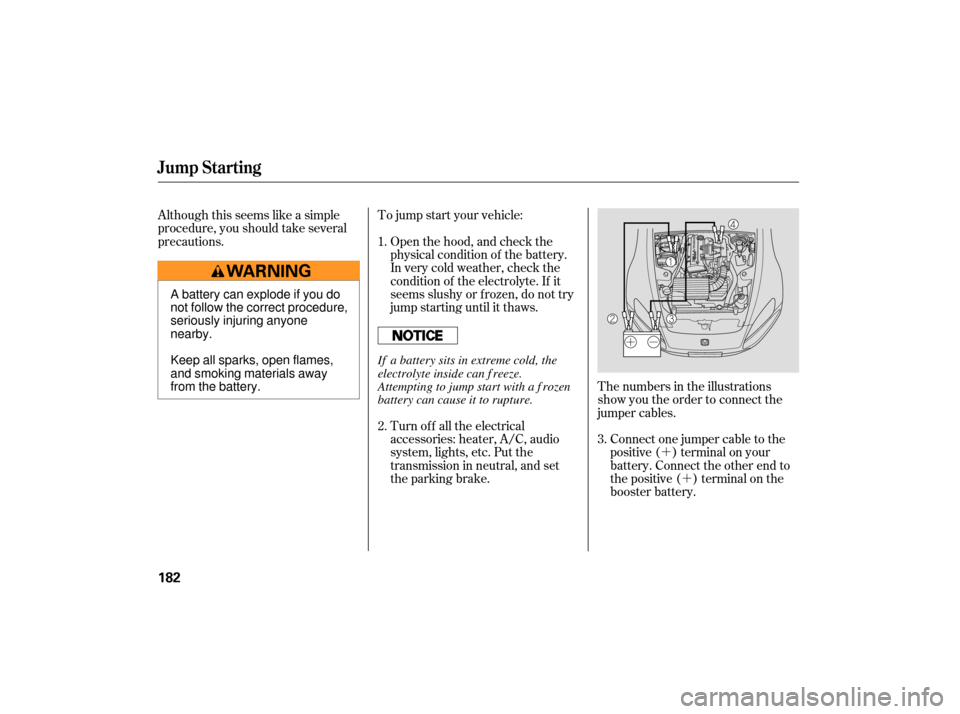
Connect one jumper cable to the
positive ( ) terminal on your
battery. Connect the other end to
the positive ( ) terminal on the
booster battery.
Turn of f all the electrical
accessories: heater, A/C, audio
system, lights, etc. Put the
transmission in neutral, and set
the parking brake. The numbers in the illustrations
show you the order to connect the
jumper cables.
3.
1.
2.
Jump Starting
182
A battery can explode if you do
not follow the correct procedure,
seriously injuring anyone
nearby.
Keep all sparks, open flames,
and smoking materials away
from the battery.
If a battery sits in extreme cold, the
electrolyte inside can f reeze.
Attempting to jump start with a f rozen
battery can cause it to rupture.
Page 186 of 228

�µThe reading on your vehicle’s
temperature gauge should stay in
the midrange under most conditions.
If it reaches the red mark, you
should determine the reason (hot
day, driving up a steep hill, etc.).
If your vehicle overheats, you should
take immediate action. The only
indication may be the temperature
gauge reading reaching the red
mark. Or you may see steam or
spray coming f rom under the hood.
Connect the second jumper cable
to the negative ( ) terminal on
the booster battery. Connect the
other end to the grounding strap
as shown. Do not connect this
jumper cable to any other part of
the engine. Keep the ends of the jumper
cables away from each other and
any metal on the vehicle until
everything is disconnected.
Otherwise, you may cause an
electrical short. Once your vehicle is running,
disconnect the negative cable f rom
your vehicle, then f rom the
booster battery. Disconnect the
positive cable f rom your vehicle,
then from the booster battery. Start your vehicle. If the starter
motor still operates slowly, check
that the jumper cables have good
metal-to-metal contact. If the booster battery is in another
vehicle, have an assistant start
that vehicle and run it at a fast idle.
6.
7. 5.
4.
CONT INUED
Jump Starting, If the Engine Overheats
If the Engine Overheats
T aking Care of t he Unexpect ed
183
Driving with the temperature gauge
reading at the red mark can cause
serious damage to your engine.