Page 245 of 331
�µ�µ�µ
�µ
�µ �µ
Youshouldcheckthefollowing
items at the specified interval s. If
you are unsure of how to perform
any check, turn to the appropriate
page listed.
Engine oil level Check every
time you fill the fuel tank. See
page .
Engine coolant level Check the
radiator reserve tank every time
you fill the fuel tank. See page .
Automatic transmission Check
the fluid level monthly. See page
.
Brakes Check the fluid level
monthly. See page .
Tires Check the tire pressure
monthly. Examine the tread for
wear and foreign objects. See page
. Lights
Check the operation of
the headlights, parking lights,
taillights, high-mount brake light,
and licen se plate lights monthly.
See page .
182 182
251 253
265 255
CONT INUED
Maintenance Minder
Owner’s Maintenance Checks
Maint enance
241
Page 246 of 331

�Î
�Î
�Ì �Ì
�Ì
�Î
Maintenance Minder
242
: Maintenance
Sub Items
Replace dust and pollen filter
Inspect drive belt
Replace transmission and transfer fluid
Replace spark plugs
Replace timing belt and inspect water pump
Inspect valve clearance
Replace engine coolant
Replace VTM-4 rear differential fluid
Maintenance
Main Items
Replace engine oil
Replace engine oil and oil filter
Inspect front and rear brakes
Check parking brake adjustment
Inspect these items:
Tie rod ends, steering gear box, and boots
Suspension components
Driveshaft boots
Brake hoses and lines (including ABS)
All fluid levels and condition of fluids
Exhaust system
Fuel lines and connect ions
Maintenance Sub Items
Rotate tires
Replace air cleaner element
If you drive in dusty conditions, replace
every 15,000 miles (24,000 km). 2
3
4
5
Symbol
A
B
Symbol 1
2 Symbol
6
If you drive primarily in urban areas that have high
concentrations of soot in the air from industry and from diesel-
powered vehicles, replace every 15,000 miles (24,000 km).
Driving in mountainous areas at very low vehicle speeds or
trailer towing results in higher transmission and transfer
temperatures or frequently fully loaded. This requires
transmission and transfer fluid changes more frequently
than recommended by the Maintenance Minder.
If you regulary drive your vehicle under these conditions, have
the transmission and transfer fluid changed every 30,000 miles
(48,000 km).
If you drive regularly in very high tempera tures (over 110°F,
43°C), in very low temperatures (under-20°F, -29°C), or towing a
trailer, replace every 60,000 mile (U.S.)/100,000 km (Canada)
Driving in mountainous areas at very low vehicle speeds or
trailer towing results in higher level of me chanical (shear) stress
to fluid or frequently fully loaded. This requires differential fluid
changes more frequently than recommended by the
Maintenance Minder. If you regularly drive your vehicle under
these conditions, have the differential fluid changed at
7,500 miles (12,000 km), then every 15,000 miles (24,000 km).
1
1
If the message ‘‚SERVICE DUE NOW ’’ does not appear more than 12 months
after the display is reset, change the engine oil every year.
See information on maintenance and emissions warranty on page .
Independent of the maintenance messages in the information display,
replace the brake fluid every 3 years.
Inspect idle speed every 160,000 miles (256,000 km).
Adjust the valves during services A, B, 1, 2, or 3 only if they are noisy.
NOTE: 1:
240
Maintenance Minder
Page 249 of 331
�Î
�Î
Fluid Locations
Maint enance
245
ENGINE OIL DIPSTICK
(Orange loop)
WASHER FLUID
(Blue cap)RADIATOR CAP AUTOMATIC
TRANSMISSION
FLUID DIPSTICK
(Yellow loop)
BRAKE FLUID
(Gray cap)
ENGINE
COOLANT
RESERVOIR POWER STEERING
FLUID (Red cap) ENGINE OIL FILL CAP
: Under the gray cover
Page 251 of 331
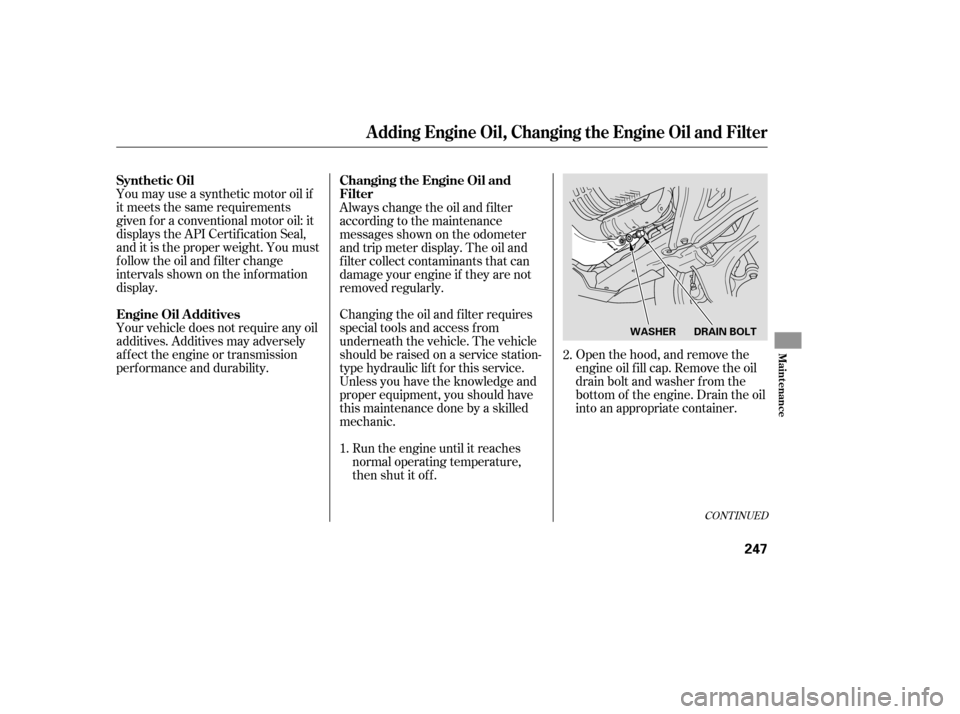
Open the hood, and remove the
engine oil f ill cap. Remove the oil
drain bolt and washer f rom the
bottom of the engine. Drain the oil
into an appropriate container.
Your vehicle does not require any oil
additives. Additives may adversely
af f ect the engine or transmission
perf ormance and durability. You may use a synthetic motor oil if
it meets the same requirements
given f or a conventional motor oil: it
displays the API Certif ication Seal,
and it is the proper weight. You must
f ollow the oil and f ilter change
intervals shown on the information
display.
Run the engine until it reaches
normal operating temperature,
then shut it off.
Changing the oil and f ilter requires
special tools and access f rom
underneath the vehicle. The vehicle
should be raised on a service station-
type hydraulic lif t f or this service.
Unless you have the knowledge and
proper equipment, you should have
this maintenance done by a skilled
mechanic. Always change the oil and f ilter
according to the maintenance
messages shown on the odometer
and trip meter display. The oil and
f ilter collect contaminants that can
damage your engine if they are not
removed regularly.
1.
2.
CONT INUED
Synthetic Oil
Engine Oil A dditivesChanging the Engine Oil and
Filter
A dding Engine Oil, Changing the Engine Oil and Filter
Maint enance
247
WASHER
DRAIN BOLT
Page 255 of 331

CONT INUED
Check the f luid level with the engine
at normal operating temperature.Park the vehicle on level ground. Insert the dipstick all the way into
the transmission securely as
shown in the illustration. Remove the dipstick (yellow loop)
f rom the transmission, and wipe it
with a clean cloth.
Remove the dipstick and check
the f luid level. It should be
between the upper and lower
marks.
1.
2.
3.
4.
Windshield Washers, A utomatic T ransmission Fluid
Automatic Transmission Fluid
Maint enance
251
DIPSTICKDIPSTICK
UPPER MARK
LOWER MARK
Do not use engine antif reeze or a
vinegar/water solution in the
windshield washer reservoir. Antif reeze
can damage your vehicle’s paint, while
a vinegar/water solution can damage
the windshield washer pump. Use only
commercially-available windshield
washer f luid.
Start the engine and let it run until
the radiator fan comes on, then
shut off the engine. For accurate
results, wait about 60 seconds
wait longer than 90 seconds.
before going to step 2, but do not
Page 256 of 331

The rear differential should be
drained and refilled with new fluid
when this service is indicated by a
maintenance message on the
info rmation display. This service
may be needed more often under
certain driving conditions (see page
).
Always use Honda VTM-4
Dif f erential Fluid, and have your
dealer replace the rear differential
f luid.
Insert the dipstick all the way back
in the transmission.
If the level is below the lower
mark, remove the f ill plug, then
add the f luid into the hole to bring
it to the level between the upper
and lower marks.
Pour the f luid slowly and caref ully so
you do not spill any. Clean up any
spill immediately; it could damage
components in the engine
compartment.
Always use Honda ATF-Z1
(automatic transmission f luid). If it’s
not available, you may use a
DEXRON
III automatic
transmission f luid as a temporary
replacement. However, continued
use can affect the shift quality. Have
the transmission f lushed and ref illed
with Honda ATF-Z1 by your dealer
as soon as it is convenient. If you are not sure how to add f luid,
contact your dealer. 6.
5.
242
Automatic transmission Fluid, Rear Dif f erential Fluid
Rear Dif f erential Fluid
252
Page 276 of 331

If you need to park your vehicle f or
an extended period (more than 1
month), there are several things you
should do to prepare it f or storage.
Proper preparation helps prevent
deterioration and makes it easier to
get your vehicle back on the road. If
possible, store your vehicle indoors.Fill the f uel tank.
Change the engine oil and f ilter.
Wash and dry the exterior
completely.
Cleantheinterior.Makesurethe
carpeting, floor mats, etc., are
completely dry.
Leave the parking brake off. Put
the transmission in Park. Block the rear wheels.
If the vehicle is to be stored f or a
longer period, it should be
supported on jackstands so the
tires are of f the ground.
Leave one window open slightly (if
the vehicle is being stored
indoors).
Disconnect the battery.
Cover the vehicle with a
‘‘breathable’’ cover, one made
f rom a porous material such as
cotton. Non-porous materials, such
as plastic sheeting, trap moisture,
which can damage the paint.
If possible, periodically run the
engine until it reaches f ull
operating temperature (the
cooling f ans cycle on and of f
twice). Pref erably, do this once a
month.
Support the f ront wiper blade
arms with a f olded towel or rag so
they do not touch the windshield.
To minimize sticking, apply a
silicone spray lubricant to all door,
In-Bed Trunk lid, and tailgate seals.
Also,applyavehiclebodywaxto
the painted surfaces that mate
with the door, In-Bed Trunk lid
and tailgate seals.
Vehicle Storage
272
Page 279 of 331
Turn on the hazard warning lights,
and turn the ignition switch to the
LOCK (0) position. Have all
passengers get out of the vehicle
while you change the tire.
Park
the vehicle on firm, level, and
non-slippery ground. Put the
transmission in Park. Apply the
parking brake.
If you are towing a trailer, unhitch
it.
If
you have a flat tire while driving,
stop in a safe place to change it.
Drive slowly along the shoulder until
you get to an exit or an area to stop
that is far away from the traffic lanes.
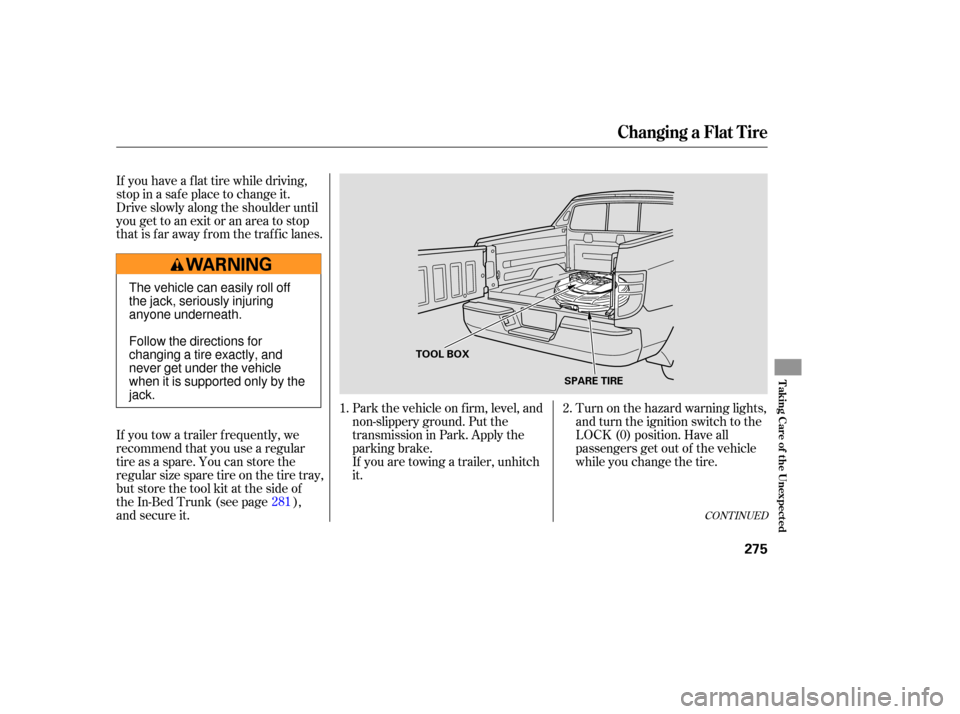
If you tow a trailer frequently, we
recommend that you use a regular
tire as a spare. You can store the
regular size spare tire on the tire tray,
but store the tool kit at the side of
the In-Bed Trunk (see page ),
and secure it. 2.
1.
281
CONT INUED
Changing a Flat Tire
T aking Care of t he Unexpect ed
275
TOOL BOX SPARE TIRE
The vehicle can easily roll off
the jack, seriously injuring
anyone underneath.
Follow the directions for
changing a tire exactly, and
never get under the vehicle
when it is supported only by the
jack.

