Page 64 of 319

�Î
�Î�Î
�Î �Î
If equipped.
The U.S. instrument panel is shown. Dif f erences f or the Canadian models are noted in the text.
:
Instrument Panel
Inst rument s and Cont rols
61
LIGHTS ON INDICATOR
HIGH BEAM INDICATOR
A/T TEMPERATURE
INDICATOR
MAINTENANCE MINDER
INDICATOR LOW OIL PRESSURE
INDICATORVSA ACTIVATION
INDICATOR
CRUISE CONTROL
INDICATOR SIDE AIRBAG OFF
INDICATOR
LOW FUEL INDICATOR
FOG LIGHT INDICATOR
(P.69)
(P.69) (P.69)
SEAT BELT REMINDER INDICATOR
(P.67)
(P.68)
(P.64)
VTM-4 INDICATOR (P.68)
FUEL ECONOMY INDICATOR (P.68)
CHARGING SYSTEM
INDICATOR (P.64)
(P.67) (P.65)
(P.66)
(P.65)
IMMOBILIZER SYSTEM
INDICATOR
(P.64)
(P.67)
PARKING BRAKE
AND BRAKE
SYSTEM
INDICATOR
SUPPLEMENTAL RESTRAINT SYSTEM
INDICATOR
MALFUNCTION
INDICATOR LAMP
BRAKE LAMP
INDICATOR (P.66) LOW TIRE PRESSURE
INDICATOR
(P.65) TIRE PRESSURE
MONITORING SYSTEM
(TPMS) INDICATOR
VEHICLE STABILITY ASSIST
(VSA) SYSTEM INDICATOR
ANTI-LOCK BRAKE SYSTEM (ABS) INDICATOR
(P.62,
277)
(P.62, 276) (P.63,
278)
(P.34, 63)
(P.33, 63)
(P.62, 276) DOOR AND TAILGATE OPEN MONITOR
TIRE PRESSURE MONITOR
(P.63)
(P.21,
62)
Page 66 of 319

This indicator normally comes on for
a few seconds when you turn the
ignition switch to the ON (II)
position, and when the ignition
switch is turned to the START (III)
position. If it comes on at any other
time, there is a problem with the
ABS. If this happens, have your
vehicle checked at a dealer. With
this on, your vehicle still has normal
braking ability but no anti -lock
brakes. For more information, see
page .
This
indicator has two functions:
Itcomesonwhenyouturnthe
ignition switch to the ON (II)
position. It is a reminder to check
the parking brake. A beeper
sounds if you drive with the
parking brake not fully released.
Driving with the parking brake not
fully released can damage the
brakes and tires.
If it stays on after you have fully
released the parking brake while
the engine is running, or if it
comes on while driving, there
could be a problem with the brake
system. For more information, see
page .
This
indicator comes on briefly when
you turn the ignition switch to the
ON (II) position. If it comes on at
any other time, it indicates a
poten tial problem with your front
airbags. This indica tor will also alert
you to a poten tial problem with your
side airbags, passenger’s side airbag
automatic cutoff system, side curtain
airbags, automatic seat belt
tensioners, driver’s seat position
sensor, or the front passenger’s seat
weight sensors. For more
info rmation, see page .
This indicator comes on when you
turn the ignition switch to the ON
(II) position. If it comes on at any
other time, it indicates that the
passenger’s side airbag has
automatically shut off. For more
inf ormation, see page . 1.
2.
33
34 278 210
Instrument Panel Indicators
Anti-lock Brake System
(A BS) Indicator
Parking Brake and Brake System
Indicator
Supplemental Restraint
System Indicator
Side Airbag Of f
Indicator
Inst rument s and Cont rols
63
U.S. Canada
U.S. Canada
Page 88 of 319
�´
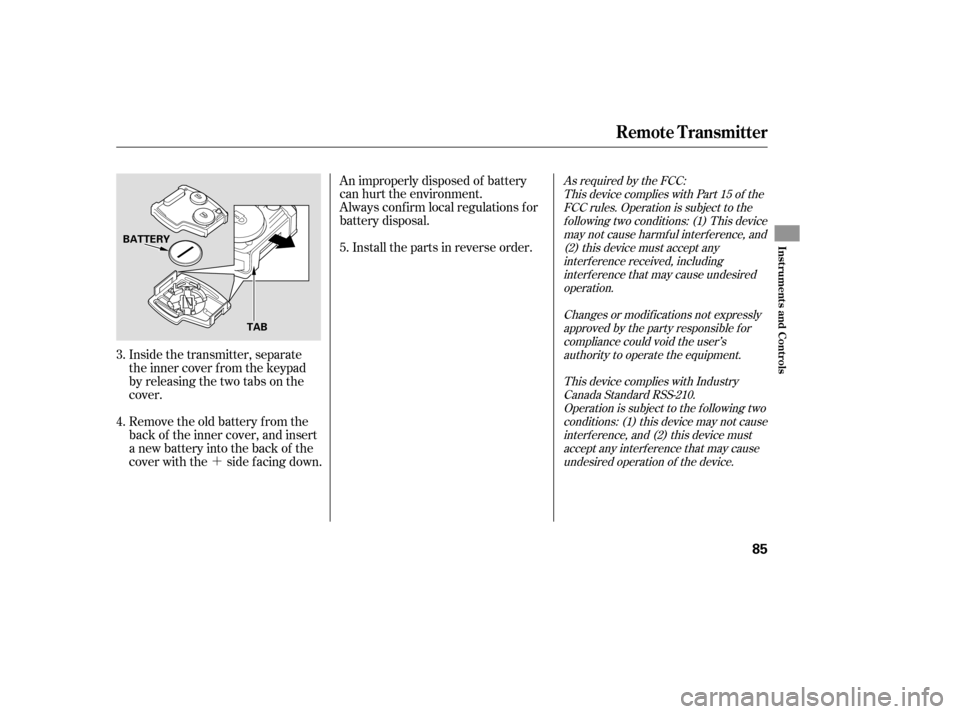
Inside the transmitter, separate
the inner cover f rom the keypad
by releasing the two tabs on the
cover.
Remove the old battery from the
back of the inner cover, and insert
a new battery into the back of the
cover with the side f acing down. An improperly disposed of battery
can hurt the environment.
Always conf irm local regulations f or
battery disposal.
Install the parts in reverse order.
3.
4. 5.
As required by the FCC:
This device complies with Part 15 of theFCC rules. Operation is subject to thef ollowing two conditions: (1) This devicemay not cause harmf ul interf erence, and(2) this device must accept anyinterf erence received, includinginterf erence that may cause undesiredoperation.
Changes or modif ications not expresslyapproved by the party responsible f orcompliance could void the user’sauthority to operate the equipment.
This device complies with IndustryCanada Standard RSS-210.Operation is subject to the f ollowing twoconditions: (1) this device may not causeinterf erence, and (2) this device mustaccept any interf erence that may causeundesired operation of the device.
Remote Transmitter
Inst rument s and Cont rols
85
BATTERY
TAB
Page 199 of 319
Thehooksoneachsideof the
tailgate and on the underside of the
cargo area storage compartment lid
are f or plastic grocery bags. To use
the hook on the storage
compartment lid, open the lid, and
attach the cord to one of the shafts
of the third seat center head
restraint.You can use the cargo net to secure
items in the cargo area, and store
small items between the two halves
of the net. To install the cargo net,
hook the loops on the f our corners of
the net to the tabs at both sides of
the tailgate sill.
If equipped
Carrying Cargo
Cargo Net
196
Page 200 of 319

This section gives you tips on
starting the engine under various
conditions, and how to operate the
automatic transmission. It also
includes important inf ormation on
parking your vehicle, the braking
system, the VTM-4 system (4WD
models only), the VSA system, the
tire pressure monitoring system, and
f acts you need if you are planning to
tow a trailer.........................
Driving Guidelines .198
.......................
Starting the Engine .199
..............
Automatic Transmission .200
..............................
VTM-4 System .204
Tire Pressure Monitoring
........................
System (TPMS) .205
..................................
Parking Tips .207
.............................
Braking System .208
...............
Anti-lock Brakes (ABS) .209
Vehicle Stability Assist (VSA)
........................................
System .211
.........................
VSA Of f Switch .212
...........................
Towing a Trailer .213
......................
Trailer Driving Tips .219
Towing Your Vehicle Behind a
................................
Motorhome .221
Of f -Highway Driving ..................................
Guidelines .222
Driving
Driving
197
Page 211 of 319

Check the brakes after driving
through deep water. Apply the
brakes moderately to see if they f eel
normal. If not, apply them gently and
f requently until they do. Be extra
cautious in your driving.
Resting your f oot on the pedal keeps
the brakes applied lightly, builds up
heat, and reduces their ef f ectiveness.
It also keeps your brake lights on all
the time, conf using drivers behind
you.
Constant application of the brakes
when going down a long hill builds
up heat and reduces their ef f ective-
ness. Use the engine to assist the
brakes by taking your f oot of f the
accelerator and downshif ting to a
lower gear. Your vehicle is equipped with disc
brakes at all f our wheels. A power
assist helps reduce the ef f ort needed
on the brake pedal. The anti-lock
brake system (ABS) helps you retain
steering control when braking very
hard. The hydraulic system that operates
the brakes has two separate circuits.
Each circuit works diagonally across
the vehicle (the lef t-f ront brake is
connected with the right-rear brake,
etc.). If one circuit should develop a
problem, you will still have braking
at two wheels. Braking System Design
Braking System
208
Page 212 of 319

If the brake pads need replacing, you
will hear a distinctive, metallic
screeching sound when you apply
the brake pedal. If you do not have
the brake pads replaced, they will
screech all the time. It is normal f or
the brakes to occasionally squeal or
squeak when you apply them.The anti-lock brake system (ABS)
helps prevent the brakes f rom
locking up, and helps you retain
steering control by pumping the
brakes rapidly, much f aster than a
person can do it.
The ABS also balances the f ront-to-
rear braking distribution according
to vehicle loading.
Let the ABS work f or you by always
keeping f irm, steady pressure on the
brake pedal. This is sometimes
ref erred to as ‘‘stomp and steer.’’You will f eel a pulsation in the brake
pedal when the ABS activates, and
you may hear some noise. This is
normal: it is the ABS rapidly
pumpingthebrakes.Ondry
pavement, you will need to press on
thebrakepedalveryhardbeforethe
ABS activates. However, you may
feel the ABS activate immediately if
you are trying to stop on snow or ice.
You should never pump the brake pedal.
Anti-lock Brakes (ABS)
Brake Wear Indicators
Braking System, Anti-lock Brakes (ABS)
Driving
209
Page 213 of 319

such as trying to take a
corn er too fast or making a sudden
lane change. Always drive at a safe
speed for the road and weather
conditions.
Always steer moderate ly
wh en you are braking hard. Severe
or sharp steering wheel movement
can still cause your vehicle to veer
into oncoming traffic or off the road.
If
this indicator comes on, the anti-
lock function of the braking system
has shut down. The brakes still work
like a conven tional system, but
without anti-lock. You should have
your dealer inspect your vehic le as
soon as possible.
If the ABS indicator and the brake
system indicator come on together,
and the parking brake is fully
released, the front-to-rear braking
distribution system may also be shut
down.
Test your brakes as instructed on
page . If the brakes f eel normal,
drive slowly and have your vehicle
repaired by your dealer as soon as
possible. Avoid sudden hard braking
which could cause the rear wheels to
lock up and possibly lead to a loss of
control. It only helps with steering
control during braking. on loose or
uneven surf aces, such as gravel or
snow, than a vehicle without anti-
lock.
278
Anti-lock Brakes (ABS)
A BS will not prevent a skid that
results f rom changing direction
abruptly,
A BS cannot prevent a loss of
stability.
ABS Indicator
Important Saf ety Reminders
A BS does not reduce the time or
distance it takes to stop the
vehicle. A vehicle with A BS may require a
longer distance to stop
210
