Page 210 of 319

Set the parking brake bef ore you put
the transmission in Park. This keeps
the vehicle from moving and putting
pressure on the parking mechanism
in the transmission.If the vehicle is f acing downhill,
turn the front wheels toward the
curb and set the parking brake. If the vehicle is f acing uphill, turn
the front wheels away from the
curb and set the parking brake.
Always use the parking brake when
you park your vehicle. Make sure
the parking brake is set f irmly or
your vehicle may roll if it is on an
incline. Make sure the moonroof (if
equipped) and the windows are
closed.
Turn of f the lights.
Place any packages, valuables, etc.
in the cargo area or take them
with you.
Lock the doors.
Check the indicator on the driver’s
door to verify that the security
system is set.
Never park over dry leaves, tall
grass, or other f lammable
materials. The hot three way
catalytic converter could cause
these materials to catch on fire.
On vehicles with security system
Parking Tips
Driving
207
Page 211 of 319

Check the brakes after driving
through deep water. Apply the
brakes moderately to see if they f eel
normal. If not, apply them gently and
f requently until they do. Be extra
cautious in your driving.
Resting your f oot on the pedal keeps
the brakes applied lightly, builds up
heat, and reduces their ef f ectiveness.
It also keeps your brake lights on all
the time, conf using drivers behind
you.
Constant application of the brakes
when going down a long hill builds
up heat and reduces their ef f ective-
ness. Use the engine to assist the
brakes by taking your f oot of f the
accelerator and downshif ting to a
lower gear. Your vehicle is equipped with disc
brakes at all f our wheels. A power
assist helps reduce the ef f ort needed
on the brake pedal. The anti-lock
brake system (ABS) helps you retain
steering control when braking very
hard. The hydraulic system that operates
the brakes has two separate circuits.
Each circuit works diagonally across
the vehicle (the lef t-f ront brake is
connected with the right-rear brake,
etc.). If one circuit should develop a
problem, you will still have braking
at two wheels. Braking System Design
Braking System
208
Page 222 of 319
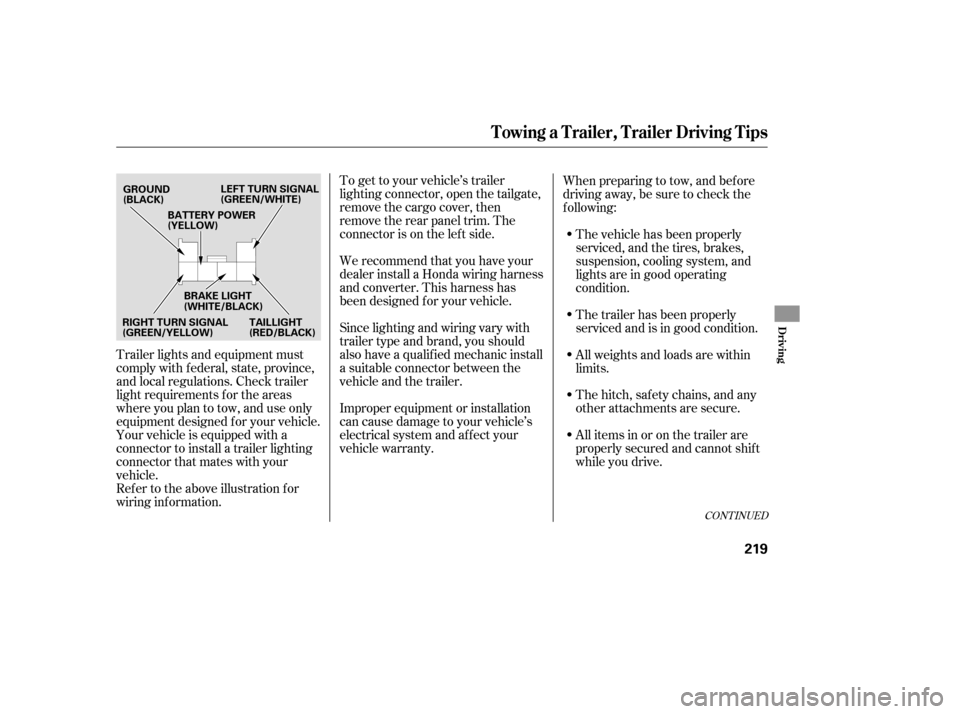
To get to your vehicle’s trailer
lighting connector, open the tailgate,
remove the cargo cover, then
remove the rear panel trim. The
connector is on the lef t side.
Trailer lights and equipment must
comply with f ederal, state, province,
and local regulations. Check trailer
light requirements f or the areas
where you plan to tow, and use only
equipment designed f or your vehicle.
Your vehicle is equipped with a
connector to install a trailer lighting
connector that mates with your
vehicle.
Ref er to the above illustration f or
wiring information. We recommend that you have your
dealer install a Honda wiring harness
and converter. This harness has
been designed f or your vehicle.
Since lighting and wiring vary with
trailer type and brand, you should
also have a qualif ied mechanic install
a suitable connector between the
vehicleandthetrailer.
Improper equipment or installation
can cause damage to your vehicle’s
electrical system and af f ect your
vehicle warranty.When preparing to tow, and bef ore
driving away, be sure to check the
f ollowing:
The vehicle has been properly
serviced, and the tires, brakes,
suspension, cooling system, and
lights are in good operating
condition.
The trailer has been properly
serviced and is in good condition.
All weights and loads are within
limits.
Thehitch,safetychains,andany
other attachments are secure.
All items in or on the trailer are
properly secured and cannot shif t
while you drive.
CONT INUED
Towing a Trailer, Trailer Driving Tips
Driving
219
GROUND
(BLACK) LEFT TURN SIGNAL
(GREEN/WHITE)
RIGHT TURN SIGNAL
(GREEN/YELLOW) BRAKE LIGHT
(WHITE/BLACK)
TAILLIGHT
(RED/BLACK)
BATTERY POWER
(YELLOW)
Page 230 of 319

If you have the skills and tools to
perform more complex maintenance
tasks on your vehicle, you may want
to purchase the service manual. See
page f or inf ormation on how to
obtain a copy, or see your dealer. This section also includes
instructions on how to read the
maintenance messages in the
inf ormation display, a maintenance
record, and instructions f or simple
maintenance tasks you may want to
take care of yourself . This section explains why it is
important to keep your vehicle well
maintained and how to f ollow basic
maintenance saf ety precautions. ......................
Maintenance Saf ety .228
....................
Maintenance Minder .229
....................
Maintenance Record .236
..............................
Fluid Locations .238
........................
Adding Engine Oil .239
.........
Changing the Oil and Filter .240
..............................
Engine Coolant .242
....................
Windshield Washers .243
....
Automatic Transmission Fluid .244
..............................
Dif f erential Oil .245
....................................
Timing Belt .245
....................................
Brake Fluid .246
....................
Power Steering Fluid .247
.............................................
Lights .248
.....................................
Floor Mats .254
.......................
Cleaning Seat Belts .254
.................................
Wiper Blades .255
...........................................
Wheels .257
...............................................
Tires .257
...................
Checking the Battery .262
.............................
Vehicle Storage .263
305
Maintenance
Maint enance
227
Page 237 of 319

�µ�µ�µ
�µ
�µ
�Ì �µ
Youshouldcheckthefollowing
items at the specified interval s. If
you are unsure of how to perform
any check, turn to the appropriate
page listed.
Engine oil level Check every
time you fill the fuel tank. See
page .
Engine coolant level Check the
radiator reserve tank every time
you fill the fuel tank. See page .
Automatic transmission Check
the fluid level monthly. See page
.
Brakes Check the fluid level
monthly. See page .
Tires Check the tire pressure
monthly. Examine the tread for
wear and foreign objects. See page
.
According
to state and federal
regulations, failure to perform
maintenance on the items marked
with will not void your emissions
warranties. However, all
maintenance services should be
performed in accordance with the
intervals indicated by the
information display. Lights
Check the operation of
the headlights, parking lights,
taillights, high-mount brake light,
turn signals, brake lights, and
license plate light monthly. See
page .
189
246
258
244 248
190
U.S. Vehicles:
Maintenance Minder
Owner’s Maintenance Checks
Maintenance, replacement, or
repair of emissions control
devices and systems may be done
by any automotive repair
establishment or individual using
parts that are ‘‘certif ied’’ to EPA
standards.
234
Page 256 of 319
Use a Phillips-head screwdriver to
remove the screw under the lens. Place a cloth on the middle edge
of a part of the lens on the
passenger’s side. Remove a part of
the lens by caref ully prying on its
edge with a small f lip tipped
screwdriver.
Reinstall the back-up light cover. Pull the burned out bulb straight
out of its socket.
Push the new bulb straight into
the socket until it bottoms.
Insert the socket back into the
light assembly. Turn it clockwise
to lock it in place.
Pull the light assembly out of the
tailgate.
Pull the bulb straight out of its
socket. Push a new bulb into the
socket until it bottoms. Reinstall
the assembly. Remove the socket f rom the light
assembly by turning it one-quarter
turn counterclockwise.
Turn on the lights to make sure
the new bulb is working.
1. 4.
5. 3.
2.
4.
5.
6. 3.
Lights
Replacing the High-mount Brake
Light
Maint enance
253
SCREWS
Page 266 of 319

Fill the f uel tank.
Change the engine oil and f ilter.Block the rear wheels.
Wash and dry the exterior
completely.
Cleantheinterior.Makesurethe
carpeting, floor mats, etc., are
completely dry.
If you need to park your vehicle f or
an extended period (more than 1
month), there are several things you
should do to prepare it f or storage.
Proper preparation helps prevent
deterioration and makes it easier to
get your vehicle back on the road. If
possible, store your vehicle indoors. Leave one window open slightly (if
the vehicle is being stored
indoors).Cover the vehicle with a
‘‘breathable’’ cover, one made
f rom a porous material such as
cotton. Non-porous materials, such
as plastic sheeting, trap moisture,
which can damage the paint.
Support the f ront wiper blade
arms with a f olded towel or rag so
they do not touch the windshield. Disconnect the battery.
Leave the parking brake off. Put
the transmission in Park. To minimize sticking, apply a
silicone spray lubricant to all door
and tailgate seals. Also, apply a
vehiclebodywaxtothepainted
surfaces that mate with the door
and tailgate seals.If possible, periodically run the
engine until it reaches f ull
operating temperature (the
cooling f ans cycle on and of f
twice). Pref erably, do this once a
month.
If the vehicle is to be stored f or a
longer period, it should be
supported on jackstands so the
tires are of f the ground.
Vehicle Storage
Maint enance
263
Page 270 of 319
CONT INUED
If you have a f lat tire while driving,
stop in a saf e place to change it.
Drive slowly along the shoulder until
you get to an exit or an area to stop
that is far away from the traffic lanes.Park the vehicle on f irm, level, and
non-slippery ground. Put the
transmission in Park. Apply the
parking brake.
If you are towing a trailer, unhitch
it.
Turn on the hazard warning lights,
and turn the ignition switch to the
LOCK (0) position. Have all
passengers get out of the vehicle
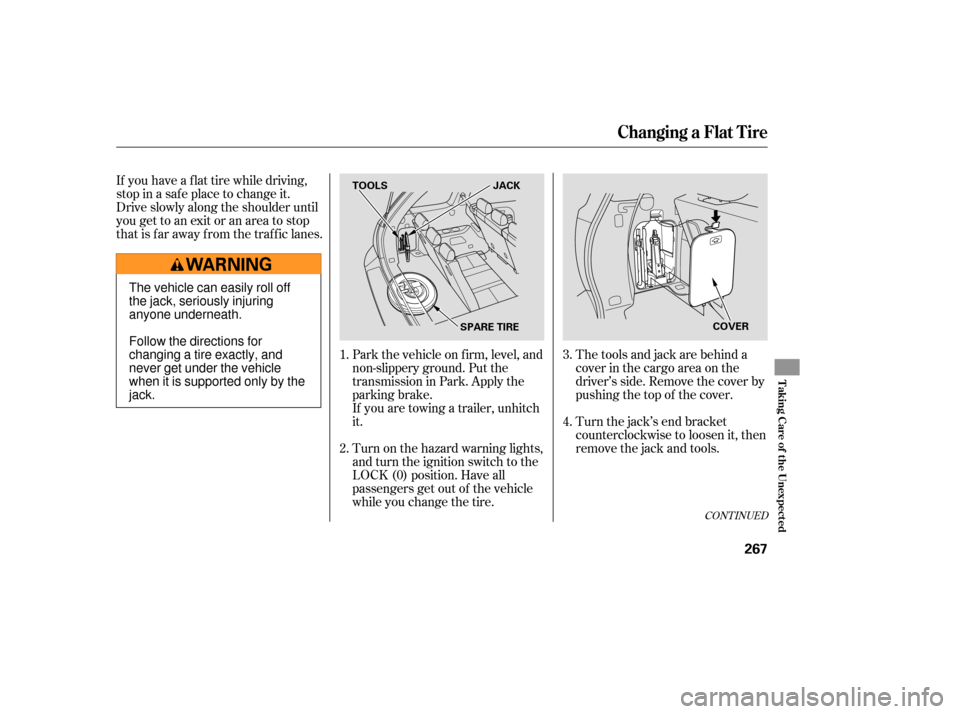
while you change the tire.Turn the jack’s end bracket
counterclockwise to loosen it, then
remove the jack and tools. Thetoolsandjackarebehinda
cover in the cargo area on the
driver’s side. Remove the cover by
pushing the top of the cover.
2. 1. 3.
4.
Changing a Flat Tire
T aking Care of t he Unexpect ed
267
SPARE TIRE
TOOLS
COVER
JACK
The vehicle can easily roll off
the jack, seriously injuring
anyone underneath.
Follow the directions for
changing a tire exactly, and
never get under the vehicle
when it is supported only by the
jack.
