Page 253 of 304

Fill the f uel tank.
Change the engine oil and f ilter.Block the rear wheels.
If the vehicle is to be stored f or a
longer period, it should be
supported on jackstands so the
tires are of f the ground.
Wash and dry the exterior
completely.
Cleantheinterior.Makesurethe
carpeting, floor mats, etc., are
completely dry.
If you need to park your vehicle f or
an extended period (more than 1
month), there are several things you
should do to prepare it f or storage.
Proper preparation helps prevent
deterioration and makes it easier to
get your vehicle back on the road. If
possible, store your vehicle indoors. Leave one window open slightly (if
the vehicle is being stored
indoors).Cover the vehicle with a
‘‘breathable’’ cover, one made
f rom a porous material such as
cotton. Non-porous materials, such
as plastic sheeting, trap moisture,
which can damage the paint.
To minimize sticking, apply a
silicone spray lubricant to all door
and trunk seals. Also, apply a
vehiclebodywaxtothepainted
surfaces that mate with the door
and trunk seals.
Support the f ront wiper blade
arms with a f olded towel or rag so
they do not touch the windshield.
Disconnect the battery. If possible, periodically run the
engine until it reaches f ull
operating temperature (the
cooling f an cycles twice).
Pref erably, do this once a month.
Leave the parking brake off. Put
the transmission in reverse
(manual) or Park (automatic).
Vehicle Storage
254
�����—�����—�����y�
���������
���y���
�(�#�����
���y���������y
Page 255 of 304

Turn on the hazard warning lights,
and turn the ignition switch to the
LOCK (0) position. Have all
passengers get out of the vehicle
while you change the tire.
Park the vehicle on f irm, level, and
non-slippery ground. Put the
transmission in Park (automatic)
or reverse (manual). Apply the
parking brake.
Open the trunk. Raise the trunk
f loor by lif ting up on the back edge.
Take the tool case out of the spare
tire.
Unscrew the wing bolt, and take
the spare tire out of its well.
If you have a f lat tire while driving,
stop in a saf e place to change it.
Drive slowly along the shoulder until
you get to an exit or an area to stop
that is far away from the traffic lanes.
Thecompactsparetireissmaller
than a standard tire, and it will affect
the vehicle’s handling. Drive
cautiously when the spare is
mounted on your vehicle.
Thesizedifferencemayalsocause
damage to the dif f erential, so do not
mount the compact spare on the
f ront. If either f ront tire goes f lat,
removethereartireonthatsame
side, mount the compact spare tire
on the rear, then mount the rear tire
on the f ront.
5.
4.
3.
2.
1.
CONT INUED
On U.S. Si model only
Changing a Flat T ire
T aking Care of t he Unexpect ed
257
SPARE TIRE
TRUNK FLOOR JACK TOOL CASE
The vehicle can easily roll off
the jack, seriously injuring
anyone underneath.
Follow the directions for
changing a tire exactly, and
never get under the vehicle
when it is supported only by thejack.
�����—�����—�����y�
�������������y���
�(�#�����
���y���������y
Page 259 of 304

Diagnosing why the engine won’t
start f alls into two areas, depending
on what you hear when you turn the
ignition switch to the START (III)
position:When you turn the ignition switch to
the START (III) position, you do not
hear the normal noise of the engine
trying to start. You may hear a
clicking sound, a series of clicks, or
nothing at all. Turn the ignition switch to the
START (III) position. If the
headlights do not dim, check the
condition of the f uses. If the f uses
areOK,thereisprobably
something wrong with the
electrical circuit f or the ignition
switch or starter motor. You will
need a qualif ied technician to
determine the problem. See
on page .
If the headlights dim noticeably or
go out when you try to start the
engine, either the battery is
discharged or the connections are
corroded. Check the condition of
the battery and terminal connec-
tions (see page ). You can
then try jump starting the vehicle
f rom a booster battery (see page ).
You can hear the starter motor
operating normally, or the starter
motor sounds like it is spinning
f aster than normal, but the engine
does not start up and run.
You hear nothing, or almost
nothing. The engine’s starter
motor does not operate at all, or
operates very slowly.
Turn the ignition switch to the ON
(II) position. Turn on the
headlights, and check their
brightness. If the headlights are
very dim or do not come on at all,
the battery is discharged. Seeon page .
Check the transmission interlock.
If you have a manual transmission,
the clutch pedal must be pushed
all the way to the f loor or the
starter will not operate. With an
automatic transmission, it must be
in Park or neutral.
Check these things:
263 276
252
263
Nothing Happens or the Starter
Motor Operates Very Slowly
Emergency T owing
Jump Starting
If theEngineWon’tStart
T aking Care of t he Unexpect ed
261
�����—�����—�����y�
���������
���y���
�(�#�����
���y���������y
Page 261 of 304
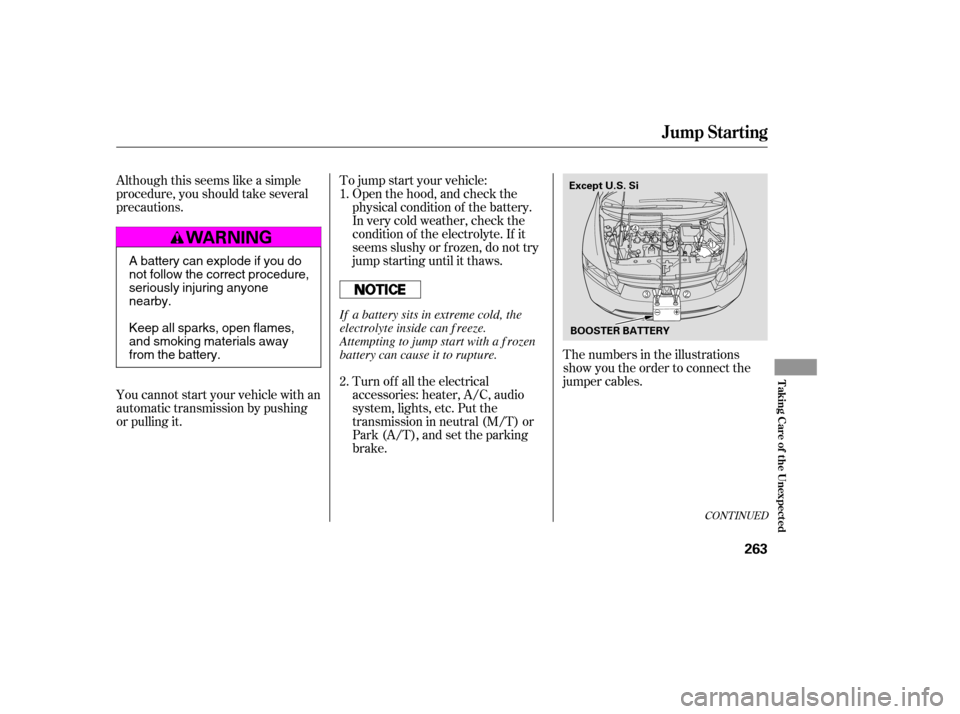
Although this seems like a simple
procedure, you should take several
precautions.Open the hood, and check the
physical condition of the battery.
In very cold weather, check the
condition of the electrolyte. If it
seems slushy or f rozen, do not try
jump starting until it thaws.
You cannot start your vehicle with an
automatic transmission by pushing
or pulling it. To jump start your vehicle:
Turn of f all the electrical
accessories: heater, A/C, audio
system, lights, etc. Put the
transmission in neutral (M/T) or
Park (A/T), and set the parking
brake. The numbers in the illustrations
show you the order to connect the
jumper cables.
1. 2.
CONT INUED
Jump Start ing
T aking Care of t he Unexpect ed
263
BOOSTER BATTERY
Except U.S. Si
A battery can explode if you do
not follow the correct procedure,
seriously injuring anyonenearby.
Keep all sparks, open flames,
and smoking materials away
from the battery.
If a battery sits in extreme cold, the
electrolyte inside can f reeze.
Attempting to jump start with a f rozen
battery can cause it to rupture.
�����—�����—�����y�
�������������y���
�(�#�����
���y���������y
Page 263 of 304

CONT INUED
Once your vehicle is running,
disconnect the negative cable f rom
your vehicle, then f rom the
booster battery. Disconnect the
positive cable f rom your vehicle,
then from the booster battery.
Keep the ends of the jumper cables
away from each other and any metal
on the vehicle until everything is
disconnected. Otherwise, you may
cause an electrical short. If the vehicle overheats, you
should take immediate action. The
only indication may be the
temperature gauge climbing to or
above the red mark. Or you may
see steam or spray coming f rom
under the hood. Saf ely pull to the side of the road.
Put the transmission in neutral
(M/T) or Park (A/T), and set the
parking brake. Turn of f all
accessories, and turn on the
hazard warning indicators.
If you see steam and/or spray
coming f rom under the hood, turn
of f the engine. Wait until you see
no more signs of steam or spray,
then open the hood.
The reading of the vehicle’s
temperature gauge should stay in
the midrange. If it climbs to the red
mark, you should determine the
reason (hot day, driving up a steep
hill, etc.).
7.
1. 2.
Jump Start ing, If t he Engine Overheat s
If the Engine Overheats
T aking Care of t he Unexpect ed
265
Steam and spray from an
overheated engine can
seriously scald you.
Do not open the hood if steam
is coming out.
Driving with the temperature gauge
reading at the red mark can cause
serious damage to the engine.
�����—�����—�����y�
�������������y���
�(�#�����
���y���������y
Page 274 of 304

�µ�µ
If your vehicle needs to be towed,
call a prof essional towing service or
organization. Never tow your vehicle
with just a rope or chain. It is very
dangerous.
The operator
loads your vehicle on the back of a
truck.
Therearetwowaystotowyour
vehicle: If , due to damage, your vehicle must
be towed with the f ront wheels on
the ground, do this:
Release the parking brake.
Shif t the transmission to neutral.
Turn of f the engine.
ShifttoD,thentoN.
Start the engine.
Release the parking brake.
Leave the ignition switch in the
ACCESSORY (I) position so the
steering wheel does not lock.
Leave the ignition switch in the
ACCESSORY (I) position so the
steering wheel does not lock.
The tow
truck uses two pivoting arms that go
under the f ront tires and lif t them of f
the ground. The rear tires remain on
the ground. With the f ront wheels on the ground,
do not tow the vehicle more than 50
miles (80 km), and keep the speed
below35mph(55km/h).
Manual transmission:
Automatic transmission:
Flat -bed Equipment
Wheel-lif t Equipment
T his is the best way to
transport your vehicle.
This is an acceptable
way to tow your vehicle.
Emergency Towing
276
Improper towing preparation will
damage the transmission. Follow the
above procedure exactly. If you cannot
shif t the transmission or start the
engine (automatic transmission), your
vehicle must be transported with the
f ront wheels of f the ground.
�����—�����—�����y�
�������������y���
�(�#�����
���y�������
�y
Page 278 of 304
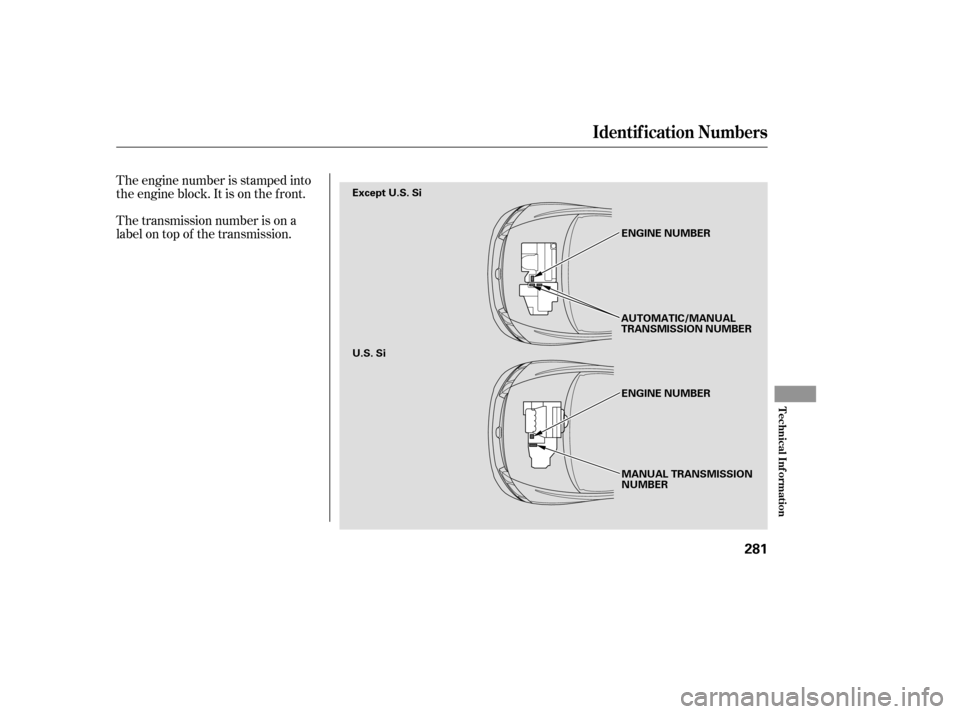
The engine number is stamped into
the engine block. It is on the f ront.
The transmission number is on a
label on top of the transmission.
Identif ication Numbers
T echnical Inf ormation
281
MANUAL TRANSMISSION
NUMBER
ENGINE NUMBER
ENGINE NUMBER
AUTOMATIC/MANUAL
TRANSMISSION NUMBER
Except U.S. Si
U.S. Si
�����—�����—�����y�
�������������y���
�(�#�����
���y���������y
Page 279 of 304

�Î�Î
�Î �Î �Î �Î
�Î�Î�Î�Î�Î�Î�Î�Î
�Î�Î
�Î�Î �Î �Î
�Î �Î�Î�Î�Î�Î
�Î
�Î
�Î�Î �Î �Î �Î�Î
Specif icat ions
282
Dimensions
Weights
EngineCapacities
176.7 in (4,489 mm)
69.0 in (1,752 mm)
56.5 in (1,435 mm)
106.3 in (2,700 mm)
59.0 in (1,499 mm)
60.2 in (1,528 mm)
3.19 x 3.44 in (81.0 x 87.3 mm)
Length
Width
Height
Wheelbase
Track
Gross vehicle weight rating See the certification label attached
to the driver’s doorjamb.
Water cooled 4-stroke
SOHC VTEC , DOHC i-VTEC 4-cylinder gasoline engine
10.5
110 cu-in (1,799 cm
)
3.39x3.39in(86x86mm)
122 cu-in (1,998 cm)
SK22PR-M11S
IFR7G-11KS
SKJ20DR-M11S
IZFR6K-11S
NGK:
DENSO:
Type
BorexStroke
Displacement
Compression ratio
Spark plugs
Spark plugs 13.2 US gal (50
)
Excluding the oil remaining in the engine
Including the coolant in the reserve tank and that remaining in
the engine
Reserve tank capacity: 0.11 US gal (0.4
)
4.8 US qt (4.5
)
2.6 US qt (2.5)
2.5 US qt (2.4
)
6.2 US qt (5.9)
1.8 US qt (1.7
)
1.7 US qt (1.6)
1.6 US qt (1.5)
1.5 US qt (1.4)
5.8 US qt (5.5)
4.8 US qt (4.5)
4.4 US qt (4.2)
3.7 US qt (3.5)
4.6 US qt (4.4)
3.9 US qt (3.7)
1.19 US gal (4.5
)
1.37 US gal (5.2)
1.45 US gal (5.5)
1.88 US gal (7.1
)
1.72 US gal (6.5)
1.80 US gal (6.8)
11.0 Fuel tank
Engine
coolant
Engine oil Automatic
transmission
fluid
Windshield
washer
reservoir
FrontRear
Approx.
NGK:
DENSO:
1:2: 1: 2: 3:4:A/T
M/T
A/T
M/T
Change Total
Change
Including
filter
Without filter
Total
ChangeTotal
Change Total
U.S. Vehicles
Canada
Vehicles
Except U.S. Si
U.S. Si Except U.S. Si
U.S. Si
12
1 2 3 4
34343434
12
12 1 2
3 34334
1
2
Manual trans-
mission fluid
�����—�����—�����y�
�������������y���
�(�#�����
���y���������y