Page 207 of 304
Trailer lights and equipment must
comply with federal, state, and local
regulations. Check with your local
recreational vehicle dealer f or the
requirements in your area, and use
only equipment designed f or your
vehicle.
Since lighting and wiring vary by
trailer type and brand, you should
have a qualif ied technician install a
suitable connector between the
vehicle and the trailer. Improper
equipment or installation can cause
damage to your vehicle’s electrical
system and af f ect your vehicle
warranty.Many states and Canadian provinces
require special outside mirrors when
towing a trailer. Even if they don’t,
you should install special mirrors if
you cannot clearly see behind you, or
if the trailer creates a blind spot.
Askyourtrailersalesorrental
agency if any other items are
recommended or required f or your
towing situation.
A ddit ional T owing Equipment
T railer L ights
Towing a Trailer
Driving
207
�����—�����—�����y�
����
������
�y���
�(�#�����
���y�����
���y
Page 208 of 304

When preparing to tow, and bef ore
driving away, be sure to check the
f ollowing:The vehicle has been properly
serviced, and the tires, brakes,
suspension, cooling system, and
lights are in good operating
condition.
All weights and loads are within
limits (see pages and ).
Thehitch,safetychains,andany
other attachments are secure.
All items in or on the trailer are
properly secured and cannot shif t
while you drive.
The lights and brakes on your
vehicle and the trailer are working
properly. Your vehicle tires and spare are
properly inf lated (see page ),
and the trailer tires and spare are
trailer maker.
Crosswinds and air turbulence
caused by passing trucks can disrupt
your steering and cause trailer to
sway. When being passed by a large
vehicle, keep a constant speed, and
steer straight ahead. Do not try to
make quick steering or braking
corrections. Always drive slowly and have
someone guide you when backing up.
Grip the of the steering
wheel; then turn the wheel to the lef t
to get the trailer to move to the lef t,
andturnthewheelrighttomovethe
trailer to the right.
Follow all normal precautions when
parking, including f irmly setting the
parking brake and putting the
transmission in Park (automatic) or
in 1st or reverse (manual). Also,
place wheel chocks at each of the
trailer’s tires.
246
205
204
bottom
Pre-T ow Checklist
Handling Crosswinds and Buf f et ing Backing Up
Parking
Towing a Trailer
208
�����—�����—�����y�
����
������
�y���
�(�#�����
���y�����
���y
Page 209 of 304

The added weight, length, and
height of a trailer will af f ect your
vehicle’s handling and perf ormance,
so driving with a trailer requires
some special driving skills and
techniques.
Foryoursafetyandthesafetyof
others,taketimetopracticedriving
maneuvers bef ore heading f or the
open road, and f ollow the guidelines
below.
Drive slower than normal in all
driving situations, and obey posted
speed limits f or vehicles with trailers.
If you have an automatic
transmission, use D position when
towing a trailer on level roads. D is
the proper shif t lever position to use
when towing a trailer in hilly terrain.
(See ‘‘ ’’ in the next
column f or additional gear
inf ormation.)Maketurnsmoreslowlyandwider
than normal. The trailer tracks a
smaller arc than your vehicle, and it
canhitorrunoversomethingthe
vehicle misses. Allow more time and
distance f or braking. Do not brake or
turn suddenly as this could cause the
trailer to jackknif e or turn over.
When climbing hills, closely watch
your temperature gauge. If it nears
the red (Hot) mark, turn the air
conditioning of f , reduce speed and, if
necessary, pull to the side of the
road to let the engine cool.
If the automatic transmission shifts
f requently while going up a hill, shif t
to D .
If youmuststopwhenfacinguphill,
use the f oot brake or parking brake.
Do not try to hold the vehicle in
place by pressing on the accelerator,
as this can cause the automatic
transmission to overheat.
When driving down hills, reduce
your speed, and shif t down to second
gear. Do not ‘‘ride’’ the brakes, and
remember, it will take longer to slow
downandstopwhentowingatrailer.
33
Driving Saf ely With a T railer
T owing Speeds and Gears
Driving on Hills Making T urns and Braking
Driving on Hills
Towing a Trailer
Driving
209
�����—�����—�����y�
����
��������y���
�(�#�����
���y�����
���y
Page 235 of 304
Your vehicle has halogen headlight
bulbs. When replacing a bulb, handle
it by its base, and protect the glass
f rom contact with your skin or hard
objects. If you touch the glass, clean
it with denatured alcohol and a clean
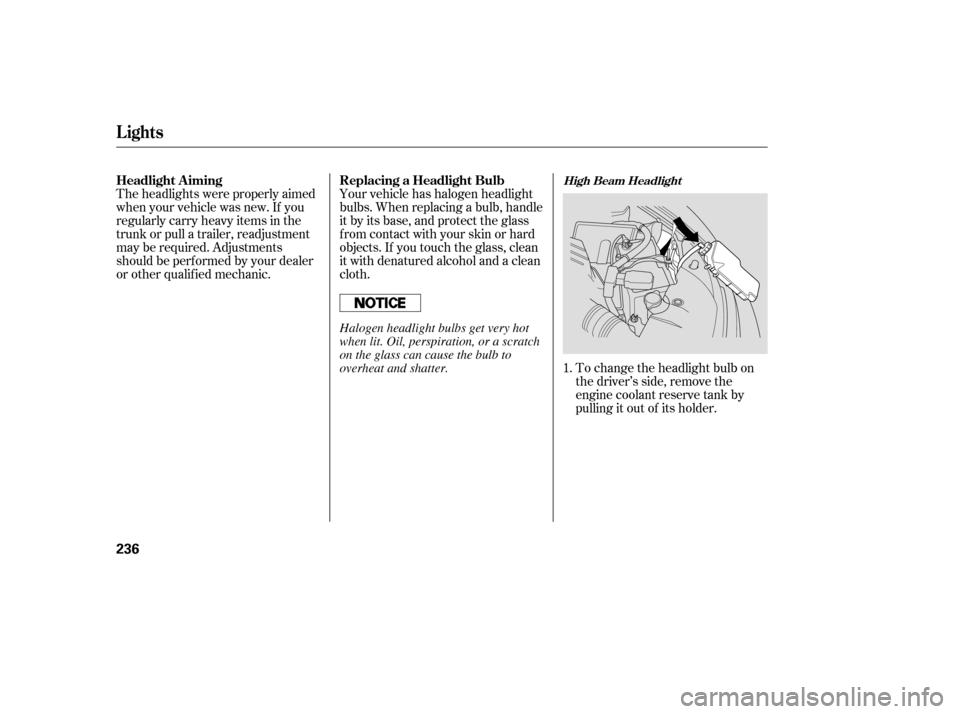
cloth.To change the headlight bulb on
the driver’s side, remove the
engine coolant reserve tank by
pulling it out of its holder.
Theheadlightswereproperlyaimed
when your vehicle was new. If you
regularly carry heavy items in the
trunk or pull a trailer, readjustment
may be required. Adjustments
should be perf ormed by your dealer
or other qualif ied mechanic.
1.
Headlight A iming Replacing a Headlight Bulb
High Beam Headlight
Lights
236
Halogen headlight bulbs get very hot
when lit. Oil, perspiration, or a scratch
on the glass can cause the bulb to
overheat and shatter.
�����—�����—�����y�
����
��������y���
�(�#�����
���y�������
�y
Page 302 of 304

�Î
�Î �Î �Î �ÎTechnical Descriptions
....
DOT Tire Quality Grading . 284
.....
Emissions Control Systems . 287
.....................
Oxygenated Fuels . 177
..........
State Emissions Testing . 290
Three Way Catalytic
...............................
Converter . 289
.................................
Tire Labeling . 286
.......................
Temperature Gauge . 67
.....................
Tether Anchor Points . 45
............................
Thef t Protection . 170
..
Three Way Catalytic Converter . 289
..........................
Time, Setting the . 169
....................................
Tire Chains . 251
.........
Tire, How to Change a Flat . 257
.........................
Tire Inf ormation . 284
...............................................
Tires . 245
..............................
Air Pressure . 246
.........................
Checking Wear . 247
..........................
Compact Spare . 256
....
DOT Tire Quality Grading . 284
......................................
Inf lation . 246
..................................
Inspection . 247
..............................
Maintenance . 248
...................................
Replacing . 249
......................................
Rotating . 248 ...........................................
Snow . 250
............................
Specif ications . 283
................................
Tire Chains . 251
...................
Tools, Tire Changing . 257
Towing
.....................................
A Trailer . 204
..................
Emergency Towing . 276
...........................
Traction Devices . 251
Transmission
Checking Fluid Level, ..............................
Automatic . 232
Checking Fluid Level, ...................................
Manual . 233
..................
Fluid Selection . 232, 233
..............
Identif ication Number . 280
.............
Shif ting the Automatic . 194
..................
Shif ting the Manual . 191
...................................
Treadwear . 284
.......................................
Trip Meter . 67
................................................
Trunk . 87
........................................
Opening . 87
...................
Open Monitor Light . 62
....................................
Turn Signals . 72 Unexpected, Taking Care
..........................................
of the . 255
..
Unif orm Tire Quality Grading . 279
........................
Unleaded Gasoline . 176
.......
Used Oil, How to Dispose of . 228
.............
WARNING, Explanation of . ii ................................
Vanity Mirror . 102
.................
Vehicle Capacity Load . 185
......................
Vehicle Dimensions . 282
....
Vehicle Identif ication Number . 280
.............................
Vehicle Storage . 254
.................................................
VIN . 280
..................................
Viscosity, Oil . 225
Vehicle Stability Assist
............................
(VSA) System . 202
............
Activation Indicator . 62, 202
..................................
Of f Switch . 203
.................
System Indicator . 62, 203
Index
U V W
VIII
�����—�����—�����y�
�������������y���
�(�#�����
���y�����
�
�y