Page 204 of 304
Your vehicle has been designed
primarily to carry passengers and
their cargo. You can also use it to
tow a trailer if you caref ully observe
the load limits, use the proper
equipment, and f ollow the guidelines
in this section.The
maximum allowable weight of the
trailer and everything in or on it
must not exceed 1,000 lbs (450 kg).
Towing a load that is too heavy can
seriously af f ect your vehicle’s
handling and perf ormance. It can
also damage the engine and
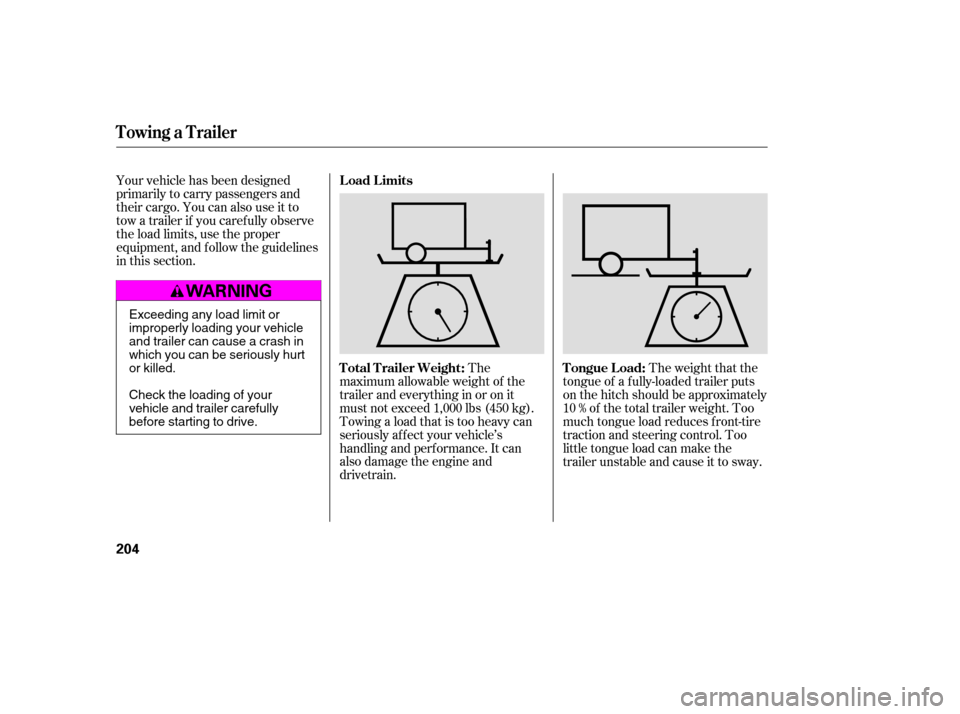
drivetrain. Theweightthatthe
tongue of a f ully-loaded trailer puts
on the hitch should be approximately
10 % of the total trailer weight. Too
much tongue load reduces f ront-tire
traction and steering control. Too
little tongue load can make the
trailer unstable and cause it to sway.
Load Limits
T otal T railer Weight: T ongue L oad:
Towing a Trailer
204
Exceeding any load limit or
improperly loading your vehicle
and trailer can cause a crash in
which you can be seriously hurt
or killed.
Check the loading of your
vehicle and trailer carefully
beforestartingtodrive.
�����—�����—�����y�
����
����
���y���
�(�#�����
���y���������y
Page 205 of 304

To achieve a proper tongue load,
start by loading 60 % of the load
toward the front of the trailer and
40 % toward the rear, then re-adjust
the load as needed.The best way to conf irm that vehicle
and trailer weights are within limits
is to have them checked at a public
scale.
Using a suitable scale or a special
tongue load gauge, check the tongue
load the f irst time you set up a
towing combination (a f ully-loaded
vehicle and trailer), then recheck the
tongue load whenever the conditions
change.
The maximum allowable weight of
the vehicle, all occupants, all cargo,
and the tongue is: The maximum allowable weight of
the vehicle axles is:
(EX)
(DX, LX, Canadian DX-G) (DX, LX, Canadian DX-G)
on the f ront axle
on the f ront axle
on the rear axle
on the rear axle
(EX) Checking L oads
Gross Vehicle Weight Rating
(GVWR): Gross Axle Weight Rating
(GA WR):
Towing a Trailer
Driving
205
3,671 lbs (1,665 kg)
3,704 lbs (1,680 kg)1,940 lbs (880 kg)
1,731 lbs (785 kg)
1,962 lbs (890 kg)
1,753 lbs (795 kg)
�����—�����—�����y�
����
��������y���
�(�#�����
���y�����
���y
Page 206 of 304

Towing can require a variety of
equipment, depending on the size of
your trailer, how it will be used, how
much load you are towing, and
where you tow.Honda recommends that any trailer
having a total weight of 1,000 lbs
(450 kg) or more be equipped with
its own electric or surge-type brakes.
If you choose electric brakes, be
sure they are electronically actuated.
Do not attempt to tap into your
vehicle’s hydraulic system. No
matter how successf ul it may seem,
any attempt to attach trailer brakes
to your vehicle’s hydraulic system
will lower braking ef f ectiveness and
create a potential hazard.
Seeyourtrailerdealerorrental
agency f or more inf ormation on
installing electric brakes.
Discuss your needs with your trailer
sales or rental agency, and f ollow the
guidelines in the rest of this section.
Also make sure that all equipment is
properly installed and that it meets
f ederal, state, province, and local
regulations. Any hitch used on your vehicle must
be properly bolted to the underbody.
Always use saf ety chains when you
tow a trailer. Make sure the chains
are secured to the trailer and hitch,
and that they cross under the tongue
and can catch the trailer if it
becomes unhitched. Leave enough
slack to allow the trailer to turn
corners easily, but do not let the
chains drag on the ground.
T owing Equipment and
A ccessories
Trailer Brakes
Hitches
Saf et y Chains
Towing a Trailer
206
�����—�����—�����y�
����
��������y���
�(�#�����
���y�����
�
�y
Page 207 of 304
Trailer lights and equipment must
comply with federal, state, and local
regulations. Check with your local
recreational vehicle dealer f or the
requirements in your area, and use
only equipment designed f or your
vehicle.
Since lighting and wiring vary by
trailer type and brand, you should
have a qualif ied technician install a
suitable connector between the
vehicle and the trailer. Improper
equipment or installation can cause
damage to your vehicle’s electrical
system and af f ect your vehicle
warranty.Many states and Canadian provinces
require special outside mirrors when
towing a trailer. Even if they don’t,
you should install special mirrors if
you cannot clearly see behind you, or
if the trailer creates a blind spot.
Askyourtrailersalesorrental
agency if any other items are
recommended or required f or your
towing situation.
A ddit ional T owing Equipment
T railer L ights
Towing a Trailer
Driving
207
�����—�����—�����y�
����
������
�y���
�(�#�����
���y�����
���y
Page 208 of 304

When preparing to tow, and bef ore
driving away, be sure to check the
f ollowing:The vehicle has been properly
serviced, and the tires, brakes,
suspension, cooling system, and
lights are in good operating
condition.
All weights and loads are within
limits (see pages and ).
Thehitch,safetychains,andany
other attachments are secure.
All items in or on the trailer are
properly secured and cannot shif t
while you drive.
The lights and brakes on your
vehicle and the trailer are working
properly. Your vehicle tires and spare are
properly inf lated (see page ),
and the trailer tires and spare are
trailer maker.
Crosswinds and air turbulence
caused by passing trucks can disrupt
your steering and cause trailer to
sway. When being passed by a large
vehicle, keep a constant speed, and
steer straight ahead. Do not try to
make quick steering or braking
corrections. Always drive slowly and have
someone guide you when backing up.
Grip the of the steering
wheel; then turn the wheel to the lef t
to get the trailer to move to the lef t,
andturnthewheelrighttomovethe
trailer to the right.
Follow all normal precautions when
parking, including f irmly setting the
parking brake and putting the
transmission in Park (automatic) or
in 1st or reverse (manual). Also,
place wheel chocks at each of the
trailer’s tires.
246
205
204
bottom
Pre-T ow Checklist
Handling Crosswinds and Buf f et ing Backing Up
Parking
Towing a Trailer
208
�����—�����—�����y�
����
������
�y���
�(�#�����
���y�����
���y
Page 209 of 304

The added weight, length, and
height of a trailer will af f ect your
vehicle’s handling and perf ormance,
so driving with a trailer requires
some special driving skills and
techniques.
Foryoursafetyandthesafetyof
others,taketimetopracticedriving
maneuvers bef ore heading f or the
open road, and f ollow the guidelines
below.
Drive slower than normal in all
driving situations, and obey posted
speed limits f or vehicles with trailers.
If you have an automatic
transmission, use D position when
towing a trailer on level roads. D is
the proper shif t lever position to use
when towing a trailer in hilly terrain.
(See ‘‘ ’’ in the next
column f or additional gear
inf ormation.)Maketurnsmoreslowlyandwider
than normal. The trailer tracks a
smaller arc than your vehicle, and it
canhitorrunoversomethingthe
vehicle misses. Allow more time and
distance f or braking. Do not brake or
turn suddenly as this could cause the
trailer to jackknif e or turn over.
When climbing hills, closely watch
your temperature gauge. If it nears
the red (Hot) mark, turn the air
conditioning of f , reduce speed and, if
necessary, pull to the side of the
road to let the engine cool.
If the automatic transmission shifts
f requently while going up a hill, shif t
to D .
If youmuststopwhenfacinguphill,
use the f oot brake or parking brake.
Do not try to hold the vehicle in
place by pressing on the accelerator,
as this can cause the automatic
transmission to overheat.
When driving down hills, reduce
your speed, and shif t down to second
gear. Do not ‘‘ride’’ the brakes, and
remember, it will take longer to slow
downandstopwhentowingatrailer.
33
Driving Saf ely With a T railer
T owing Speeds and Gears
Driving on Hills Making T urns and Braking
Driving on Hills
Towing a Trailer
Driving
209
�����—�����—�����y�
����
��������y���
�(�#�����
���y�����
���y
Page 243 of 304
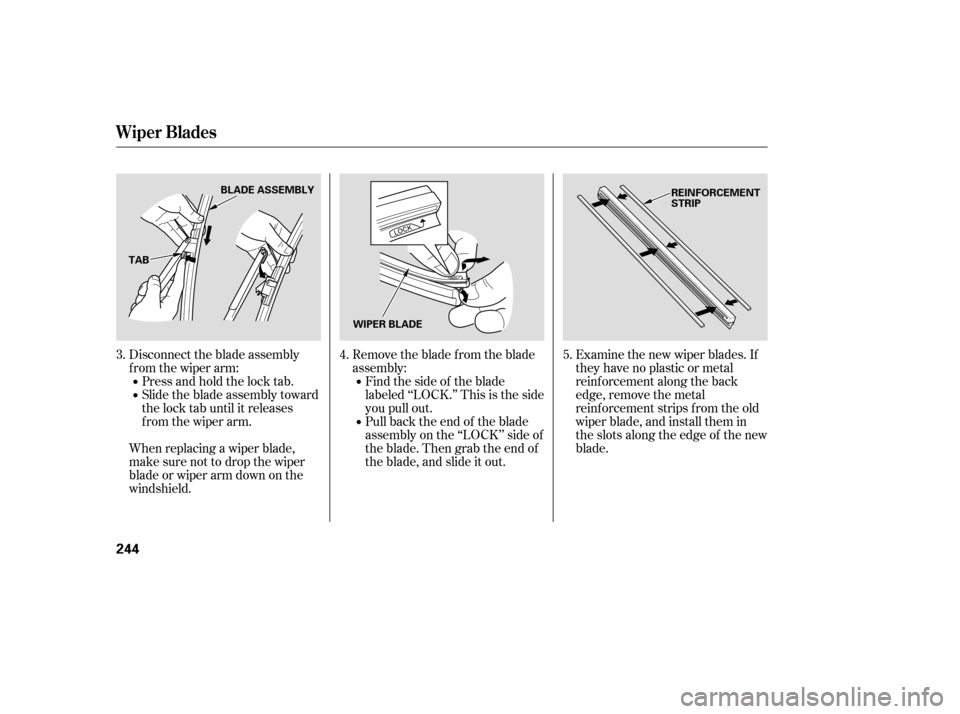
Examine the new wiper blades. If
they have no plastic or metal
reinf orcement along the back
edge, remove the metal
reinf orcement strips f rom the old
wiper blade, and install them in
the slots along the edge of the new
blade.
Disconnect the blade assembly
from the wiper arm:
Press and hold the lock tab.
Slide the blade assembly toward
the lock tab until it releases
from the wiper arm.
When replacing a wiper blade,
make sure not to drop the wiper
blade or wiper arm down on the
windshield. Remove the blade from the blade
assembly:
Findthesideof theblade
labeled ‘‘LOCK.’’ This is the side
you pull out.
Pull back the end of the blade
assembly on the ‘‘LOCK’’ side of
theblade.Thengrabtheendof
the blade, and slide it out.
3.
4.5.
Wiper Blades
244
BLADE ASSEMBLY
TAB WIPER BLADE REINFORCEMENT
STRIP
�����—�����—�����y�
�������������y���
�(�#�����
���y���������y
Page 251 of 304
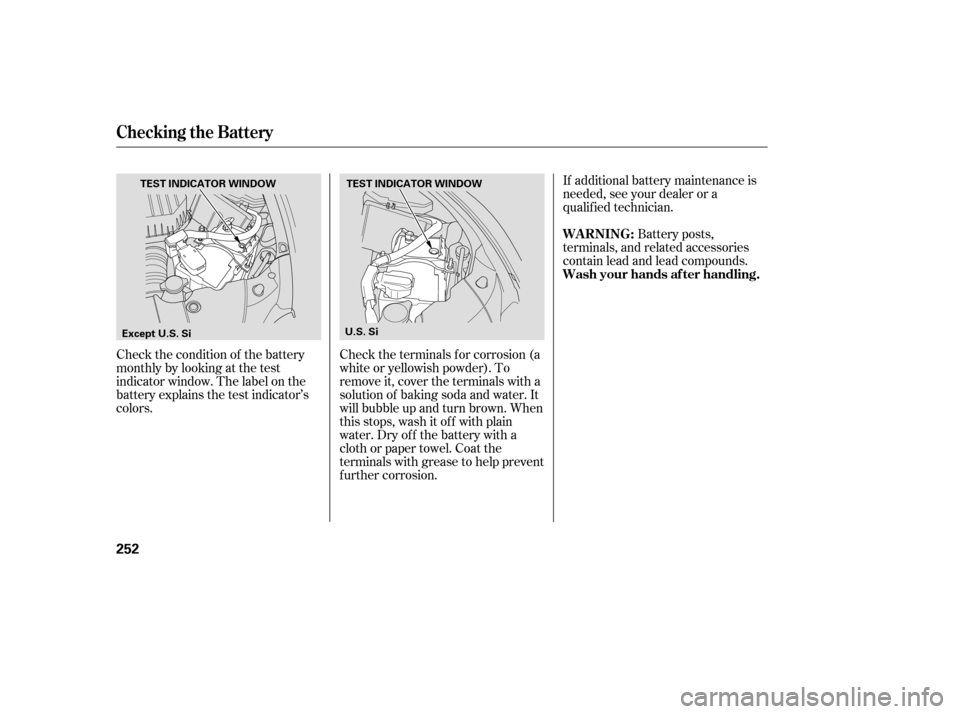
Check the condition of the battery
monthlybylookingatthetest
indicator window. The label on the
battery explains the test indicator’s
colors.If additional battery maintenance is
needed, see your dealer or a
qualif ied technician.
Battery posts,
terminals, and related accessories
contain lead and lead compounds.
Check the terminals f or corrosion (a
white or yellowish powder). To
remove it, cover the terminals with a
solution of baking soda and water. It
will bubble up and turn brown. When
this stops, wash it of f with plain
water. Dry off the battery with a
cloth or paper towel. Coat the
terminals with grease to help prevent
f urther corrosion.
Checking the Battery
WARNING:
Wash your hands af ter handling.
252
TEST INDICATOR WINDOW TEST INDICATOR WINDOW
Except U.S. Si U.S. Si
�����—�����—�����y�
�������������y���
�(�#�����
���y���������y