Page 154 of 268
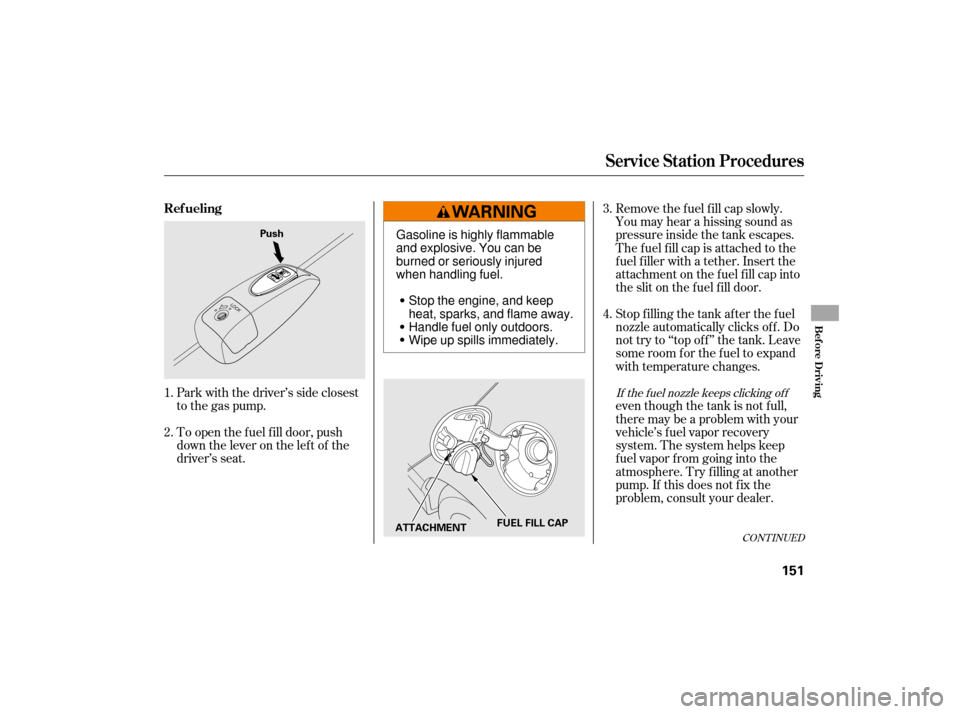
Park with the driver’s side closest
to the gas pump.
To open the f uel f ill door, push
down the lever on the lef t of the
driver’s seat.Removethefuelfillcapslowly.
You may hear a hissing sound as
pressure inside the tank escapes.
The fuel fill cap is attached to the
f uel f iller with a tether. Insert the
attachment on the fuel fill cap into
the slit on the fuel fill door.
Stop f illing the tank af ter the f uel
nozzle automatically clicks of f . Do
not try to ‘‘top off’’ the tank. Leave
some room f or the f uel to expand
with temperature changes.
even though the tank is not f ull,
there may be a problem with your
vehicle’s fuel vapor recovery
system. The system helps keep
f uel vapor f rom going into the
atmosphere. Try f illing at another
pump. If this does not f ix the
problem, consult your dealer.
1.
2. 3.
4.
CONT INUED
If the f uel nozzle keeps clicking of f
Service Station Procedures
Ref ueling
Bef ore Driving
151
Push
FUEL FILL CAP
ATTACHMENTGasoline is highly flammable
and explosive. You can be
burned or seriously injured
when handling fuel.
Stop the engine, and keep
heat, sparks, and flame away.
Handle fuel only outdoors.
Wipe up spills immediately.
Page 181 of 268
To eliminate potential hazards, read
the instructions bef ore you begin,
and make sure you have the tools
and skills required.To clean parts, use a commercially
available degreaser or parts
cleaner, not gasoline.
To reduce the possibility of f ire or
explosion, keep cigarettes, sparks,
and flames away from the battery
and all f uel-related parts. Make sure your vehicle is parked
on level ground, the parking brake
is set, and the engine is of f . Some of the most important saf ety
precautions are given here. However,
we cannot warn you of every
conceivable hazard that can arise in
perf orming maintenance. Only you
can decide whether or not you
should perf orm a given task.Do
not run the engine unless
instructed to do so. Let the
engine and exhaust system cool
down bef ore touching any parts.
Wear eye protection and
protective clothing when working
with the battery or compressed air.
All service items not detailed in this
section should be perf ormed by a
certif ied technician or qualif ied
mechanic.
Be sure there is
adequate ventilation whenever you
operate the engine.
Maintenance Saf ety
Important Saf ety Precautions Injury f rom moving parts. Burns f rom hot parts.
Potential Vehicle Hazards Carbon Monoxide poison f rom
engine exhaust.
178
Failure to properly follow
maintenance instructions and
precautions can cause you to
be seriously hurt or killed.
Always follow the procedures
and precautions in this owner’s
manual.
Improperly maintaining this
vehicle or failing to correct a
problem before driving can
cause a crash in which you can
be seriously hurt or killed.
Always follow the inspection,
maintenance recommendations,
and schedules in this owner’s
manual.
Page 188 of 268

�Ì�Ì
�Ì
Maintenance Minder
185
: Maintenance
Sub Items
Rotate tires
Replace air cleaner element
If you drive in dusty conditions, replace
every 15,000 miles (24,000 km).
Replace dust and pollen filter
If you drive primarily in urban areas that have high
concentrations of soot in the air from industry and
from diesel-powered vehicles, replace every 15,000
miles (24,000 km).
Inspect drive belt
Replace transmission fluid
Replace spark plugs
Inspect valve clearance
Replace engine coolant
Maintenance
Main Items
Replace engine oil
Replace engine oil and oil filter
Inspect front and rear brakes
Check parking brake adjustment
Inspect these items:
Tie rod ends, steering gear box, and boots
Suspension components
Driveshaft boots
Brake hoses and lines (including ABS)
All fluid levels and condition of fluids
Exhaust system
Fuel lines and connect ions
A
B
Symbol
Symbol
1
2
3
4
5
If the message ‘‘SERVICE OIL’’ does not appear more than 12 months after
the display is reset, change the engine oil every year.
Independent of the maintenance minder display, replace the brake fluid
every 3 years.
Adjust the valves during services A, B, 1, 2, or 3 only if they are noisy.
See information on maintenance and emissions warranty on page .
Inspect idle speed every 160,000 miles (256,000 km).
NOTE: 1:
183
1
1
Maintenance Minder
Page 215 of 268
�µ
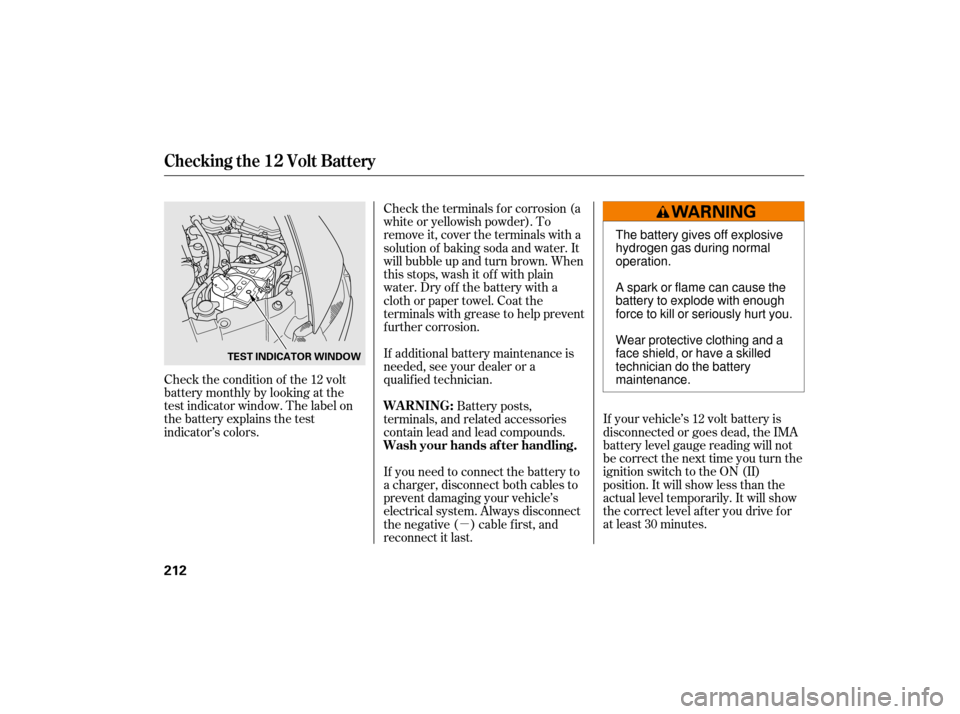
Check the condition of the 12 volt
battery monthly by looking at the
test indicator window. The label on
the battery explains the test
indicator’s colors.
If your vehicle’s 12 volt battery is
disconnected or goes dead, the IMA
battery level gauge reading will not
be correct the next time you turn the
ignition switch to the ON (II)
position. It will show less than the
actual level temporarily. It will show
the correct level af ter you drive f or
at least 30 minutes.
Check the terminals f or corrosion (a
white or yellowish powder). To
remove it, cover the terminals with a
solution of baking soda and water. It
will bubble up and turn brown. When
this stops, wash it of f with plain
water. Dry off the battery with a
cloth or paper towel. Coat the
terminals with grease to help prevent
f urther corrosion.
If additional battery maintenance is
needed, see your dealer or a
qualif ied technician.
Battery posts,
terminals, and related accessories
contain lead and lead compounds.
If you need to connect the battery to
a charger, disconnect both cables to
prevent damaging your vehicle’s
electrical system. Always disconnect
the negative ( ) cable first, and
reconnect it last.
Checking the 12 Volt Battery
WARNING:
Wash your hands af ter handling.
212
TEST INDICATOR WINDOW
The battery gives off explosive
hydrogen gas during normal
operation.
A spark or flame can cause the
battery to explode with enough
force to kill or seriously hurt you.
Wear protective clothing and a
face shield, or have a skilled
technician do the battery
maintenance.
Page 226 of 268
�´�´
Although this seems like a simple
procedure, you should take several
precautions.
To jump start your vehicle:
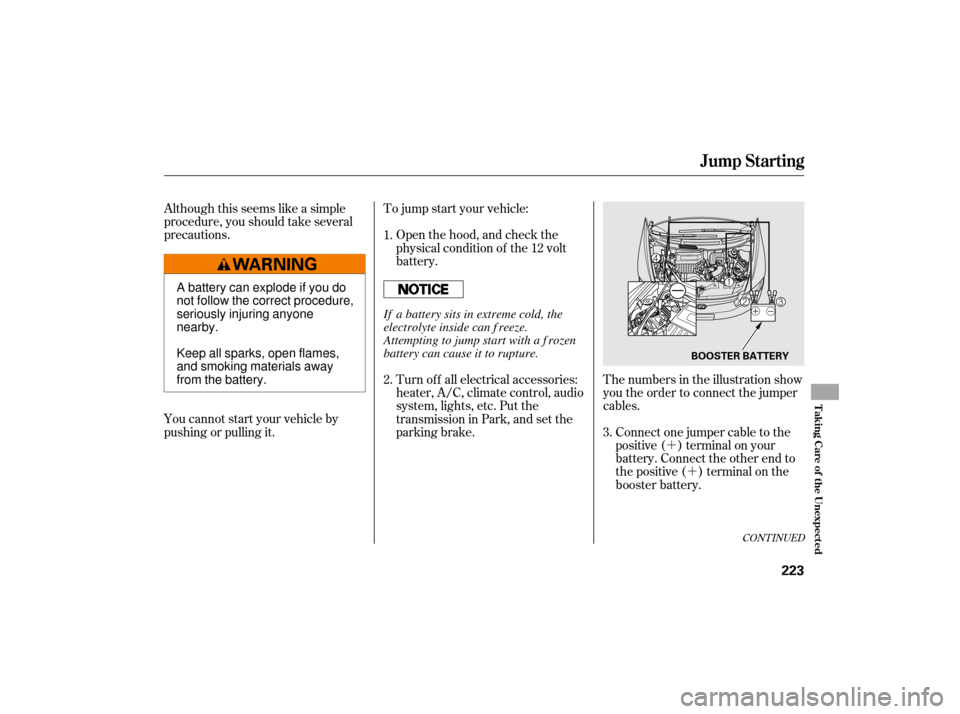
The numbers in the illustration show
you the order to connect the jumper
cables.Connect one jumper cable to the
positive ( ) terminal on your
battery. Connect the other end to
the positive ( ) terminal on the
booster battery.
You cannot start your vehicle by
pushing or pulling it. Open the hood, and check the
physical condition of the 12 volt
battery.
Turn of f all electrical accessories:
heater, A/C, climate control, audio
system, lights, etc. Put the
transmission in Park, and set the
parking brake.
1.
2.
3.
CONT INUED
Jump Starting
T aking Care of t he Unexpect ed
223
BOOSTER BATTERY
A battery can explode if you do
not follow the correct procedure,
seriously injuring anyone
nearby.
Keep all sparks, open flames,
and smoking materials away
from the battery.If a battery sits in extreme cold, the
electrolyte inside can f reeze.
Attempting to jump start with a f rozen
battery can cause it to rupture.
Page 245 of 268

�Î
�Î
�Î
�Î
Specif ications
242
Dimensions
Weights
EngineCapacities
176.7 in (4,489 mm)
69.0 in (1,752 mm)
56.3 in (1,430 mm)
106.3 in (2,700 mm)
59.1 in (1,501 mm)
60.2 in (1,529 mm)
2.87 x 3.15 in (73.0 x 80.0 mm) 82 cu-in (1.339 cm
)
10.8
Length
Width
Height
Wheelbase
Track
Gross vehicle weight rating See the certification label attached
to the driver’s doorjamb.
Type
BorexStroke
Displacement
Compression ratio
Spark plugs ILFR6J-11K SK20HPR-L11 Fuel tank
Engine
coolant
Engine oil
Automatic
transmission
fluid
3.0 US qt (2.8
)
5.4 US qt (5.1)
2.6 US qt (2.5
)
4.8 US qt (4.5)
Including the coolant in the reserve tank and that remaining in the
engine
Reserve tank capacity: 0.108 US gal (0.41
)
Excluding the oil remaining in the engine 13.2 US gal (50
)
1.255 US gal (4.75)
1.59 US gal (6.0)
3.4 US qt (3.2
)
3.2 US qt (3.0)
4.0 US qt (3.8)
Water cooled 4-stroke SOHC i-VTEC
gasoline engine with Hybrid Electric
Front
Rear
Approx.
1:
2: Change
Total
Change
Without filter
Total
Change
Total
U.S. Vehicles
Canada Vehicles
(NGK) (DENSO)
Windshield
washer reservoir
1
2
Including filter