Page 189 of 311

Store or secure all items that could
be thro wn around and hurt
someone during a crash. Distribute
cargo evenly on the
floor of the trunk, placing the
heaviest items on the bottom and
as far forward as possible.
If you carry large items that
prevent you from closing the trunk
lid, exhaust gas can enter the
pa ssenger area. To avoid the
possibility of , f ollow the instructions
on page . If youfolddownthebackseat,tie
down items that could be thrown
about the vehicle during a crash or
sudden stop.
Do not put any items on top of the
trunk panel. They can block your
view and be thrown around the
vehicle during a crash.
Be sure items placed on the f loor
behind the f ront seats cannot roll
under the seats and interf ere with
the driver’s ability to operate the
pedals, the proper operation of the
seats, or proper operation of the
sensors under the seats.
Keep the glove box closed while
driving. If it is open, a passenger
could injure their knees during a
crash or sudden stop. 51
Carrying Items in the Passenger
Compartment
Carrying Cargo in the Trunk
carbon monoxide
poisoning
Carrying Cargo
186
Page 192 of 311
Make sure all windows, mirrors,
and outside lights are clean and
unobstructed. Remove frost, snow,
or ice.
Check that the hood and trunk are
fully closed. Check
that any items you may be
carrying are stored properly or
fastened down securely.
Check the seat adjustment (see
page ).
Check the adjustment of the
inside and outside mirrors (see
page ).
Check the steering wheel
ad justment (see page ).
Make sure the doors are securely
closed and locked. Fasten
your seat belt. Check that
your passengers have fastened
their seat belts (see page ).
Youshoulddothefollowingchecks
and
adjustments every day before
you drive your vehicle.
When you start the engine, check
the gauges and indicato rs in the
instrument panel (see page ).
Vi sually check the tires. If a tire
looks low, use a gauge to check its
pressure (see page ).
1.
2.
3. 4.
9.
8. 7. 6. 5. 10.
245 91
99 75 14
57
Preparing to Drive
Driving
189
Page 201 of 311

If your vehicle has an automatic
transmission, set the parking brake
bef ore you put the transmission in
Park. This keeps the vehicle f rom
moving and putting pressure on the
parking mechanism in the
transmission.Make sure the moonroof (if
equipped) and the windows are
closed.
Place any packages, valuables, etc.,
in the trunk or take them with you. Turn of f the lights.
If the vehicle is f acing uphill, turn
the front wheels away from the
curb. If you have a manual
transmission, put it in f irst gear.
If the vehicle is f acing downhill,
turn the front wheels toward the
curb. If you have a manual
transmission, put it in reverse gear.
Make sure the parking brake is
f ully released bef ore driving away.
Driving with the parking brake
partially set can overheat or
damage the rear brakes.
Lock the doors.
Always use the parking brake when
you park your vehicle. Make sure
the parking brake is set f irmly, or
your vehicle may roll if it is parked
on an incline.
Check the indicator on the
instrument panel to verif y that the
security system is set.
Never park over dry leaves, tall
grass, or other f lammable
materials. The hot three way
catalytic converter could cause
these materials to catch on fire.
On vehicles with security system
Parking T ips
Parking
198
Never install a sunshade between the
upper and lower meters on the
instrument panel. If you do, you could
cause heat damage to the upper meter
on a very hot day.
Page 239 of 311
Your vehicle has halogen headlight
bulbs. When replacing a bulb, handle
it by its base, and protect the glass
f rom contact with your skin or hard
objects. If you touch the glass, clean
it with denatured alcohol and a clean
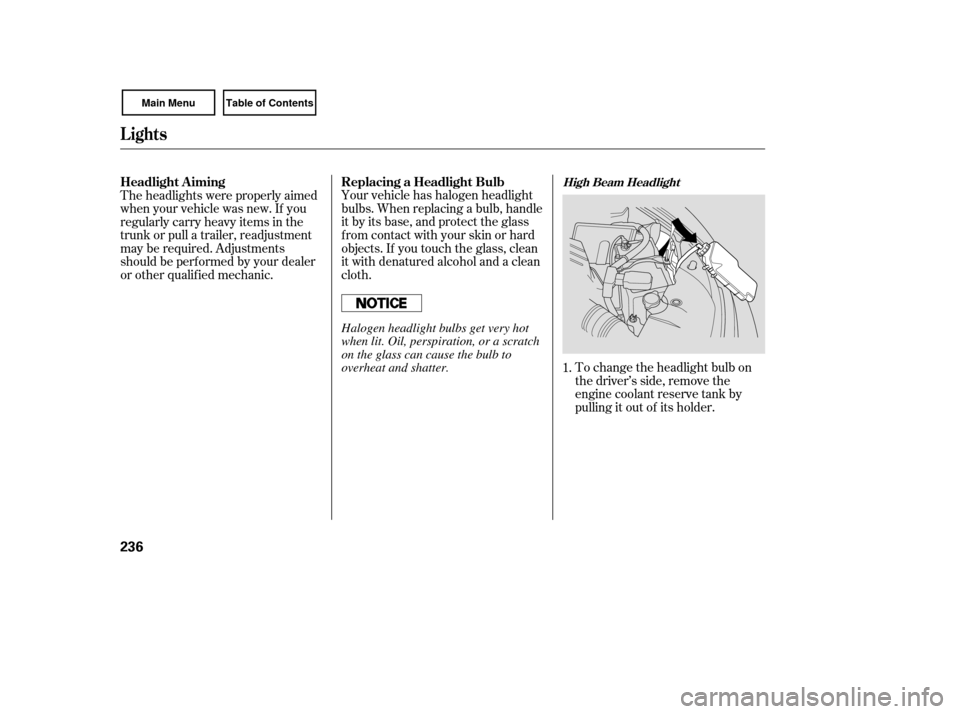
cloth.To change the headlight bulb on
the driver’s side, remove the
engine coolant reserve tank by
pulling it out of its holder.
Theheadlightswereproperlyaimed
when your vehicle was new. If you
regularly carry heavy items in the
trunk or pull a trailer, readjustment
may be required. Adjustments
should be perf ormed by your dealer
or other qualif ied mechanic.
1.
Headlight A iming Replacing a Headlight Bulb
High Beam Headlight
Lights
236
Halogen headlight bulbs get very hot
when lit. Oil, perspiration, or a scratch
on the glass can cause the bulb to
overheat and shatter.
Page 242 of 311
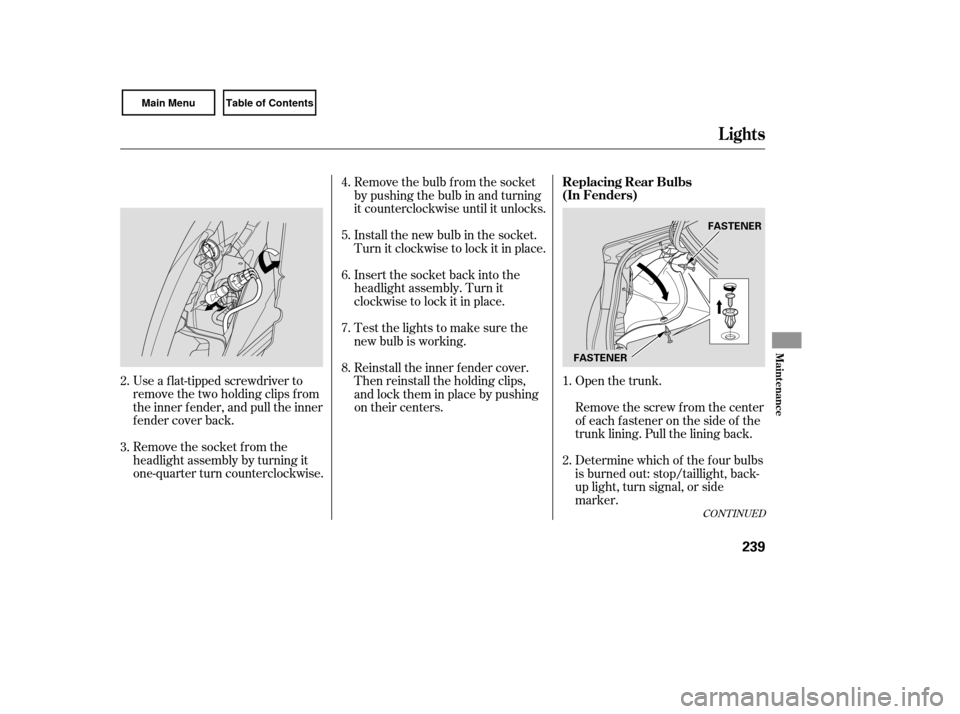
Open the trunk.
Remove the socket from the
headlight assembly by turning it
one-quarter turn counterclockwise. Use a f lat-tipped screwdriver to
remove the two holding clips f rom
the inner f ender, and pull the inner
f ender cover back. Remove the bulb f rom the socket
by pushing the bulb in and turning
it counterclockwise until it unlocks.
Remove the screw from the center
of each f astener on the side of the
trunk lining. Pull the lining back.
Determine which of the f our bulbs
is burned out: stop/taillight, back-
up light, turn signal, or side
marker.
Install the new bulb in the socket.
Turn it clockwise to lock it in place.
Insert the socket back into the
headlight assembly. Turn it
clockwise to lock it in place.
Test the lights to make sure the
new bulb is working.
Reinstall the inner f ender cover.
Then reinstall the holding clips,
andlocktheminplacebypushing
on their centers.
1.
4.
5.
6.
7.
8.
3. 2. 2.
CONT INUED
Replacing Rear Bulbs
(In Fenders)
Lights
Maint enance
239
FASTENERFASTENER
Page 243 of 311
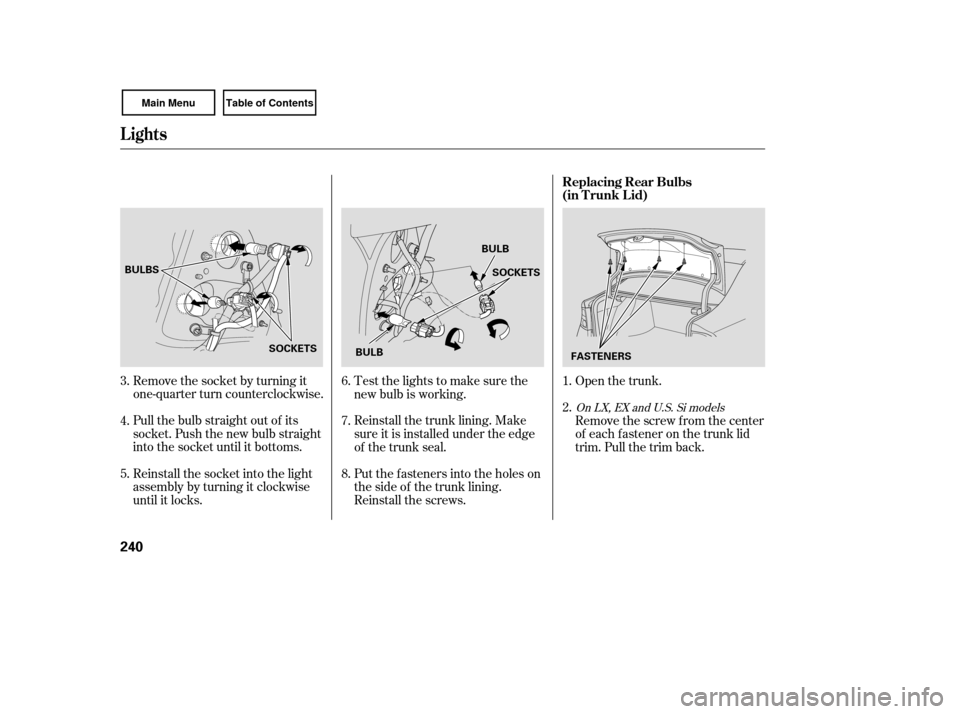
Open the trunk.
Remove the socket by turning it
one-quarter turn counterclockwise.
Pull the bulb straight out of its
socket. Push the new bulb straight
into the socket until it bottoms.
Reinstall the socket into the light
assembly by turning it clockwise
until it locks. Put the f asteners into the holes on
the side of the trunk lining.
Reinstall the screws. Reinstall the trunk lining. Make
sure it is installed under the edge
of the trunk seal. Test the lights to make sure the
new bulb is working.
Remove the screw from the center
of each f astener on the trunk lid
trim. Pull the trim back.
1.
2.
4.
5. 6.
7.
8.
3.
On LX, EX and U.S. Si models
Lights
Replacing Rear Bulbs
(in T runk L id)
240
BULBS
SOCKETS SOCKETS
BULB
BULB FASTENERS
Page 244 of 311
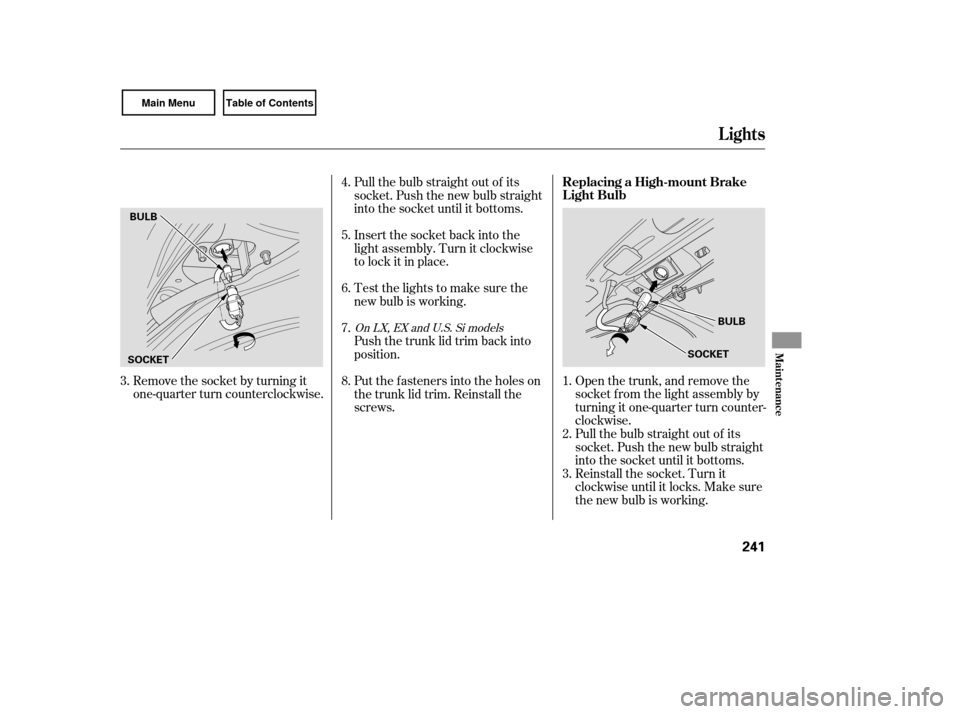
Remove the socket by turning it
one-quarter turn counterclockwise.Open the trunk, and remove the
socket f rom the light assembly by
turning it one-quarter turn counter-
clockwise.
Pull the bulb straight out of its
socket. Push the new bulb straight
into the socket until it bottoms.
Reinstall the socket. Turn it
clockwise until it locks. Make sure
the new bulb is working.
Pull the bulb straight out of its
socket. Push the new bulb straight
into the socket until it bottoms.
Insert the socket back into the
light assembly. Turn it clockwise
to lock it in place.
Test the lights to make sure the
new bulb is working.
Push the trunk lid trim back into
position.
Put the f asteners into the holes on
the trunk lid trim. Reinstall the
screws.
2. 1.
3.
4.
5.
6.
7.
8.
3.
On LX, EX and U.S. Si models
Lights
Replacing a High-mount Brake
Light Bulb
Maint enance
241
BULB
SOCKET
BULB
SOCKET
Page 257 of 311

Fill the f uel tank.
Change the engine oil and f ilter.Block the rear wheels.
If the vehicle is to be stored f or a
longer period, it should be
supported on jackstands so the
tires are of f the ground.
Wash and dry the exterior
completely.
Cleantheinterior.Makesurethe
carpeting, floor mats, etc., are
completely dry.
If you need to park your vehicle f or
an extended period (more than 1
month), there are several things you
should do to prepare it f or storage.
Proper preparation helps prevent
deterioration and makes it easier to
get your vehicle back on the road. If
possible, store your vehicle indoors. Leave one window open slightly (if
the vehicle is being stored
indoors).Cover the vehicle with a
‘‘breathable’’ cover, one made
f rom a porous material such as
cotton. Non-porous materials, such
as plastic sheeting, trap moisture,
which can damage the paint.
To minimize sticking, apply a
silicone spray lubricant to all door
and trunk seals. Also, apply a
vehiclebodywaxtothepainted
surfaces that mate with the door
and trunk seals. Support the f ront wiper blade
arms with a f olded towel or rag so
they do not touch the windshield. Disconnect the battery. If possible, periodically run the
engine until it reaches f ull
operating temperature (the
cooling f an cycles twice).
Pref erably, do this once a month.
Leave the parking brake off. Put
the transmission in reverse
(manual) or Park (automatic).
Vehicle Storage
254