Page 233 of 292

When installing cables, f ollow the
manuf acturer’s instructions, and
mount them as tight as you can.
Make sure they are not contacting
the brake lines or suspension. Drive
slowly with them installed. If you
hear them coming into contact with
the body or chassis, stop and
investigate. Remove them as soon as
youbegindrivingonclearedroads.
Link-type: SCC Quick Grip QG1134
Because your vehicle has limited tire
clearance, Honda strongly
recommends using the chains listed
below, made by Security Chain
Company (SCC).
Mount tire chains on your tires when
required by driving conditions or
local laws. Install them only on the
f ront tires.
Cable-type: SCC SZ 134
Link-type: SCC Quick Grip QG1134
Cable-types: SCC Radial Chain
CH2311T or SCC SC Cable SC1030
U.S. VP and LX
V6 mo dels
Canadian DX-G, SE, and EX-L
U.S. SE, EX, and EX-L
Tires
T ire Chains
234
Using the wrong chains, or not
properly installing chains, can
damage the brake lines and
cause a crash in which you can
be seriously injured or killed.
Follow all instructions in this
owner’s manual regarding the
selection and use of tire chains.
�����—�����—�
���y�
�������������y���
�(�����������y���������y
Page 236 of 292

Block the rear wheels.
If the vehicle is to be stored f or a
longer period, it should be
supported on jackstands so the
tires are of f the ground.
Leave one window open slightly (if
the vehicle is being stored
indoors).
Disconnect the battery.Support the f ront wiper blade
arms with a f olded towel or rag so
they do not touch the windshield.
To minimize sticking, apply a
silicone spray lubricant to all door
and trunk seals. Also, apply a
vehiclebodywaxtothepainted
surfaces that mate with the door
and trunk seals.
Cover the vehicle with a
‘‘breathable’’ cover, one made
f rom a porous material such as
cotton. Non-porous materials, such
as plastic sheeting, trap moisture,
which can damage the paint.
If possible, periodically run the
engine until it reaches f ull
operating temperature (the
cooling f an cycles twice).
Pref erably, do this once a month.
Leave the parking brake off. Put
the transmission in Reverse
(manual transmission) or Park
(automatic transmission).
Vehicle Storage
Maint enance
237
�����—�����—�
���y�
�����������
�y���
�(�����������y���������y
Page 238 of 292
Check the inf lation pressure of the
compact spare tire every time you
check the other tires. It should be
inf lated to:
Follow these precautions:Never exceed 50 mph (80 km/h).
This tire gives a harsher ride and
less traction on some road
surf aces. Use greater caution
while driving. Do not mount snow chains on the
compact spare tire.
Do not use the compact spare tire
if you are towing a trailer.
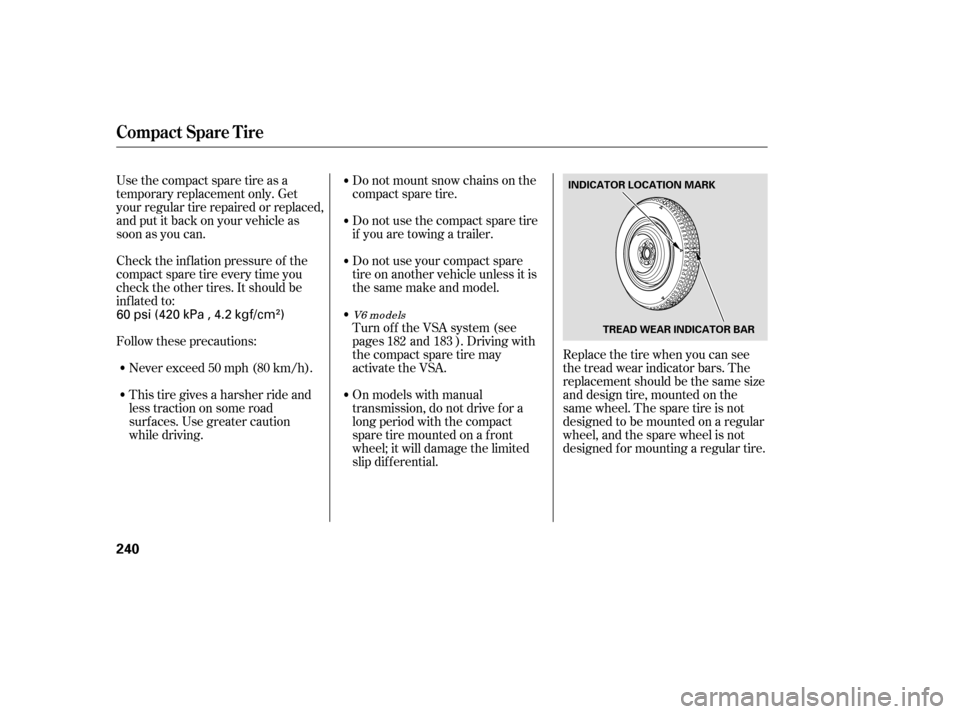
Replace the tire when you can see
the tread wear indicator bars. The
replacement should be the same size
and design tire, mounted on the
same wheel. The spare tire is not
designed to be mounted on a regular
wheel, and the spare wheel is not
designed f or mounting a regular tire.
Use the compact spare tire as a
temporary replacement only. Get
your regular tire repaired or replaced,
and put it back on your vehicle as
soon as you can.
Do not use your compact spare
tire on another vehicle unless it is
thesamemakeandmodel.
Turn of f the VSA system (see
pages and ). Driving with
thecompactsparetiremay
activate the VSA.
On models with manual
transmission, do not drive f or a
long period with the compact
spare tire mounted on a f ront
wheel; it will damage the limited
slip dif f erential.182 183
V6 mo dels
Compact Spare Tire
240
INDICATOR LOCATION MARK
TREAD WEAR INDICATOR BAR
60 psi (420 kPa , 4.2 kgf/cm)
�����—�����—�
���y�
�������������y���
�(�����������y���������y
Page 260 of 292

�µ�µ
If your vehicle needs to be towed,
call a prof essional towing service or
organization. Never tow your vehicle
with just a rope or chain. It is very
dangerous.
The operator
loads your vehicle on the back of a
truck.
Therearetwowaystotowyour
vehicle: If , due to damage, your vehicle must
be towed with the f ront wheels on
the ground, do this:
Release the parking brake.
Shif t the transmission to neutral.
The tow
truck uses two pivoting arms that go
under the tires (f ront) and lif t them
of f the ground. The other two tires
remain on the ground. Turn of f the engine.
ShifttoD,thentoN.
Start the engine.
Release the parking brake.
Leave the ignition switch in the
ACCESSORY (I) position so the
steering wheel does not lock.
Leave the ignition switch in the
ACCESSORY (I) position so the
steering wheel does not lock. With the f ront wheels on the ground,
do not tow the vehicle more than 50
miles (80 km), and keep the speed
below35mph(55km/h).
Manual transmission:
Automatic transmission:
Flat -bed Equipment
Wheel-lif t Equipment
T his is the best way to
transport your vehicle.
T his is an
acceptable way to tow your
vehicle.
Emergency Towing
262
Improper towing preparation will
damage the transmission. Follow the
above procedure exactly. If you cannot
shif t the transmission or start the
engine (automatic transmission), your
vehicle must be transported with the
f ront wheels of f the ground.
�����—�����—�
���y�
������
������y���
�(�����������y���������y
Page 267 of 292

�µ
�Î �Î�Î
�Î�Î�Î �Î
�Î �Î
�Î
�Î
�Î�Î �Î�Î �Î�Î
�Î�Î
�Î�Î �Î�Î�Î�Î
�Î�Î�Î�Î�Î�Î�Î�Î
Specif icat ions
270
Engine
Alignment Tires
Type
BorexStroke
Displacement
Compression ratio
Spark plugs Water cooled 4-stroke, DOHC
i-VTEC 4-cylinder, SOHC VTEC
6-cylinder (V6), gasoline engine 3.43 x 3.9 in (87.0 x 99.0 mm)
3.39 x 3.39 in (86.0 x 86.0 mm) 143.6 cu-in (2,354 cm
)
182.8 cu-in (2,997 cm)
9.7 : 1
10 : 1
IZFR6K-11 SKJ20DR-M11IZFR6K-13SKJ20DR-M13
Toe-in
CamberCaster 0.00 in (0.0 mm)
0.08 in (2.0 mm)
0°1°
3°15’ Size
Pressure
P195/65R15 89H
T135/90D15
60 psi (420 kPa , 4.2 kgf/cm
)
P205/65R15 92H
29 psi (200 kPa , 2.0 kgf/cm)
30 psi (210 kPa , 2.1 kgf/cm)
P205/60R16 91V
30 psi (210 kPa , 2.1 kgf/cm)
32 psi (220 kPa , 2.2 kgf/cm)
P215/50R17 93V
Front Rear
FrontRear
Front NGK:
DENSO:NGK:
DENSO:
4-cylinder models
V6 m o d el s
3:4:5: Front/Rear
Spare
Front Rear
Spare
U.S. VP
U.S. LX
V6 m o d el s
LX-SUL, SE-SUL, EX-SUL, and EXLSUL models U.S. SE, EX, and EX-L
1: 2:3: 4:
Canadian DX-G, SE, and EX-L3 4 3
4
34 3, 4 3, 4
3, 5
3, 5 1234
1, 3, 42
1, 3
2, 4
�����—�����—�
���y�
�������������y���
�(�����������y���������y
Page 268 of 292

�µ
Quality grades can be f ound where
applicable on the tire sidewall
between the tread shoulder and the
maximum section width. For
example: The treadwear grade is a compara-
tive rating based on the wear rate of
the tire when tested under controlled
conditions on a specif ied government
test course. For example, a tire
graded 150 would wear one and one-
half (1 1/2) times as well on the
government course as a tire graded
100. The relative perf ormance of
tires depends upon the actual condi-
tions of their use, however, and may
depart signif icantly f rom the norm
due to variations in driving habits,
service practices, and dif f erences in
road characteristics and climate.The traction grades, f rom highest to
lowest, are AA, A, B, and C. Those
grades represent the tire’s ability to
stop on wet pavement as measured
under controlled conditions on
specif ied government test surf aces
of asphalt and concrete. A tire
marked C may have poor traction
perf ormance.
Warning: The traction grade
assignedtothistireisbasedon
straight-ahead braking traction tests,
and does not include acceleration,
cornering, hydroplaning, or peak
traction characteristics.
All passenger vehicle tires must
conf orm to Federal Saf ety
Requirements in addition to these
grades.
The tires on your vehicle meet all
U.S. Federal Saf ety Requirements.
All tires are also graded f or
treadwear, traction, and temperature
perf ormance according to
Department of Transportation
(DOT) standards. The f ollowing
explains these gradings.
Unif orm T ire Quality Grading
T readwear 200
Traction AA
Temperature A Treadwear Traction AA, A, B, C
DOT T ire Quality Grading (U.S. Vehicles)
T echnical Inf ormation
271
�����—�����—�
���y�
�������������y���
�(�����������y���������y
Page 269 of 292

�µWarning: The temperature grade f or
this tire is established f or a tire that
is properly inf lated and not
overloaded. Excessive speed,
underinf lation, or excessive loading,
either separately or in combination,
can cause heat buildup and possible
tire f ailure.
The temperature grades are A (the
highest), B, and C, representing the
tire’s resistance to the generation of
heat, and its ability to dissipate heat
when tested under controlled
conditions on a specif ied indoor
laboratory test wheel. Sustained high
temperature can cause the material
of the tire to degenerate and reduce
tire life, and excessive temperature
can lead to sudden tire f ailure. The
Grade C corresponds to a level of
perf ormance which all passenger car
tires must meet under the Federal
Motor Vehicle Saf ety Standard No.
109. Grades B and A represent
higher levels of perf ormance on the
laboratory test wheel than the
minimum required by law.
Temperature A,B,C
DOT T ire Quality Grading (U.S. Vehicles)
272
�����—�����—�
���y�
�����������
�y���
�(�����������y���������y
Page 270 of 292

�µ �µ �µ �µ�µ �µ �µ
�µ�µ �µ
�µ
�µ
�µ
Rim diameter in inches.
Load index (a numerical code
associated with the maximum
load the tire can carry).
Speed symbol (an
alphabetical code indicating
the maximum speed rating).
The tire identif ication number (TIN)
is a group of numbers and letters
that look like the f ollowing example
TIN. TIN is located on the sidewall
of the tire.
The tires that came on your vehicle
have a number of markings. Those
you should be aware of are described
below.
Whenever tires are replaced, they
should be replaced with tires of the
same size. Following is an example
of tire size with an explanation of
what each component means.
Vehicletype(Pindicates
passenger vehicle).
Tire width in millimeters.
Aspect ratio (the tire’s section
height as a percentage of its
width).
Tire construction code (R
indicates radial). The maximum load the
tire can carry at
maximum air pressure.
The maximum air
pressurethetirecanhold.
Date of manuf acture.
Tire type code.
This indicates that the tire
meets all requirements of
the U.S. Department of
Transportation. Manuf acturer’s
identification mark.
P R V
16 DOT B97R FW6X 2202
20560 91
Max Press
Max Load
Tire Labeling
T ire Ident if icat ion Number
Tire Size
Maximum T ire L oad
Maximum T ire Pressure
T echnical Inf ormation
273
P205/60R16 91V
DOT B97R FW6X 2202
�����—�����—�
���y�
���������
���y���
�(�����������y���������y