Page 43 of 292

�µ
Leaving children without
adult supervision is illegal in most
states and Canadian provinces,
and can be very hazardous.
For example, infants and small
childrenleftinavehicleonahot
day can die f rom heatstroke. A
child lef t alone with the key in the
ignition switch can accidentally set
the vehicle in motion, possibly
injuring themselves or others. Children
who play in vehicles can
accidentally get trapped inside.
Teach your children not to play in
or around vehicles. Know how to
operate the emergency trunk
opener and decide if your children
should be shown how to use this
feature(seepage ).
Even very young
children learn how to unlock
vehicle doors, turn on the ignition
switch, and open the trunk, which
can lead to accidental injury or
death.
This can prevent children
f rom accidentally f alling out (see
page ).
An inf ant must be properly
restrained in a rear-f acing, reclining
child seat until the child reaches the
seat maker’s weight or height limit
f or the seat, and the child is at least
one year old.
Only a rear-f acing child seat provides
proper support f or a baby’s head,
neck, and back.
78
83
CONT INUED
Do not leave children alone in avehicle. L ock all doors and t he t runk when
your vehicle is not in use.
K eep vehicle keys and remot etransmitters out of the reach of children.
Use childproof door locks t o
prevent children f rom opening t hedoors.
Child Seat T ype
Protecting Inf ants
Protecting Children General Guidelines, Protecting Inf ants and Small Children
Driver and Passenger Saf ety
39
�����—�����—�
���y�
������
������y���
�(�����������y���������y
Page 45 of 292
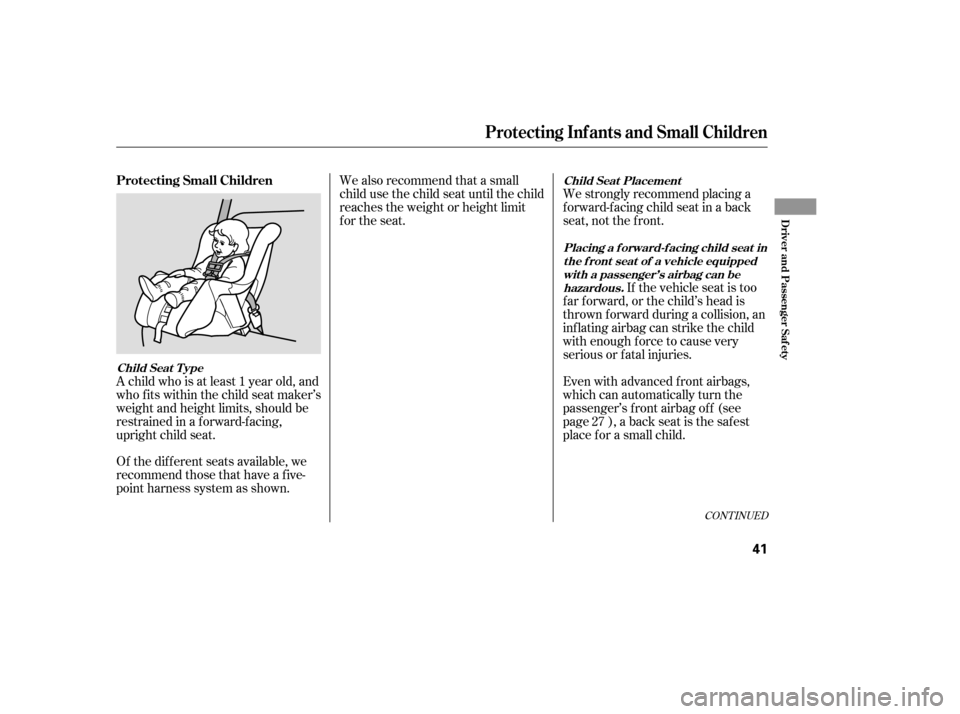
A child who is at least 1 year old, and
who f its within the child seat maker’s
weight and height limits, should be
restrained in a f orward-f acing,
upright child seat.
Of the different seats available, we
recommend those that have a f ive-
point harness system as shown.We strongly recommend placing a
forward-facing child seat in a back
seat, not the f ront.
If the vehicle seat is too
f ar f orward, or the child’s head is
thrown f orward during a collision, an
inf lating airbag can strike the child
with enough force to cause very
serious or f atal injuries.
Even with advanced front airbags,
which can automatically turn the
passenger’s front airbag off (see
page ), a back seat is the saf est
place f or a small child.
We also recommend that a small
child use the child seat until the child
reaches the weight or height limit
for the seat.
27
CONT INUED
Child Seat Placement
Child Seat T ype Placing a f orward-f acing child seat in
t he f ront seat of a vehicle equippedwith a passenger’s airbag can be
hazardous.Protecting Small Children
Protecting Inf ants and Small Children
Driver and Passenger Saf ety
41
�����—�����—�
���y�
�������������y���
�(�����������y���������y
Page 51 of 292
Af ter conf irming that the belt is
locked, grab the shoulder part of
the belt near the buckle, and pull
up to remove any slack from the
lap part of the belt. Remember, if
the lap part of the belt is not tight,
the child seat will not be secure.To deactivate the lockable retractor
and remove a child seat, unlatch the
buckle, unroute the seat belt, and let
the belt fully retract.
Push and pull the child seat
f orward and f rom side-to-side to
verif y that it is secure enough to
stay upright during normal driving
maneuvers. If the child seat is not
secure, unlatch the belt, allow it to
retract f ully, then repeat these
steps.
To remove slack, it may help to
putweightonthechildseat,or
push on the back of the seat while
pulling up on the belt.
4.
5.
Inst alling a Child Seat
Driver and Passenger Saf ety
47
�����—�����—�
���y�
�������������y���
�(�����������y���������y
Page 53 of 292

To determine if a lap/shoulder belt
properly f its a child, have the child
put on the seat belt, then ask
yourself :
When a child reaches the
recommended weight or height limit
for a forward-facing child seat, the
child should sit in a back seat on a
booster seat and wear a lap/shoulder
belt.
Does the child sit all the way back
against the seat?
Do the child’s knees bend
comf ortably over the edge of the
seat?
The f ollowing pages give
instructions on how to check proper
seat belt f it, what kind of booster
seat to use if one is needed, and
important precautions f or a child
who must sit in f ront.
1. 2.
CONT INUED
Checking Seat Belt Fit
Protecting L arger Children
Driver and Passenger Saf ety
49
Allowing a child age 12 or under
to sit in front can result in injury
or death if the passenger’s front
airbag inflates.
If a child must ride in front,
move the vehicle seat as far
back as possible, use a booster
seat if needed, have the child
sit up properly and wear the
seat belt properly.
�����—�����—�
���y�
���������
���y���
�(�����������y���������y
Page 54 of 292

Does the shoulder belt cross
between the child’s neck and arm?
Is the lap part of the belt as low as
possible, touching the child’s
thighs?
Will the child be able to stay
seated like this f or the whole trip?
If you answer yes to all these
questions, the child is ready to wear
the lap/shoulder belt correctly. If
you answer no to any question, the
child needs to ride on a booster seat. A child who has outgrown a f orward-
f acing child seat should ride in a
back seat and use a booster seat
until the lap/shoulder belt f its them
properly without the booster.
Some states and Canadian provinces
also require children to use a booster
seat until they reach a given age or
weight (e.g., 6 years or 60 lbs). Be
sure to check current laws in the
states or provinces where you intend to drive. If a child who uses a booster seat
must ride in f ront, move the vehicle
seat as far back as possible and be
sure the child is wearing the seat
belt properly.
Booster seats can be high-back or
low-back. Whichever style you select,
make sure the booster seat meets
f ederal saf ety standards (see page
) and that you f ollow the booster
seat maker’s instructions.
A child may continue using a booster
seat until the tops of their ears are
even with the top of the vehicle’s or
booster’s seat-back. A child of this
height should be tall enough to use
the lap/shoulder belt without a
booster seat.
4. 5.
3.
42
Using a Booster Seat
Protecting L arger Children
50
�����—�����—�
���y�
�����������
�y���
�(�����������y���������y
Page 62 of 292

This indicator comes on when you
turn the ignition switch to the ON
(II) position. If it comes on at any
other time, it indicates that the
passenger’s side airbag has
automatically shut off. For more
inf ormation, see page .
This indicator normally comes on f or
a f ew seconds when you turn the
ignition switch to the ON (II)
position, and when the ignition
switch is turned to the START (III)
position. If it comes on at any other
time, there is a problem with the
ABS. If this happens, have your
vehicle checked at a dealer. With
this on, your vehicle still has normal
braking ability but no anti-lock
brakes. For more inf ormation, see
page .
This indicator comes on brief ly when
you turn the ignition switch to the
ON (II) position. If it comes on at
any other time, it indicates a
potential problem with your f ront
airbags. This indicator will also alert
you to a potential problem with your
side airbags, passenger’s side airbag
automatic cutoff system, side curtain
airbags, automatic seat belt
tensioners, driver’s seat position
sensor, or the f ront passenger’s
weight sensors. For more
inf ormation, see page .
This indicator has two f unctions:
Itcomesonwhenyouturnthe
ignition switch to the ON (II)
position. It is a reminder to check
the parking brake. A beeper
sounds if you drive with the
parking brake not f ully released.
Driving with the parking brake not
fully released can damage the
brakes and tires.
If it remains lit af ter you f ully
release the parking brake while
the engine is running, or if it
comes on while driving, there
could be a problem with the brake
system. For more inf ormation, see
page . 30
31
1. 2.
180
255 Anti-lock Brake System
(A BS) Indicator
Supplemental Restraint
System Indicator
Parking Brake and Brake System
Indicator
Side Airbag Of f
Indicator
Instrument Panel Indicators
Inst rument s and Cont rols
59
Canada
U.S.
Canada
U.S.
�����—�����—�
���y�
�������������y���
�(�����������y���������y
Page 85 of 292
To protect items in the trunk when
you need to give the key to someone
else:Give the person the valet key.
Pull up on the trunk release lever
located to the lef t of the driver’s
seat.
Lockthetrunkreleaseleverwith
the master key. Also make sure
the trunk pass-through cover is
locked (see page ).
Press and hold the trunk release
button on the remote transmitter. To close the trunk, press down on
the trunk lid.
See page f or cargo loading and
weight limit inf ormation. Keep the
trunk lid closed at all times while
driving to avoid damaging the lid,
and to prevent exhaust gas from
getting into the interior. See
on page .
You can open the trunk in either of
the following ways: 1. 2.
165
89
53
Trunk
Carbon
Monoxide Hazard
82
Pull
TRUNK RELEASE LEVER MASTER
KEY
�����—�����—�
���y�
�������������y���
�(�����������y���������y
Page 162 of 292
Always drive in the highest gear
possible.
Try to maintain a constant speed.
Everytimeyouslowdownand
speed up, your vehicle uses extra
f uel. Use cruise control when
appropriate.
Combine several short trips into
one.
The air conditioning puts an extra
load on the engine which makes it
usemorefuel.Usethefresh-air
ventilation when possible.
Always maintain your vehicle
according to the maintenance
messages displayed on the
inf ormation display. See
on page
.
Drive moderately. Rapid
acceleration, abrupt cornering,
and hard braking use more f uel.
The build-up of snow or mud on
your vehicle’s underside adds
weight and rolling resistance.
Frequent cleaning helps your f uel
mileage and reduces the chance of
corrosion.
an underinf lated tire
causes more ‘‘rolling resistance,’’
which uses more f uel. 198
For example,
Improving Fuel Economy
Owner’s
Maintenance Checks
Fuel Economy
Bef ore Driving
161
�����—�����—�
���y�
����
������
�y���
�(�����������y���
�����y


