Page 75 of 287

The battery temperature will
normalize af ter a f ew minutes of
driving, and the IMA system will
work normally.
This gauge shows you the status of
the integrated motor assist (IMA).
When the IMA battery is being
charged, the lef t side of the gauge
illuminates. When the IMA is
assisting the engine, the right side of
the gauge illuminates. This shows the temperature of the
engine’s coolant. During normal
operation, the reading should be in
the middle of the gauge. In severe
driving conditions, such as very hot
weather or a long period of uphill
driving, the reading may reach near
the red mark. If it reaches the red
(Hot) mark, pull saf ely to the side of
theroad.Seepage for
instructions and precautions on
checking the engine’s cooling
system.
If the IMA battery is too hot or too
cold, the IMA system shuts down to
protect the battery. This disables the
IMA assist and auto idle stop, even
though the battery level gauge may
show that the battery is well-charged.
Theref ore, those f unctions may not
operate when you f irst start driving
in very hot or very cold weather.
243
Charge/Assist Gauge Temperature Gauge
Gauges
72
CHARGE/ASSIST GAUGE
06/08/08 14:28:16 31SDR620_077
Page 116 of 287

�Û�Ý�µ
The automatic climate control
system adjusts the f an speed and
airflow levels to maintain the interior
temperature you select.
Press the AUTO button.
Set the desired temperature by
turning the temperature control
dial. You will see AUTO in the
system’s display.
Set the desired temperature by
pressing the driver’s side
temperature control buttons. Press
to raise the temperature or
to lower it. The selected
temperature will show in the upper
display. The system automatically selects the
proper mix of conditioned and/or
heated air that will, as quickly as
possible, raise or lower the interior
temperature to your pref erence.
If you set the temperature to its
lowest limit (Lo), or its highest limit
(Hi), the system runs at f ull cooling
or heating only. It does not regulate
the interior temperature.
In cold weather, the fan will not
come on automatically until the
heater starts to develop warm air.
When
the indicator in the Dual button is on,
the driver’s side and passenger’s side
temperature can be controlled
independently (seepage). 115
Dual Temperature Control
On vehicles without navigation system
On vehicles with navigation system
Automatic Climate Control
Climate Control System
Features
113
06/08/08 14:35:24 31SDR620_118
Page 192 of 287

When preparing to tow, and bef ore
driving away, be sure to check the
f ollowing:The vehicle has been properly
serviced, and the tires, brakes,
suspension, cooling system, and
lights are in good operating
condition.
The lights and brakes on your
vehicle and the trailer are working
properly. All items in or on the trailer are
properly secured and cannot shif t
while you drive. Thehitch,safetychains,andany
other attachments are secure. All weights and loads are within
limits (see pages and ). Your vehicle tires and spare are
properly inf lated (see page ),
and the trailer tires and spare are
inflated as recommended by the
trailer maker.
Foryoursafetyandthesafetyof
others,taketimetopracticedriving
maneuvers bef ore heading f or the
open road, and f ollow the guidelines
below. The added weight, length, and
height of a trailer will af f ect your
vehicle’s handling and perf ormance,
so driving with a trailer requires
some special driving skills and
techniques. Driveslowerthannormalinall
driving situations, and obey posted
speed limits f or vehicles with trailers.
UsetheDpositionwhentowinga
trailer on level roads. Do not exceed
55 mph (88 km/h). At higher speeds,
thetrailermayswayoraffectvehicle
handling.
D is the proper shif t lever position
tousewhentowingatrailerinhilly
terrain.
185 186 224
3
Pre-T ow Checklist
Driving Saf ely With a T railerT owing Speeds and Gears
Towing a Trailer
Driving
189
06/08/08 14:47:07 31SDR620_194
Page 210 of 287

If Honda antif reeze/coolant is not
available, you may use another
major-brand non-silicate coolant as a
temporaryreplacement.Makesureit
is a high-quality coolant
recommended f or aluminum engines.
Continued use of any non-Honda
coolant can result in corrosion,
causing the cooling system to
malf unction or f ail. Have the cooling
system f lushed and ref illed with
Honda antif reeze/coolant as soon as
possible.
If the reserve tank is completely
empty, you should also check the
coolant level in the radiator.
If the coolant level in the reserve
tank is at or below the MIN line, add
coolant to bring it up to the MAX line.
Inspect the cooling system f or leaks.
Always use Honda Long-lif e Anti-
f reeze/Coolant Type 2. This coolant
is pre-mixed with 50 percent
antif reeze and 50 percent water.
Never add straight antifreeze or
plain water.
CONT INUED
A dding Engine Coolant
Engine Coolant
Maint enance
207
RESERVE TANK
Removing the radiator cap
while the engine is hot can
cause the coolant to spray out,
seriously scalding you.
Always let the engine and
radiator cool down before
removing the radiator cap.
06/08/08 14:49:47 31SDR620_212
Page 211 of 287
Pour coolant into the reserve tank.
Fill it to half way between the MAX
and MIN marks. Put the cap back
on the reserve tank.
Do not add any rust inhibitors or
other additives to your vehicle’s
cooling system. They may not be
compatible with the coolant or
engine components.
The coolant level should be up to
the base of the f iller neck. Add
coolant if it is low.
Pourthecoolantslowlyand
caref ully so you do not spill any.
Clean up any spill immediately; it
could damage components in the
engine compartment.
Put the radiator cap back on and
tighten it.
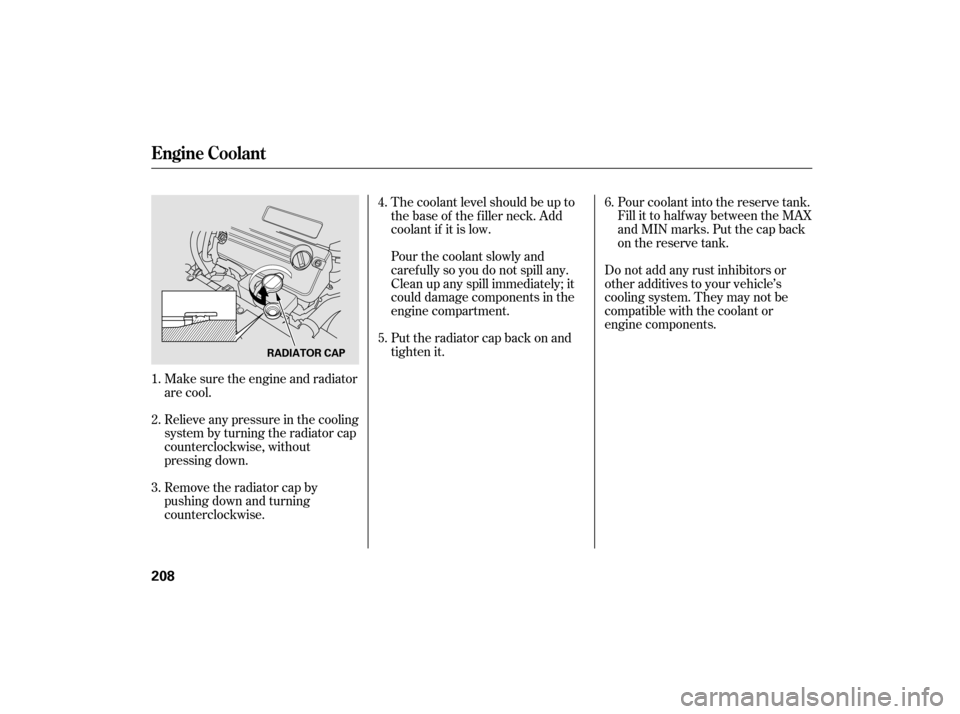
Make sure the engine and radiator
are cool.
Relieve any pressure in the cooling
system by turning the radiator cap
counterclockwise, without
pressing down.
Remove the radiator cap by
pushing down and turning
counterclockwise. 4.
1.
2.
3. 5.
6.
Engine Coolant
208
RADIATOR CAP
06/08/08 14:49:56 31SDR620_213
Page 223 of 287
This f ilter removes the dust and
pollenthatisbroughtinfromthe
outside through the heating and
cooling system.
Have your dealer replace the filter
when this service is indicated by a
maintenance message on the
inf ormation display. It should be
replaced every 15,000 miles (24,000
km) if you drive primarily in urban
areas that have high concentrations
of soot in the air, or if the f low f rom
the heating and cooling system
becomeslessthanusual.
A udio A ntenna
Dust and Pollen Filter
A udio A ntenna, Dust and Pollen Filter
220
Your vehicle is equipped with an
antenna at the rear of the roof . Bef ore
using a ‘‘drive-through’’ car wash,
remove the antenna by unscrewing it by
hand. This prevents the antenna f rom
being damaged by the car wash brushes.
06/08/08 14:51:50 31SDR620_225
Page 247 of 287

Using gloves or a large heavy
cloth, turn the radiator cap
counterclockwise, without pushing
down, to the f irst stop. Af ter the
pressure releases, push down on
the cap, and turn it until it comes
off.Put the radiator cap back on
tightly. Run the engine, and check
the temperature gauge. If it goes
back to the red mark, the engine
needs repair (see
on page ).
If the temperature stays normal,
check the coolant level in the
radiator reserve tank. If it has
gone down, add coolant to the
MAX mark. Put the cap back on
tightly.
If you do not f ind an obvious leak,
check the coolant level in the
radiator reserve tank. Add coolant
if the level is below the MIN mark.
If there was no coolant in the
reserve tank, you may need to add
coolant to the radiator. Let the
engine cool down until the pointer
reaches the middle of the tempera-
ture gauge, or lower, bef ore check-
ing the radiator.
Start the engine, and set the
temperature to maximum heat
(climate control to AUTO at
‘‘ ’’). Add coolant to the
radiator up to the base of the f iller
neck. If you do not have the
proper coolant mixture available,
you can add plain water.
Remember to have the cooling
system drained and ref illed with
the proper mixture as soon as you
can.
7. 6. 8.
9.10.
11.
255
Emergency
Towing
If theEngineOverheats
244
Removing the radiator cap
while the engine is hot can
cause the coolant to spray out,
seriously scalding you.
Always let the engine and
radiator cool down before
removing the radiator cap.
06/08/08 14:55:29 31SDR620_249
Page 256 of 287
�µ
�´No.No.
Amps. Circuits Protected No.
Amps. Amps. Circuits Protected
Circuits Protected
1
2
3
4
5 6
7
8
9
10
10 A
30 A
10 A
15 A
10 A Left Headlight Low
Rear Defroster Coil
Left Headlight Hi
Small Light
Right Headlight Hi 11
12
13
14
15
16
17
18
19
20
21
22
23
10 A
7.5 A 15 A
20 A 30 A
7.5 A 15 A
40 A
40 A
15 A
30 A
40 A
40 A
40 A
40 A
120 A 70 A
50 A
50 A Cooling Fan
MG. Clutch
Horn, Stop
Rear Defroster
Back Up, ACC
Hazard
VSA Motor
VSA
Option
Option
Heater Motor
Battery
EPS
BIG1Main
Power Window Main
Right Headlight Low
Back Up
FI ECU
Condenser Fan
Not Used
Fuse Locations
T aking Care of t he Unexpect ed
253
UNDER-HOOD FUSE/RELAY BOX
06/08/08 14:56:46 31SDR620_258