Page 169 of 287

Store or secure all items that could
be thrown around and hurt
someone during a crash.
If you carry large items that
prevent you f rom closing the trunk
lid, exhaust gas can enter the
passenger area. To avoid the
possibility of
, f ollow the instructions
on page .
If you carry any items on a roof
rack, be sure the total weight of
the rack and the items does not
exceed 165 lbs (75 kg).
If you use an accessory roof rack,
the roof rack weight limit may be
lower. Ref er to the inf ormation that
came with your roof rack. Do not put any items on top of the
rear shelf . They can block your
viewandbethrownaroundthe
vehicle during a crash.
Besureitemsplacedonthefloor
behind the f ront seats cannot roll
under the seats and interf ere with
the driver’s ability to operate the
pedals or the seat.
Keep the glove box closed while
driving so that someone in the
passenger seat can avoid injuries
to their knees in a crash or a
sudden stop.
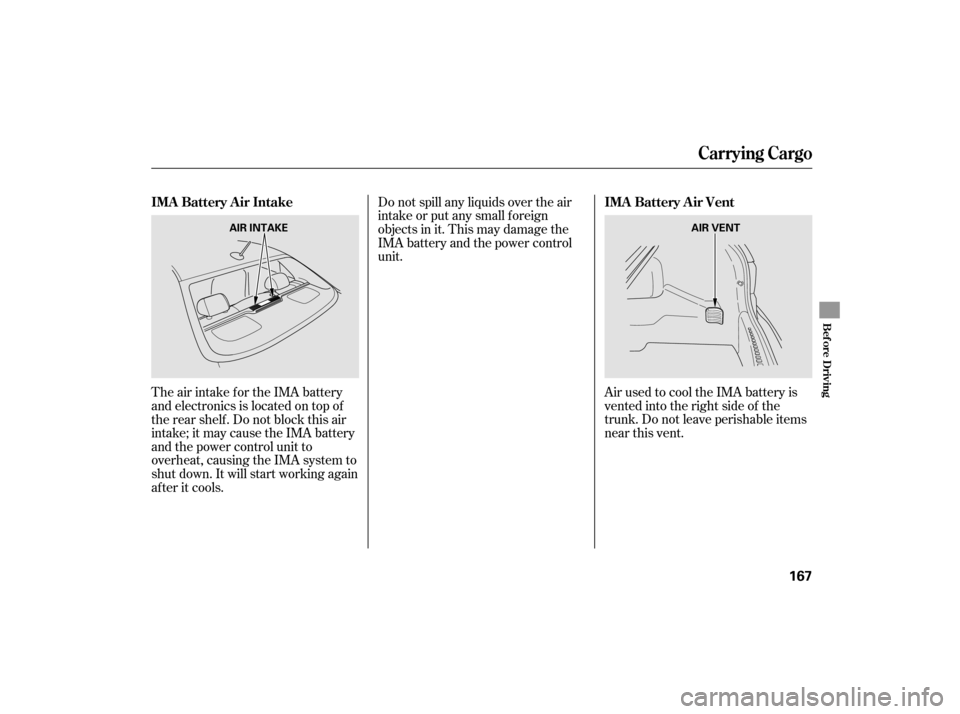
Do not put any objects on the IMA
battery air intake on the rear shelf
(see page ).
Distribute cargo evenly on the
f loor of the trunk, placing the
heaviest items on the bottom and
as far forward as possible. Tie
down items that could be thrown
about the vehicle during a crash or
sudden stop.
Do not store any perishable items
near the IMA battery vent (see
page).
167 54
167
carbon monoxide
poisoning Carrying Cargo in the Passenger
Compartment
Carrying Cargo in the Trunk or on
a Roof Rack
Carrying Cargo
166
06/08/08 14:43:43 31SDR620_171
Page 170 of 287
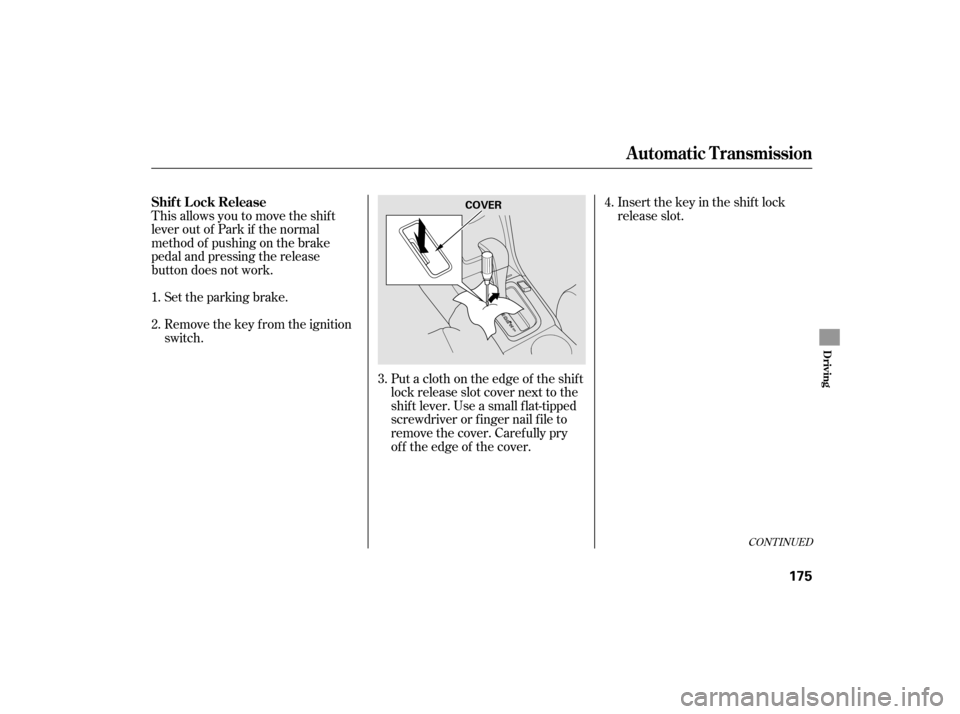
Do not spill any liquids over the air
intake or put any small f oreign
objects in it. This may damage the
IMA battery and the power control
unit.Air used to cool the IMA battery is
vented into the right side of the
trunk. Do not leave perishable items
near this vent.
The air intake for the IMA battery
and electronics is located on top of
the rear shelf . Do not block this air
intake; it may cause the IMA battery
and the power control unit to
overheat, causing the IMA system to
shut down. It will start working again
af ter it cools.
Carrying Cargo
IMA Battery Air Intake
IMA Battery Air Vent
Bef ore Driving
167
AIR INTAKE AIR VENT
06/08/08 14:43:51 31SDR620_172
Page 172 of 287

This section gives you tips on
starting the engine under various
conditions, and how to operate the
automatic transmission. It also
includes important inf ormation on
parking your vehicle, the braking
system, the vehicle stability assist
(VSA) system, and f acts you need if
you are planning to tow a trailer.
........................Preparing to Drive . 170
.......................Starting the Engine . 171
..............Automatic Transmission . 172
Shif t Lever Position
...............................Indicators . 172
.......................................Shif ting . 172
..............Engine Speed Limiter . 174
....................Shif t Lock Release . 175
............................Auto Idle Stop . 177
...........Auto Idle Stop Indicator . 178
...........................................Parking . 179
.............................Braking System . 180
...........Braking System Design . 180
.....Brake Pad Wear Indicators . 180
...............Anti-lock Brakes (ABS) . 181
............................ABS Indicator . 181
Vehicle Stability Assist (VSA)
....................................System . 183
.........VSA Activation Indicator . 183
..............VSA System Indicator . 183
.........................VSA Of f Switch . 184
...................VSA and Tire Sizes . 184
...........................Towing a Trailer . 185
Driving
Driving
169
06/08/08 14:43:58 31SDR620_174
Page 173 of 287
Youshoulddothefollowingchecks
and adjustments bef ore you drive
your vehicle.Make sure all windows, mirrors,
and outside lights are clean and
unobstructed. Remove f rost, snow,
or ice.
Make sure the doors are securely
closed and locked.
Fasten your seat belt. Check that
your passengers have f astened
their seat belts (see page ). Check the steering wheel
adjustment (see page ).
Check that the hood is f ully closed.
Check that the trunk is f ully
closed.
Visually check the tires. If a tire
looks low, use a gauge to check its
pressure.
Check that any items you may be
carrying are stored properly or
f astened down securely. Check the seat adjustment (see
pages to ).
Check the adjustment of the
inside and outside mirrors (see
pages and ).
When you start the engine, check
the gauges and indicators in the
instrument panel (see pages to
).
3. 2. 1.
4.
5. 6.
7.
8.
9.
11.
10. 16
90 92
93 94 80 73
59
Preparing to Drive
170
06/08/08 14:44:11 31SDR620_175
Page 175 of 287
If the malf unction indicator lamp
comes on along with the ‘‘D’’
indicator, there is a problem with the
automatic transmission control
system. Avoid rapid acceleration and
have the transmission checked by
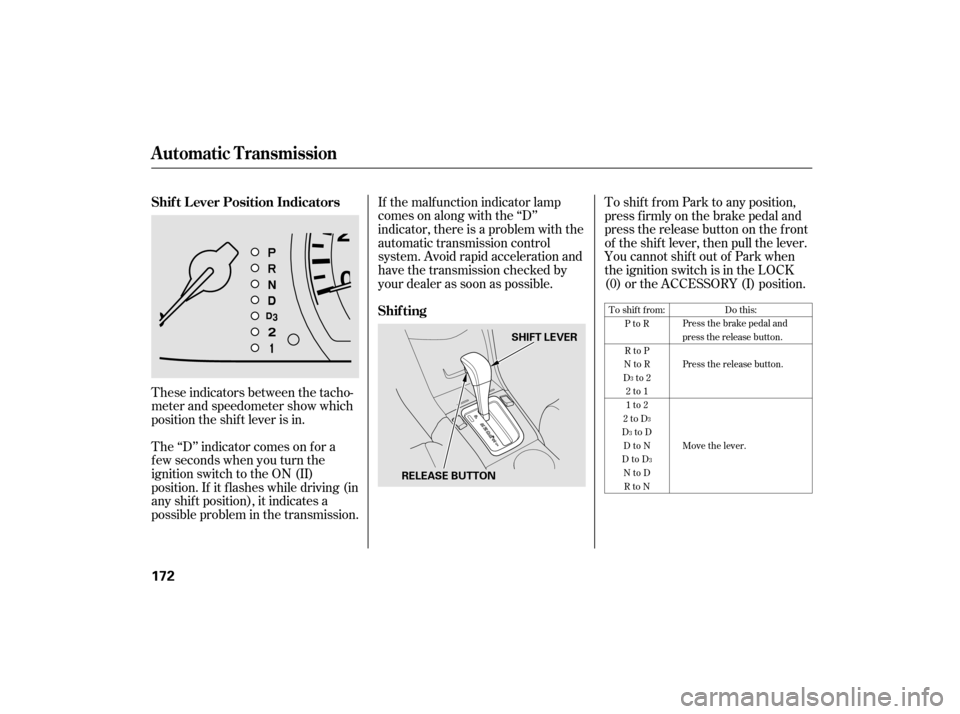
your dealer as soon as possible.To shif t f rom Park to any position,
press firmly on the brake pedal and
pressthereleasebuttononthefront
of the shif t lever, then pull the lever.
YoucannotshiftoutofParkwhen
the ignition switch is in the LOCK
(0) or the ACCESSORY (I) position.
The ‘‘D’’ indicator comes on f or a
f ew seconds when you turn the
ignition switch to the ON (II)
position. If it f lashes while driving (in
any shif t position), it indicates a
possible problem in the transmission. These indicators between the tacho-
meter and speedometer show which
position the shif t lever is in.
To shift from: PtoR
RtoP
NtoR
Dto2 2to1
1to2
2toD
DtoD DtoN
DtoD NtoDRtoN Do this:
Press the brake pedal and
press the release button.
Press the release button.
Move the lever.
3
3
3
3
Automatic Transmission
Shif t L ever Position Indicators
Shif ting
172
SHIFT LEVER
RELEASE BUTTON
06/08/08 14:44:32 31SDR620_177
Page 176 of 287

�µ�µ
�µ
�µ
�µ
If you have done all of the above and
still cannot move the lever out of
Park, see on
page .
You must also press the release
button to shift into Park. To avoid
transmission damage, come to a
complete stop bef ore shif ting into
Park. The shif t lever must be in Park
bef ore you can remove the key f rom
the ignition switch.
Press the brake
pedal and press the release button to
shif t f rom Park to Reverse. To shif t
from Reverse to Neutral, come to a
completestopandthenshift.
This position is similar
to D, except only the first three
gears are selected instead of all f ive.
Use D when towing a trailer in hilly
terrain, or to provide engine braking
when going down a steep hill. D can
also keep the transmission f rom
cycling between third and f ourth
gears in stop-and-go driving.
Use this position f or
your normal driving. The
transmission automatically selects a
suitable gear for the vehicle speed
and acceleration. You may notice the
transmission shif ting up at higher
speeds when the engine is cold. This
helps the engine warm up f aster.
Use Neutral if you
need to restart a stalled engine, or if
it is necessary to stop brief ly with
the engine idling. Shif t to the Park
position if you need to leave your
vehicle and apply the parking brake.
Press on the brake pedal when you
are moving the shif t lever f rom
Neutral to another gear.
This position mechani-
cally locks the transmission. Use
Park whenever you are turning of f or
starting the engine. To shif t out of
Park, you must press on the brake
pedal and have your f oot of f the
accelerator pedal. Press the release
buttononthefrontof theshiftlever
to move it.
175
3
3
CONT INUED
Automatic Transmission
Shif t L ock Release
Reverse (R) Drive (D )
Drive (D)
Neutral (N)
Park (P)3
Driving
173
06/08/08 14:44:40 31SDR620_178
Page 177 of 287

�µ�µThis position locks
the transmission in second gear. It
does not downshif t to f irst gear
when you come to a stop.
Use second gear:
For starting out on a slippery
surf ace or in deep snow.
To help reduce wheel spin.
When driving downhill with a
trailer. If you exceed the maximum speed
f or the gear you are in, the engine
speed will enter into the tachometer’s
red zone. If this occurs, you may f eel
the engine cut in and out. This is
caused by a limiter in the engine’s
computer controls. The engine will
run normally when you reduce the
rpm below the red zone.
For more power when climbing.
To increase engine braking when
going down steep hills. To shif t f rom second to
first, press the release button on the
f ront of the shif t lever. This position
locks the transmission in f irst gear.
By upshif ting and downshif ting
through 1, 2, D , and D, you can
operate this transmission much like
a manual transmission without a
clutch pedal.
3
Automatic Transmission
Second (2) Engine Speed L imiter
First (1)
174
06/08/08 14:44:49 31SDR620_179
Page 178 of 287
Put a cloth on the edge of the shif t
lock release slot cover next to the
shif t lever. Use a small f lat-tipped
screwdriverorfingernailfileto
remove the cover. Caref ully pry
of f the edge of the cover.Insert the key in the shift lock
release slot.
This allows you to move the shif t
lever out of Park if the normal
method of pushing on the brake
pedal and pressing the release
button does not work.
Remove the key from the ignition
switch. Set the parking brake.
1.
2.
3.4.
CONT INUED
Automatic Transmission
Shif t L ock Release
Driving
175
COVER
06/08/08 14:44:57 31SDR620_180