2007 GMC SIERRA CLASSIC tires
[x] Cancel search: tiresPage 562 of 674
Used Replacement Wheels
{CAUTION:
Putting a used wheel on your vehicle is
dangerous. You cannot know how it has
been used or how far it has been driven. It
could fail suddenly and cause a crash. If
you have to replace a wheel, use a new
GM original equipment wheel.
Tire Chains
{CAUTION:
If your vehicle has dual wheels or
P265/75R16, LT265/75R16, P265/70R17 or
P275/55R20 size tires, do not use tire
chains. They can damage your vehicle
because there is not enough clearance.
Tire chains used on a vehicle without the
proper amount of clearance can cause
damage to the brakes, suspension or
other vehicle parts. The area damaged by
the tire chains could cause you to lose
control of your vehicle and you or others
may be injured in a crash.
CAUTION: (Continued)
562
Page 563 of 674
CAUTION: (Continued)
Use another type of traction device
only if its manufacturer recommends
it for use on your vehicle and tire size
combination and road conditions. Follow
that manufacturer’s instructions. To help
avoid damage to your vehicle, drive
slowly, readjust or remove the device if it
is contacting your vehicle, and do not
spin your vehicle’s wheels.
If you do nd traction devices that will t,
install them on the rear tires.
Notice:If your vehicle does not have dual
wheels and is equipped with a tire size other
than P265/75R16, LT265/75R16, P265/70R17
or P275/55R20, use tire chains only where legal
and only when you must. Use chains that
are the proper size for your tires. Install them
on the tires of the rear axle. Don’t use
chains on the tires of the front axle.Tighten them as tightly as possible with the
ends securely fastened. Drive slowly and follow
the chain manufacturer’s instructions. If you
can hear the chains contacting your vehicle,
stop and retighten them. If the contact
continues, slow down until it stops. Driving
too fast or spinning the wheels with chains on
will damage your vehicle.
If a Tire Goes Flat
It is unusual for a tire to blowout while you are
driving, especially if you maintain your vehicle’s
tires properly. If air goes out of a tire, it is
much more likely to leak out slowly. But if you
should ever have a blowout, here are a few tips
about what to expect and what to do:
If a front tire fails, the at tire will create a drag
that pulls the vehicle toward that side. Take
your foot off the accelerator pedal and grip the
steering wheel rmly. Steer to maintain lane
position, and then gently brake to a stop well out
of the traffic lane.
563
Page 588 of 674
Spare Tire
Your vehicle, when new, had a fully-inated spare
tire. A spare tire may lose air over time, so check its
ination pressure regularly. SeeInation - Tire
Pressure on page 551andLoading Your Vehicle on
page 409for information regarding proper tire
ination and loading your vehicle. For instruction on
how to remove, install or store a spare tire, see
Removing the Flat Tire and Installing the Spare Tire
on page 571andStoring a Flat or Spare Tire and
Tools on page 584.
Notice:If your vehicle has four-wheel drive
and the different size spare tire is installed
on your vehicle, do not drive in four-wheel
drive until you can have your at tire repaired
and/or replaced. You could damage your
vehicle, and the repair costs would not be
covered by your warranty. Never use
four-wheel drive when the different size spare
tire is installed on your vehicle.Your vehicle may have a different size spare tire
than the road tires originally installed on your
vehicle. This spare tire was developed for use on
your vehicle, so it is all right to drive on it. If
your vehicle has four-wheel drive and the different
size spare tire is installed, keep the vehicle in
two-wheel drive.
After installing the spare tire on your vehicle, you
should stop as soon as possible and make
sure the spare tire is correctly inated. Have the
damaged or at road tire repaired or replaced
as soon as you can and installed back onto your
vehicle. This way, the spare tire will be available
in case you need it again.
Do not mix tires and wheels of different sizes,
because they will not t. Keep your spare tire and
its wheel together. If your vehicle has a spare
tire that does not match your vehicle’s original road
tires and wheels in size and type, do not include
the spare in the tire rotation.
588
Page 595 of 674
The surface of these wheels is similar to the
painted surface of your vehicle. Do not use strong
soaps, chemicals, abrasive polishes, abrasive
cleaners, cleaners with acid, or abrasive cleaning
brushes on them because you could damage
the surface. Do not use chrome polish on
aluminum wheels.
Notice:Using chrome polish on aluminum
wheels could damage the wheels. The repairs
would not be covered by your warranty.
Use chrome polish on chrome wheels only.
Use chrome polish only on chrome-plated wheels,
but avoid any painted surface of the wheel, and
buff off immediately after application.
Notice:If you drive your vehicle through an
automatic car wash that has silicone carbide
tire cleaning brushes, you could damage
the aluminum or chrome-plated wheels. The
repairs would not be covered by your warranty.
Never drive a vehicle equipped with aluminum
or chrome-plated wheels through an
automatic car wash that uses silicone carbide
tire cleaning brushes.Do not take your vehicle through an automatic car
wash that has silicone carbide tire cleaning
brushes. These brushes can also damage the
surface of these wheels.
Tires
To clean the tires, use a stiff brush with tire
cleaner.
Notice:Using petroleum-based tire dressing
products on your vehicle may damage the
paint nish and/or tires. When applying a tire
dressing, always wipe off any overspray
from all painted surfaces on your vehicle.
Sheet Metal Damage
If the vehicle is damaged and requires sheet
metal repair or replacement, make sure the body
repair shop applies anti-corrosion material to
parts repaired or replaced to restore corrosion
protection.
Original manufacturer replacement parts will
provide the corrosion protection while maintaining
the warranty.
595
Page 619 of 674
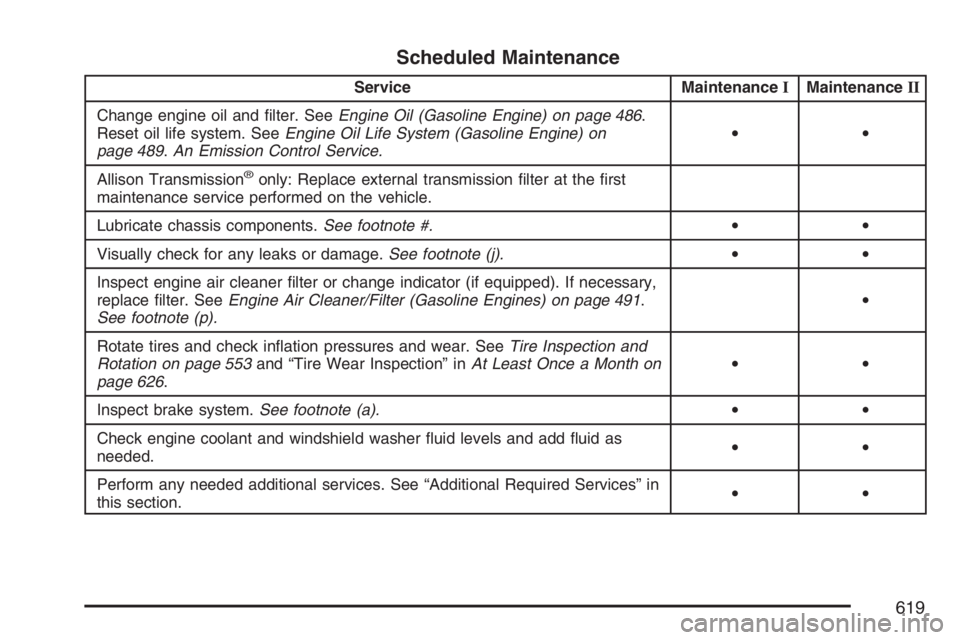
Scheduled Maintenance
Service MaintenanceIMaintenanceII
Change engine oil and lter. SeeEngine Oil (Gasoline Engine) on page 486.
Reset oil life system. SeeEngine Oil Life System (Gasoline Engine) on
page 489.An Emission Control Service.••
Allison Transmission
®only: Replace external transmission lter at the rst
maintenance service performed on the vehicle.
Lubricate chassis components.See footnote #.••
Visually check for any leaks or damage.See footnote (j).••
Inspect engine air cleaner lter or change indicator (if equipped). If necessary,
replace lter. SeeEngine Air Cleaner/Filter (Gasoline Engines) on page 491.
See footnote (p).•
Rotate tires and check ination pressures and wear. SeeTire Inspection and
Rotation on page 553and “Tire Wear Inspection” inAt Least Once a Month on
page 626.••
Inspect brake system.See footnote (a).••
Check engine coolant and windshield washer uid levels and add uid as
needed.••
Perform any needed additional services. See “Additional Required Services” in
this section.••
619
Page 626 of 674
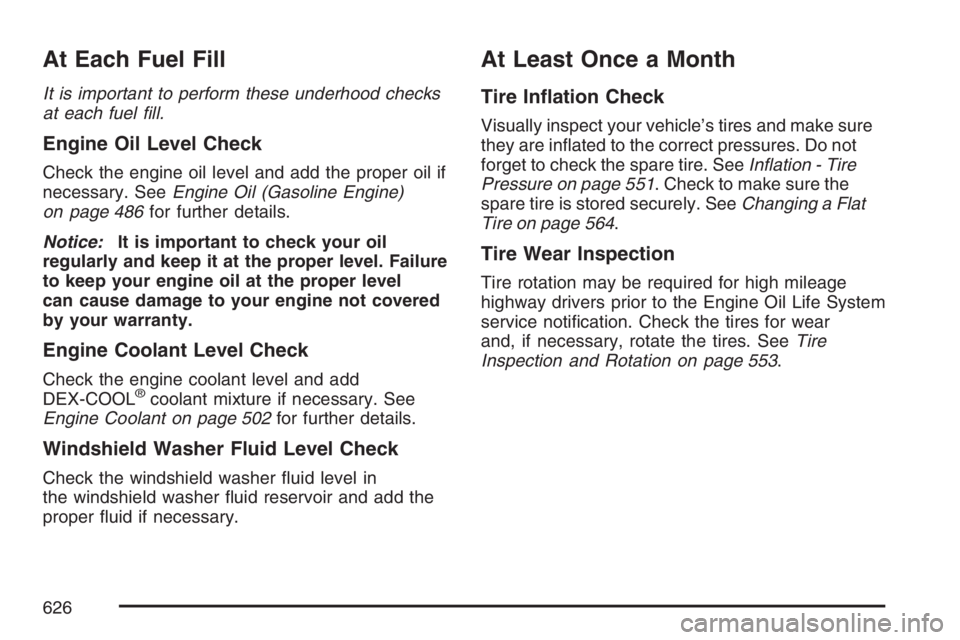
At Each Fuel Fill
It is important to perform these underhood checks
at each fuel ll.
Engine Oil Level Check
Check the engine oil level and add the proper oil if
necessary. SeeEngine Oil (Gasoline Engine)
on page 486for further details.
Notice:It is important to check your oil
regularly and keep it at the proper level. Failure
to keep your engine oil at the proper level
can cause damage to your engine not covered
by your warranty.
Engine Coolant Level Check
Check the engine coolant level and add
DEX-COOL®coolant mixture if necessary. See
Engine Coolant on page 502for further details.
Windshield Washer Fluid Level Check
Check the windshield washer uid level in
the windshield washer uid reservoir and add the
proper uid if necessary.
At Least Once a Month
Tire Ination Check
Visually inspect your vehicle’s tires and make sure
they are inated to the correct pressures. Do not
forget to check the spare tire. SeeInation - Tire
Pressure on page 551. Check to make sure the
spare tire is stored securely. SeeChanging a Flat
Tire on page 564.
Tire Wear Inspection
Tire rotation may be required for high mileage
highway drivers prior to the Engine Oil Life System
service notication. Check the tires for wear
and, if necessary, rotate the tires. SeeTire
Inspection and Rotation on page 553.
626
Page 647 of 674
GMC and General Motors of Canada Limited
reserve the right to limit services or reimbursement
to an owner or driver when, in their sole
discretion, the claims become excessive in
frequency or type of occurrence.
Roadside Assistance is not part of or included in
the coverage provided by the New Vehicle Limited
Warranty. GMC and General Motors of Canada
reserve the right to make any changes or
discontinue the Roadside Assistance program at
any time without notication.
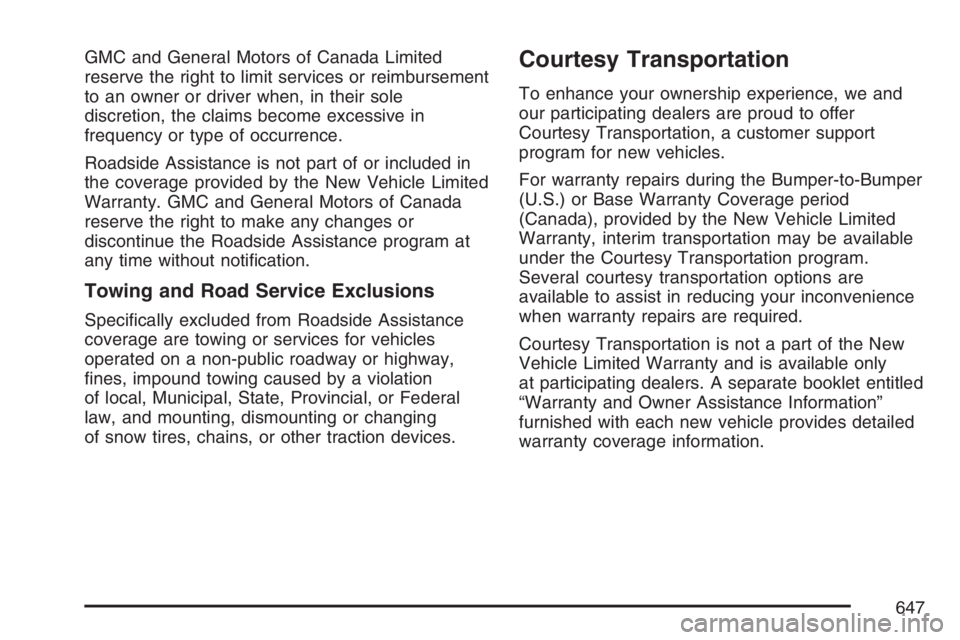
Towing and Road Service Exclusions
Specically excluded from Roadside Assistance
coverage are towing or services for vehicles
operated on a non-public roadway or highway,
nes, impound towing caused by a violation
of local, Municipal, State, Provincial, or Federal
law, and mounting, dismounting or changing
of snow tires, chains, or other traction devices.
Courtesy Transportation
To enhance your ownership experience, we and
our participating dealers are proud to offer
Courtesy Transportation, a customer support
program for new vehicles.
For warranty repairs during the Bumper-to-Bumper
(U.S.) or Base Warranty Coverage period
(Canada), provided by the New Vehicle Limited
Warranty, interim transportation may be available
under the Courtesy Transportation program.
Several courtesy transportation options are
available to assist in reducing your inconvenience
when warranty repairs are required.
Courtesy Transportation is not a part of the New
Vehicle Limited Warranty and is available only
at participating dealers. A separate booklet entitled
“Warranty and Owner Assistance Information”
furnished with each new vehicle provides detailed
warranty coverage information.
647
Page 659 of 674
A
Accessories and Modications..................... 468
Accessory Power Outlet(s).......................... 228
Adding a Snow Plow or Similar
Equipment................................................ 416
Adding Equipment to Your Airbag-Equipped
Vehicle..................................................... 109
Additives, Fuel............................................ 472
Add-On Electrical Equipment....................... 599
Air Cleaner/Filter, Engine............................. 491
Air Conditioning.........................230, 231, 235
Airbag
Off Light.................................................. 248
Passenger Status Indicator....................... 250
Readiness Light....................................... 247
Airbag Sensing and Diagnostic
Module (SDM).......................................... 650
Airbag System............................................... 91
Adding Equipment to Your
Airbag-Equipped Vehicle....................... 109
Airbag Off Switch..................................... 100
How Does an Airbag Restrain?.................. 98
Passenger Sensing System...................... 103
Servicing Your Airbag-Equipped Vehicle.... 108
What Makes an Airbag Inate?.................. 97Airbag System (cont.)
What Will You See After an Airbag
Inates?................................................. 98
When Should an Airbag Inate?................. 95
Where Are the Airbags?............................. 93
AM-FM Radio.............................................. 291
Antenna, Fixed Mast................................... 353
Antenna, XM™ Satellite Radio
Antenna System....................................... 353
Anti-Lock Brake System (ABS).................... 361
Anti-Lock Brake, System Warning Light....... 255
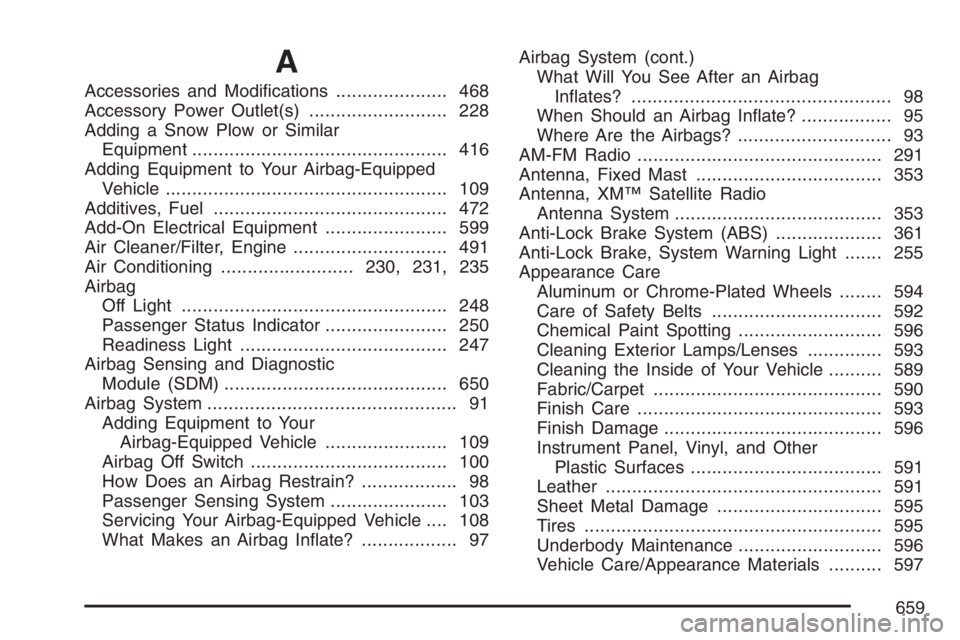
Appearance Care
Aluminum or Chrome-Plated Wheels........ 594
Care of Safety Belts................................ 592
Chemical Paint Spotting........................... 596
Cleaning Exterior Lamps/Lenses.............. 593
Cleaning the Inside of Your Vehicle.......... 589
Fabric/Carpet........................................... 590
Finish Care.............................................. 593
Finish Damage......................................... 596
Instrument Panel, Vinyl, and Other
Plastic Surfaces.................................... 591
Leather.................................................... 591
Sheet Metal Damage............................... 595
Tires........................................................ 595
Underbody Maintenance........................... 596
Vehicle Care/Appearance Materials.......... 597
659