2007 GMC SIERRA CLASSIC engine overheat
[x] Cancel search: engine overheatPage 510 of 674
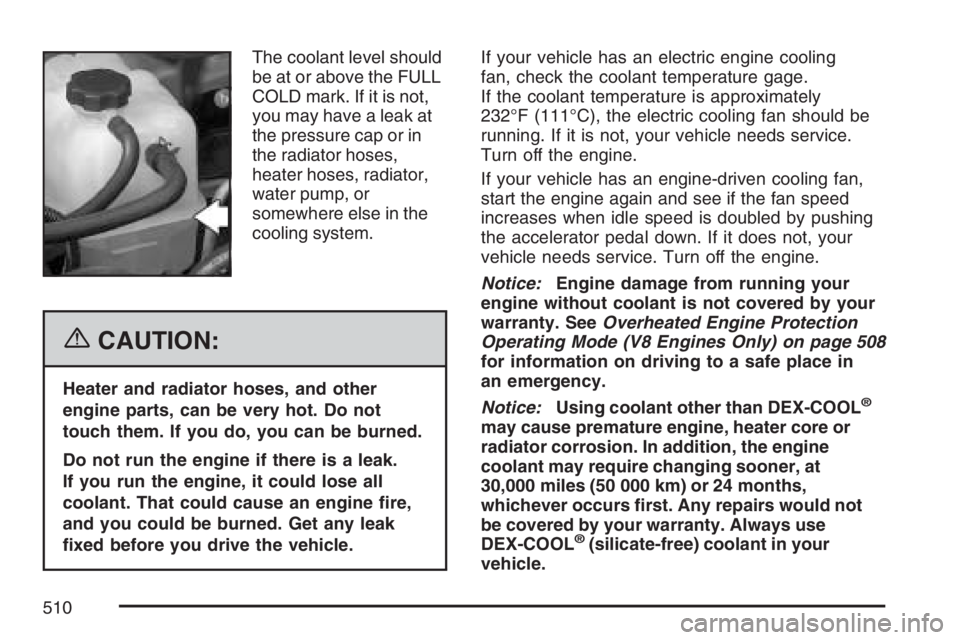
The coolant level should
be at or above the FULL
COLD mark. If it is not,
you may have a leak at
the pressure cap or in
the radiator hoses,
heater hoses, radiator,
water pump, or
somewhere else in the
cooling system.
{CAUTION:
Heater and radiator hoses, and other
engine parts, can be very hot. Do not
touch them. If you do, you can be burned.
Do not run the engine if there is a leak.
If you run the engine, it could lose all
coolant. That could cause an engine re,
and you could be burned. Get any leak
xed before you drive the vehicle.If your vehicle has an electric engine cooling
fan, check the coolant temperature gage.
If the coolant temperature is approximately
232°F (111°C), the electric cooling fan should be
running. If it is not, your vehicle needs service.
Turn off the engine.
If your vehicle has an engine-driven cooling fan,
start the engine again and see if the fan speed
increases when idle speed is doubled by pushing
the accelerator pedal down. If it does not, your
vehicle needs service. Turn off the engine.
Notice:Engine damage from running your
engine without coolant is not covered by your
warranty. SeeOverheated Engine Protection
Operating Mode (V8 Engines Only) on page 508
for information on driving to a safe place in
an emergency.
Notice:Using coolant other than DEX-COOL®
may cause premature engine, heater core or
radiator corrosion. In addition, the engine
coolant may require changing sooner, at
30,000 miles (50 000 km) or 24 months,
whichever occurs rst. Any repairs would not
be covered by your warranty. Always use
DEX-COOL
®(silicate-free) coolant in your
vehicle.
510
Page 512 of 674

{CAUTION:
Adding only plain water to your cooling
system can be dangerous. Plain water, or
some other liquid such as alcohol, can
boil before the proper coolant mixture will.
Your vehicle’s coolant warning system is
set for the proper coolant mixture. With
plain water or the wrong mixture, your
engine could get too hot but you would
not get the overheat warning. Your engine
could catch re and you or others could
be burned. Use a 50/50 mixture of clean,
drinkable water and a proper coolant.
Notice:In cold weather, water can freeze and
crack the engine, radiator, heater core and
other parts. Use the recommended coolant and
the proper coolant mixture.
{CAUTION:
You can be burned if you spill coolant
on hot engine parts. Coolant contains
ethylene glycol and it will burn if the
engine parts are hot enough. Do not spill
coolant on a hot engine.
1. You can remove the
coolant surge tank
pressure cap when
the cooling system,
including the coolant
surge tank pressure
cap and upper
radiator hose, is no
longer hot.
Turn the pressure cap slowly counterclockwise
about one full turn. If you hear a hiss, wait
for that to stop. A hiss means there is
still some pressure left.
512
Page 552 of 674

How to Check
Use a good quality pocket-type gage to check
tire pressure. You cannot tell if your tires are
properly inated simply by looking at them.
Radial tires may look properly inated even when
they’re underinated. Check the tire’s ination
pressure when the tires are cold. Cold means your
vehicle has been sitting for at least three hours
or driven no more than 1 mile (1.6 km).
Remove the valve cap from the tire valve stem.
Press the tire gage rmly onto the valve to
get a pressure measurement. If the cold tire
ination pressure matches the recommended
pressure on the Tire and Loading Information
label, no further adjustment is necessary. If the
ination pressure is low, add air until you reach the
recommended amount.
If you overll the tire, release air by pushing on
the metal stem in the center of the tire valve.
Recheck the tire pressure with the tire gage.
Be sure to put the valve caps back on the valve
stems. They help prevent leaks by keeping out dirt
and moisture.
Dual Tire Operation
When the vehicle is new, or whenever a wheel,
wheel bolt or wheel nut is replaced, check the
wheel nut torque after 100, 1,000 and 6,000 miles
(160, 1 600 and 10 000 km) of driving. For proper
torque and wheel nut tightening information, see
Removing the Spare Tire and Tools on page 566.
The outer tire on a dual wheel setup generally
wears faster than the inner tire. Your tires will wear
more evenly and last longer if you rotate the
tires periodically, seeTire Inspection and Rotation
on page 553. Also seeScheduled Maintenance
(Gasoline Engine) on page 617.
{CAUTION:
If you operate your vehicle with a tire
that is badly underinated, the tire can
overheat. An overheated tire can lose air
suddenly or catch re. You or others
could be injured. Be sure all tires
(including the spare) are properly inated.
SeeInation - Tire Pressure on page 551, for
information on proper tire ination.
552
Page 664 of 674
Engine (cont.)
Check and Service Engine Soon Light..... 258
Coolant.................................................... 502
Coolant Heater......................................... 139
Coolant Temperature Gage...................... 256
Drive Belt Routing.................................... 633
Engine Compartment Overview................ 480
Exhaust................................................... 174
Fan Noise................................................ 514
Oil ........................................................... 486
Oil Life System........................................ 489
Overheated Protection Operating Mode.... 508
Overheating............................................. 505
Starting.................................................... 137
Entry Lighting.............................................. 227
Event Data Recorders (EDR)...................... 650
Exit Lighting................................................ 227
Extender, Safety Belt..................................... 43
F
Filter
Engine Air Cleaner................................... 491
Finish Damage............................................ 596
Fixed Mast Antenna.................................... 353
Flashers, Hazard Warning........................... 212Flash-to-Pass.............................................. 216
Flat Tire...................................................... 563
Flat Tire, Changing...................................... 564
Flat Tire, Storing......................................... 584
Fluid
Automatic Transmission...................494, 497
Manual Transmission................................ 500
Power Steering........................................ 515
Windshield Washer.................................. 516
Fog Lamps.................................................. 225
Four-Wheel Drive...............................153, 528
Four-Wheel-Drive Light................................ 263
Front Axle................................................... 529
Front Reading Lamps.................................. 227
Front Storage Area...................................... 202
Fuel............................................................ 470
Additives.................................................. 472
California Fuel.......................................... 471
E85 (85% Ethanol)................................... 473
Filling a Portable Fuel Container.............. 477
Filling Your Tank...................................... 474
Fuels in Foreign Countries....................... 474
Gage....................................................... 264
Gasoline Octane...................................... 470
Gasoline Specications............................ 471
Low Warning Light................................... 265
664
Page 669 of 674
Overheated Engine Protection
Operating Mode....................................... 508
Owner Checks and Services....................... 625
Owners, Canadian.......................................... 3
P
Paint, Damage............................................ 596
Park (P)
Shifting Into............................................. 170
Shifting Out of......................................... 172
Parking
Brake....................................................... 169
Over Things That Burn............................ 173
Passenger Airbag Status Indicator............... 250
Passenger Sensing System......................... 103
Passing....................................................... 369
Passlock
®.................................................... 133
Pickup Conversion to Chassis Cab.............. 423
Power
Accessory Outlet(s).................................. 228
Door Locks.............................................. 121
Electrical System..................................... 599
Lumbar Controls........................................ 11
Retained Accessory (RAP)....................... 137
Seat.......................................................... 10Power (cont.)
Steering Fluid.......................................... 515
Windows.................................................. 130
Programmable Automatic Door Locks.......... 123
Q
Questions and Answers About Safety Belts ... 26
R
Radios........................................................ 289
AM-FM Radio.......................................... 291
Care of Your Cassette Tape Player.......... 350
Care of Your CD and DVD Player............ 352
Care of Your CDs and DVDs................... 352
Radio with Cassette and CD.................... 304
Radio with CD......................................... 294
Radio with Six-Disc CD............................ 318
Rear Seat Audio...................................... 347
Setting the Time for Radios with Radio
Data Systems (RDS)............................ 291
Setting the Time for Radios without
Radio Data Systems (RDS).................. 290
Theft-Deterrent......................................... 348
Understanding Reception......................... 350
669