2007 GMC SIERRA CLASSIC service indicator
[x] Cancel search: service indicatorPage 279 of 674
SERVICE CHARGING SYSTEM
On some vehicles, if there is a problem with the
battery charging system, this message will appear
on the DIC. Under certain conditions, the battery
warning light may also turn on in the instrument
panel cluster. SeeBattery Warning Light on
page 253. The battery will not be charging at an
optimal rate and the vehicle will lose the ability
to enter the fuel economy mode. The vehicle
is safe to drive, however you should have
the electrical system checked by your dealer.
Pressing any of the four DIC buttons will
acknowledge the message and clear it from the
DIC display. If your vehicle does not have the four
DIC buttons, pressing the trip odometer reset
stem will acknowledge the message and clear it
from the DIC display.
TIGHTEN FUEL CAP
If the vehicle’s fuel cap is not tightened properly,
this message may appear along with the check
engine light on the instrument panel. See
Malfunction Indicator Lamp on page 258. Fully
reinstall the fuel cap. SeeFilling the Tank
on page 474. The diagnostic system can determine
if the fuel cap has been left off or improperly
installed. A loose or missing fuel cap will allow fuel
to evaporate into the atmosphere. A few driving
trips with the cap properly installed should turn the
light and message off.
TRACTION ACTIVE
When the traction control system had detected
that any of the vehicle’s wheels are slipping,
the traction control system will activate and this
message will appear on the DIC. For more
information, seeTraction Assist System (TAS) on
page 363.
279
Page 338 of 674
DVD Player
The DVD player is located in the overhead
console. The DVD player can be controlled by the
buttons on the DVD player and/or by the buttons
on the remote control. See “Remote Control” later
in this section for more information.
The DVD player power may be turned on when
the ignition is in RUN, ACCESSORY, or when
Retained Accessory Power (RAP) is active.
The RSE system DVD player is only compatible
with DVDs of the appropriate region code for the
country that the vehicle was sold in. The DVD
region code is printed on the jacket of most DVDs.
Standard audio CDs, CD-R, CD-RW, Video CD
and Photo CD/CD-R media are fully supported by
this DVD player. DVD-R and DVD-RW media
is supported if formatted as DVD-Video. DVD+R
and DVD+RW media may or may not be supported
by the DVD player. The DVD player does not
support DVD-RAM, DVD-ROM, and DVD Audio
media. An error message will appear on the
display if this type of media is inserted into the
DVD player.When using the wired headphones, not included, if
the front seat passengers play a CD in the Radio
with Six-Disc CD (if equipped) or use XM™ Satellite
Radio Service (if equipped), you will hear the audio
for these sources, instead of the DVD or CD that is
currently playing through the RSE.
If an error message appears on the video screen,
see “DVD Messages” later in this section.
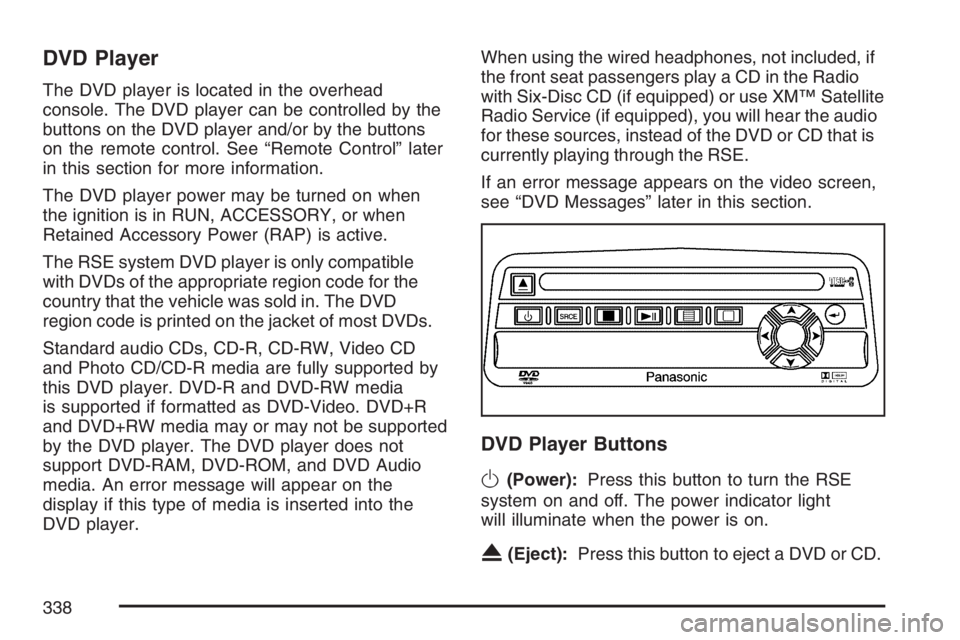
DVD Player Buttons
O(Power):Press this button to turn the RSE
system on and off. The power indicator light
will illuminate when the power is on.
X(Eject):Press this button to eject a DVD or CD.
338
Page 352 of 674
A non-scrubbing action, wet-type cleaner which
uses a cassette with a fabric belt to clean the tape
head can be used. This type of cleaning cassette
will not eject on its own. A non-scrubbing
action cleaner may not clean as thoroughly as the
scrubbing type cleaner. The use of a
non-scrubbing action, dry-type cleaning cassette is
not recommended.
After the player is cleaned, press and hold the
eject button for ve seconds to reset the CLEAN
indicator. The radio will display --- or CLEANED to
show the indicator was reset.
Cassettes are subject to wear and the sound
quality may degrade over time. Always make sure
the cassette tape is in good condition before
the tape player is serviced.Care of Your CDs and DVDs
Handle CDs carefully. Store them in their original
cases or other protective cases and away from
direct sunlight and dust. The CD player scans the
bottom surface of the disc. If the surface of a
CD is damaged, such as cracked, broken,
or scratched, the CD will not play properly or not
at all. If the surface of a CD is soiled, take a
soft, lint free cloth or dampen a clean, soft cloth in
a mild, neutral detergent solution mixed with
water, and clean it. Make sure the wiping process
starts from the center to the edge.
Do not touch the bottom side of a CD while
handling it; this could damage the surface. Pick up
CDs by grasping the outer edges or the edge of
the hole and the outer edge.
Care of the CD and DVD Player
The use of CD lens cleaners for CDs is not
advised, due to the risk of contaminating the lens
of the CD optics with lubricants internal to the
CD mechanism.
352
Page 471 of 674
If your vehicle has the 6.0L V8 engine
(VIN Code N), use premium unleaded gasoline
with a posted octane rating of 91 or higher.
You may also use regular unleaded gasoline rated
at 87 octane or higher, but your vehicle’s
acceleration may be slightly reduced, and you
may notice a slight audible knocking noise,
commonly referred to as spark knock. If the octane
is less than 87, you may notice a heavy knocking
noise when you drive. If this occurs, use a
gasoline rated at 87 octane or higher as soon as
possible. Otherwise, you might damage your
engine. If you are using gasoline rated at
87 octane or higher and you hear heavy knocking,
your engine needs service.
Gasoline Specications
At a minimum, gasoline should meet ASTM
specication D 4814 in the United States or
CAN/CGSB-3.5 in Canada. Some gasolines may
contain an octane-enhancing additive called
methylcyclopentadienyl manganese tricarbonyl
(MMT). General Motors recommends against the
use of gasolines containing MMT. SeeAdditives
on page 472for additional information.
California Fuel
If your vehicle is certied to meet California
Emissions Standards, it is designed to operate on
fuels that meet California specications. See the
underhood emission control label. If this fuel is not
available in states adopting California emissions
standards, your vehicle will operate satisfactorily on
fuels meeting federal specications, but emission
control system performance may be affected. The
malfunction indicator lamp may turn on and your
vehicle may fail a smog-check test. SeeMalfunction
Indicator Lamp on page 258. If this occurs, return to
your authorized GM dealer for diagnosis. If it is
determined that the condition is caused by the type
of fuel used, repairs may not be covered by your
warranty.
471
Page 472 of 674

Additives
To provide cleaner air, all gasolines in the United
States are now required to contain additives
that will help prevent engine and fuel system
deposits from forming, allowing your emission
control system to work properly. In most cases,
you should not have to add anything to your
fuel. However, some gasolines contain only the
minimum amount of additive required to meet U.S.
Environmental Protection Agency regulations.
To help keep fuel injectors and intake valves clean,
or if your vehicle experiences problems due to
dirty injectors or valves, look for gasoline that is
advertised as TOP TIER Detergent Gasoline.
Also, your GM dealer has additives that will help
correct and prevent most deposit-related problems.
Gasolines containing oxygenates, such as
ethers and ethanol, and reformulated gasolines
may be available in your area. General Motors
recommends that you use these gasolines if they
comply with the specications described earlier.
However, E85 (85% ethanol) and other fuels
containing more than 10% ethanol must not be
used in vehicles that were not designed for
those fuels.Notice:Your vehicle was not designed for
fuel that contains methanol. Do not use
fuel containing methanol. It can corrode metal
parts in your fuel system and also damage
the plastic and rubber parts. That damage
would not be covered under your warranty.
Some gasolines that are not reformulated for low
emissions may contain an octane-enhancing
additive called methylcyclopentadienyl manganese
tricarbonyl (MMT); ask the attendant where you
buy gasoline whether the fuel contains MMT.
General Motors recommends against the use of
such gasolines. Fuels containing MMT can reduce
the life of spark plugs and the performance of
the emission control system may be affected. The
malfunction indicator lamp may turn on. If this
occurs, return to your authorized GM dealer
for service.
472
Page 519 of 674

Brake Wear
Your vehicle has front disc brakes and may have
rear drum brakes or rear disc brakes.
Disc brake pads have built-in wear indicators that
make a high-pitched warning sound when the
brake pads are worn and new pads are needed.
The sound may come and go or be heard all
the time your vehicle is moving, except when you
are pushing on the brake pedal rmly.
{CAUTION:
The brake wear warning sound means that
soon your brakes will not work well. That
could lead to an accident. When you hear
the brake wear warning sound, have your
vehicle serviced.
Notice:Continuing to drive with worn-out
brake pads could result in costly brake repair.
Some driving conditions or climates may cause
a brake squeal when the brakes are rst applied or
lightly applied. This does not mean something is
wrong with your brakes.Properly torqued wheel nuts are necessary to help
prevent brake pulsation. When tires are rotated,
inspect brake pads for wear and evenly tighten
wheel nuts in the proper sequence to GM torque
specications.
If you have rear drum brakes, they do not have
wear indicators, but if you ever hear a rear brake
rubbing noise, have the rear brake linings
inspected immediately. Rear brake drums should
be removed and inspected each time the tires
are removed for rotation or changing. Drum brakes
have an inspection hole to inspect lining wear
during scheduled maintenance. When you have
the front brake pads replaced, have the rear
brakes inspected, too.
Brake linings should always be replaced as
complete axle sets.
Brake Pedal Travel
See your dealer if the brake pedal does not return
to normal height, or if there is a rapid increase in
pedal travel. This could be a sign of brake trouble.
Brake Adjustment
Every time you make a brake stop, your brakes
adjust for wear.
519
Page 619 of 674
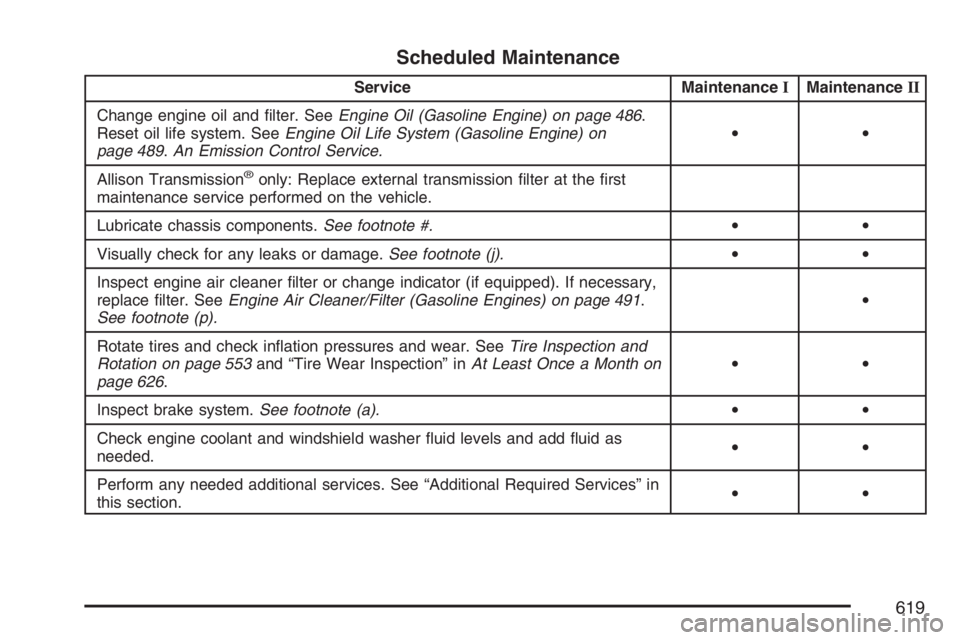
Scheduled Maintenance
Service MaintenanceIMaintenanceII
Change engine oil and lter. SeeEngine Oil (Gasoline Engine) on page 486.
Reset oil life system. SeeEngine Oil Life System (Gasoline Engine) on
page 489.An Emission Control Service.••
Allison Transmission
®only: Replace external transmission lter at the rst
maintenance service performed on the vehicle.
Lubricate chassis components.See footnote #.••
Visually check for any leaks or damage.See footnote (j).••
Inspect engine air cleaner lter or change indicator (if equipped). If necessary,
replace lter. SeeEngine Air Cleaner/Filter (Gasoline Engines) on page 491.
See footnote (p).•
Rotate tires and check ination pressures and wear. SeeTire Inspection and
Rotation on page 553and “Tire Wear Inspection” inAt Least Once a Month on
page 626.••
Inspect brake system.See footnote (a).••
Check engine coolant and windshield washer uid levels and add uid as
needed.••
Perform any needed additional services. See “Additional Required Services” in
this section.••
619
Page 621 of 674
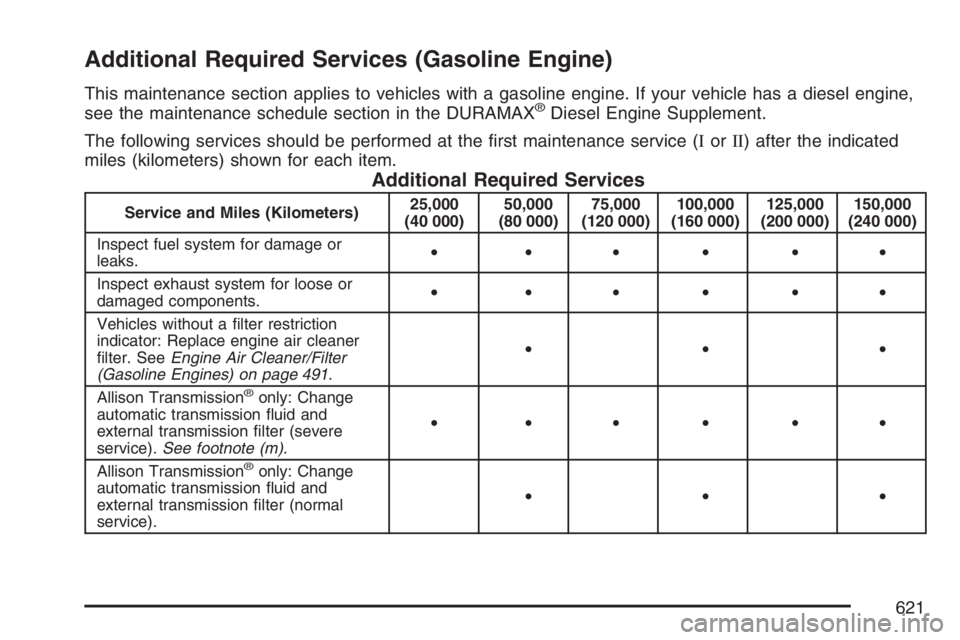
Additional Required Services (Gasoline Engine)
This maintenance section applies to vehicles with a gasoline engine. If your vehicle has a diesel engine,
see the maintenance schedule section in the DURAMAX®Diesel Engine Supplement.
The following services should be performed at the rst maintenance service (IorII) after the indicated
miles (kilometers) shown for each item.
Additional Required Services
Service and Miles (Kilometers)25,000
(40 000)50,000
(80 000)75,000
(120 000)100,000
(160 000)125,000
(200 000)150,000
(240 000)
Inspect fuel system for damage or
leaks.• •••••
Inspect exhaust system for loose or
damaged components.• •••••
Vehicles without a lter restriction
indicator: Replace engine air cleaner
lter. SeeEngine Air Cleaner/Filter
(Gasoline Engines) on page 491.•••
Allison Transmission
®only: Change
automatic transmission uid and
external transmission lter (severe
service).See footnote (m).• •••••
Allison Transmission
®only: Change
automatic transmission uid and
external transmission lter (normal
service).•••
621