Page 383 of 674
Q:What should I do if my vehicle stalls,
or is about to stall, and I cannot make it
up the hill?
A:If this happens, there are some things you
should do, and there are some things you
must not do. First, here is what youshoulddo:
Push the brake pedal to stop the vehicle
and keep it from rolling backwards. Also, apply
the parking brake.
If the engine is still running, shift the
transmission to REVERSE (R), release the
parking brake, and slowly back down the
hill in REVERSE (R).
If the engine has stopped running, you will
need to restart it. With the brake pedal
pressed and the parking brake still applied,
shift the transmission to PARK (P), or shift to
NEUTRAL if your vehicle has a manual
transmission, and restart the engine. Then,
shift to REVERSE (R), release the parking
brake, and slowly back down the hill as
straight as possible in REVERSE (R).
As you are backing down the hill, put your left
hand on the steering wheel at the 12 o’clock
position. This way, you will be able to tell if the
wheels are straight and maneuver as you back
down. It is best that you back down the hill with
the wheels straight rather than in the left or right
direction. Turning the wheel too far to the left or
right will increase the possibility of a rollover.
Here are some things youmust notdo if you stall,
or are about to stall, when going up a hill.
Never attempt to prevent a stall by shifting into
NEUTRAL (N), or pressing the clutch if your
vehicle has a manual transmission, to rev-up
the engine and regain forward momentum. This
will not work. Your vehicle will roll backwards
very quickly and you could go out of control.
Instead, apply the regular brake to stop the
vehicle. Then apply the parking brake. Shift to
REVERSE (R), release the parking brake, and
slowly back straight down.
Never attempt to turn around if you are about to
stall when going up a hill. If the hill is steep
enough to stall your vehicle, it is steep enough
to cause you to roll over if you turn around.
If you cannot make it up the hill, you must back
straight down the hill.
383
Page 475 of 674
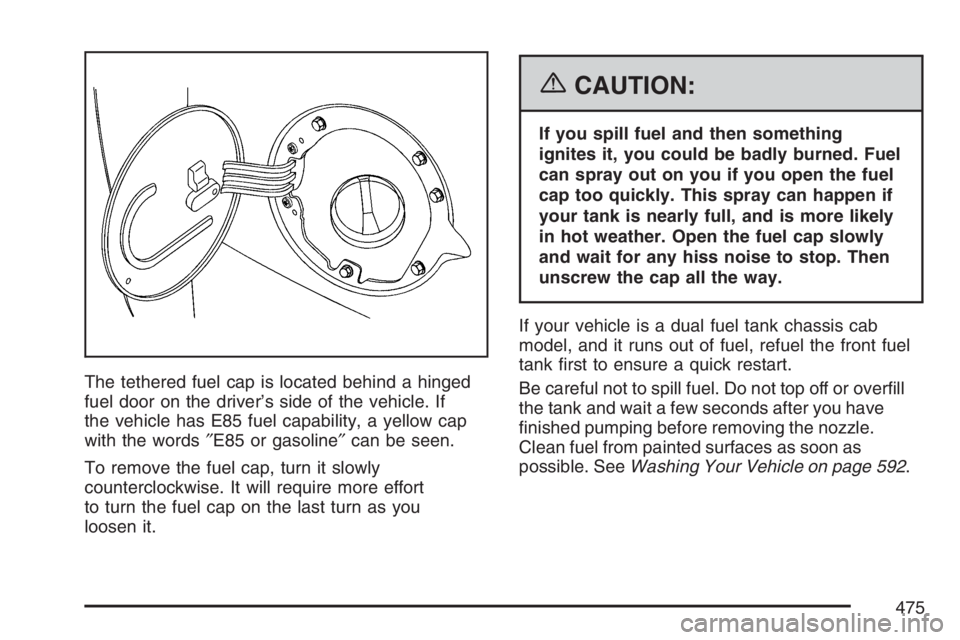
The tethered fuel cap is located behind a hinged
fuel door on the driver’s side of the vehicle. If
the vehicle has E85 fuel capability, a yellow cap
with the words″E85 or gasoline″can be seen.
To remove the fuel cap, turn it slowly
counterclockwise. It will require more effort
to turn the fuel cap on the last turn as you
loosen it.
{CAUTION:
If you spill fuel and then something
ignites it, you could be badly burned. Fuel
can spray out on you if you open the fuel
cap too quickly. This spray can happen if
your tank is nearly full, and is more likely
in hot weather. Open the fuel cap slowly
and wait for any hiss noise to stop. Then
unscrew the cap all the way.
If your vehicle is a dual fuel tank chassis cab
model, and it runs out of fuel, refuel the front fuel
tank rst to ensure a quick restart.
Be careful not to spill fuel. Do not top off or overll
the tank and wait a few seconds after you have
nished pumping before removing the nozzle.
Clean fuel from painted surfaces as soon as
possible. SeeWashing Your Vehicle on page 592.
475
Page 476 of 674
When replacing the fuel cap, turn it clockwise until it
clicks. It will require more effort to turn the fuel cap
on the last turn as you tighten it. Make sure the
cap is fully installed. The diagnostic system can
determine if the fuel cap has been left off or
improperly installed. This would allow fuel to
evaporate into the atmosphere. SeeMalfunction
Indicator Lamp on page 258.
The TIGHTEN FUEL CAP message will be
displayed on the Driver Information Center (DIC) if
the fuel cap is not properly installed. SeeDIC
Warnings and Messages on page 270for more
information.
{CAUTION:
If a re starts while you are refueling, do
not remove the nozzle. Shut off the ow
of fuel by shutting off the pump or by
notifying the station attendant. Leave the
area immediately.
Notice:If you need a new fuel cap, be sure to
get the right type. Your dealer can get one
for you. If you get the wrong type, it may not
t properly. This may cause your malfunction
indicator lamp to light and may damage
your fuel tank and emissions system. See
Malfunction Indicator Lamp on page 258.
476
Page 512 of 674

{CAUTION:
Adding only plain water to your cooling
system can be dangerous. Plain water, or
some other liquid such as alcohol, can
boil before the proper coolant mixture will.
Your vehicle’s coolant warning system is
set for the proper coolant mixture. With
plain water or the wrong mixture, your
engine could get too hot but you would
not get the overheat warning. Your engine
could catch re and you or others could
be burned. Use a 50/50 mixture of clean,
drinkable water and a proper coolant.
Notice:In cold weather, water can freeze and
crack the engine, radiator, heater core and
other parts. Use the recommended coolant and
the proper coolant mixture.
{CAUTION:
You can be burned if you spill coolant
on hot engine parts. Coolant contains
ethylene glycol and it will burn if the
engine parts are hot enough. Do not spill
coolant on a hot engine.
1. You can remove the
coolant surge tank
pressure cap when
the cooling system,
including the coolant
surge tank pressure
cap and upper
radiator hose, is no
longer hot.
Turn the pressure cap slowly counterclockwise
about one full turn. If you hear a hiss, wait
for that to stop. A hiss means there is
still some pressure left.
512
Page 533 of 674
Headlamps
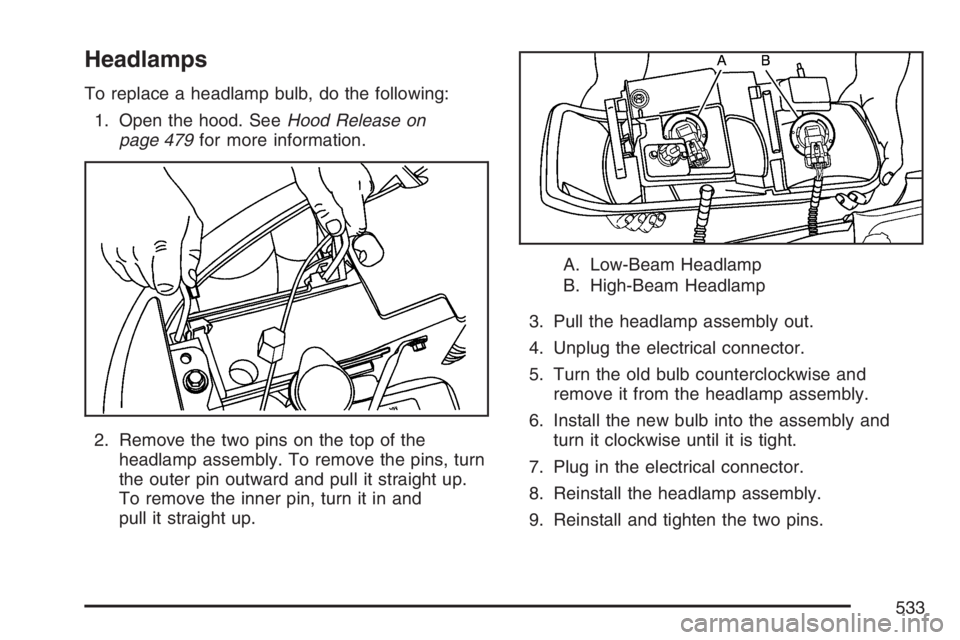
To replace a headlamp bulb, do the following:
1. Open the hood. SeeHood Release on
page 479for more information.
2. Remove the two pins on the top of the
headlamp assembly. To remove the pins, turn
the outer pin outward and pull it straight up.
To remove the inner pin, turn it in and
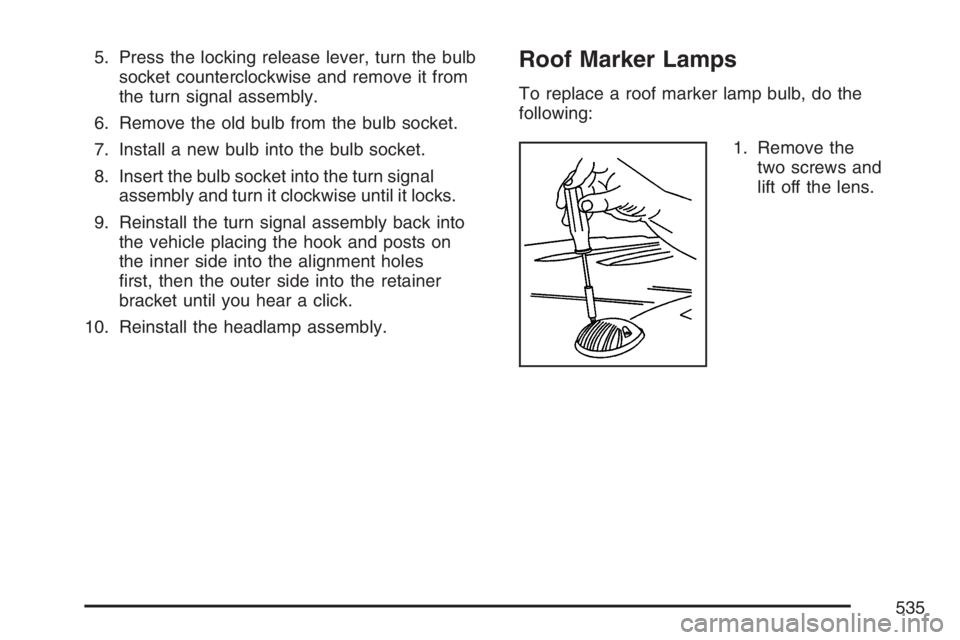
pull it straight up.A. Low-Beam Headlamp
B. High-Beam Headlamp
3. Pull the headlamp assembly out.
4. Unplug the electrical connector.
5. Turn the old bulb counterclockwise and
remove it from the headlamp assembly.
6. Install the new bulb into the assembly and
turn it clockwise until it is tight.
7. Plug in the electrical connector.
8. Reinstall the headlamp assembly.
9. Reinstall and tighten the two pins.
533
Page 535 of 674
5. Press the locking release lever, turn the bulb
socket counterclockwise and remove it from
the turn signal assembly.
6. Remove the old bulb from the bulb socket.
7. Install a new bulb into the bulb socket.
8. Insert the bulb socket into the turn signal
assembly and turn it clockwise until it locks.
9. Reinstall the turn signal assembly back into
the vehicle placing the hook and posts on
the inner side into the alignment holes
rst, then the outer side into the retainer
bracket until you hear a click.
10. Reinstall the headlamp assembly.Roof Marker Lamps
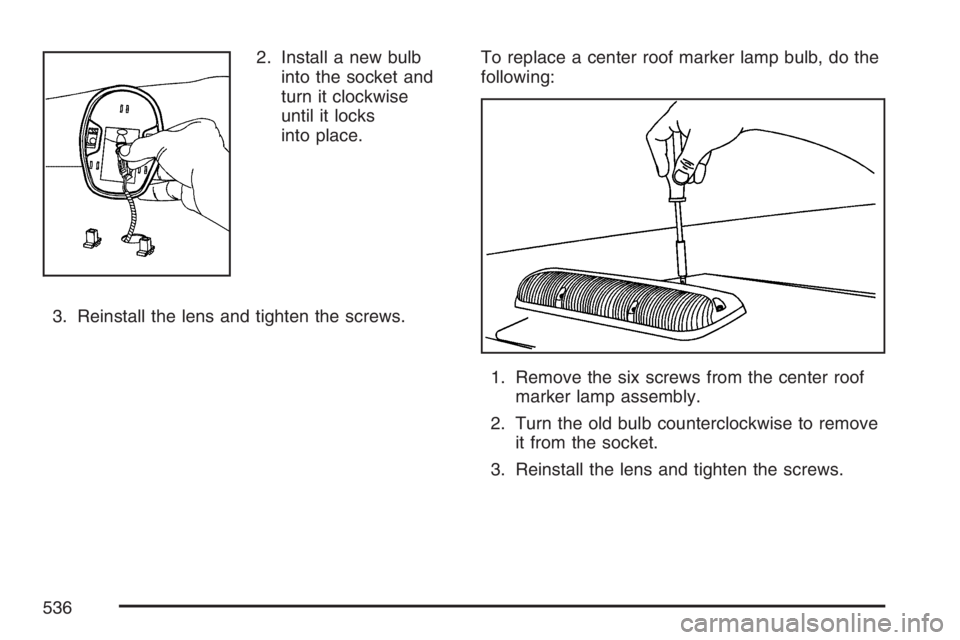
To replace a roof marker lamp bulb, do the
following:
1. Remove the
two screws and
lift off the lens.
535
Page 536 of 674
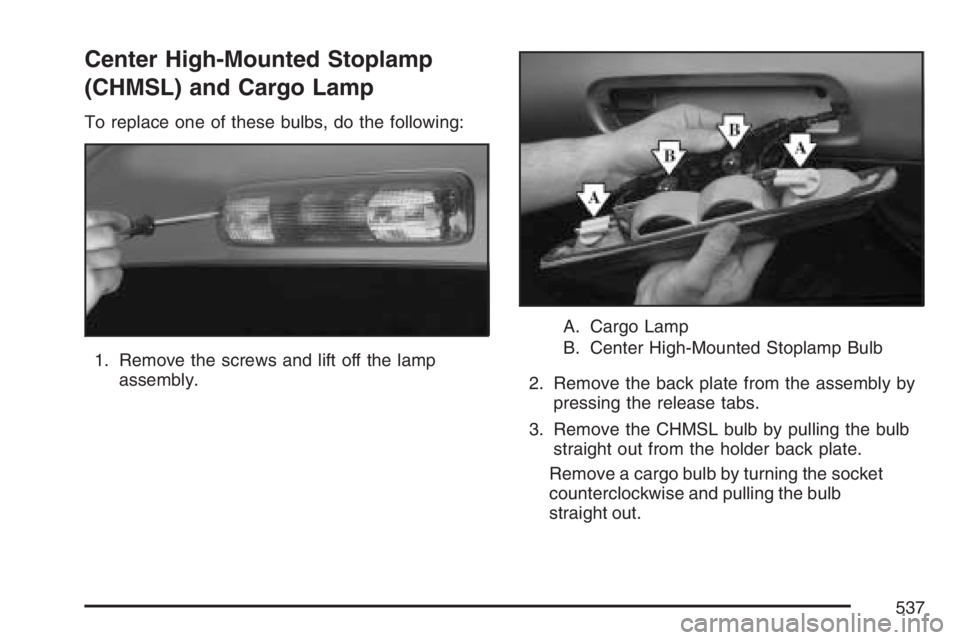
2. Install a new bulb
into the socket and
turn it clockwise
until it locks
into place.
3. Reinstall the lens and tighten the screws.To replace a center roof marker lamp bulb, do the
following:
1. Remove the six screws from the center roof
marker lamp assembly.
2. Turn the old bulb counterclockwise to remove
it from the socket.
3. Reinstall the lens and tighten the screws.
536
Page 537 of 674
Center High-Mounted Stoplamp
(CHMSL) and Cargo Lamp
To replace one of these bulbs, do the following:
1. Remove the screws and lift off the lamp
assembly.A. Cargo Lamp
B. Center High-Mounted Stoplamp Bulb
2. Remove the back plate from the assembly by
pressing the release tabs.
3. Remove the CHMSL bulb by pulling the bulb
straight out from the holder back plate.
Remove a cargo bulb by turning the socket
counterclockwise and pulling the bulb
straight out.
537