Page 54 of 674
Securing an Add-on Child Restraint in
the Vehicle
{CAUTION:
A child can be seriously injured or killed
in a crash if the child restraint is not
properly secured in the vehicle. Make sure
the child restraint is properly installed in
the vehicle using the vehicle’s safety belt
or LATCH system, following the
instructions that came with that restraint,
and also the instructions in this manual.
To help reduce the chance of injury, the child
restraint must be secured in the vehicle. Child
restraint systems must be secured in vehicle seats
by lap belts or the lap belt portion of a lap-shoulder
belt, or by the LATCH system. SeeLower
Anchors and Tethers for Children (LATCH) on
page 58for more information. A child can
be endangered in a crash if the child restraint is
not properly secured in the vehicle.When securing an add-on child restraint, refer to
the instructions that come with the restraint which
may be on the restraint itself or in a booklet, or both,
and to this manual. The child restraint instructions
are important, so if they are not available, obtain a
replacement copy from the manufacturer.
Keep in mind that an unsecured child restraint can
move around in a collision or sudden stop and
injure people in the vehicle. Be sure to properly
secure any child restraint in your vehicle — even
when no child is in it.
Securing the Child Within the Child
Restraint
There are several systems for securing the child
within the child restraint. One system, the
three-point harness, has straps that come down
over each of the infant’s shoulders and buckle
together at the crotch. The ve-point harness
system has two shoulder straps, two hip straps, and
a crotch strap. A shield may take the place of hip
straps. A T-shaped shield has shoulder straps that
are attached to a at pad which rests low against
the child’s body. A shelf- or armrest-type shield has
straps that are attached to a wide, shelf-like shield
that swings up or to the side.
54
Page 55 of 674
{CAUTION:
A child can be seriously injured or killed
in a crash if the child is not properly
secured in the child restraint. Make sure
the child is properly secured, following
the instructions that came with that
restraint.
Because there are different systems, it is important
to refer to the instructions that come with the
restraint. A child can be endangered in a crash if
the child is not properly secured in the child
restraint.
Where to Put the Restraint
Accident statistics show that children are safer
if they are restrained in the rear rather than
the front seat.
We recommend that child restraints be secured in
a rear seat including an infant riding in a
rear-facing infant seat, a child riding in a
forward-facing child seat and an older child riding
in a booster seat.
Your vehicle may have a label on your sun visor
that says, “Never put a rear-facing child seat in the
front.” This is because the risk to the rear-facing
child is so great, if the airbag deploys.
Never put a child in a rear-facing child restraint in
the right front passenger seat unless your
vehicle has the passenger sensing system or an
airbag off switch and the passenger airbag
status indicator or the airbag off light shows off.
55
Page 56 of 674
Never put a rear facing child restraint in the right
front passenger seat unless the airbag is off.
Here is why:
{CAUTION:
A child in a rear-facing child restraint can
be seriously injured or killed if the right
front passenger’s airbag inates. This is
because the back of the rear-facing child
restraint would be very close to the
inating airbag. Be sure the airbag is off
before using a rear-facing child restraint
in the right front seat position.
CAUTION: (Continued)
CAUTION: (Continued)
Even though the passenger sensing
system or airbag off switch are designed
to turn off the passenger’s frontal airbag
under certain conditions, no system is
fail-safe, and no one can guarantee that
an airbag will not deploy under some
unusual circumstance, even though it is
turned off. General Motors recommends
that rear-facing child restraints be
transported in vehicles with a rear seat
that will accommodate a rear-facing child
restraint, whenever possible.
If you need to secure a forward-facing
child restraint in the right front seat,
always move the front passenger seat as
far back as it will go. It is better to secure
the child restraint in a rear seat.
56
Page 57 of 674
{CAUTION:
A child in a child restraint in the center
front seat can be badly injured or killed by
the right front passenger’s airbag if it
inates. Never secure a child restraint in
the center front seat. It is always better to
secure a child restraint in the rear seat.
Do not use child restraints in the center front seat
position. The restraints will not work properly.
There is limited space in the rear seating area of
an extended cab model. If you want to secure
a child restraint in a rear seating position of
an extended cab model, especially in the rear
center position, be sure to study the instructions
that came with your child restraint to see if there is
enough room to secure your seat properly.If your vehicle has the passenger sensing system
or the airbag off switch and you need to secure
a rear-facing child restraint in the right front
passenger’s seat, the passenger’s frontal airbag
must be off. SeePassenger Sensing System
on page 103,Airbag Off Switch on page 100,
Securing a Child Restraint in the Right Front Seat
Position (Regular and Extended Cab) (With
Airbag Off Switch) on page 78orSecuring a Child
Restraint in the Right Front Seat Position
(Regular and Extended Cab) (With Passenger
Sensing System) on page 85for more on
this including important safety information.
Wherever you install a child restraint, be sure to
secure the child restraint properly.
Keep in mind that an unsecured child restraint can
move around in a collision or sudden stop and
injure people in the vehicle. Be sure to properly
secure any child restraint in your vehicle — even
when no child is in it.
57
Page 58 of 674
Lower Anchors and Tethers for
Children (LATCH)
The LATCH system holds a child restraint during
driving or in a crash. This system is designed
to make installation of a child restraint easier. The
LATCH system uses anchors in the vehicle and
attachments on the child restraint that are made for
use with the LATCH system
Make sure that a LATCH-compatible child restraint
is properly installed using the anchors, or use
the vehicle’s safety belts to secure the restraint,
following the instructions that came with that
restraint, and also the instructions in this manual.
When installing a child restraint with a top
tether, you must also use either the lower anchors
or the safety belts to properly secure the child
restraint. A child restraint must never be installed
using only the top tether and anchor.
In order to use the LATCH system in your vehicle,
you need a child restraint that has LATCH
attachments. The child restraint manufacturer will
provide you with instructions on how to use
the child restraint and its attachments. The
following explains how to attach a child restraint
with these attachments in your vehicle.Not all vehicle seating positions or child restraints
have lower anchors and attachments or top
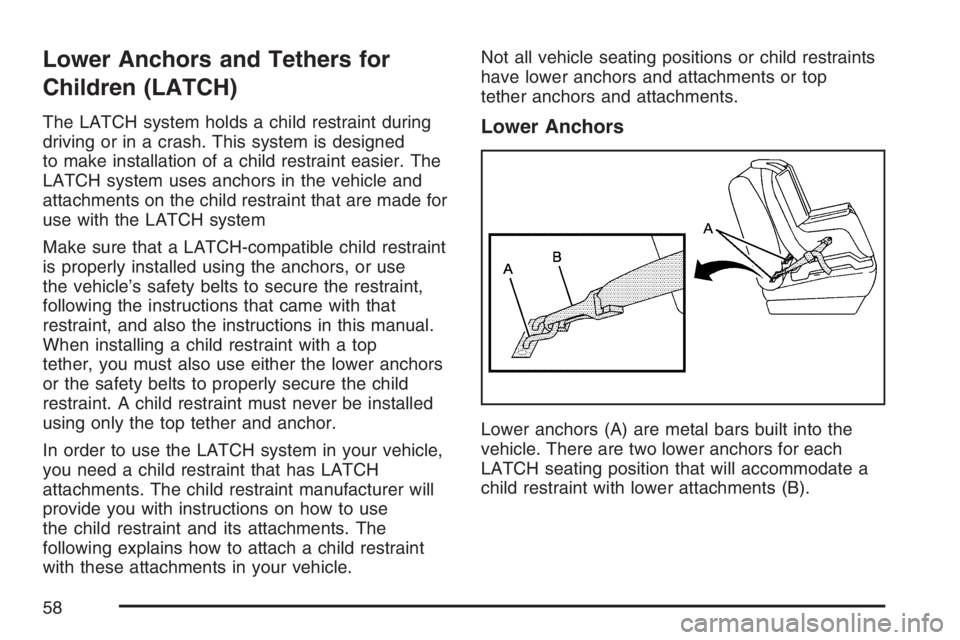
tether anchors and attachments.Lower Anchors
Lower anchors (A) are metal bars built into the
vehicle. There are two lower anchors for each
LATCH seating position that will accommodate a
child restraint with lower attachments (B).
58
Page 59 of 674
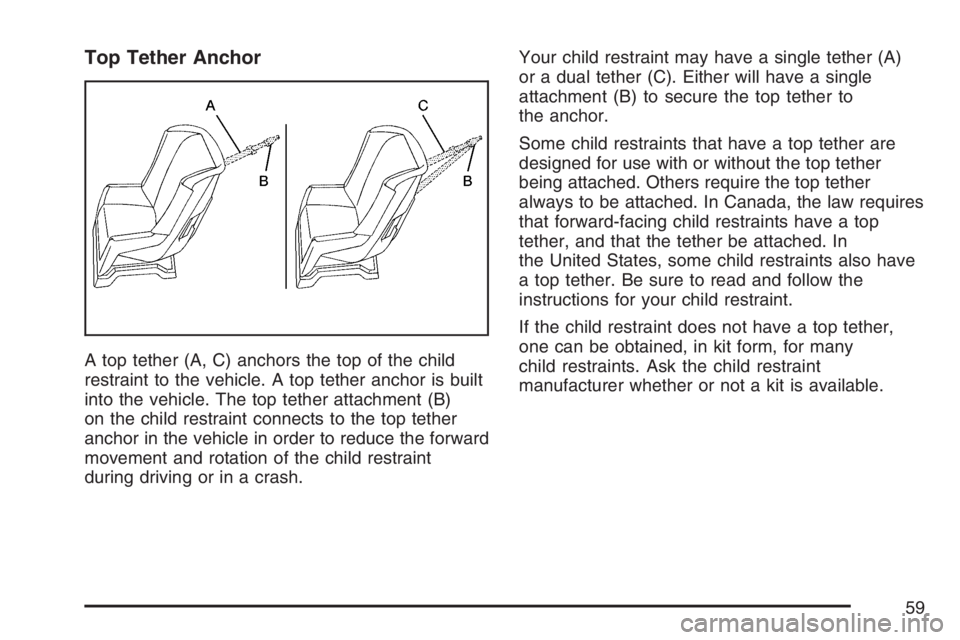
Top Tether Anchor
A top tether (A, C) anchors the top of the child
restraint to the vehicle. A top tether anchor is built
into the vehicle. The top tether attachment (B)
on the child restraint connects to the top tether
anchor in the vehicle in order to reduce the forward
movement and rotation of the child restraint
during driving or in a crash.Your child restraint may have a single tether (A)
or a dual tether (C). Either will have a single
attachment (B) to secure the top tether to
the anchor.
Some child restraints that have a top tether are
designed for use with or without the top tether
being attached. Others require the top tether
always to be attached. In Canada, the law requires
that forward-facing child restraints have a top
tether, and that the tether be attached. In
the United States, some child restraints also have
a top tether. Be sure to read and follow the
instructions for your child restraint.
If the child restraint does not have a top tether,
one can be obtained, in kit form, for many
child restraints. Ask the child restraint
manufacturer whether or not a kit is available.
59
Page 60 of 674
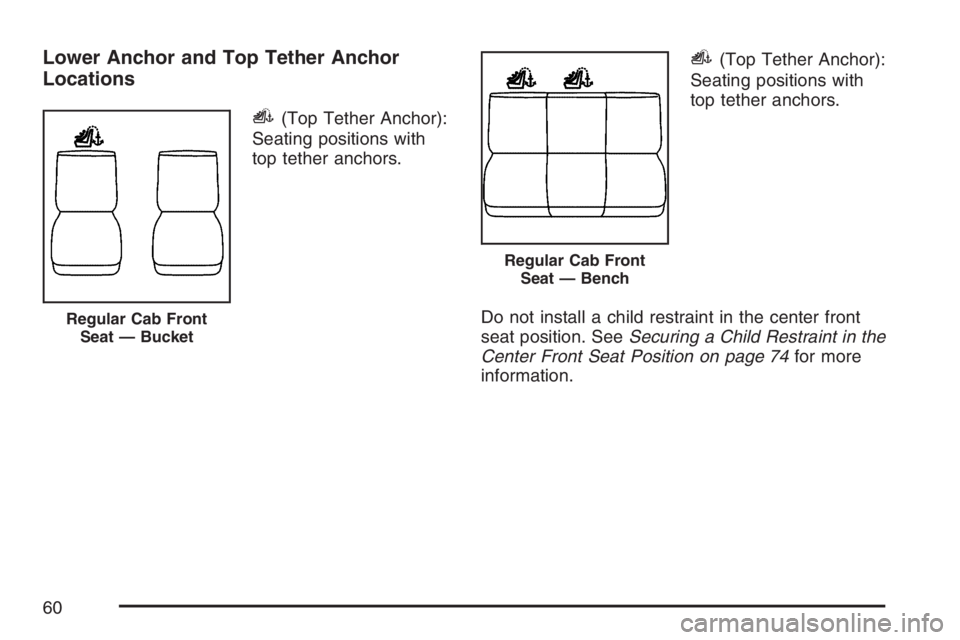
Lower Anchor and Top Tether Anchor
Locations
i(Top Tether Anchor):
Seating positions with
top tether anchors.
i(Top Tether Anchor):
Seating positions with
top tether anchors.
Do not install a child restraint in the center front
seat position. SeeSecuring a Child Restraint in the
Center Front Seat Position on page 74for more
information.
Regular Cab Front
Seat — Bucket
Regular Cab Front
Seat — Bench
60
Page 62 of 674
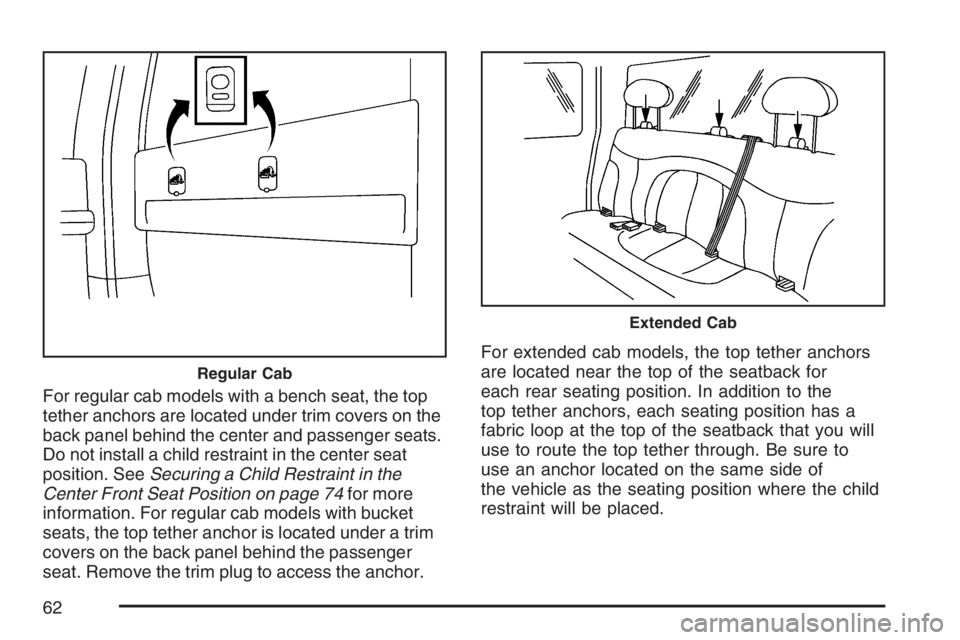
For regular cab models with a bench seat, the top
tether anchors are located under trim covers on the
back panel behind the center and passenger seats.
Do not install a child restraint in the center seat
position. SeeSecuring a Child Restraint in the
Center Front Seat Position on page 74for more
information. For regular cab models with bucket
seats, the top tether anchor is located under a trim
covers on the back panel behind the passenger
seat. Remove the trim plug to access the anchor.For extended cab models, the top tether anchors
are located near the top of the seatback for
each rear seating position. In addition to the
top tether anchors, each seating position has a
fabric loop at the top of the seatback that you will
use to route the top tether through. Be sure to
use an anchor located on the same side of
the vehicle as the seating position where the child
restraint will be placed.
Regular Cab
Extended Cab
62