2007 GMC ACADIA automatic transmission
[x] Cancel search: automatic transmissionPage 95 of 554

Keys.............................................................. 97
Remote Keyless Entry (RKE) System.......... 98
Remote Keyless Entry (RKE) System
Operation............................................... 100
Doors and Locks........................................ 106
Door Locks................................................ 106
Power Door Locks..................................... 107
Delayed Locking........................................ 107
Programmable Automatic Door Locks........ 107
Rear Door Security Locks......................... 108
Lockout Protection..................................... 108
Liftgate...................................................... 109
Power Liftgate........................................... 110
Windows...................................................... 114
Power Windows........................................ 115
Sun Visors................................................ 117Theft-Deterrent Systems............................. 118
Content Theft-Deterrent............................. 118
PASS-Key
®III+......................................... 120
PASS-Key®III+ Operation......................... 121
Starting and Operating Your Vehicle......... 123
New Vehicle Break-In................................ 123
Ignition Positions....................................... 124
Retained Accessory Power (RAP)............. 125
Starting the Engine.................................... 126
Engine Coolant Heater.............................. 127
Automatic Transmission Operation............. 129
Tow/Haul Mode......................................... 133
Parking Brake........................................... 134
Shifting Into Park (P)................................. 135
Shifting Out of Park (P)............................. 137
Parking Over Things That Burn................. 137
Engine Exhaust......................................... 138
Running the Engine While Parked............. 139
Section 2 Features and Controls
95
Page 112 of 554
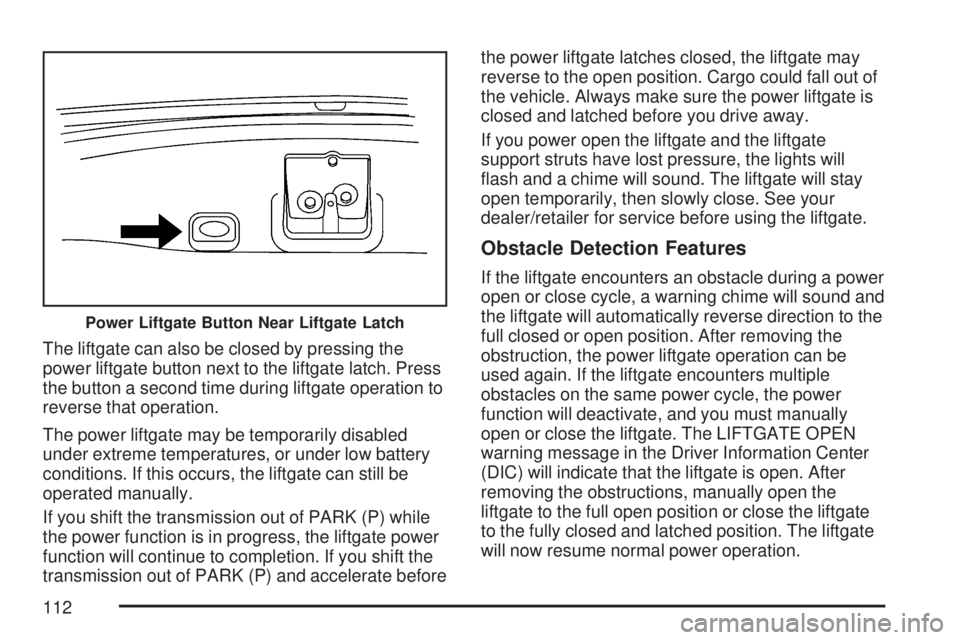
The liftgate can also be closed by pressing the
power liftgate button next to the liftgate latch. Press
the button a second time during liftgate operation to
reverse that operation.
The power liftgate may be temporarily disabled
under extreme temperatures, or under low battery
conditions. If this occurs, the liftgate can still be
operated manually.
If you shift the transmission out of PARK (P) while
the power function is in progress, the liftgate power
function will continue to completion. If you shift the
transmission out of PARK (P) and accelerate beforethe power liftgate latches closed, the liftgate may
reverse to the open position. Cargo could fall out of
the vehicle. Always make sure the power liftgate is
closed and latched before you drive away.
If you power open the liftgate and the liftgate
support struts have lost pressure, the lights will
ash and a chime will sound. The liftgate will stay
open temporarily, then slowly close. See your
dealer/retailer for service before using the liftgate.
Obstacle Detection Features
If the liftgate encounters an obstacle during a power
open or close cycle, a warning chime will sound and
the liftgate will automatically reverse direction to the
full closed or open position. After removing the
obstruction, the power liftgate operation can be
used again. If the liftgate encounters multiple
obstacles on the same power cycle, the power
function will deactivate, and you must manually
open or close the liftgate. The LIFTGATE OPEN
warning message in the Driver Information Center
(DIC) will indicate that the liftgate is open. After
removing the obstructions, manually open the
liftgate to the full open position or close the liftgate
to the fully closed and latched position. The liftgate
will now resume normal power operation.
Power Liftgate Button Near Liftgate Latch
112
Page 129 of 554

Automatic Transmission Operation
Your vehicle has an electronic shift position
indicator within the instrument panel cluster.
When using the Electronic Range Select Mode a
number will display next to the L, indicating
the current gear that has been selected.
See Electronic Range Select mode in this section
for more information.
Your automatic transmission has a shift lever
located on the console between the seats.
PARK (P):This position locks your front wheels. It
is the best position to use when you start your
engine because your vehicle cannot move easily.{CAUTION:
It is dangerous to get out of your vehicle
if the shift lever is not fully in PARK (P)
with the parking brake rmly set. Your
vehicle can roll.
Do not leave your vehicle when the engine
is running unless you have to. If you have
left the engine running, the vehicle can
move suddenly. You or others could be
injured. To be sure your vehicle will not
move, even when you are on fairly level
ground, always set your parking brake
and move the shift lever to PARK (P). See
Shifting Into Park (P) on page 135.Ifyou
are pulling a trailer, seeTowing a Trailer
on page 371.
Make sure the shift lever is fully in PARK (P)
before starting the engine. Your vehicle has an
automatic transmission shift lock control system.
129
Page 132 of 554

When you shift from DRIVE (D) to LOW (L), the
transmission will shift to a pre-determined
lower gear range. The highest gear available for
this pre-determined range is displayed next to
the L in the DIC. SeeDriver Information Center
(DIC) on page 232andDIC Operation and
Displays (With DIC Buttons) on page 233orDIC
Operation and Displays (Without DIC Buttons)
on page 239for more information. The number
displayed in the DIC is the highest gear that
the transmission will be allowed to operate in.
However, your vehicle can automatically shift to
lower gears as required by various driving
conditions. This means that all gears below that
number are available. For example, when
FOURTH (4) is shown next to the L, FIRST (1)
through FOURTH (4) gears are automatically
shifted by the vehicle. You cannot shift into
FIFTH (5) until the plus (+) button is used or you
shift back into DRIVE (D) mode.While in LOW (L), the transmission will prevent
shifting to a lower gear range if the engine speed
is too high for the gear range you are trying to
select. You have a brief period of time to slow the
vehicle speed. If vehicle speed is not reduced
within the timeframe allowed, the lower gear range
attempted will not be available. The highest
possible gear that is allowed for that engine speed
will display next to the L in the DIC. Try again
to slow the vehicle speed and press the minus (−)
button to the desired lower gear range.
Automatic Engine Grade braking is not available
when the ERS is active. It is available in
DRIVE (D) for both normal and Tow/Haul mode.
While using the ERS, cruise control and the
tow/haul mode can be used. SeeTow/Haul Mode
on page 133for more information.
132
Page 133 of 554
Tow/Haul Mode
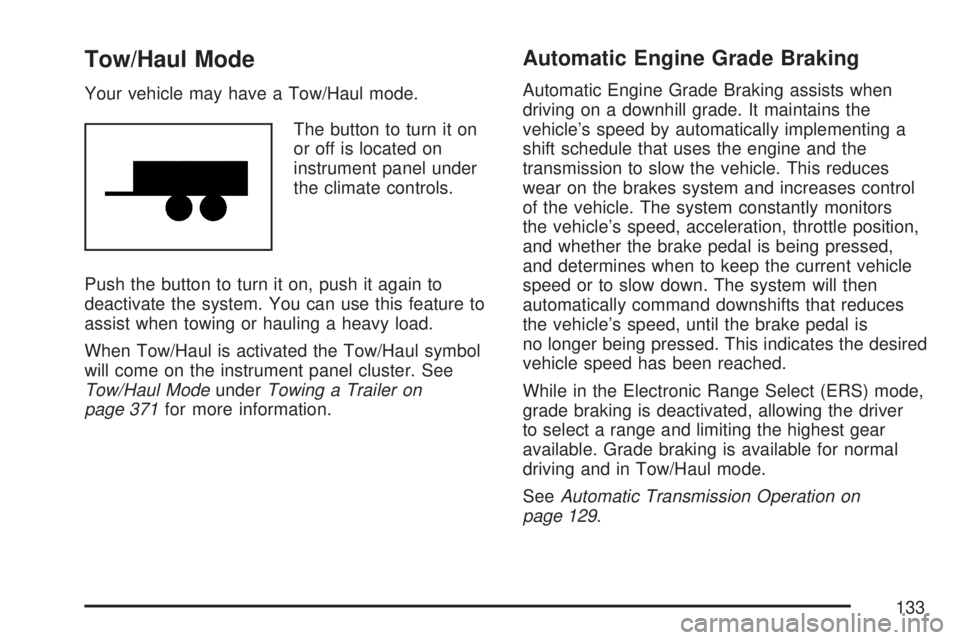
Your vehicle may have a Tow/Haul mode.
The button to turn it on
or off is located on
instrument panel under
the climate controls.
Push the button to turn it on, push it again to
deactivate the system. You can use this feature to
assist when towing or hauling a heavy load.
When Tow/Haul is activated the Tow/Haul symbol
will come on the instrument panel cluster. See
Tow/Haul ModeunderTowing a Trailer on
page 371for more information.
Automatic Engine Grade Braking
Automatic Engine Grade Braking assists when
driving on a downhill grade. It maintains the
vehicle’s speed by automatically implementing a
shift schedule that uses the engine and the
transmission to slow the vehicle. This reduces
wear on the brakes system and increases control
of the vehicle. The system constantly monitors
the vehicle’s speed, acceleration, throttle position,
and whether the brake pedal is being pressed,
and determines when to keep the current vehicle
speed or to slow down. The system will then
automatically command downshifts that reduces
the vehicle’s speed, until the brake pedal is
no longer being pressed. This indicates the desired
vehicle speed has been reached.
While in the Electronic Range Select (ERS) mode,
grade braking is deactivated, allowing the driver
to select a range and limiting the highest gear
available. Grade braking is available for normal
driving and in Tow/Haul mode.
SeeAutomatic Transmission Operation on
page 129.
133
Page 137 of 554
Shifting Out of Park (P)
Your vehicle has an automatic transmission shift
lock control system. You have to apply your
regular brake rst and then press the shift lever
button before you can shift from PARK (P).
SeeAutomatic Transmission Operation on
page 129.
If you cannot shift out of PARK (P), ease pressure
on the shift lever and push the shift lever all the
way into PARK (P) as you maintain brake
application. Then press the shift lever button and
move the shift lever into the gear you wish.
Parking Over Things That Burn
{CAUTION:
Things that can burn could touch hot
exhaust parts under your vehicle and
ignite. Do not park over papers, leaves,
dry grass, or other things that can burn.
137
Page 193 of 554

Format Two:This display includes the information
in Format One without the transmission information
and the outside air temperature.
Format Three:This display includes all the
information in Format One along with a circular
tachometer, but without outside air temperature.
All formats will show the turn-by-turn navigation
information and provide details about the next
driving maneuver to be made. When you near your
destination, the HUD will display a distance bar
that will ll in the closer you get to your destination.All navigation information is provided to the HUD
by the navigation radio, if the vehicle has one.
The HUD image displayed on the windshield will
automatically dim and brighten to compensate
for outside lighting.
The HUD image can temporarily light up
depending on the angle and position of the
sunlight on the HUD display. This is normal and
will change when the angle of the sunlight on
the HUD display changes.
Polarized sunglasses could make the HUD image
harder to see.
Care of the HUD
Clean the inside of the windshield as needed to
remove any dirt or lm that could reduce the
sharpness or clarity of the HUD image.
To clean the HUD lens, use a soft, clean cloth
that has household glass cleaner sprayed
on it. Wipe the HUD lens gently, then dry it.
Do not spray cleaner directly on the lens
because the cleaner could leak into the unit.
193
Page 232 of 554

Driver Information Center (DIC)
Your vehicle has a Driver Information Center (DIC).
The DIC displays information about your vehicle.
It also displays warning messages if a system
problem is detected.
All messages will appear in the DIC display
located at the top of the instrument panel cluster.
The DIC comes on when the ignition is on.
After a short delay, the DIC will display the
information that was last displayed before the
engine was turned off.
The DIC also displays a shift lever position
indicator on the bottom line of the display. See
Automatic Transmission Operation on page 129
for more information.The outside air temperature also displays on the
DIC when viewing the trip and fuel information.
The outside air temperature automatically
appears in the top right corner of the DIC display.
If there is a problem with the system that
controls the temperature display, the numbers
will be replaced with dashes. If this occurs,
have the vehicle serviced.
If your vehicle has DIC buttons, see “DIC Operation
and Displays (With DIC Buttons)” later in this
section andDIC Vehicle Customization (With DIC
Buttons) on page 255for the displays available.
If your vehicle does not have DIC buttons, see
“DIC Operation and Displays (Without DIC
Buttons)” later in this section for the displays
available.
232