Page 355 of 554

{CAUTION:
Coasting downhill in NEUTRAL (N) or with
the ignition off is dangerous. The brakes
will have to do all the work of slowing
down. They could get so hot that they
would not work well. You would then have
poor braking or even none going down a
hill. You could crash. Always have the
engine running and your vehicle in gear
when you go downhill.
Know how to go down hills. The most
important thing to know is this: let the engine
do some of the slowing down. Shift to a
lower gear when you go down a steep or
long hill.
Know how to go uphill. You may want to shift
down to a lower gear. The lower gears help
cool the engine and transmission, and you can
climb the hill better.
Stay in your own lane when driving on
two-lane roads in hills or mountains. Do not
swing wide or cut across the center of the
road. Drive at speeds that let you stay in your
own lane.
As you go over the top of a hill, be alert.
There could be something in your lane,
like a stalled car or an accident.
You may see highway signs on mountains
that warn of special problems. Examples
are long grades, passing or no-passing zones,
a falling rocks area, or winding roads.
Be alert to these and take appropriate action.
355
Page 358 of 554
The Anti-Lock Brake System (ABS) improves your
vehicle’s stability when you make a hard stop
on a slippery road. Even though you have ABS,
you want to begin stopping sooner than you would
on dry pavement. SeeAnti-Lock Brake System
(ABS) on page 335.
Allow greater following distance on any
slippery road.
Watch for slippery spots. The road might be
ne until you hit a spot that is covered with
ice. On an otherwise clear road, ice patches
may appear in shaded areas where the
sun cannot reach, such as around clumps of
trees, behind buildings, or under bridges.
Sometimes the surface of a curve or an
overpass can remain icy when the surrounding
roads are clear. If you see a patch of ice
ahead of you, brake before you are on it.
Try not to brake while you are actually on the
ice, and avoid sudden steering maneuvers.
If You Are Caught in a Blizzard
If you are stopped by heavy snow, you could be in
a serious situation. You should probably stay with
your vehicle unless you know for sure that you
are near help and you can hike through the snow.
Here are some things to do to summon help
and keep yourself and your passengers safe:
Turn on the hazard ashers.
Tie a red cloth to your vehicle to alert police
that you have been stopped by the snow.
Put on extra clothing or wrap a blanket
around you. If you do not have blankets
or extra clothing, make body insulators
from newspapers, burlap bags, rags, oor
mats — anything you can wrap around
yourself or tuck under your clothing to
keep warm.
358
Page 368 of 554

Dinghy Towing
If you have a front-wheel-drive vehicle, it can be
dinghy towed from the front. These vehicles
may also be towed by putting the front wheels on
a dolly. See “Dolly Towing” later in this section.
If you have an all-wheel-drive vehicle, it can
be dinghy towed from the front. You can also tow
these vehicles by placing them on a platform
trailer with all four wheels off of the ground.
These vehicles cannot be towed using a dolly.
For vehicles being dinghy towed, the vehicle
should be run at the beginning of each day and
at each RV fuel stop for about ve minutes.
This will ensure proper lubrication of transmission
components. Put the IGN (Ignition) fuse in to
start the vehicle.To tow your vehicle from the front with all four
wheels on the ground:
1. Position the vehicle to tow and then secure it.
2. Turn the ignition to OFF.
3. Set the parking brake.
4. To prevent your battery from draining while
the vehicle is being towed, remove the IGN
(Ignition) fuse from the underhood fuse block.
SeeUnderhood Fuse Block on page 493.
5. Turn the ignition to ACCESSORY.
368
Page 369 of 554
6. Shift your transmission to NEUTRAL (N).
7. Release the parking brake.
Notice:If you tow your vehicle without
performing each of the steps listed under
“Dinghy Towing,” you could damage the
automatic transmission. Be sure to follow all
steps of the dinghy towing procedure prior
to and after towing your vehicle.
Notice:If you exceed 65 mph (105 km/h) while
towing your vehicle, it could be damaged.
Never exceed 65 mph (105 km/h) while towing
your vehicle.
Once you have reached your destination, do the
following:
1. Set the parking brake.
2. Turn the ignition key to OFF and remove the
key from the ignition.
3. Reinstall the IGN (Ignition) fuse.
Notice:Don’t tow a vehicle with the front
drive wheels on the ground if one of the front
tires is a compact spare tire. Towing with
two different tire sizes on the front of the
vehicle can cause severe damage to the
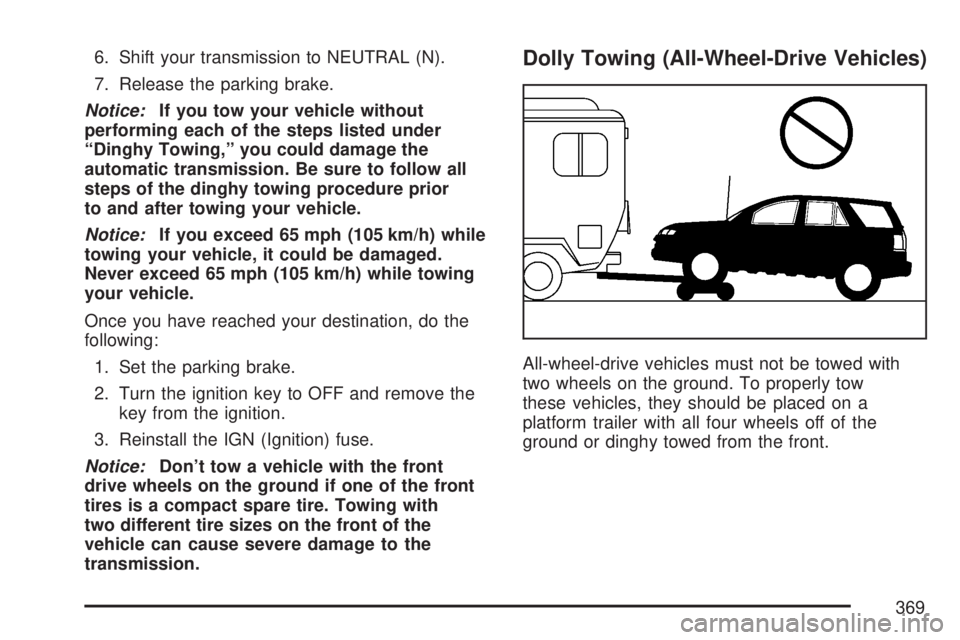
transmission.Dolly Towing (All-Wheel-Drive Vehicles)
All-wheel-drive vehicles must not be towed with
two wheels on the ground. To properly tow
these vehicles, they should be placed on a
platform trailer with all four wheels off of the
ground or dinghy towed from the front.
369
Page 370 of 554
Dolly Towing (Front-Wheel-Drive
Vehicles Only)
To tow your front-wheel-drive vehicle from the
front with two wheels on the ground:
1.
Put the front wheels on a dolly.
2.Move the shift lever to PARK (P).
3.Set the parking brake and then remove the key.
4.Clamp the steering wheel in a straight-ahead
position with a clamping device designed
for towing.
5. Release the parking brake.
Towing Your Vehicle From the Rear
Notice:Towing your vehicle from the rear
could damage it. Also, repairs would not
be covered by the warranty. Never have your
vehicle towed from the rear.
Do not tow your vehicle from the rear.
370
Page 371 of 554

Towing a Trailer
{CAUTION:
If you do not use the correct equipment
and drive properly, you can lose control
when you pull a trailer. For example, if the
trailer is too heavy, the brakes may not
work well — or even at all. You and your
passengers could be seriously injured.
You may also damage your vehicle; the
resulting repairs would not be covered by
your warranty. Pull a trailer only if you
have followed all the steps in this section.
Ask your dealer/retailer for advice and
information about towing a trailer with
your vehicle.
To identify the trailering capacity of your vehicle,
you should read the information in “Weight of
the Trailer” that appears later in this section.But trailering is different than just driving your
vehicle by itself. Trailering means changes
in handling, acceleration, braking, durability and
fuel economy. Successful, safe trailering takes
correct equipment, and it has to be used properly.
That’s the reason for this part. In it are many
time-tested, important trailering tips and safety
rules. Many of these are important for your safety
and that of your passengers. So please read
this section carefully before you pull a trailer.
Load-pulling components such as the engine,
transmission, rear axle, wheel assemblies and tires
are forced to work harder against the drag of
the added weight. The engine is required
to operate at relatively higher speeds and under
greater loads, generating extra heat. What’s more,
the trailer adds considerably to wind resistance,
increasing the pulling requirements.
371
Page 378 of 554
Safety Chains
You should always attach chains between your
vehicle and your trailer. Cross the safety
chains under the tongue of the trailer so that the
tongue will not drop to the road if it becomes
separated from the hitch. Instructions about safety
chains may be provided by the hitch manufacturer
or by the trailer manufacturer. Follow the
manufacturer’s recommendation for attaching
safety chains and do not attach them to the
bumper. Always leave just enough slack so you
can turn with your rig. And, never allow safety
chains to drag on the ground.
Trailer Brakes
If you tow more than 1,000 lbs (450 kg), use trailer
brakes. Because your vehicle has anti-lock brakes,
don’t try to tap into your vehicle’s hydraulic brake
system. If you do, both brake systems won’t
work well, or at all.
Be sure to read and follow the instructions for the
trailer brakes so you’ll be able to install, adjust
and maintain them properly.
Driving with a Trailer
Towing a trailer requires a certain amount of
experience. Before setting out for the open road,
you’ll want to get to know your rig. Acquaint
yourself with the feel of handling and braking with
the added weight of the trailer. And always
keep in mind that the vehicle you are driving is
now a good deal longer and not nearly as
responsive as your vehicle is by itself.
Before you start, check all trailer hitch parts and
attachments, safety chains, electrical connector,
lamps, tires and mirror adjustment. If the trailer has
electric brakes, start your vehicle and trailer moving
and then apply the trailer brake controller by hand
to be sure the brakes are working. This lets you
check your electrical connection at the same time.
During your trip, check occasionally to be sure
that the load is secure, and that the lamps and any
trailer brakes are still working.
Following Distance
Stay at least twice as far behind the vehicle ahead
as you would when driving your vehicle without
a trailer. This can help you avoid situations
that require heavy braking and sudden turns.
378
Page 380 of 554

Driving on Grades
Your vehicle is designed primarily as a passenger
and load carrying vehicle. If you tow a trailer,
your vehicle will require more frequent
maintenance due to the additional load. Because
of the added load of the trailer, your vehicle’s
engine may overheat on hot days, when going up
a long or steep grade with a trailer. If the engine
coolant temperature gage indicates overheating,
turn off the air conditioning to reduce engine load,
pull off the road and stop in a safe spot.
Reduce speed and shift to a lower gear before
you start down a long or steep downgrade. If you
don’t shift down, you might have to use your
brakes so much that they would get hot and no
longer work well.
On a long uphill grade, shift down and reduce
your speed to around 55 mph (88 km/h) to reduce
the possibility of the engine and the transmission
overheating.
Parking on Hills
{CAUTION:
You really should not park your vehicle,
with a trailer attached, on a hill.
If something goes wrong, your rig could
start to move. People can be injured, and
both your vehicle and the trailer can be
damaged.
But if you ever have to park your rig on a hill,
here’s how to do it:
1. Apply your regular brakes, but don’t shift
into PARK (P).
When parking uphill, turn your wheels away
from the curb. When parking downhill,
turn your wheels into the curb.
2. Have someone place chocks behind the
trailer wheels.
380