2007 FORD SUPER DUTY remote control
[x] Cancel search: remote controlPage 4 of 28
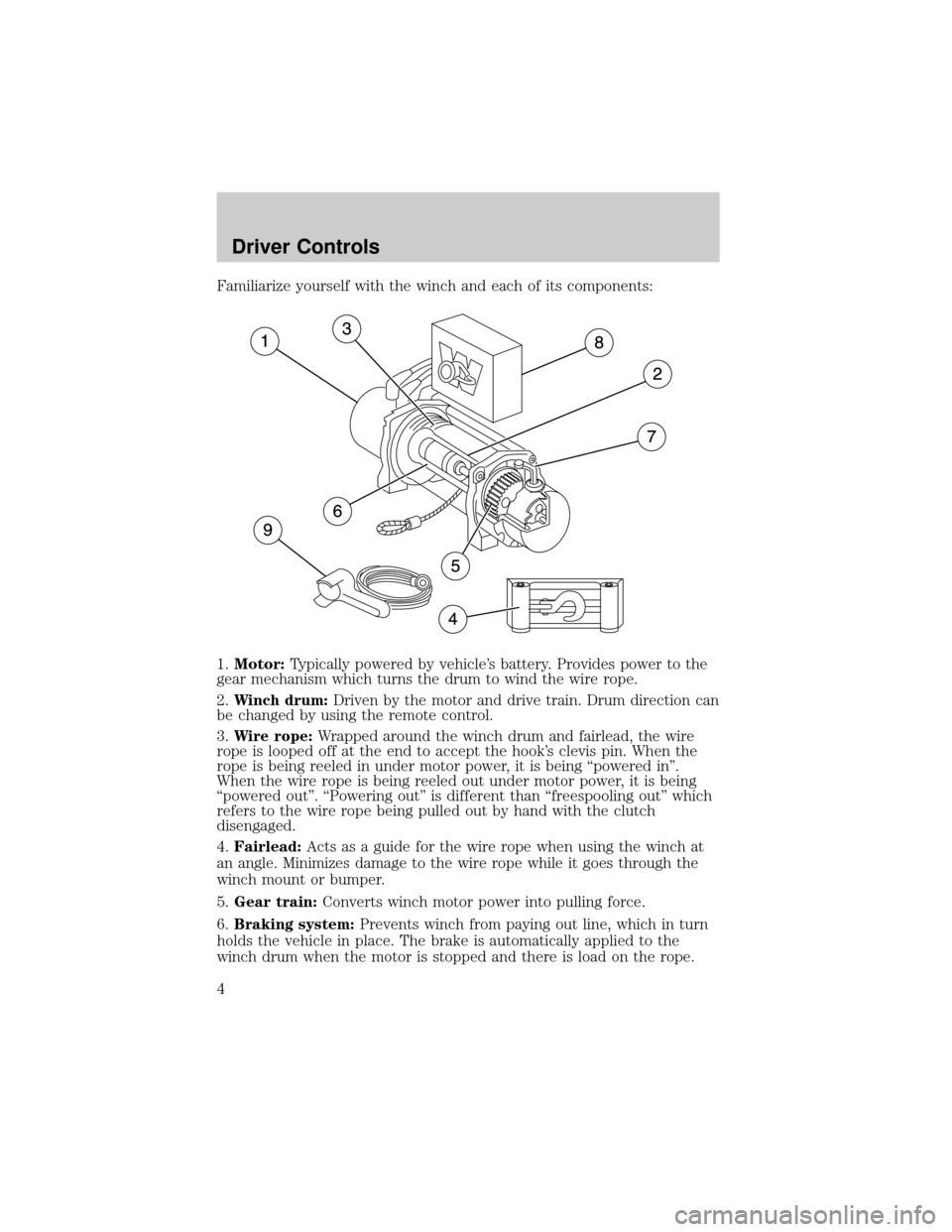
Familiarize yourself with the winch and each of its components:
1.Motor:Typically powered by vehicle's battery. Provides power to the
gear mechanism which turns the drum to wind the wire rope.
2.Winch drum:Driven by the motor and drive train. Drum direction can
be changed by using the remote control.
3.Wire rope:Wrapped around the winch drum and fairlead, the wire
rope is looped off at the end to accept the hook's clevis pin. When the
rope is being reeled in under motor power, it is being ªpowered inº.
When the wire rope is being reeled out under motor power, it is being
ªpowered outº. ªPowering outº is different than ªfreespooling outº which
refers to the wire rope being pulled out by hand with the clutch
disengaged.
4.Fairlead:Acts as a guide for the wire rope when using the winch at
an angle. Minimizes damage to the wire rope while it goes through the
winch mount or bumper.
5.Gear train:Converts winch motor power into pulling force.
6.Braking system:Prevents winch from paying out line, which in turn
holds the vehicle in place. The brake is automatically applied to the
winch drum when the motor is stopped and there is load on the rope.
Driver Controls
4
Page 5 of 28

7.Clutch:Allows the operator to manually disengage the winch drum
from the gear train, enabling the drum to freely rotate (ªfreespoolingº).
Engaging the clutch ªlocksº the winch drum back onto the gear train.
Note:Never engage or disengage the clutch if the winch is under load,
the wire rope is in tension or the winch drum is moving.
8.Control box:Enables the operator to change the direction of the
winch drum rotation.
9.Remote control:Plugs into the control box allowing the operator to
control the winch direction as well as stand clear of the wire rope while
operating the winch.
Winch accessories
Some of the following accessories are items you'll want to have with you
to ensure safe operation of your winch; some are enhancements to add
versatility and convenience to your winch:
²Gloves:It is extremely important to wear protective gloves while
operating the winch or handling wire rope since the rope will, through
normal use, develop sharp barbs which can slice through skin.
²Hook strap:This safety item is
used to hold the rope wire away
from the fairlead as the rope is
being powered in. Winches can
develop tremendous pulling
pressure which can easily remove
fingers and limbs that get
pinched. Put a hook strap in the
loop and hold the strap between
the thumb and forefingers.
²Clevis/D-Shackle:The
D-Shackle is a safe means for
connecting the looped ends of
cables and straps. The shackle's
pin is threaded to allow easy
removal.
²Choker chains:These can be used to hook-up another vehicle or
sharp objects for an anchor point. Chains, however, will damage or kill
trees.
Driver Controls
5
Page 6 of 28
²Tow hooks:Secured properly to your vehicle's frame, tow hooks
provide an attachment point for wire hooks, straps and chains.
²Tree trunk protector:Typically made of tough, high-quality nylon a
tree trunk protector provides an attachment point for the winch rope
to a wide variety of anchor points and objects, as well as protect living
trees.
²Heavy blanket:In certain situations you may decide to throw a
heavy blanket or similar object over the wire rope. A heavy blanket
such as a quilted mover's blanket can absorb energy should the wire
rope break. Place it on the wire rope midway between the winch and
the anchor point. Do this before the wire rope is put under tension.
Do not approach or move the blanket once tension is applied. Do not
allow it to get pulled into the fairlead. If necessary to move or remove
the blanket, slack the tension on the wire rope first.
²Recovery strap:Used to ªsnatchº out a stuck vehicle. Never use a
recovery strap in a winching operation. The recovery strap is designed
to stretch; because of this, it stores energy and could react like a
rubber band should your rigging fail.
Never attach a recovery strap to the winch hook to the increase
the length of a pull. Never attempt to tow a vehicle with the
recovery strap attached directly to the winch hook. Never use ªbungieº
straps that develop tremendous and potentially dangerous amounts of
force when stretched.
²Shovels and hand tools (i.e., axe or off-road jack):These come
in handy when additional assistance is needed during winching
activities.
²Backup parts:Extra items such as an extra clevis/D-shackle or a
remote control unit should be carried in case of emergency. For
severe and/or continuous winch use, you may want to consider
including an extra wire rope and winch hook.
²Toolbox items:Always bring along hand wrenches, screwdrivers,
pliers and tools to change wire rope.
²Jumper cables:It's always a good idea to carry jumper cables in case
your battery becomes drained during a winching operation. Also, a
dual battery system and a battery isolator kit can be installed to
prevent draining the electrical source during winching operation.
A fully charged conventional automotive battery with a minimum of 650
cold cranking amp is recommended to obtain peak performance from
your winch. Make sure all electrical connections are clean and tight.
Driver Controls
6
Page 7 of 28

Winch operation
Before you pull
Make sure the new rope is stretched before its first use. Unspool the
wire rope, leaving five wraps on the drum. Apply at least 500 lbs. (227
kg) of tension. This can be done by setting up an anchor point and
pulling your vehicle to it at a slightly inclined, flat surface and letting the
vehicle roll.
Before you use your winch, remember these key points:
1. Think safety at all times.
2. Always take your time to assess your situation and plan your pull
carefully.
3. Always take your time when using the winch.
4. Use the right equipment for your situation.
5. Always wear leather gloves and do not allow the wire rope to slide
through your hands.
6. You and only you should handle the wire rope and operate the remote
control switch.
7. Practice. Practice and practice the steps.
Choosing an anchor point
A secure anchor is critical to winching operations. The anchor must be
strong enough to hold while winching. Natural anchors include trees,
stumps and rocks. Hook the rope as low as possible. If no natural
anchors are available, when recovering another vehicle, your vehicle
becomes the anchor point. In this case, be sure to put the transmission
in neutral, apply the parking brake and block the wheels to prevent it
from moving.
The anchor point should allow you to pull straight in the direction the
vehicle will move. This allows the rope to wind tightly and evenly on the
winch drum. An anchor point as far away as possible will provide the
winch with its greatest pulling power.
Winching hand signals
In some situations, recovery could involve two people. While one person
drives, the other person provides navigation assistance and ensures the
rope is winding properly. Understanding the right hand signals help
provide clear understanding between the driver and the navigator. Also,
if the driver controlling the winch can not see both hands of the
navigator, the winch should not be activated. The following are some
suggested hand signals to review:
Driver Controls
7
Page 9 of 28
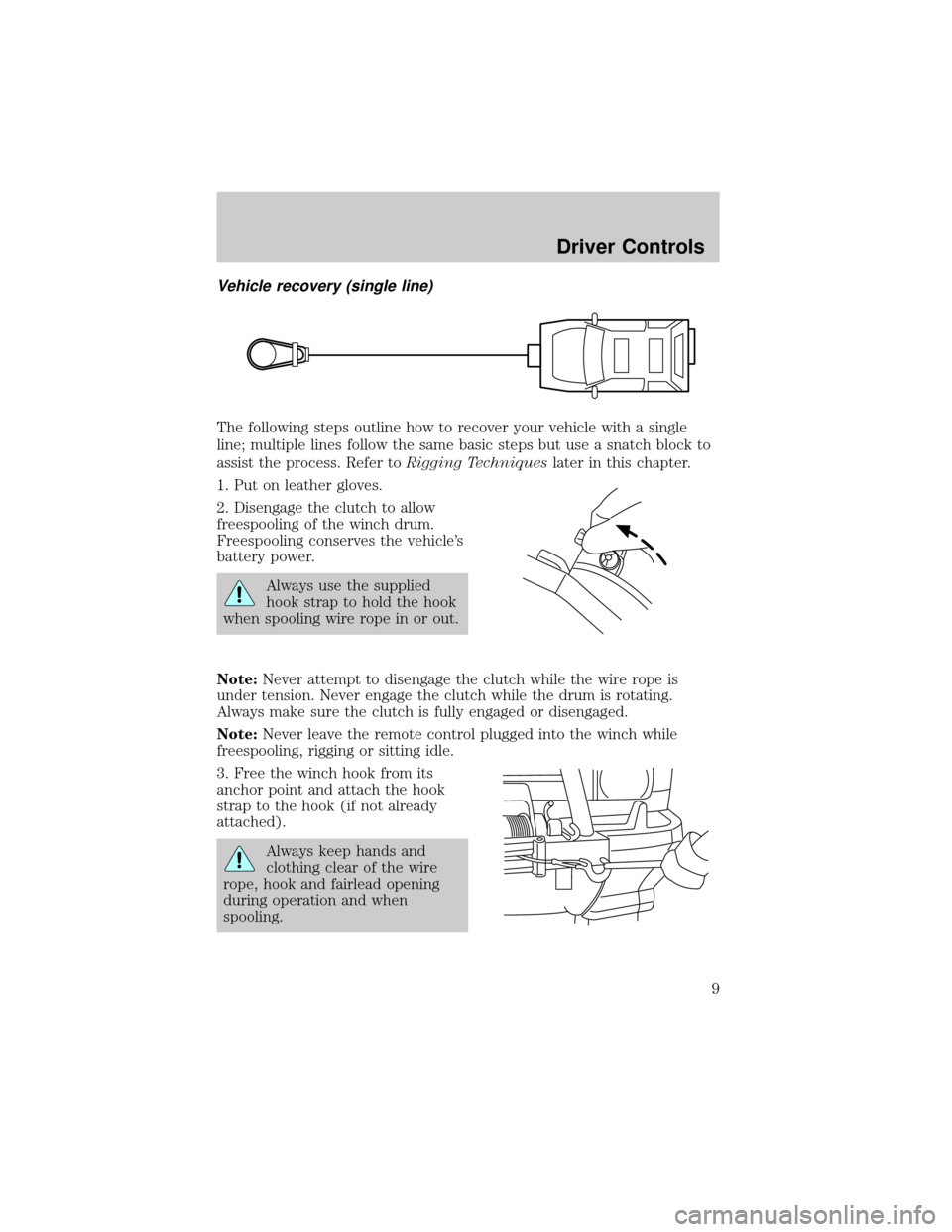
Vehicle recovery (single line)
The following steps outline how to recover your vehicle with a single
line; multiple lines follow the same basic steps but use a snatch block to
assist the process. Refer toRigging Techniqueslater in this chapter.
1. Put on leather gloves.
2. Disengage the clutch to allow
freespooling of the winch drum.
Freespooling conserves the vehicle's
battery power.
Always use the supplied
hook strap to hold the hook
when spooling wire rope in or out.
Note:Never attempt to disengage the clutch while the wire rope is
under tension. Never engage the clutch while the drum is rotating.
Always make sure the clutch is fully engaged or disengaged.
Note:Never leave the remote control plugged into the winch while
freespooling, rigging or sitting idle.
3. Free the winch hook from its
anchor point and attach the hook
strap to the hook (if not already
attached).
Always keep hands and
clothing clear of the wire
rope, hook and fairlead opening
during operation and when
spooling.
Driver Controls
9
Page 10 of 28
4. Pull the wire rope to the anchor point. Be sure to keep a certain
amount of tension in the rope; when slackened, it can become twisted
and overwrap leading to rope damage.
Note:Never winch when there are less than five wraps of wire rope
around the drum.
5. Secure the rope to the anchor point. (SeeChoosing an anchor point
earlier in ths chapter.
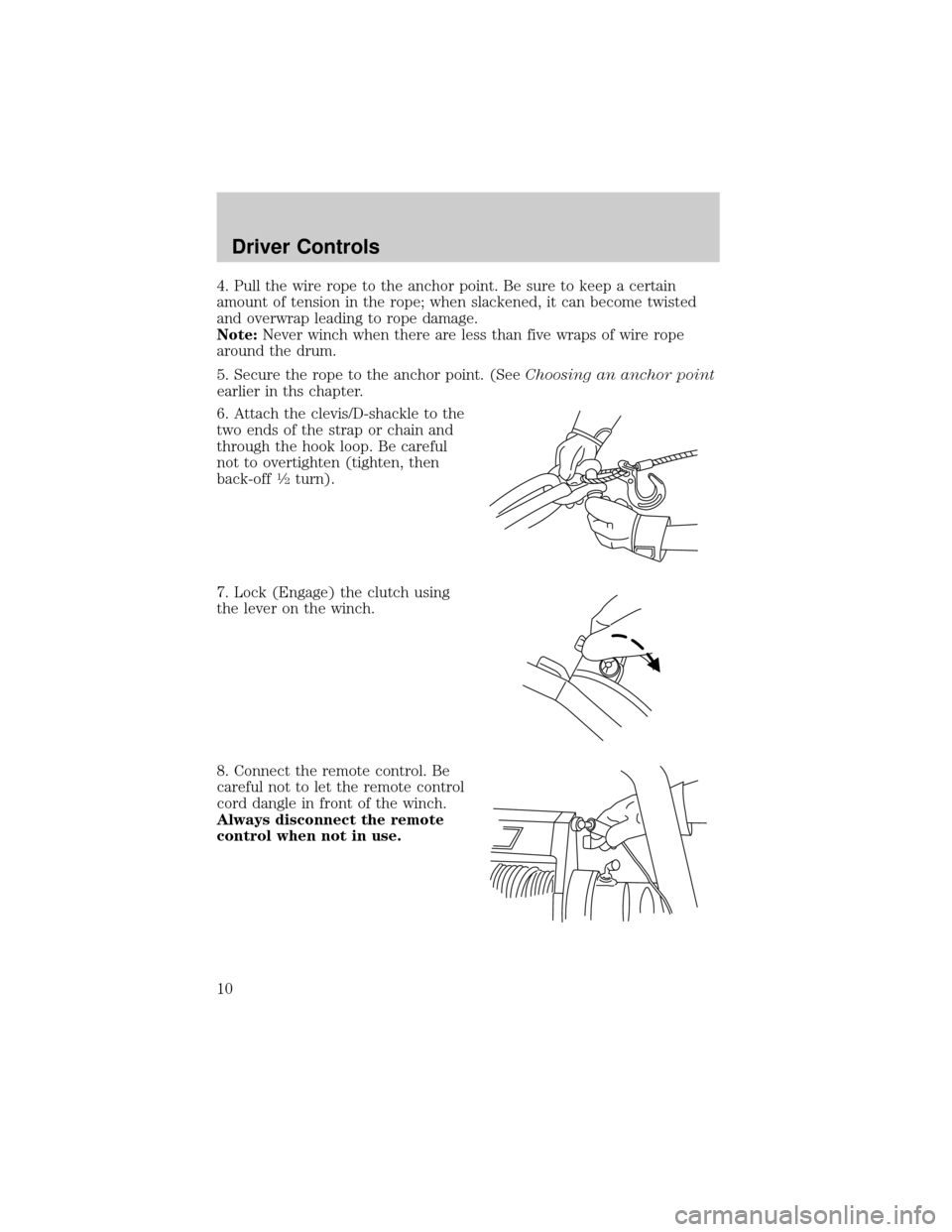
6. Attach the clevis/D-shackle to the
two ends of the strap or chain and
through the hook loop. Be careful
not to overtighten (tighten, then
back-off
1¤2turn).
7. Lock (Engage) the clutch using
the lever on the winch.
8. Connect the remote control. Be
careful not to let the remote control
cord dangle in front of the winch.
Always disconnect the remote
control when not in use.
Driver Controls
10
Page 12 of 28

16. Once recovery of the vehicle is complete, be sure to secure the
vehicle's brakes and put the transmission in P (Park) (automatic
transmission) or 1 (First) (manual transmission). Release tension in the
wire rope.
17. Disconnect the wire rope from the anchor.
18. Rewind the wire rope. Control
the winch at all times and walk the
rope in without letting it slide
through your hands.
19. Disconnect the remote control from the control box and store it in a
clean dry place. Install the cap on the solenoid plug.
How to spool under no load
Arrange the remote control lead so it cannot be caught in the winch.
Arrange the wire rope so it will not kink or tangle when spooled. Be sure
any wire rope already on the spooling drum is wound tightly and evenly
layered (unspool and tighten and layer evenly, if necessary). Keep the
wire rope under light tension and spool the wire rope back onto the
winch drum in even layers. Stop frequently to tighten and straighten the
layers as necessary. Repeat this process until the winch hook is the same
distance as the full length of the remote control from the winch. Attach
the hook strap, then walk the wire rope toward the fairlead, carefully
spooling in the remaining rope by pulsing the remote control switch.
Store the hook at the fairlead or tensioned to a suitable location to the
side.
Driver Controls
12
Page 15 of 28

Secure the winch hook. While keeping the line near the ground, insert
the winch hook through the clevis/D-shackle. Check the anchor. Make
sure all connections are secured and free of debris before continuing
with the winching procedure.
Maintenance
²Inspect the wire rope before and after each winching operation. If the
wire rope has become kinked or frayed, it needs to be replaced. Be
sure to also inspect the winch hook and hook pin for signs of wear or
damage. Replace as necessary.
²Keep winch, wire rope and switch control free from contaminants. Use
a clean rag or towel to remove any dirt and debris. If necessary,
unwind the winch completely (leaving a minimum of five wraps of
rope on the drum) and wipe it clean before rewinding it. Using a light
oil on the rope and winch hook can keep rust and corrosion from
forming.
²Operating the winch for an extended period of time places an
additional load on your vehicle battery. Be sure to check and maintain
your battery and battery cables according to manufacturer guidelines.
Also, inspect the switch control and all electrical connections to be
certain they are clean and tight fitting.
²Inspect the remote control, if so equipped, for damage. Be sure to cap
the remote socket to prevent dirt and debris from entering the
connections. Store the remote control in a dry, protected area.
²No lubrication is required for the life of the winch.
Driver Controls
15