2007 FORD SUPER DUTY lights
[x] Cancel search: lightsPage 164 of 312
Points to Remember:
•Remember to adjust gain setting before using the TBC for the first
time.
•Readjust GAIN setting on the TBC (according to procedure above)
whenever road, weather and trailer or vehicle loading conditions
change from those that existed when the gain was initially set.
•The sliding lever on the TBC should be used only for manual
activation of trailer brakes to assist with proper adjustment of the
GAIN. Misuse, such as application during trailer sway, could cause
instability of trailer and/or tow vehicle.
•Avoid towing in adverse weather conditions. The TBC does not
provide anti-lock control of the trailer wheels. Trailer wheels can
lock-up on slippery surfaces, resulting in reduced stability of trailer
and tow vehicle.
•The TBC interacts with the brake system of the vehicle, including
ABS, in order to reduce the likelihood of trailer wheel lockup.
Therefore, if these systems are not functioning properly the TBC may
not function at full performance.
•When the vehicle is turned off, the TBC Output is disabled and the
display is shut down. Reactivation of the ignition from 3 (OFF) to 4
(ON) will awaken the TBC module.
•The TBC is only a factory or dealer installed item. Ford is not
responsible for warranty or performance of the TBC due to misuse or
customer installation.
•Do not attempt removal of the TBC without consulting the
Workshop Manual.Damage to the unit may result.
Trailer lamps
Trailer lamps are required on most towed vehicles. Make sure all running
lights, brake lights, turn signals and hazard lights are working. See your
authorized dealer or trailer rental agency for proper instructions and
equipment for hooking up trailer lamps.
Using a step bumper (if equipped)
The rear bumper is equipped with an integral hitch and only requires a
ball with a one inch (25.4 mm) shank diameter. The bumper has a 5,000
lb. (2,270 kg) trailer weight and 500 lb. (227 kg) tongue weight capacity.
If it is necessary to relocate the trailer hitch ball position, a
frame-mounted trailer hitch must be installed.
2007 F-250/350/450/550(f23)
Owners Guide (post-2002-fmt)
USA(fus)
Tires, Wheels and Loading
164
Page 169 of 312
STARTING
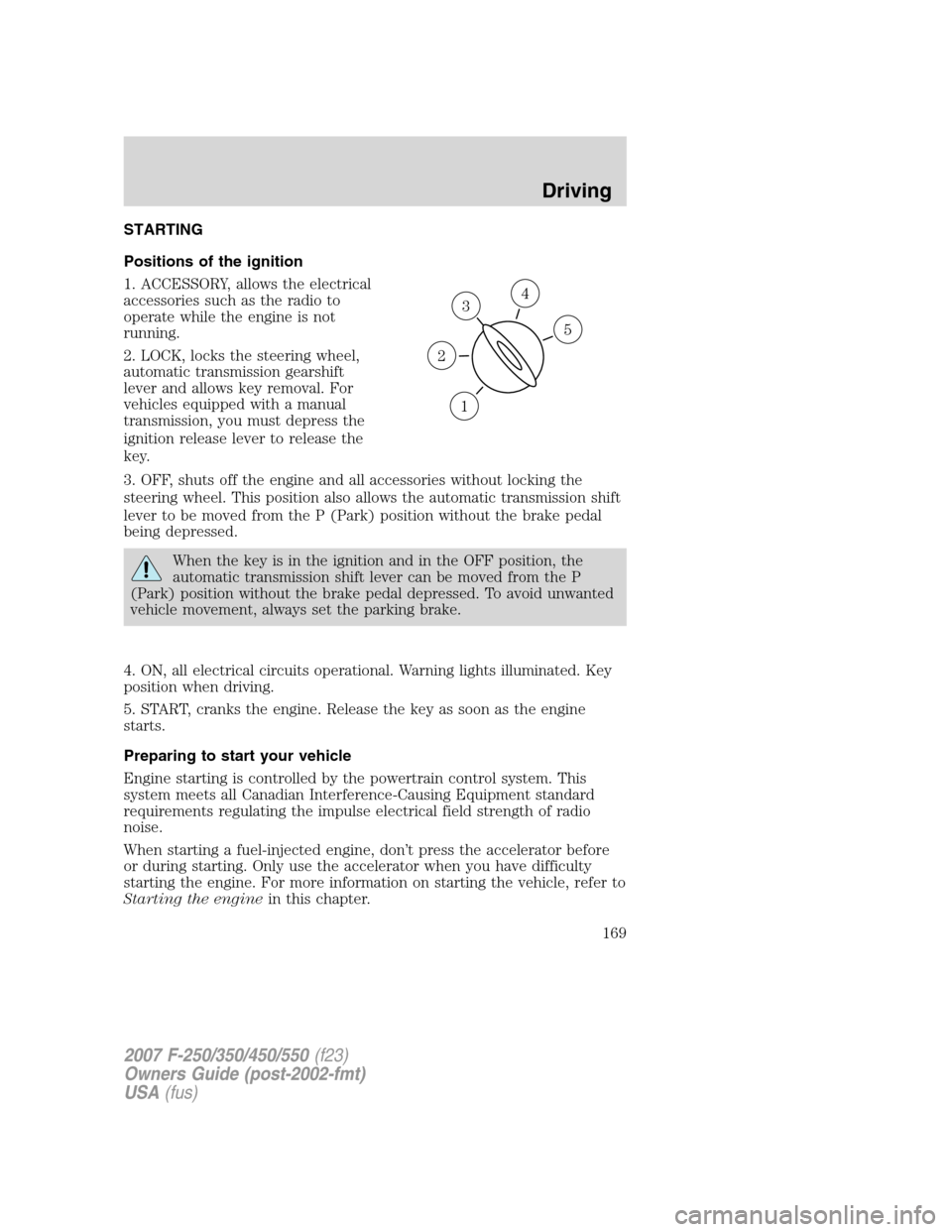
Positions of the ignition
1. ACCESSORY, allows the electrical
accessories such as the radio to
operate while the engine is not
running.
2. LOCK, locks the steering wheel,
automatic transmission gearshift
lever and allows key removal. For
vehicles equipped with a manual
transmission, you must depress the
ignition release lever to release the
key.
3. OFF, shuts off the engine and all accessories without locking the
steering wheel. This position also allows the automatic transmission shift
lever to be moved from the P (Park) position without the brake pedal
being depressed.
When the key is in the ignition and in the OFF position, the
automatic transmission shift lever can be moved from the P
(Park) position without the brake pedal depressed. To avoid unwanted
vehicle movement, always set the parking brake.
4. ON, all electrical circuits operational. Warning lights illuminated. Key
position when driving.
5. START, cranks the engine. Release the key as soon as the engine
starts.
Preparing to start your vehicle
Engine starting is controlled by the powertrain control system. This
system meets all Canadian Interference-Causing Equipment standard
requirements regulating the impulse electrical field strength of radio
noise.
When starting a fuel-injected engine, don’t press the accelerator before
or during starting. Only use the accelerator when you have difficulty
starting the engine. For more information on starting the vehicle, refer to
Starting the enginein this chapter.
3
1
2
5
4
2007 F-250/350/450/550(f23)
Owners Guide (post-2002-fmt)
USA(fus)
Driving
169
Page 173 of 312
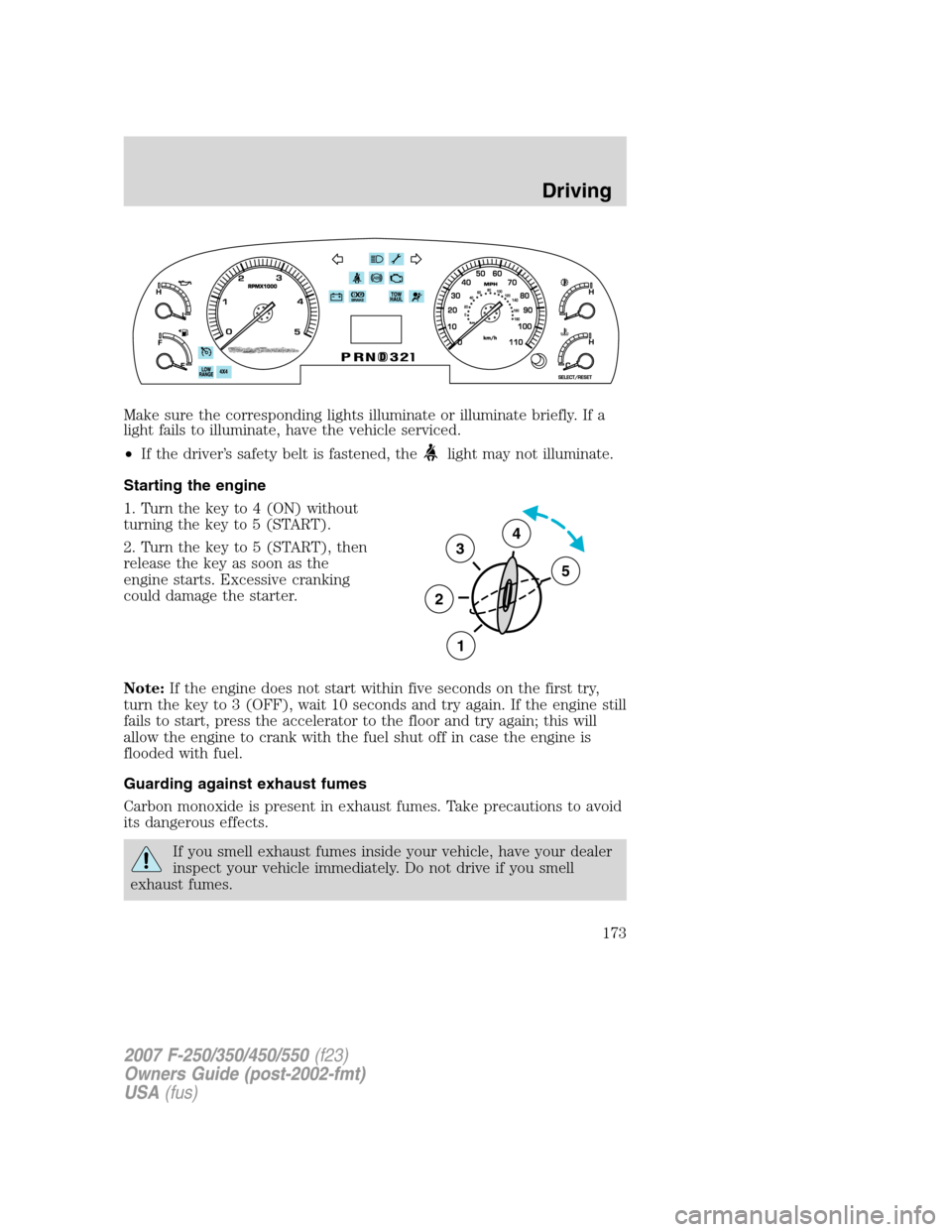
Make sure the corresponding lights illuminate or illuminate briefly. If a
light fails to illuminate, have the vehicle serviced.
•If the driver’s safety belt is fastened, the
light may not illuminate.
Starting the engine
1. Turn the key to 4 (ON) without
turning the key to 5 (START).
2. Turn the key to 5 (START), then
release the key as soon as the
engine starts. Excessive cranking
could damage the starter.
Note:If the engine does not start within five seconds on the first try,
turn the key to 3 (OFF), wait 10 seconds and try again. If the engine still
fails to start, press the accelerator to the floor and try again; this will
allow the engine to crank with the fuel shut off in case the engine is
flooded with fuel.
Guarding against exhaust fumes
Carbon monoxide is present in exhaust fumes. Take precautions to avoid
its dangerous effects.
If you smell exhaust fumes inside your vehicle, have your dealer
inspect your vehicle immediately. Do not drive if you smell
exhaust fumes.
3
2
1
5
4
2007 F-250/350/450/550(f23)
Owners Guide (post-2002-fmt)
USA(fus)
Driving
173
Page 188 of 312
LOW (4WD Low) can be engaged, the vehicle speed must be
below 3 mph (5 km/h) with the brake pedal depressed and the
transmission in N (Neutral). This vehicle is equipped with a
non-synchronous low range gearset which will not allow the
transfer case to shift into 4X4 LOW (4WD Low) if vehicle speed
is above 3 mph (5 km/h). It is recommended that a shift to 4X4
LOW (4WD Low) is performed while the vehicle is moving at a
speed below 3 mph (5 km/h).
The 4WD system:
•provides 4x4 High engagement and disengagement while the vehicle is
moving.
•is operated by a rotary control located on the instrument panel that
allows you select 2WD, 4x4 High or 4x4 Low operation.
•uses auto-manual hub locks that can be engaged and disengaged
automatically based on the 4x4 mode selected.
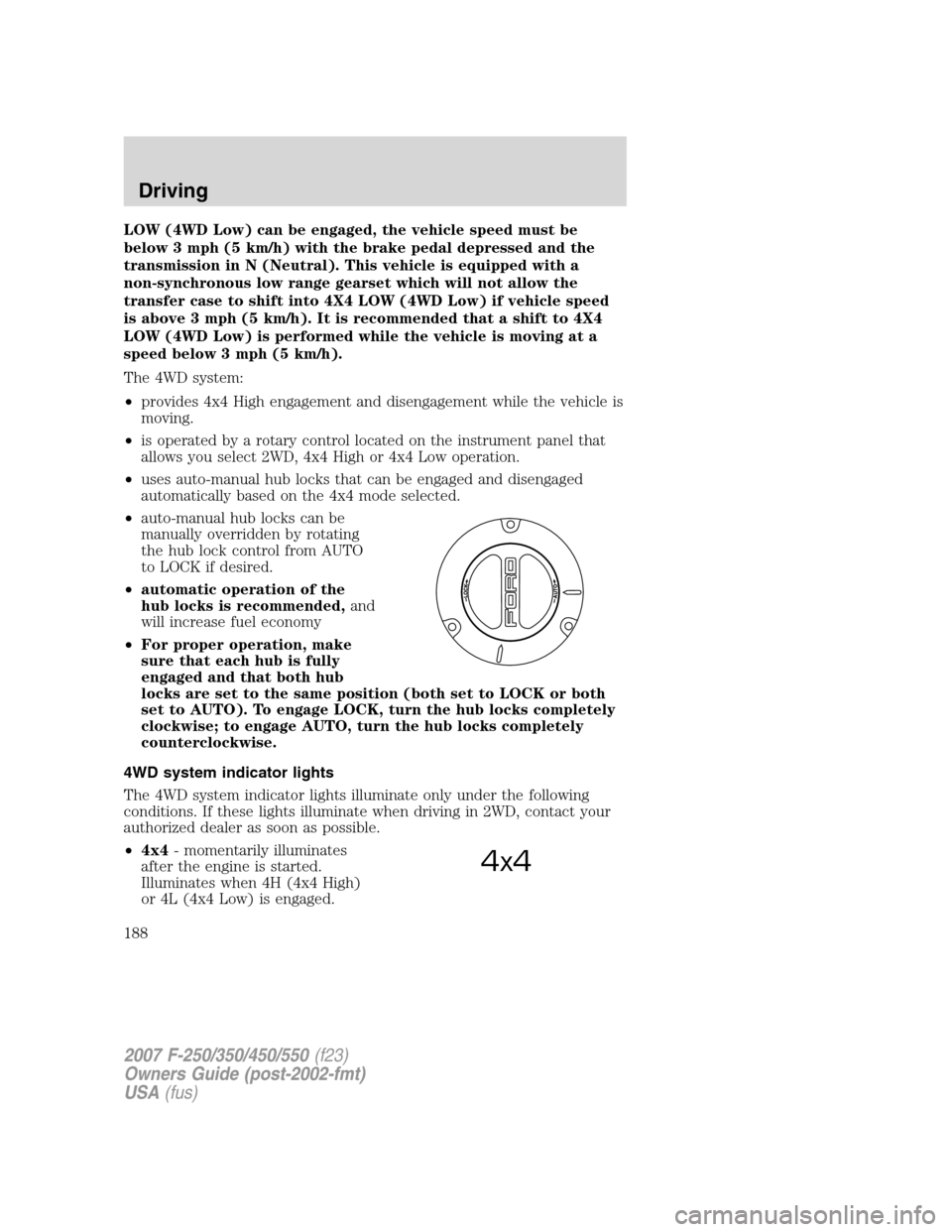
•auto-manual hub locks can be
manually overridden by rotating
the hub lock control from AUTO
to LOCK if desired.
•automatic operation of the
hub locks is recommended,and
will increase fuel economy
•For proper operation, make
sure that each hub is fully
engaged and that both hub
locks are set to the same position (both set to LOCK or both
set to AUTO). To engage LOCK, turn the hub locks completely
clockwise; to engage AUTO, turn the hub locks completely
counterclockwise.
4WD system indicator lights
The 4WD system indicator lights illuminate only under the following
conditions. If these lights illuminate when driving in 2WD, contact your
authorized dealer as soon as possible.
•4x4- momentarily illuminates
after the engine is started.
Illuminates when 4H (4x4 High)
or 4L (4x4 Low) is engaged.
4x4
2007 F-250/350/450/550(f23)
Owners Guide (post-2002-fmt)
USA(fus)
Driving
188
Page 280 of 312
3. The fuel cap may not have been securely tightened.
These temporary malfunctions can be corrected by filling the fuel tank
with good quality fuel and/or properly tightening the fuel cap. After three
driving cycles without these or any other temporary malfunctions
present, the
light should turn off. (A driving cycle consists of a
cold engine startup followed by mixed city/highway driving.) No
additional vehicle service is required.
If the
light remains on, have your vehicle serviced at the first
available opportunity.
Readiness for Inspection/Maintenance (I/M) testing
In some localities, it may be a legal requirement to pass an I/M test of
the on-board diagnostics system. If your
light is on, refer to the
description in theWarning lights and chimessection of the
Instrument Clusterchapter. Your vehicle may not pass the I/M test with
the
light on.
If the vehicle’s powertrain system or its battery has just been serviced,
the on-board diagnostics system is reset to a “not ready for I/M test”
condition. To ready the on-board diagnostics system for I/M testing, a
minimum of 30 minutes of city and highway driving is necessary as
described below:
•First, at least 10 minutes of driving on an expressway or highway.
•Next, at least 20 minutes driving in stop-and-go, city-type traffic with
at least four idle periods.
Allow the vehicle to sit for at least eight hours without starting the
engine. Then, start the engine and complete the above driving cycle. The
engine must warm up to its normal operating temperature. Once started,
do not turn off the engine until the above driving cycle is complete.
2007 F-250/350/450/550(f23)
Owners Guide (post-2002-fmt)
USA(fus)
Maintenance and Specifications
280
Page 303 of 312
Four-Wheel Drive vehicles .......187
description ..............................191
driving off road .......................193
electronic shift ................187, 191
indicator light .........................188
lever operated shift ................189
manual locking hubs ..............187
preparing to drive your
vehicle .....................................178
Fuel ............................................270
calculating fuel
economy ............................75, 275
cap ...........................................272
capacity ...................................291
choosing the right fuel ...........273
comparisons with EPA fuel
economy estimates .................278
detergent in fuel .....................274
filling your vehicle with
fuel ...........................270, 272, 275
filter, specifications ........270, 290
fuel pump shut-off switch .....207
improving fuel economy ........275
octane rating ...................274, 295
quality ......................................274
running out of fuel .................275
safety information relating to
automotive fuels .....................270
Fuel pump shut-off switch .......207
Fuses ..................................208–209
G
Gas cap (see Fuel cap) ............272
Gas mileage
(see Fuel economy) .................275
Gauges .........................................16
transmission fluid
temperature gauge ...................20
H
Hazard flashers .........................207Head restraints ...........................92
Headlamps ...................................42
aiming ..................................44, 46
autolamp system
.......................42
daytime running lights
.............43
flash to pass
..............................44
high beam
.................................44
replacing bulbs
.............49–50, 52
turning on and off
....................42
Heating
heating and air conditioning
system
...........................36–37, 39
Hood
..........................................254
I
Ignition
...............................169, 295
Infant seats
(see Safety seats)
.....................123
Inspection/maintenance (I/M)
testing
........................................280
Instrument panel
cleaning
...................................248
cluster
........................................12
lighting up panel and
interior
.......................................44
J
Jump-starting your vehicle
......230
K
Keyless entry system
.................90
Keys
positions of the ignition
.........169
2007 F-250/350/450/550(f23)
Owners Guide (post-2002-fmt)
USA(fus)
Index
303
Page 304 of 312
L
Lamps
autolamp system .......................42
daytime running light ...............43
fog lamps ...................................43
headlamps .................................42
headlamps, flash to pass ..........44
instrument panel, dimming .....44
interior lamps ...........................48
replacing
bulbs .................. 48–50, 52, 54–56
Lane change indicator
(see Turn signal) ........................48
Lights, warning and indicator ....12
anti-lock brakes (ABS) ..........175
speed control ............................66
Load limits .................................150
Loading instructions .................156
Locks
childproof ..................................85
Lug nuts ....................................229
Lumbar support, seats ...............97
M
Manual transmission .................182
fluid capacities ........................291
reverse .....................................184
Message center ...............70, 72–73
english/metric button ...............77
system check button ................76
warning messages .....................78
Mirrors .........................................58
automatic dimming rearview
mirror ........................................61
fold away ...................................63
heated ........................................62
side view mirrors (power) .......61signal .........................................62
Moon roof ....................................69
Motorcraft parts ................270, 290
O
Octane rating ............................274
Oil (see Engine oil) ..................258
Overdrive .....................................58
P
Parking brake ............................176
Parts (see Motorcraft parts) ....290
Pedals (see Power adjustable
foot pedals) .................................64
Power adjustable foot pedals .....64
Power distribution box
(see Fuses) ...............................214
Power door locks ........................83
Power mirrors .............................61
Power point .................................59
Power steering ..........................177
fluid, checking and adding ....281
fluid, refill capacity ................291
Power Windows ...........................60
Preparing to drive your
vehicle ........................................178
R
Radio ................................20, 22, 27
Relays ........................................208
Remote entry system .................86
illuminated entry ......................89
locking/unlocking doors ...........83
Reverse sensing system ...........185
2007 F-250/350/450/550(f23)
Owners Guide (post-2002-fmt)
USA(fus)
Index
304
Page 306 of 312
fluid, checking and adding
(manual) .................................286
fluid, refill capacities ..............291
manual operation ....................182
Turn signal ..................................48
U
Upfitter controls .........................67
V
Vehicle Identification Number
(VIN) ..........................................296
Vehicle loading ..........................150
Ventilating your vehicle ...........174W
Warning lights (see Lights)
.......12
Washer fluid
..............................257
Water, Driving through
.............201
Windows
power
.........................................60
Windshield washer fluid and
wipers
..........................................57
checking and adding fluid
.....257
replacing wiper blades
...........257
Wrecker towing
.........................236
2007 F-250/350/450/550(f23)
Owners Guide (post-2002-fmt)
USA(fus)
Index
306