2007 FORD SUPER DUTY weight
[x] Cancel search: weightPage 16 of 72
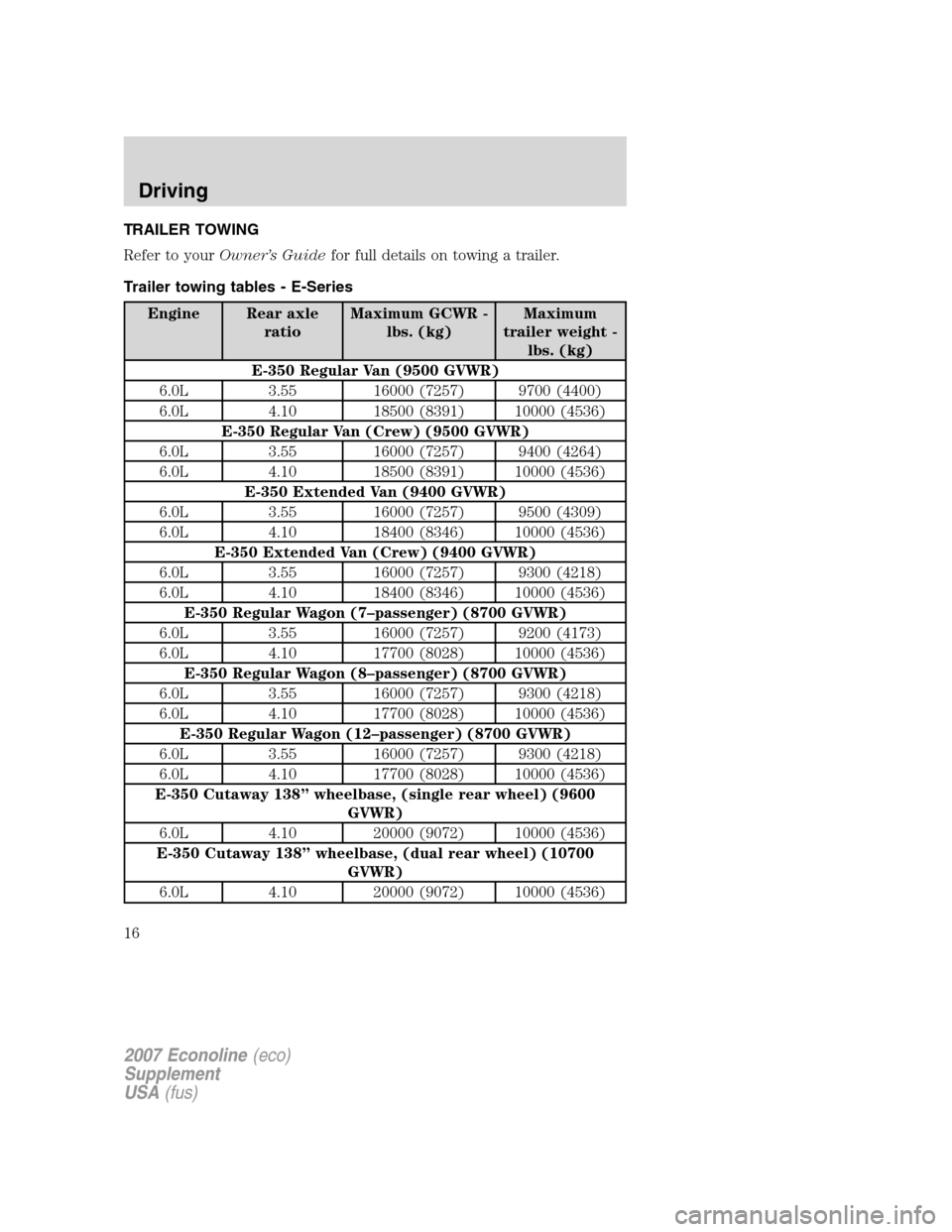
TRAILER TOWING
Refer to yourOwner’s Guidefor full details on towing a trailer.
Trailer towing tables - E-Series
Engine Rear axle
ratioMaximum GCWR -
lbs. (kg)Maximum
trailer weight -
lbs. (kg)
E-350 Regular Van (9500 GVWR)
6.0L 3.55 16000 (7257) 9700 (4400)
6.0L 4.10 18500 (8391) 10000 (4536)
E-350 Regular Van (Crew) (9500 GVWR)
6.0L 3.55 16000 (7257) 9400 (4264)
6.0L 4.10 18500 (8391) 10000 (4536)
E-350 Extended Van (9400 GVWR)
6.0L 3.55 16000 (7257) 9500 (4309)
6.0L 4.10 18400 (8346) 10000 (4536)
E-350 Extended Van (Crew) (9400 GVWR)
6.0L 3.55 16000 (7257) 9300 (4218)
6.0L 4.10 18400 (8346) 10000 (4536)
E-350 Regular Wagon (7–passenger) (8700 GVWR)
6.0L 3.55 16000 (7257) 9200 (4173)
6.0L 4.10 17700 (8028) 10000 (4536)
E-350 Regular Wagon (8–passenger) (8700 GVWR)
6.0L 3.55 16000 (7257) 9300 (4218)
6.0L 4.10 17700 (8028) 10000 (4536)
E-350 Regular Wagon (12–passenger) (8700 GVWR)
6.0L 3.55 16000 (7257) 9300 (4218)
6.0L 4.10 17700 (8028) 10000 (4536)
E-350 Cutaway 138” wheelbase, (single rear wheel) (9600
GVWR)
6.0L 4.10 20000 (9072) 10000 (4536)
E-350 Cutaway 138” wheelbase, (dual rear wheel) (10700
GVWR)
6.0L 4.10 20000 (9072) 10000 (4536)
2007 Econoline(eco)
Supplement
USA(fus)
Driving
16
Page 17 of 72
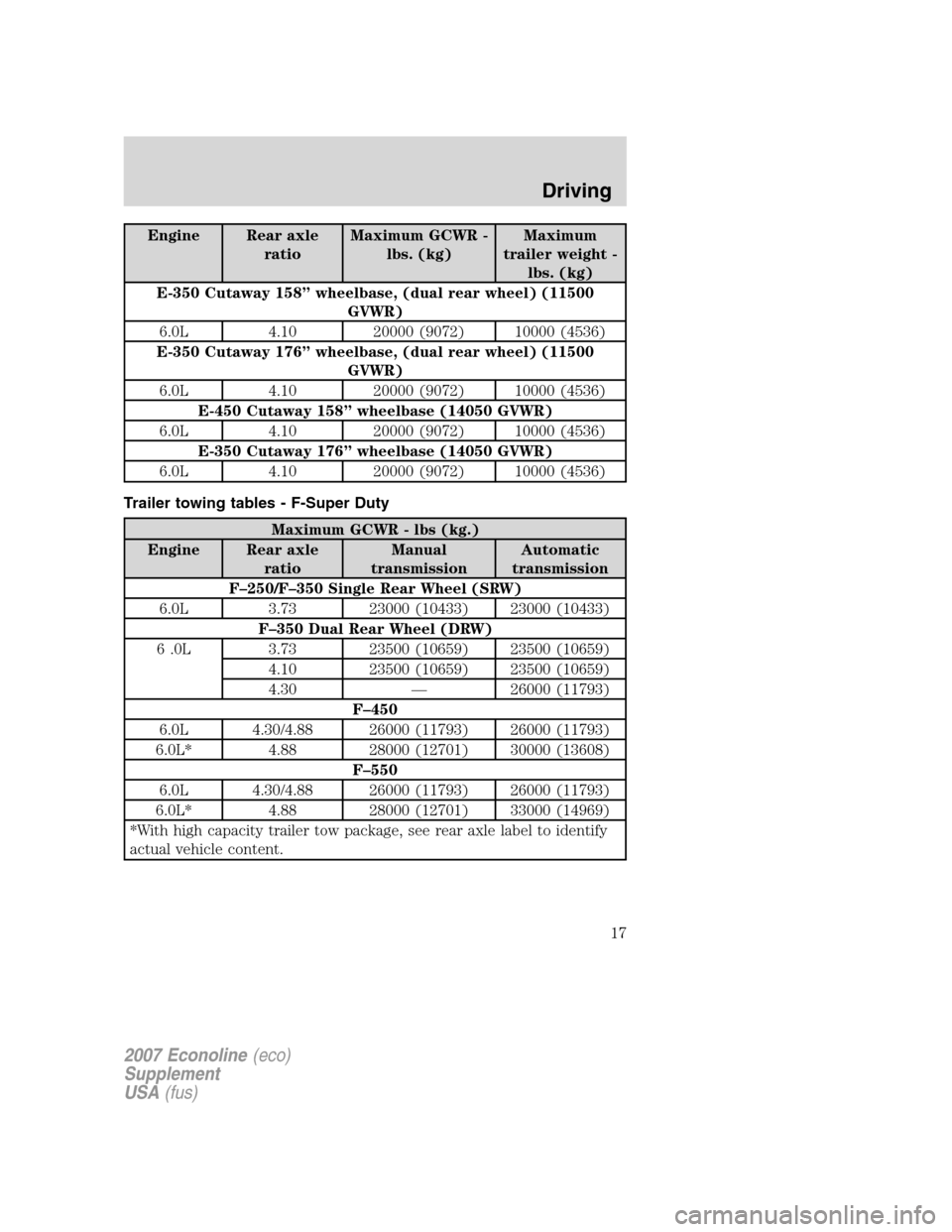
Engine Rear axle
ratioMaximum GCWR -
lbs. (kg)Maximum
trailer weight -
lbs. (kg)
E-350 Cutaway 158” wheelbase, (dual rear wheel) (11500
GVWR)
6.0L 4.10 20000 (9072) 10000 (4536)
E-350 Cutaway 176” wheelbase, (dual rear wheel) (11500
GVWR)
6.0L 4.10 20000 (9072) 10000 (4536)
E-450 Cutaway 158” wheelbase (14050 GVWR)
6.0L 4.10 20000 (9072) 10000 (4536)
E-350 Cutaway 176” wheelbase (14050 GVWR)
6.0L 4.10 20000 (9072) 10000 (4536)
Trailer towing tables - F-Super Duty
Maximum GCWR - lbs (kg.)
Engine Rear axle
ratioManual
transmissionAutomatic
transmission
F–250/F–350 Single Rear Wheel (SRW)
6.0L 3.73 23000 (10433) 23000 (10433)
F–350 Dual Rear Wheel (DRW)
6 .0L 3.73 23500 (10659) 23500 (10659)
4.10 23500 (10659) 23500 (10659)
4.30 — 26000 (11793)
F–450
6.0L 4.30/4.88 26000 (11793) 26000 (11793)
6.0L* 4.88 28000 (12701) 30000 (13608)
F–550
6.0L 4.30/4.88 26000 (11793) 26000 (11793)
6.0L* 4.88 28000 (12701) 33000 (14969)
*With high capacity trailer tow package, see rear axle label to identify
actual vehicle content.
2007 Econoline(eco)
Supplement
USA(fus)
Driving
17
Page 18 of 72
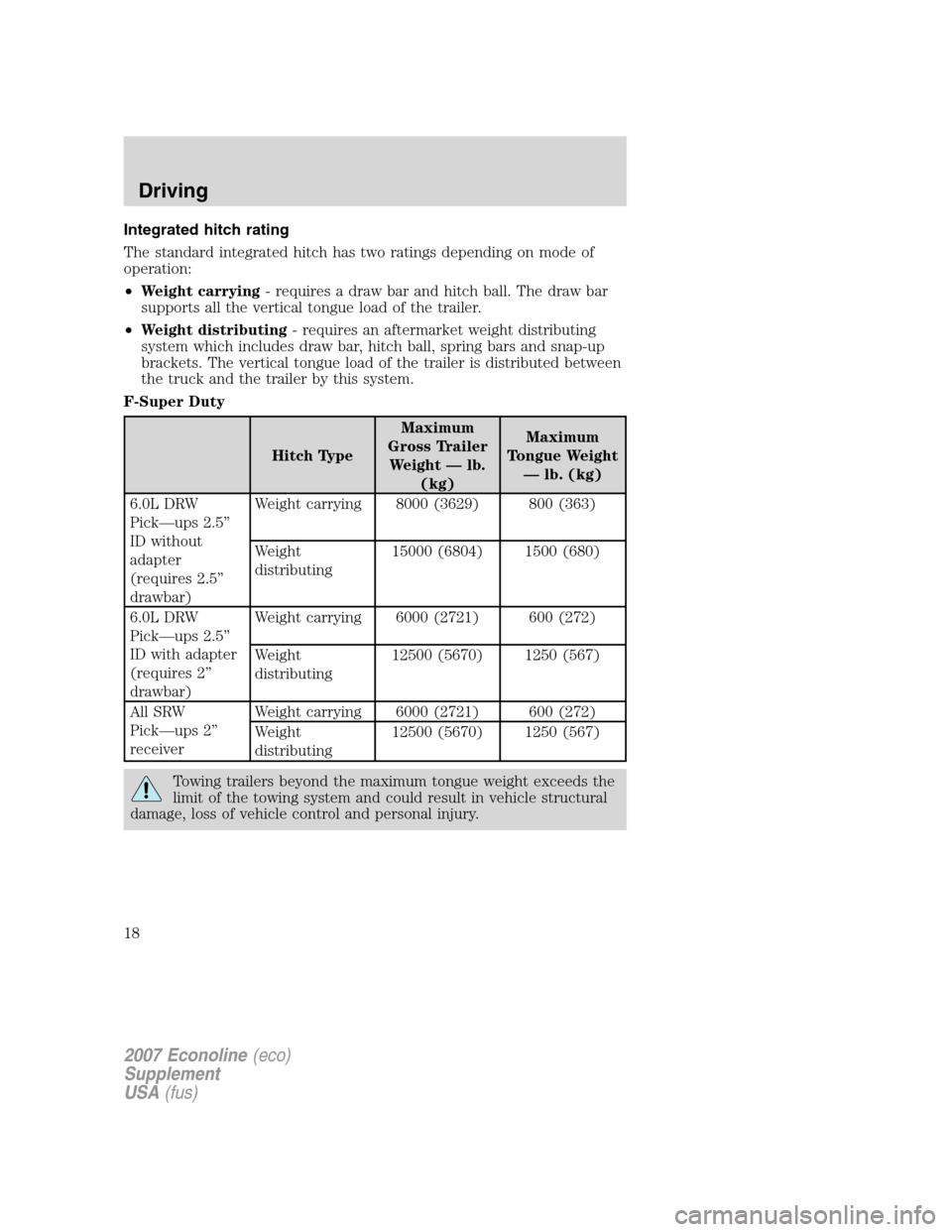
Integrated hitch rating
The standard integrated hitch has two ratings depending on mode of
operation:
•Weight carrying- requires a draw bar and hitch ball. The draw bar
supports all the vertical tongue load of the trailer.
•Weight distributing- requires an aftermarket weight distributing
system which includes draw bar, hitch ball, spring bars and snap-up
brackets. The vertical tongue load of the trailer is distributed between
the truck and the trailer by this system.
F-Super Duty
Hitch TypeMaximum
Gross Trailer
Weight — lb.
(kg)Maximum
Tongue Weight
— lb. (kg)
6.0L DRW
Pick—ups 2.5”
ID without
adapter
(requires 2.5”
drawbar)Weight carrying 8000 (3629) 800 (363)
Weight
distributing15000 (6804) 1500 (680)
6.0L DRW
Pick—ups 2.5”
ID with adapter
(requires 2”
drawbar)Weight carrying 6000 (2721) 600 (272)
Weight
distributing12500 (5670) 1250 (567)
All SRW
Pick—ups 2”
receiverWeight carrying 6000 (2721) 600 (272)
Weight
distributing12500 (5670) 1250 (567)
Towing trailers beyond the maximum tongue weight exceeds the
limit of the towing system and could result in vehicle structural
damage, loss of vehicle control and personal injury.
2007 Econoline(eco)
Supplement
USA(fus)
Driving
18
Page 39 of 72
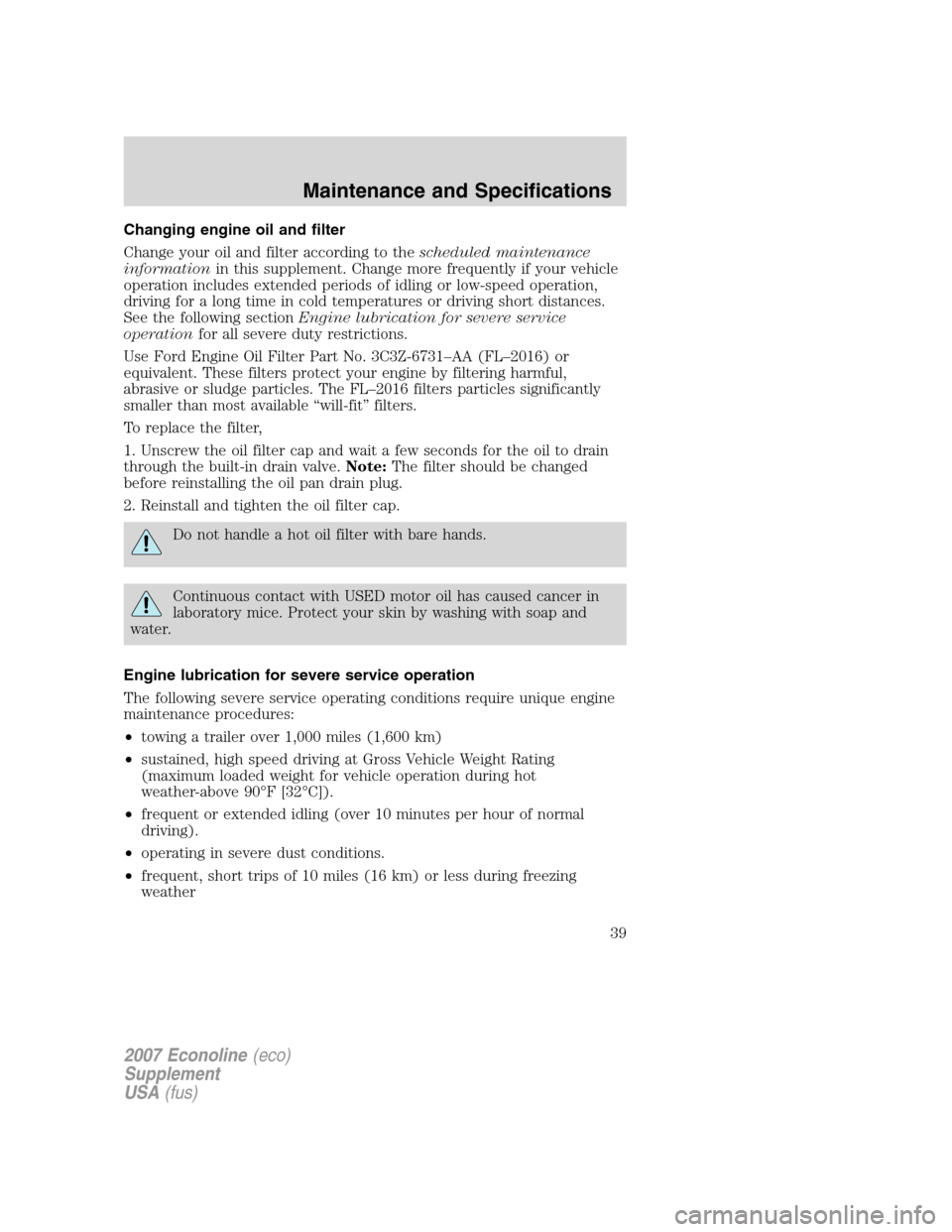
Changing engine oil and filter
Change your oil and filter according to thescheduled maintenance
informationin this supplement. Change more frequently if your vehicle
operation includes extended periods of idling or low-speed operation,
driving for a long time in cold temperatures or driving short distances.
See the following sectionEngine lubrication for severe service
operationfor all severe duty restrictions.
Use Ford Engine Oil Filter Part No. 3C3Z-6731–AA (FL–2016) or
equivalent. These filters protect your engine by filtering harmful,
abrasive or sludge particles. The FL–2016 filters particles significantly
smaller than most available “will-fit” filters.
To replace the filter,
1. Unscrew the oil filter cap and wait a few seconds for the oil to drain
through the built-in drain valve.Note:The filter should be changed
before reinstalling the oil pan drain plug.
2. Reinstall and tighten the oil filter cap.
Do not handle a hot oil filter with bare hands.
Continuous contact with USED motor oil has caused cancer in
laboratory mice. Protect your skin by washing with soap and
water.
Engine lubrication for severe service operation
The following severe service operating conditions require unique engine
maintenance procedures:
•towing a trailer over 1,000 miles (1,600 km)
•sustained, high speed driving at Gross Vehicle Weight Rating
(maximum loaded weight for vehicle operation during hot
weather-above 90°F [32°C]).
•frequent or extended idling (over 10 minutes per hour of normal
driving).
•operating in severe dust conditions.
•frequent, short trips of 10 miles (16 km) or less during freezing
weather
2007 Econoline(eco)
Supplement
USA(fus)
Maintenance and Specifications
39
Page 43 of 72
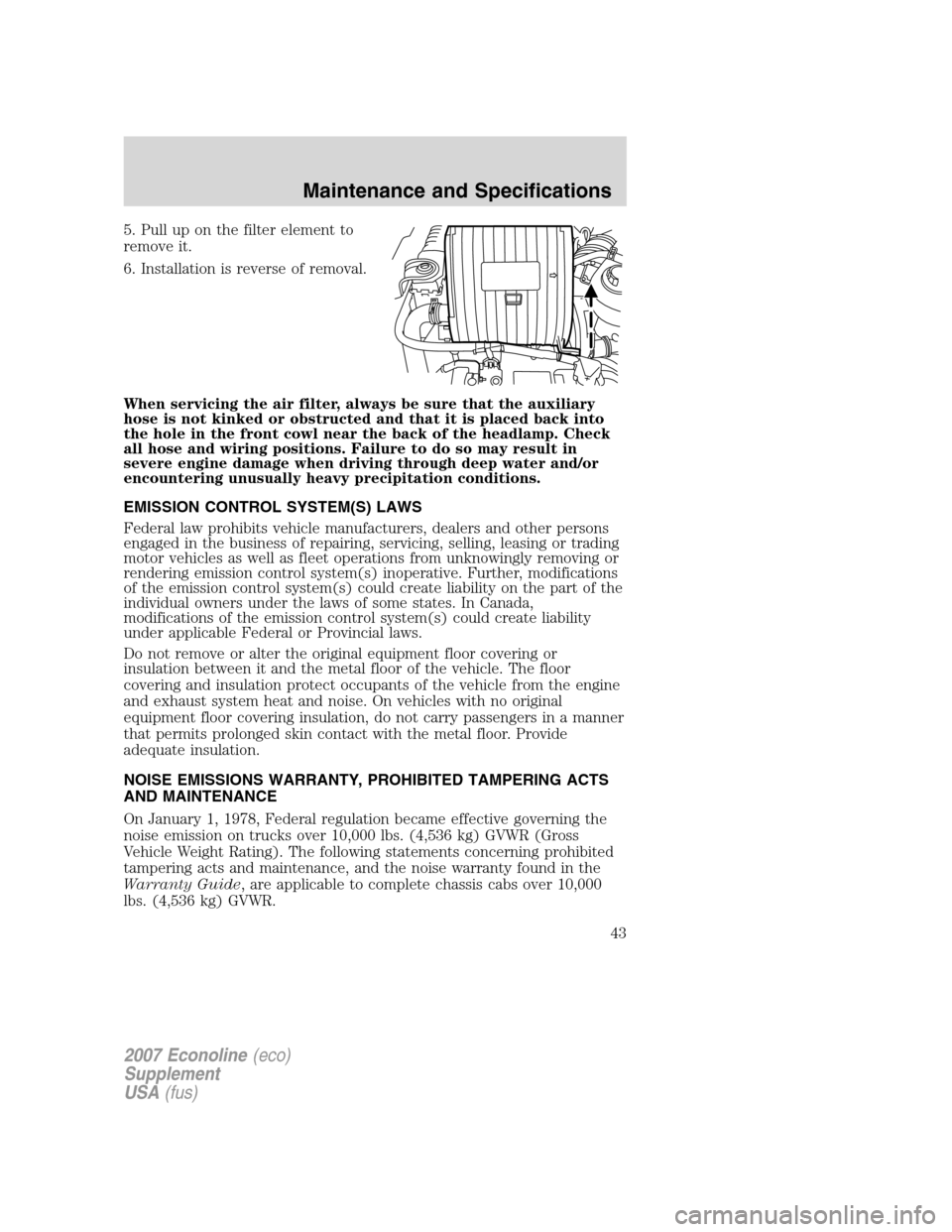
5. Pull up on the filter element to
remove it.
6. Installation is reverse of removal.
When servicing the air filter, always be sure that the auxiliary
hose is not kinked or obstructed and that it is placed back into
the hole in the front cowl near the back of the headlamp. Check
all hose and wiring positions. Failure to do so may result in
severe engine damage when driving through deep water and/or
encountering unusually heavy precipitation conditions.
EMISSION CONTROL SYSTEM(S) LAWS
Federal law prohibits vehicle manufacturers, dealers and other persons
engaged in the business of repairing, servicing, selling, leasing or trading
motor vehicles as well as fleet operations from unknowingly removing or
rendering emission control system(s) inoperative. Further, modifications
of the emission control system(s) could create liability on the part of the
individual owners under the laws of some states. In Canada,
modifications of the emission control system(s) could create liability
under applicable Federal or Provincial laws.
Do not remove or alter the original equipment floor covering or
insulation between it and the metal floor of the vehicle. The floor
covering and insulation protect occupants of the vehicle from the engine
and exhaust system heat and noise. On vehicles with no original
equipment floor covering insulation, do not carry passengers in a manner
that permits prolonged skin contact with the metal floor. Provide
adequate insulation.
NOISE EMISSIONS WARRANTY, PROHIBITED TAMPERING ACTS
AND MAINTENANCE
On January 1, 1978, Federal regulation became effective governing the
noise emission on trucks over 10,000 lbs. (4,536 kg) GVWR (Gross
Vehicle Weight Rating). The following statements concerning prohibited
tampering acts and maintenance, and the noise warranty found in the
Warranty Guide, are applicable to complete chassis cabs over 10,000
lbs. (4,536 kg) GVWR.
2007 Econoline(eco)
Supplement
USA(fus)
Maintenance and Specifications
43
Page 63 of 72
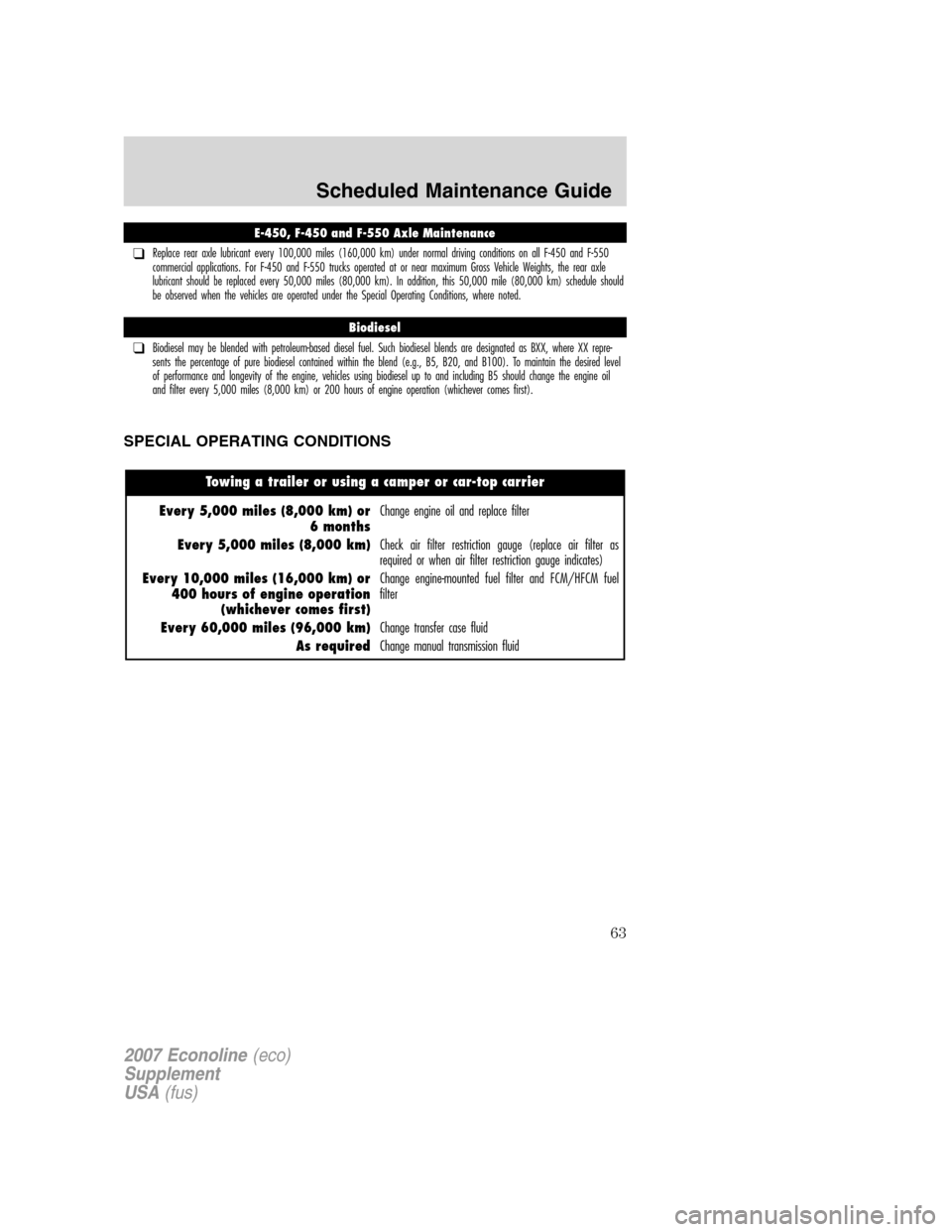
SPECIAL OPERATING CONDITIONS
Towing a trailer or using a camper or car-top carrier
Every 5,000 miles (8,000 km) or6 monthsChange engine oil and replace filter
Every 5,000 miles (8,000 km) Check air filter restriction gauge (replace air filter as
required or when air filter restriction gauge indicates)
Every 10,000 miles (16,000 km) or 400 hours of engine operation (whichever comes first) Change engine-mounted fuel filter and FCM/HFCM fuel
filter
Every 60,000 miles (96,000 km) Change transfer case fluid
As required Change manual transmission fluid
E-450, F-450 and F-550 Axle Maintenance
❑Replace rear axle lubricant every 100,000 miles (160,000 km) under normal driving conditions on all F-450 and F-550
commercial applications. For F-450 and F-550 trucks operated at or near maximum Gross Vehicle Weights, the rear axle
lubricant should be replaced every 50,000 miles (80,000 km). In addition, this 50,000 mile (80,000 km) schedule should
be observed when the vehicles are operated under the Special Operating Conditions, where noted.
Biodiesel
❑Biodiesel may be blended with petroleum-based diesel fuel. Such biodiesel blends are designated as BXX, where XX repre-
sents the percentage of pure biodiesel contained within the blend (e.g., B5, B20, and B100). To maintain the desired level
of performance and longevity of the engine, vehicles using biodiesel up to and including B5 should change the engine oil
and filter every 5,000 miles (8,000 km) or 200 hours of engine operation (whichever comes first).
2007 Econoline (eco)
Supplement
USA (fus)
Scheduled Maintenance Guide
63