2007 FORD SUPER DUTY towing
[x] Cancel search: towingPage 3 of 72
Guidelines. Using a Ford vehicle without the Ford ambulance
preparation package to produce an ambulance voids the Ford warranty
and could result in elevated underbody temperatures, fuel
overpressurization and the risk of fuel expulsion and fires. To determine
whether the vehicle is equipped with the Ford ambulance preparation
package, inspect the information plate on the driver’s side door pillar.
Contact the manufacturer of your vehicle to determine whether the
ambulance manufacturer’s followed Ford’s recommendations.
WARNINGS
Throughout this guide, you will find warnings identified by the
symbol
. Warnings remind you to be especially careful to reduce the
risk of personal injury.
NEW VEHICLE BREAK-IN
Your vehicle does not need an extensive break-in. Try not to drive
continuously at the same speed for the first 1,000 miles (1,600 km) of
new vehicle operation. Vary your speed to allow parts to adjust
themselves to other parts.
Drive your new vehicle at least 500 miles (800 km) before towing a
trailer.
Do not add friction modifier compounds or special break-in oils during
the first few thousand miles (kilometers) of operation, since these
additives may prevent piston ring seating. SeeEngine oilin the
Maintenance and Specificationschapter of this supplement for more
information on oil usage.
DIESEL ENGINE INFORMATION
The Diesel engine fuel system consists of:
•On F-Super Duty vehicles,a frame-mounted Horizontal Fuel
Conditioner Module (HFCM)
•On E-Series vehicles,a Fuel Conditioner Module (FCM) mounted on
the driver-side of the transmission case
•an engine-mounted secondary fuel filter
•a unit injector for each cylinder
The FCM/HFCM acts as a primary fuel filter/water separator which
removes both water and impurities from the fuel. The engine-mounted
fuel filter and the FCM/HFCM filter should be changed at the
recommended service interval. Refer to thescheduled maintenance
informationin this supplement for more information.
2007 Econoline(eco)
Supplement
USA(fus)
Introduction
3
Page 16 of 72
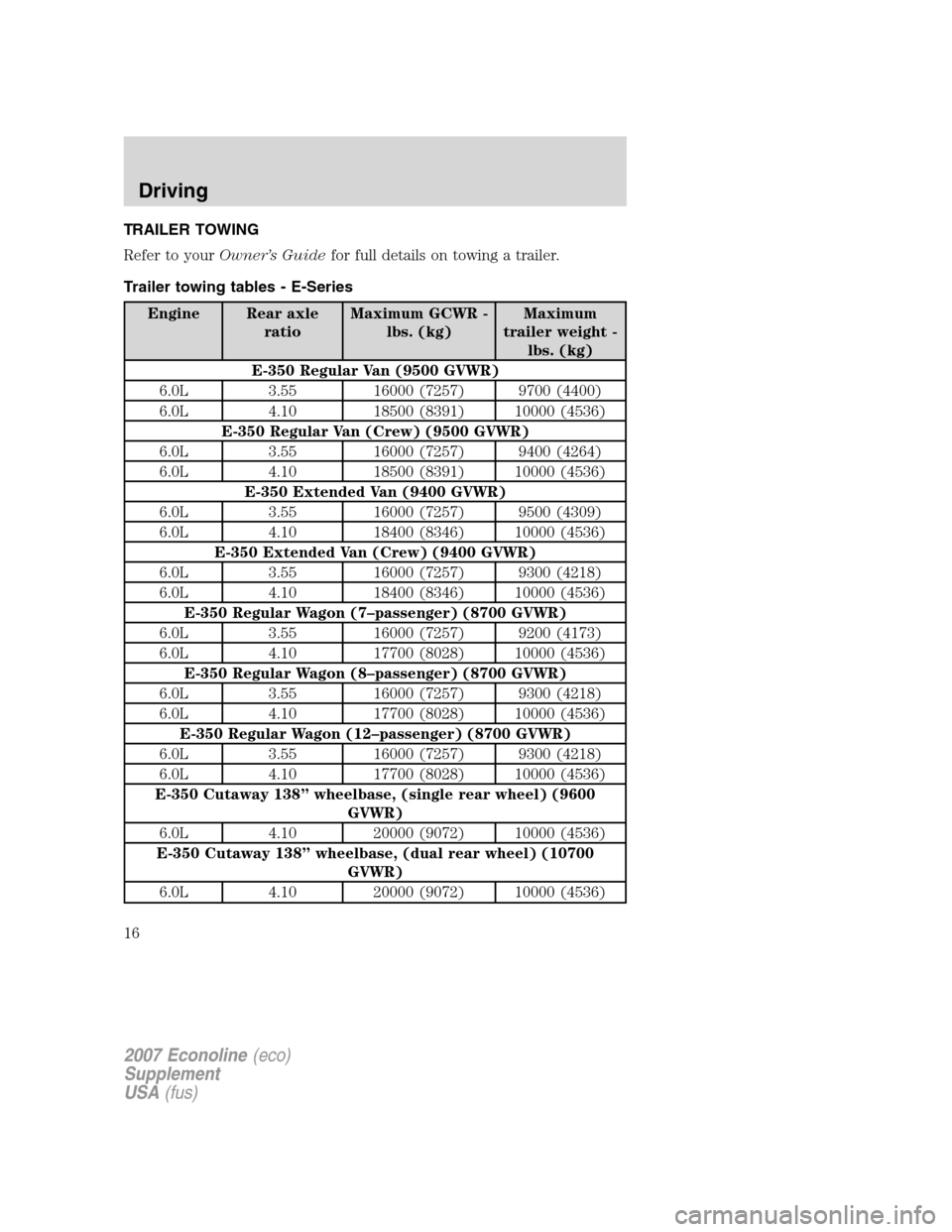
TRAILER TOWING
Refer to yourOwner’s Guidefor full details on towing a trailer.
Trailer towing tables - E-Series
Engine Rear axle
ratioMaximum GCWR -
lbs. (kg)Maximum
trailer weight -
lbs. (kg)
E-350 Regular Van (9500 GVWR)
6.0L 3.55 16000 (7257) 9700 (4400)
6.0L 4.10 18500 (8391) 10000 (4536)
E-350 Regular Van (Crew) (9500 GVWR)
6.0L 3.55 16000 (7257) 9400 (4264)
6.0L 4.10 18500 (8391) 10000 (4536)
E-350 Extended Van (9400 GVWR)
6.0L 3.55 16000 (7257) 9500 (4309)
6.0L 4.10 18400 (8346) 10000 (4536)
E-350 Extended Van (Crew) (9400 GVWR)
6.0L 3.55 16000 (7257) 9300 (4218)
6.0L 4.10 18400 (8346) 10000 (4536)
E-350 Regular Wagon (7–passenger) (8700 GVWR)
6.0L 3.55 16000 (7257) 9200 (4173)
6.0L 4.10 17700 (8028) 10000 (4536)
E-350 Regular Wagon (8–passenger) (8700 GVWR)
6.0L 3.55 16000 (7257) 9300 (4218)
6.0L 4.10 17700 (8028) 10000 (4536)
E-350 Regular Wagon (12–passenger) (8700 GVWR)
6.0L 3.55 16000 (7257) 9300 (4218)
6.0L 4.10 17700 (8028) 10000 (4536)
E-350 Cutaway 138” wheelbase, (single rear wheel) (9600
GVWR)
6.0L 4.10 20000 (9072) 10000 (4536)
E-350 Cutaway 138” wheelbase, (dual rear wheel) (10700
GVWR)
6.0L 4.10 20000 (9072) 10000 (4536)
2007 Econoline(eco)
Supplement
USA(fus)
Driving
16
Page 17 of 72
Engine Rear axle
ratioMaximum GCWR -
lbs. (kg)Maximum
trailer weight -
lbs. (kg)
E-350 Cutaway 158” wheelbase, (dual rear wheel) (11500
GVWR)
6.0L 4.10 20000 (9072) 10000 (4536)
E-350 Cutaway 176” wheelbase, (dual rear wheel) (11500
GVWR)
6.0L 4.10 20000 (9072) 10000 (4536)
E-450 Cutaway 158” wheelbase (14050 GVWR)
6.0L 4.10 20000 (9072) 10000 (4536)
E-350 Cutaway 176” wheelbase (14050 GVWR)
6.0L 4.10 20000 (9072) 10000 (4536)
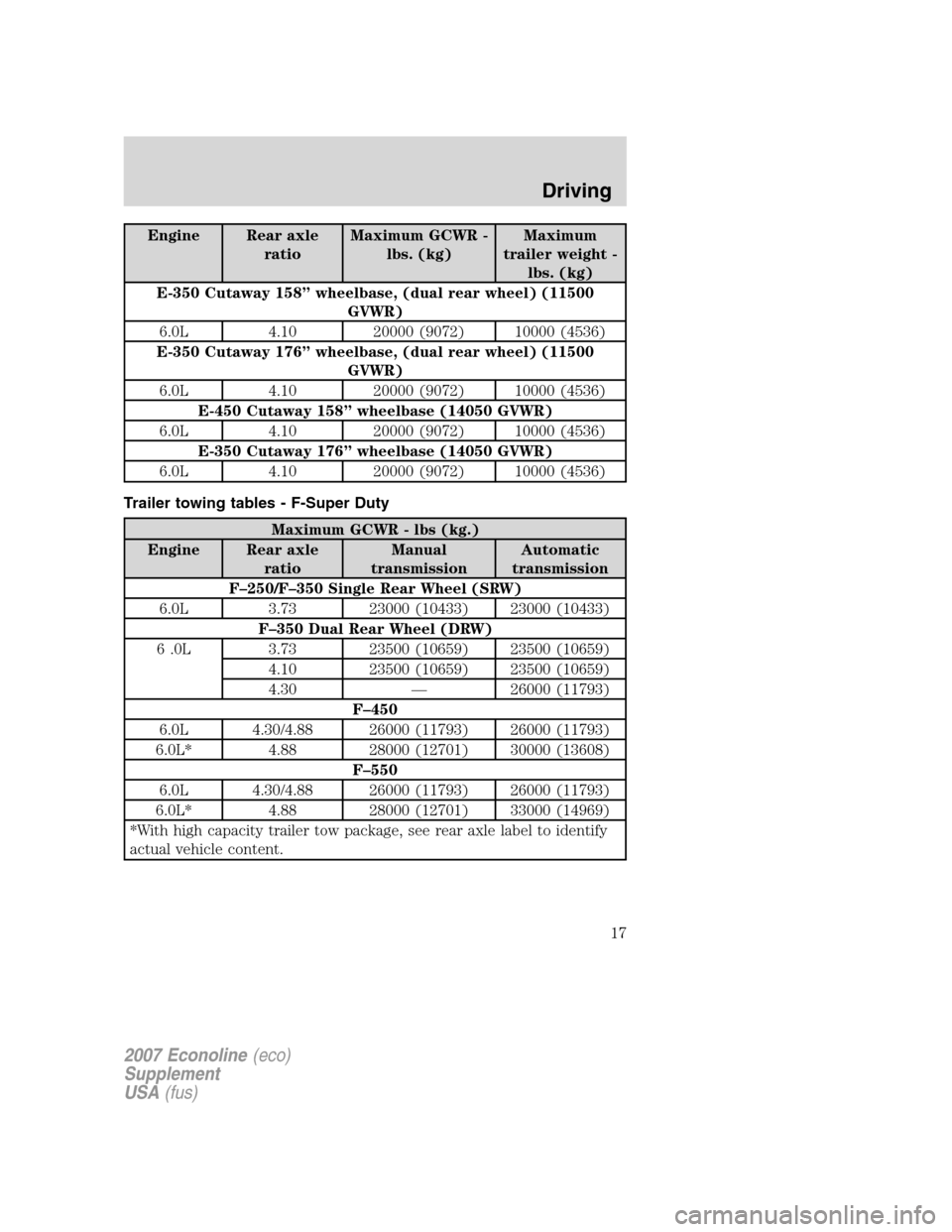
Trailer towing tables - F-Super Duty
Maximum GCWR - lbs (kg.)
Engine Rear axle
ratioManual
transmissionAutomatic
transmission
F–250/F–350 Single Rear Wheel (SRW)
6.0L 3.73 23000 (10433) 23000 (10433)
F–350 Dual Rear Wheel (DRW)
6 .0L 3.73 23500 (10659) 23500 (10659)
4.10 23500 (10659) 23500 (10659)
4.30 — 26000 (11793)
F–450
6.0L 4.30/4.88 26000 (11793) 26000 (11793)
6.0L* 4.88 28000 (12701) 30000 (13608)
F–550
6.0L 4.30/4.88 26000 (11793) 26000 (11793)
6.0L* 4.88 28000 (12701) 33000 (14969)
*With high capacity trailer tow package, see rear axle label to identify
actual vehicle content.
2007 Econoline(eco)
Supplement
USA(fus)
Driving
17
Page 18 of 72
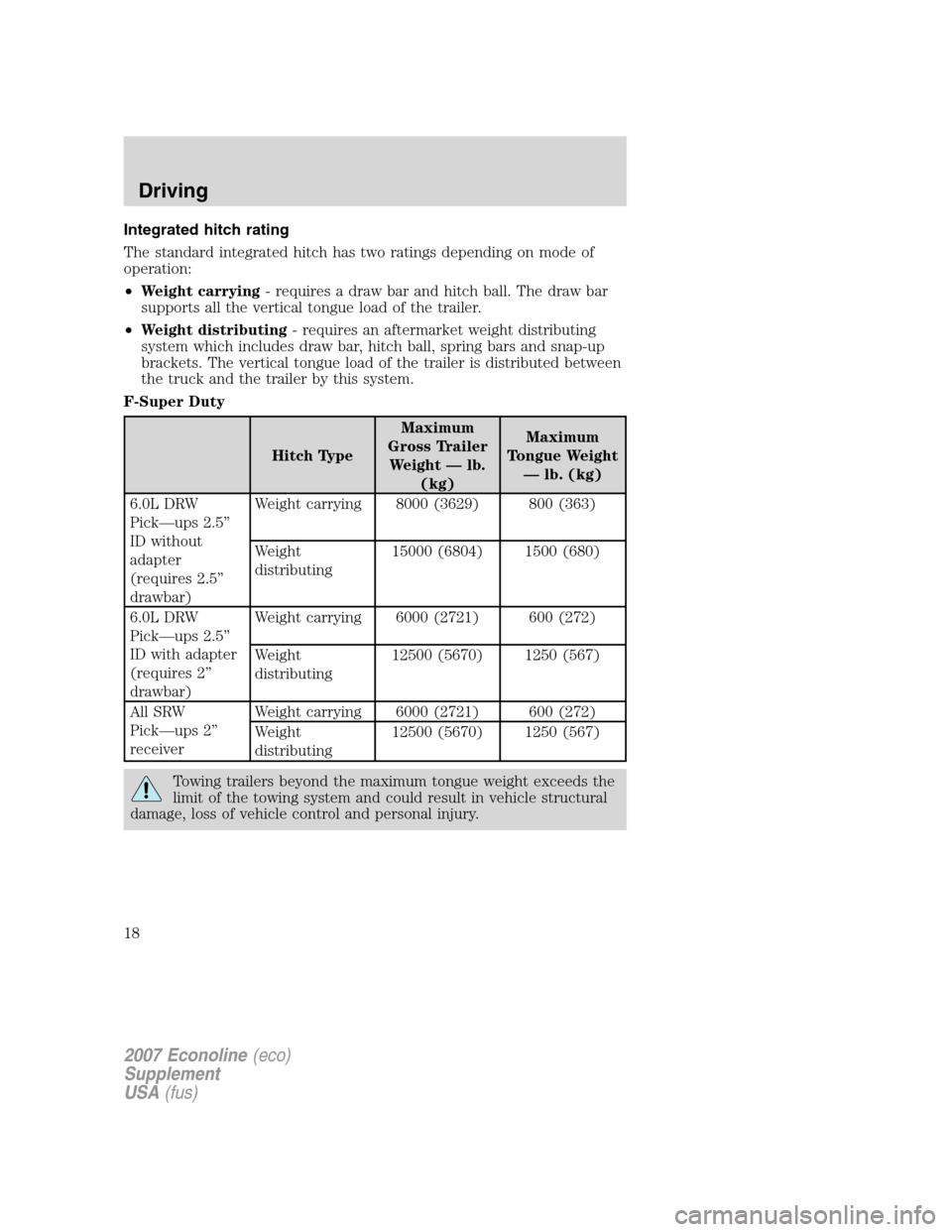
Integrated hitch rating
The standard integrated hitch has two ratings depending on mode of
operation:
•Weight carrying- requires a draw bar and hitch ball. The draw bar
supports all the vertical tongue load of the trailer.
•Weight distributing- requires an aftermarket weight distributing
system which includes draw bar, hitch ball, spring bars and snap-up
brackets. The vertical tongue load of the trailer is distributed between
the truck and the trailer by this system.
F-Super Duty
Hitch TypeMaximum
Gross Trailer
Weight — lb.
(kg)Maximum
Tongue Weight
— lb. (kg)
6.0L DRW
Pick—ups 2.5”
ID without
adapter
(requires 2.5”
drawbar)Weight carrying 8000 (3629) 800 (363)
Weight
distributing15000 (6804) 1500 (680)
6.0L DRW
Pick—ups 2.5”
ID with adapter
(requires 2”
drawbar)Weight carrying 6000 (2721) 600 (272)
Weight
distributing12500 (5670) 1250 (567)
All SRW
Pick—ups 2”
receiverWeight carrying 6000 (2721) 600 (272)
Weight
distributing12500 (5670) 1250 (567)
Towing trailers beyond the maximum tongue weight exceeds the
limit of the towing system and could result in vehicle structural
damage, loss of vehicle control and personal injury.
2007 Econoline(eco)
Supplement
USA(fus)
Driving
18
Page 38 of 72
Engine oils with improved fuel economy properties (energy conserving)
are currently available. If you use an energy conserving oil, be sure it
meets the recommended Ford Specification,APIservice categories and
SAE viscosity grades listed in theLubricant Specificationschart later
in this chapter. Some energy conserving oilsdo notmeet the
requirements necessary for your diesel engine.
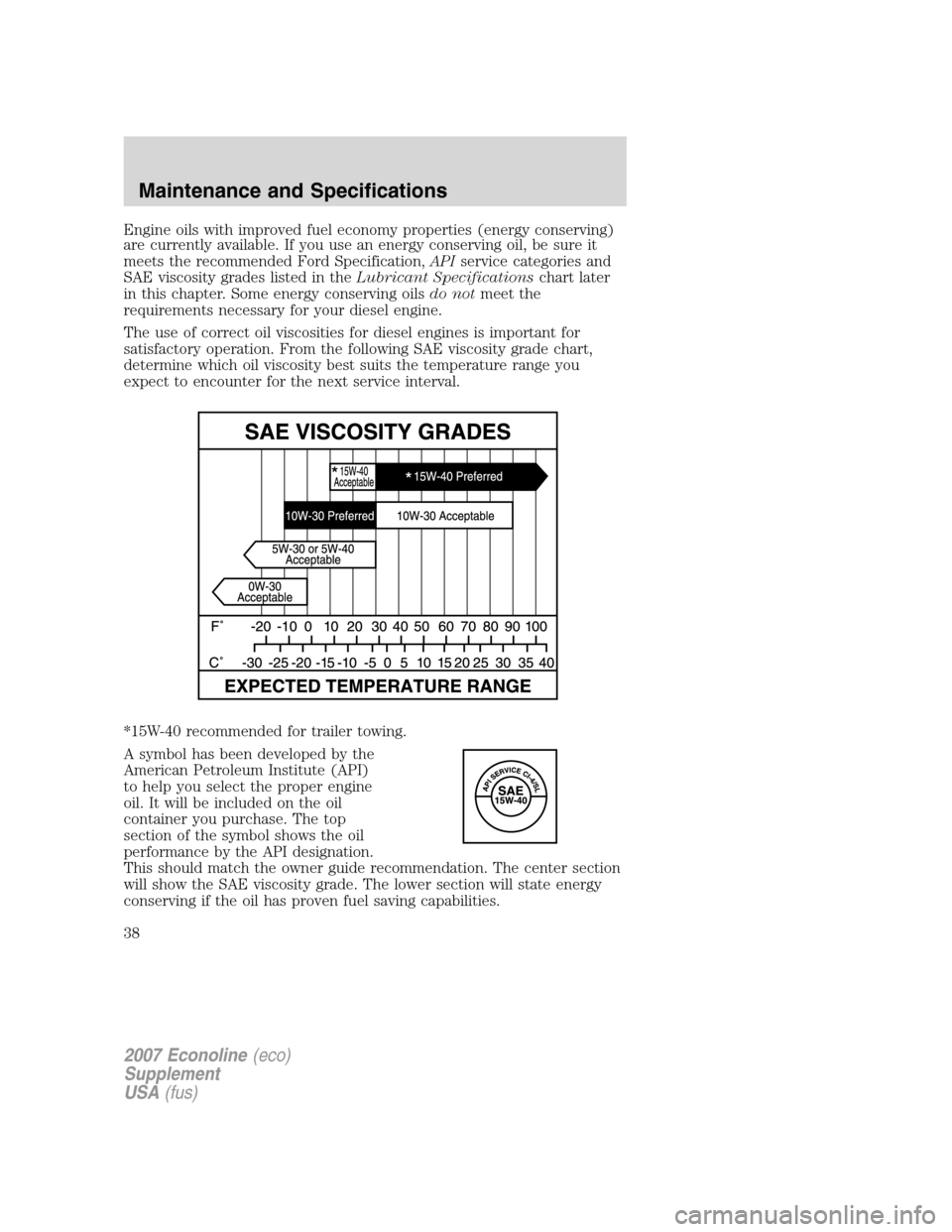
The use of correct oil viscosities for diesel engines is important for
satisfactory operation. From the following SAE viscosity grade chart,
determine which oil viscosity best suits the temperature range you
expect to encounter for the next service interval.
*15W-40 recommended for trailer towing.
A symbol has been developed by the
American Petroleum Institute (API)
to help you select the proper engine
oil. It will be included on the oil
container you purchase. The top
section of the symbol shows the oil
performance by the API designation.
This should match the owner guide recommendation. The center section
will show the SAE viscosity grade. The lower section will state energy
conserving if the oil has proven fuel saving capabilities.
2007 Econoline(eco)
Supplement
USA(fus)
Maintenance and Specifications
38
Page 39 of 72
Changing engine oil and filter
Change your oil and filter according to thescheduled maintenance
informationin this supplement. Change more frequently if your vehicle
operation includes extended periods of idling or low-speed operation,
driving for a long time in cold temperatures or driving short distances.
See the following sectionEngine lubrication for severe service
operationfor all severe duty restrictions.
Use Ford Engine Oil Filter Part No. 3C3Z-6731–AA (FL–2016) or
equivalent. These filters protect your engine by filtering harmful,
abrasive or sludge particles. The FL–2016 filters particles significantly
smaller than most available “will-fit” filters.
To replace the filter,
1. Unscrew the oil filter cap and wait a few seconds for the oil to drain
through the built-in drain valve.Note:The filter should be changed
before reinstalling the oil pan drain plug.
2. Reinstall and tighten the oil filter cap.
Do not handle a hot oil filter with bare hands.
Continuous contact with USED motor oil has caused cancer in
laboratory mice. Protect your skin by washing with soap and
water.
Engine lubrication for severe service operation
The following severe service operating conditions require unique engine
maintenance procedures:
•towing a trailer over 1,000 miles (1,600 km)
•sustained, high speed driving at Gross Vehicle Weight Rating
(maximum loaded weight for vehicle operation during hot
weather-above 90°F [32°C]).
•frequent or extended idling (over 10 minutes per hour of normal
driving).
•operating in severe dust conditions.
•frequent, short trips of 10 miles (16 km) or less during freezing
weather
2007 Econoline(eco)
Supplement
USA(fus)
Maintenance and Specifications
39
Page 63 of 72
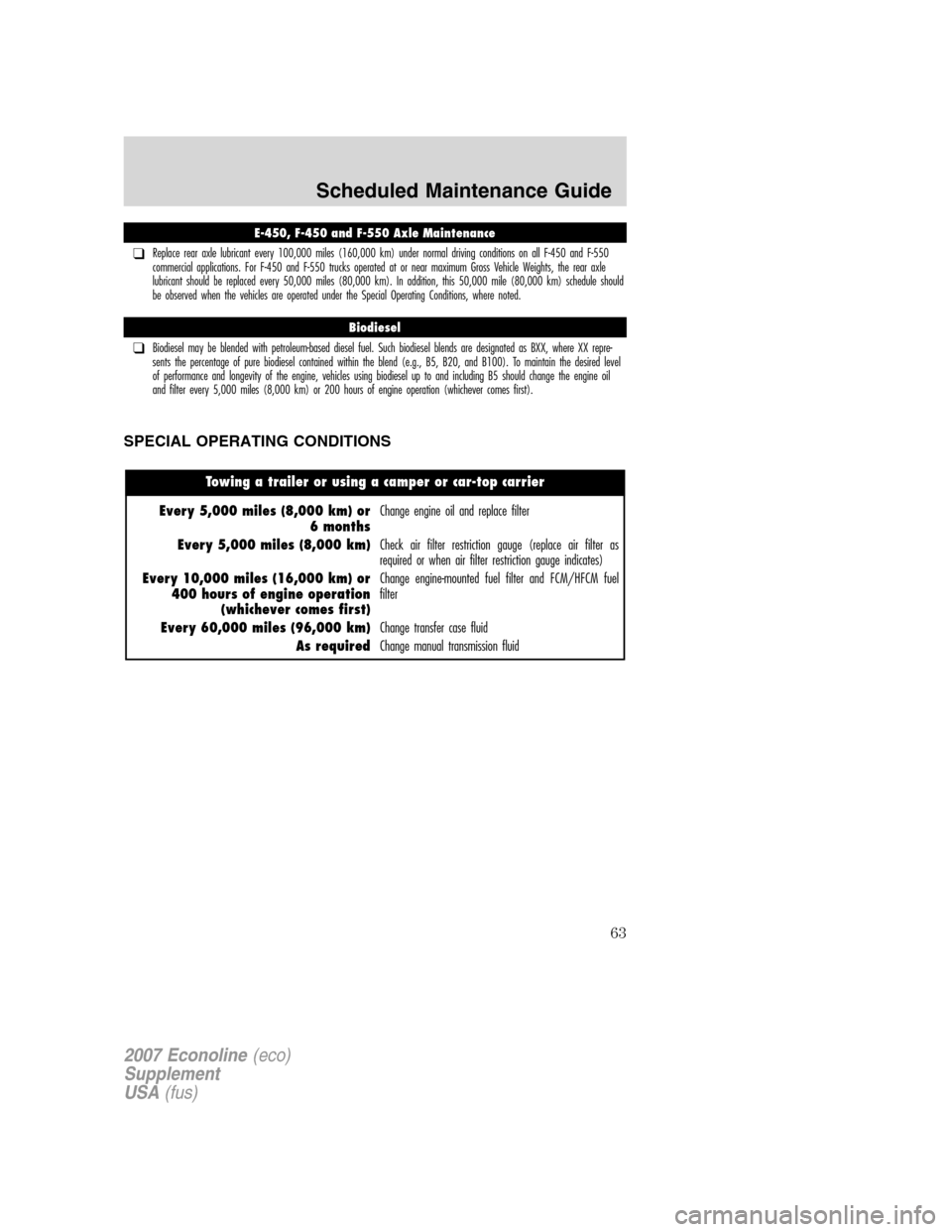
SPECIAL OPERATING CONDITIONS
Towing a trailer or using a camper or car-top carrier
Every 5,000 miles (8,000 km) or6 monthsChange engine oil and replace filter
Every 5,000 miles (8,000 km) Check air filter restriction gauge (replace air filter as
required or when air filter restriction gauge indicates)
Every 10,000 miles (16,000 km) or 400 hours of engine operation (whichever comes first) Change engine-mounted fuel filter and FCM/HFCM fuel
filter
Every 60,000 miles (96,000 km) Change transfer case fluid
As required Change manual transmission fluid
E-450, F-450 and F-550 Axle Maintenance
❑Replace rear axle lubricant every 100,000 miles (160,000 km) under normal driving conditions on all F-450 and F-550
commercial applications. For F-450 and F-550 trucks operated at or near maximum Gross Vehicle Weights, the rear axle
lubricant should be replaced every 50,000 miles (80,000 km). In addition, this 50,000 mile (80,000 km) schedule should
be observed when the vehicles are operated under the Special Operating Conditions, where noted.
Biodiesel
❑Biodiesel may be blended with petroleum-based diesel fuel. Such biodiesel blends are designated as BXX, where XX repre-
sents the percentage of pure biodiesel contained within the blend (e.g., B5, B20, and B100). To maintain the desired level
of performance and longevity of the engine, vehicles using biodiesel up to and including B5 should change the engine oil
and filter every 5,000 miles (8,000 km) or 200 hours of engine operation (whichever comes first).
2007 Econoline (eco)
Supplement
USA (fus)
Scheduled Maintenance Guide
63