Page 208 of 296
Emergency maneuvers
•In an unavoidable emergency situation where a sudden sharp turn
must be made, remember to avoid “over-driving” your vehicle (i.e.,
turn the steering wheel only as rapidly and as far as required to avoid
the emergency). Excessive steering will result in less vehicle control,
not more. Additionally, smooth variations of the accelerator and/or
brake pedal pressure should be utilized if changes in vehicle speed are
called for. Avoid abrupt steering, acceleration or braking which could
result in an increased risk of loss of vehicle control, vehicle rollover
and/or personal injury. Use all available road surface to return the
vehicle to a safe direction of travel.
•In the event of an emergency stop, avoid skidding the tires and do not
attempt any sharp steering wheel movements.
•If the vehicle goes from one type of surface to another (i.e., from
concrete to gravel) there will be a change in the way the vehicle
responds to a maneuver (steering, acceleration or braking). Again,
avoid these abrupt inputs.
AWD Systems (if equipped)
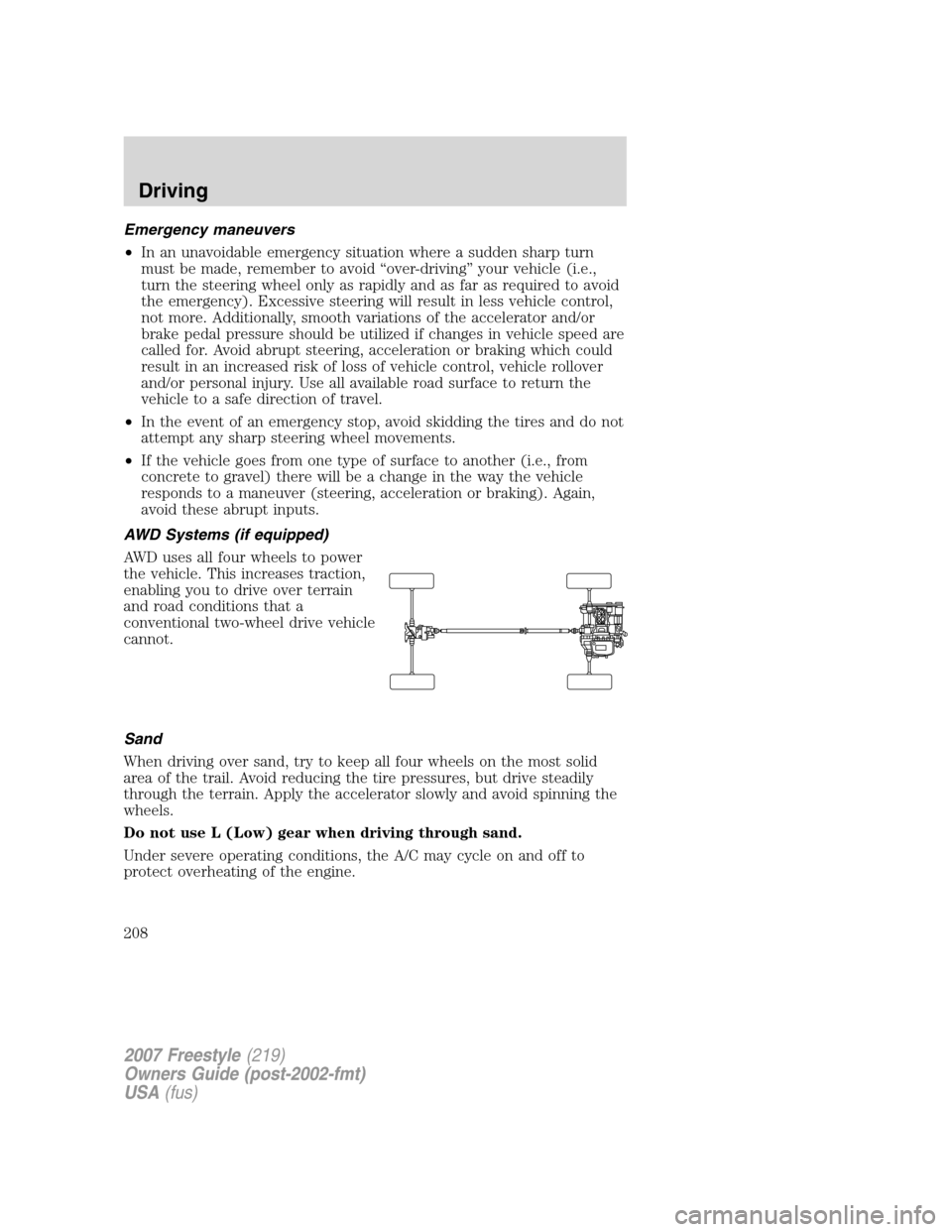
AWD uses all four wheels to power
the vehicle. This increases traction,
enabling you to drive over terrain
and road conditions that a
conventional two-wheel drive vehicle
cannot.
Sand
When driving over sand, try to keep all four wheels on the most solid
area of the trail. Avoid reducing the tire pressures, but drive steadily
through the terrain. Apply the accelerator slowly and avoid spinning the
wheels.
Do not use L (Low) gear when driving through sand.
Under severe operating conditions, the A/C may cycle on and off to
protect overheating of the engine.
2007 Freestyle(219)
Owners Guide (post-2002-fmt)
USA(fus)
Driving
208
Page 209 of 296
Avoid excessive speed because vehicle momentum can work against you
and cause the vehicle to become stuck to the point that assistance may
be required from another vehicle. Remember, you may be able to back
out the way you came if you proceed with caution.
Mud and water
If you must drive through high water, drive slowly. Traction or brake
capability may be limited.
When driving through water, determine the depth; avoid water higher
than the bottom of the hubs (if possible) and proceed slowly. If the
ignition system gets wet, the vehicle may stall.
Once through water, always try the brakes. Wet brakes do not stop the
vehicle as effectively as dry brakes. Drying can be improved by moving
your vehicle slowly while applying light pressure on the brake pedal.
Be cautious of sudden changes in vehicle speed or direction when you
are driving in mud. Even AWD vehicles can lose traction in slick mud. As
when you are driving over sand, apply the accelerator slowly and avoid
spinning your wheels. If the vehicle does slide, steer in the direction of
the slide until you regain control of the vehicle.
If the transmission, AWD system components or axles are submerged in
water, their fluids should be checked and changed, if necessary.
Driving through deep water may damage the transmission.
If the front or rear axle is submerged in water, the axle lubricant and
PTU (Power Transfer Unit) lubricant should be checked and changed if
necessary.
After driving through mud, clean off residue stuck to rotating driveshafts
and tires. Excess mud stuck on tires and rotating driveshafts causes an
imbalance that could damage drive components.
“Tread Lightly” is an educational
program designed to increase public
awareness of land-use regulations
and responsibilities in our nations
wilderness areas. Ford Motor
Company joins the U.S. Forest Service and the Bureau of Land
Management in encouraging you to help preserve our national forest and
other public and private lands by “treading lightly.”
2007 Freestyle(219)
Owners Guide (post-2002-fmt)
USA(fus)
Driving
209
Page 210 of 296
Driving on hilly or sloping terrain
Although natural obstacles may make it necessary to travel diagonally up
or down a hill or steep incline, you should always try to drive straight up
or straight down.Avoid driving crosswise or turning on steep
slopes or hills.A danger lies in losing traction, slipping sideways and
possibly rolling over. Whenever driving on a hill, determine beforehand
the route you will use. Do not drive over the crest of a hill without
seeing what conditions are on the other side. Do not drive in reverse
over a hill without the aid of an observer.
When climbing a steep slope or hill, start in a lower gear rather than
downshifting to a lower gear from a higher gear once the ascent has
started. This reduces strain on the engine and the possibility of stalling.
If you do stall out, do not try to turn around because you might roll over.
It is better to back down to a safe location.
Apply just enough power to the wheels to climb the hill. Too much
power will cause the tires to slip, spin or lose traction, resulting in loss of
vehicle control.
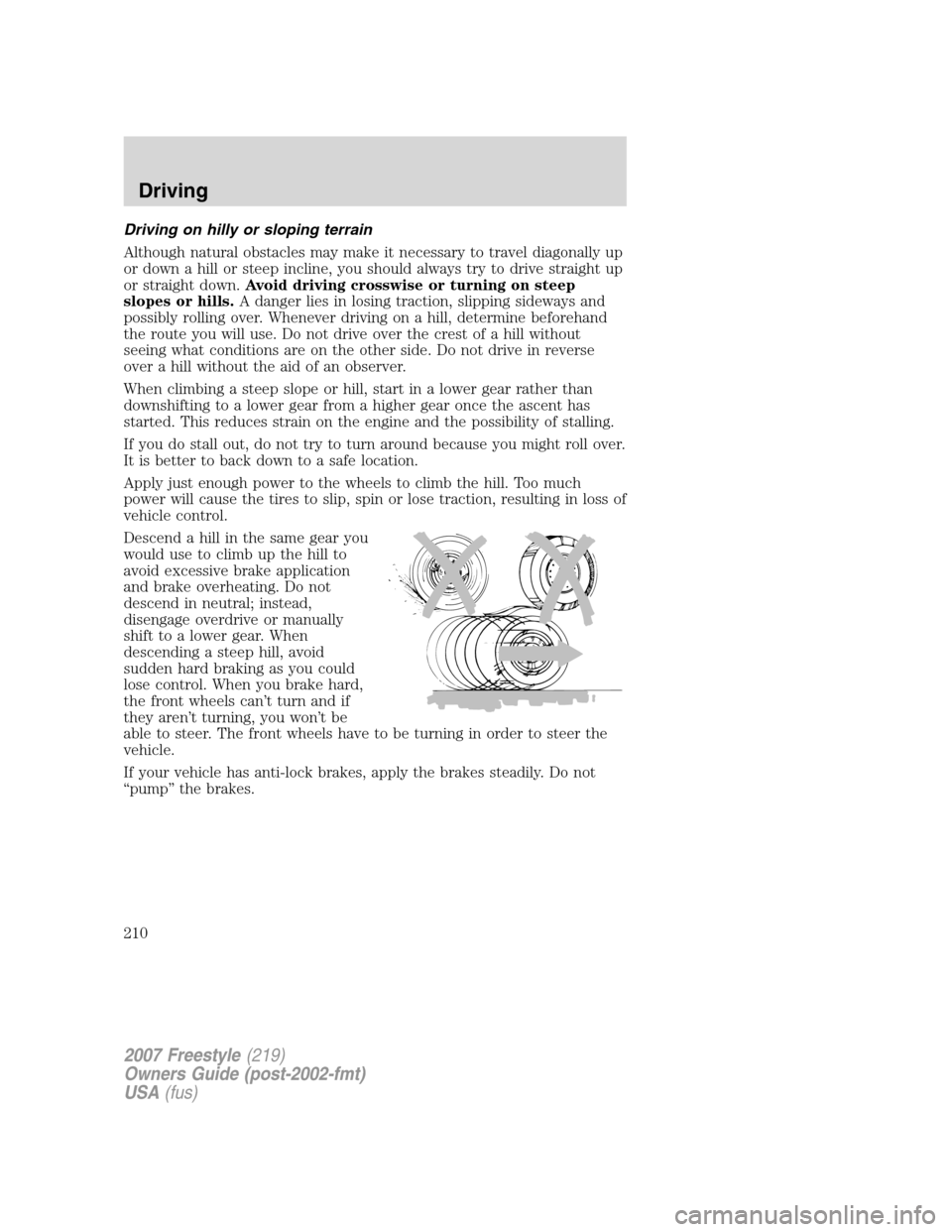
Descend a hill in the same gear you
would use to climb up the hill to
avoid excessive brake application
and brake overheating. Do not
descend in neutral; instead,
disengage overdrive or manually
shift to a lower gear. When
descending a steep hill, avoid
sudden hard braking as you could
lose control. When you brake hard,
the front wheels can’t turn and if
they aren’t turning, you won’t be
able to steer. The front wheels have to be turning in order to steer the
vehicle.
If your vehicle has anti-lock brakes, apply the brakes steadily. Do not
“pump” the brakes.
2007 Freestyle(219)
Owners Guide (post-2002-fmt)
USA(fus)
Driving
210
Page 218 of 296
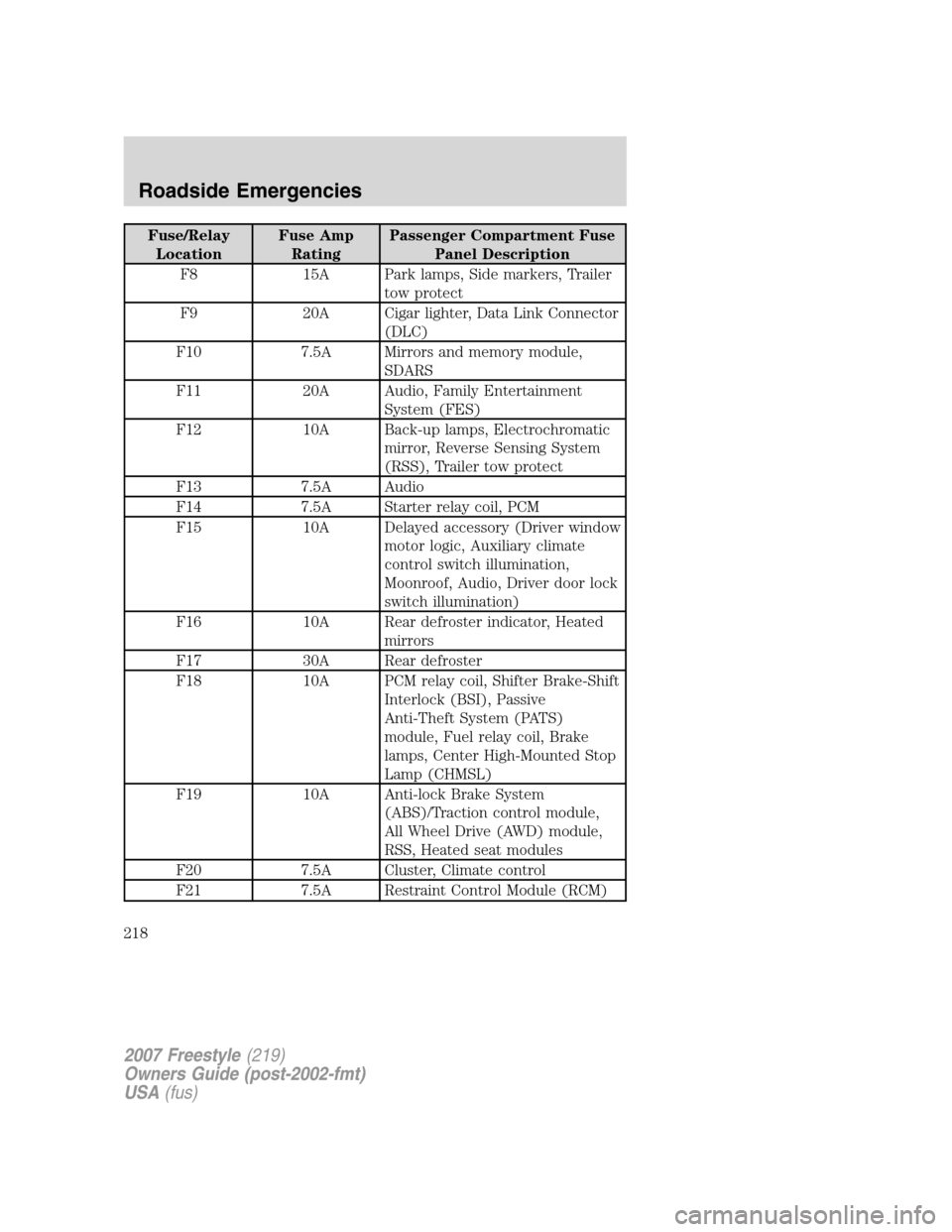
Fuse/Relay
LocationFuse Amp
RatingPassenger Compartment Fuse
Panel Description
F8 15A Park lamps, Side markers, Trailer
tow protect
F9 20A Cigar lighter, Data Link Connector
(DLC)
F10 7.5A Mirrors and memory module,
SDARS
F11 20A Audio, Family Entertainment
System (FES)
F12 10A Back-up lamps, Electrochromatic
mirror, Reverse Sensing System
(RSS), Trailer tow protect
F13 7.5A Audio
F14 7.5A Starter relay coil, PCM
F15 10A Delayed accessory (Driver window
motor logic, Auxiliary climate
control switch illumination,
Moonroof, Audio, Driver door lock
switch illumination)
F16 10A Rear defroster indicator, Heated
mirrors
F17 30A Rear defroster
F18 10A PCM relay coil, Shifter Brake-Shift
Interlock (BSI), Passive
Anti-Theft System (PATS)
module, Fuel relay coil, Brake
lamps, Center High-Mounted Stop
Lamp (CHMSL)
F19 10A Anti-lock Brake System
(ABS)/Traction control module,
All Wheel Drive (AWD) module,
RSS, Heated seat modules
F20 7.5A Cluster, Climate control
F21 7.5A Restraint Control Module (RCM)
2007 Freestyle(219)
Owners Guide (post-2002-fmt)
USA(fus)
Roadside Emergencies
218
Page 221 of 296
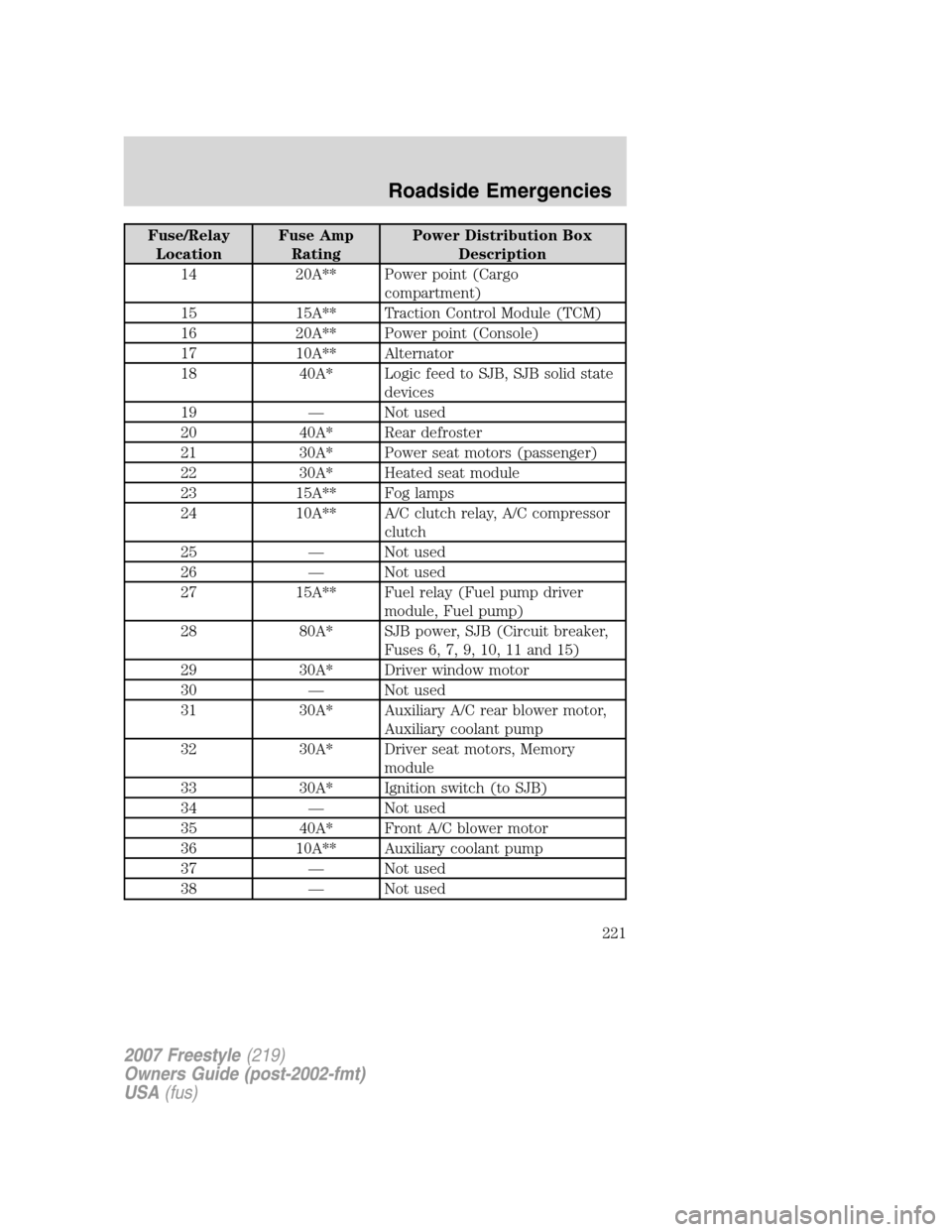
Fuse/Relay
LocationFuse Amp
RatingPower Distribution Box
Description
14 20A** Power point (Cargo
compartment)
15 15A** Traction Control Module (TCM)
16 20A** Power point (Console)
17 10A** Alternator
18 40A* Logic feed to SJB, SJB solid state
devices
19 — Not used
20 40A* Rear defroster
21 30A* Power seat motors (passenger)
22 30A* Heated seat module
23 15A** Fog lamps
24 10A** A/C clutch relay, A/C compressor
clutch
25 — Not used
26 — Not used
27 15A** Fuel relay (Fuel pump driver
module, Fuel pump)
28 80A* SJB power, SJB (Circuit breaker,
Fuses 6, 7, 9, 10, 11 and 15)
29 30A* Driver window motor
30 — Not used
31 30A* Auxiliary A/C rear blower motor,
Auxiliary coolant pump
32 30A* Driver seat motors, Memory
module
33 30A* Ignition switch (to SJB)
34 — Not used
35 40A* Front A/C blower motor
36 10A** Auxiliary coolant pump
37 — Not used
38 — Not used
2007 Freestyle(219)
Owners Guide (post-2002-fmt)
USA(fus)
Roadside Emergencies
221
Page 295 of 296

tire grades ...............................170
treadwear ........................169, 174
Towing .......................................190
recreational towing .................193
trailer towing ..........................190
wrecker ....................................235
Traction control ........................199
Transaxle
fluid, checking and adding
(automatic) .............................281
fluid, refill capacities ..............283
lubricant specifications ..........283
Transmission .............................201
brake-shift interlock (BSI) ....201
Turn signal ..................................62
V
Vehicle Identification Number
(VIN) ..........................................286Vehicle loading ..........................184
Ventilating your vehicle ...........197
W
Warning lights (see Lights)
.......10
Washer fluid
..............................255
Water, Driving through
.............212
Windows
power
.........................................72
rear wiper/washer
.....................68
Windshield washer fluid and
wipers
checking and adding fluid
.....255
operation
...................................67
replacing wiper blades
...........256
Wrecker towing
.........................235
2007 Freestyle(219)
Owners Guide (post-2002-fmt)
USA(fus)
Index
295