Page 118 of 224
8.U.S. DOT Tire Identification Number (TIN):This begins with the
letters “DOT” and indicates that the tire meets all federal standards. The
next two numbers or letters are the plant code designating where it was
manufactured, the next two are the tire size code and the last four
numbers represent the week and year the tire was built. For example,
the numbers 317 mean the 31st week of 1997. After 2000 the numbers
go to four digits. For example, 2501 means the 25th week of 2001. The
numbers in between are identification codes used for traceability. This
information is used to contact customers if a tire defect requires a recall.
9.M+S or M/S:Mud and Snow, or
AT:All Terrain, or
AS:All Season.
10.Tire Ply Composition and Material Used:Indicates the number of
plies or the number of layers of rubber-coated fabric in the tire tread and
sidewall. Tire manufacturers also must indicate the ply materials in the
tire and the sidewall, which include steel, nylon, polyester, and others.
11.Maximum Load:Indicates the maximum load in kilograms and
pounds that can be carried by the tire. Refer to the Safety Compliance
Certification Label, which is located on the B-Pillar or the edge of the
driver’s door, for the correct tire pressure for your vehicle.
12.Treadwear, Traction and Temperature Grades
•Treadwear:The treadwear grade is a comparative rating based on the
wear rate of the tire when tested under controlled conditions on a
specified government test course. For example, a tire graded 150
would wear one and one-half (1
12) times as well on the government
course as a tire graded 100.
•Traction:The traction grades, from highest to lowest are AA, A, B,
and C. The grades represent the tire’s ability to stop on wet pavement
as measured under controlled conditions on specified government test
surfaces of asphalt and concrete. A tire marked C may have poor
traction performance.
•Temperature:The temperature grades are A (the highest), B and C,
representing the tire’s resistance to the generation of heat and its
ability to dissipate heat when tested under controlled conditions on a
specified indoor laboratory test wheel.
2007 Focus(foc)
Owners Guide (post-2002-fmt)
USA(fus)
Tires, Wheels and Loading
118
Page 119 of 224
13.Maximum Permissible Inflation Pressure:Indicates the tire
manufacturers’ maximum permissible pressure and/or the pressure at
which the maximum load can be carried by the tire. This pressure is
normally higher than the manufacturer’s recommended cold inflation
pressure which can be found on the Safety Compliance Certification
Label or Tire Label which is located on the B-Pillar or the edge of the
driver’s door. The cold inflation pressure should never be set lower than
the recommended pressure on the vehicle label.
The tire suppliers may have additional markings, notes or warnings such
as standard load, radial tubeless, etc.
Additional information contained on the tire sidewall for “LT” type
tires
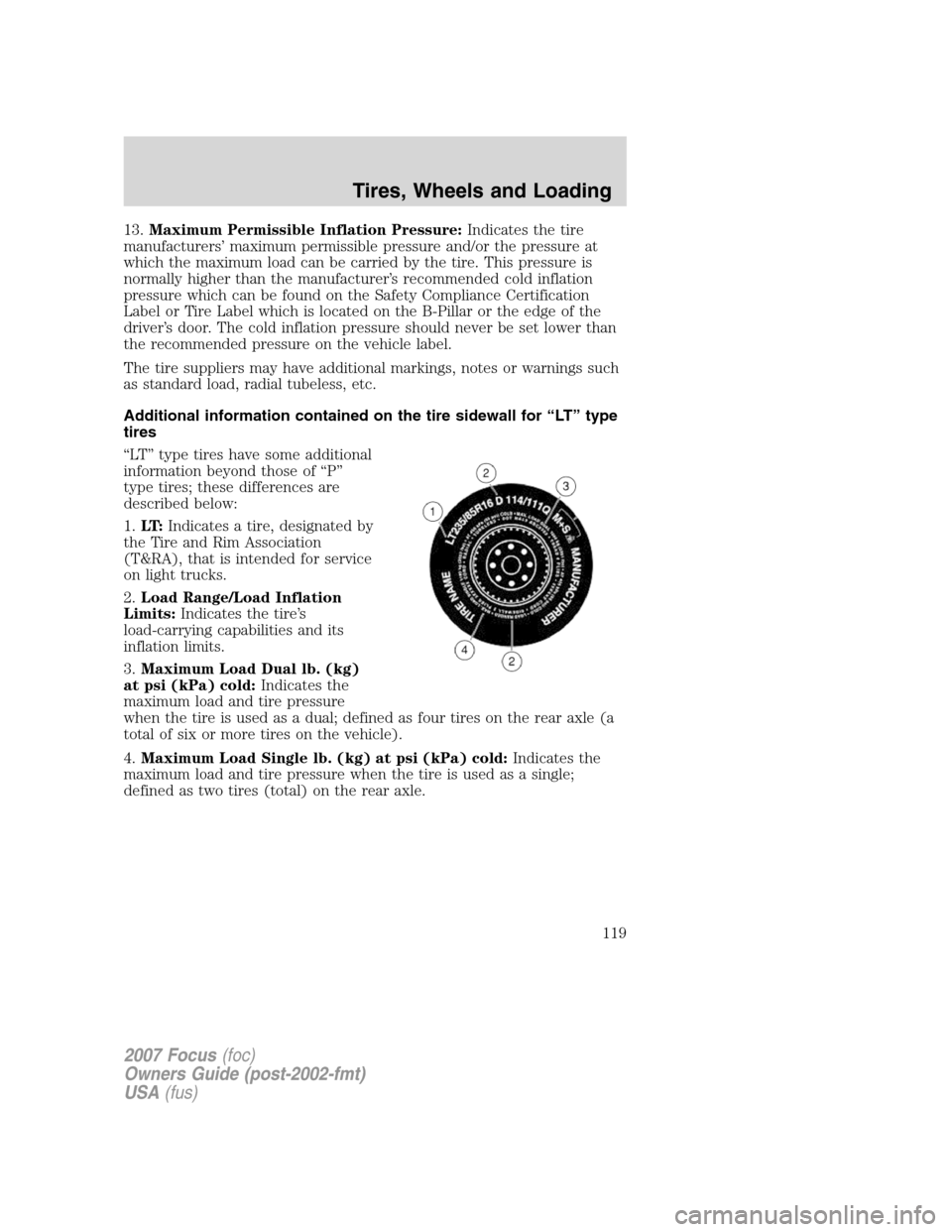
“LT” type tires have some additional
information beyond those of “P”
type tires; these differences are
described below:
1.LT:Indicates a tire, designated by
the Tire and Rim Association
(T&RA), that is intended for service
on light trucks.
2.Load Range/Load Inflation
Limits:Indicates the tire’s
load-carrying capabilities and its
inflation limits.
3.Maximum Load Dual lb. (kg)
at psi (kPa) cold:Indicates the
maximum load and tire pressure
when the tire is used as a dual; defined as four tires on the rear axle (a
total of six or more tires on the vehicle).
4.Maximum Load Single lb. (kg) at psi (kPa) cold:Indicates the
maximum load and tire pressure when the tire is used as a single;
defined as two tires (total) on the rear axle.
2007 Focus(foc)
Owners Guide (post-2002-fmt)
USA(fus)
Tires, Wheels and Loading
119
Page 120 of 224

Information on “T” type tires
“T” type tires have some additional
information beyond those of “P”
type tires; these differences are
described below:
T145/80D16 is an example of a tire
size.
Note:The temporary tire size for
your vehicle may be different from
this example.
1.T:Indicates a type of tire,
designated by the Tire and Rim
Association (T&RA), that is
intended for temporary service on
cars, SUVs, minivans and light
trucks.
2.145:Indicates the nominal width
of the tire in millimeters from
sidewall edge to sidewall edge. In general, the larger the number, the
wider the tire.
3.80:Indicates the aspect ratio which gives the tire’s ratio of height to
width. Numbers of 70 or lower indicate a short sidewall.
4.D:Indicates a “diagonal” type tire.
R:Indicates a “radial” type tire.
5.16:Indicates the wheel or rim diameter in inches. If you change your
wheel size, you will have to purchase new tires to match the new wheel
diameter.
Location of the tire label
You will find a Tire Label containing tire inflation pressure by tire size
and other important information located on the B-Pillar or the edge of
the driver’s door.
SNOW TIRES AND CHAINS
The original equipment tires on your vehicle have an all-weather tread
design to provide traction, handling, and braking performance in
year-round driving. You may install snow tires for improved traction
when driving in areas with sustained periods of snow or icy driving
conditions.
2007 Focus(foc)
Owners Guide (post-2002-fmt)
USA(fus)
Tires, Wheels and Loading
120
Page 218 of 224

Safety Compliance
Certification Label ....................210
Seat belts
(see Safety restraints) ...............68
Seats ............................................63
child safety seats ......................99
SecuriLock passive anti-theft
system ..........................................60
Servicing your vehicle ..............177
Spark plugs,
specifications .....................204, 209
Specification chart,
lubricants ...................................206
Speed control ..............................45
Starting your vehicle ........129–131
jump starting ..........................157
Steering wheel
controls ......................................48
tilting .........................................41
Sunroof (moonroof) ...................48
T
Temperature control
(see Climate control) .................25
Tilt steering wheel ......................41
Tires ...................................107–108
alignment ................................114
care ..........................................111
changing ..................................153
checking the pressure ............111
inflating ...................................109
label .........................................120
replacing ..................................113
rotating ....................................115
safety practices .......................114
sidewall information ...............116
snow tires and chains ............120spare tire .................................151
terminology .............................108
tire grades ...............................108
treadwear ........................107, 112
Towing .......................................125
recreational towing .................128
trailer towing ..........................125
wrecker ....................................162
Traction control ........................134
Transaxle
lubricant specifications ..........206
Transmission
automatic operation ...............136
brake-shift interlock (BSI) ....136
fluid, checking and adding
(automatic) .............................202
fluid, checking and adding
(manual) .................................204
fluid, refill capacities ..............206
manual operation ....................139
Trunk ...........................................54
remote release ..........................58
Turn signal ..................................32
V
Vehicle Identification Number
(VIN) ..........................................210
Vehicle loading ..........................121
Ventilating your vehicle ...........132
W
Warning lights (see Lights) .......10
Washer fluid ..............................180
Water, Driving through .............141
Windows
power .........................................43
2007 Focus(foc)
Owners Guide (post-2002-fmt)
USA(fus)
Index
218