Page 215 of 288
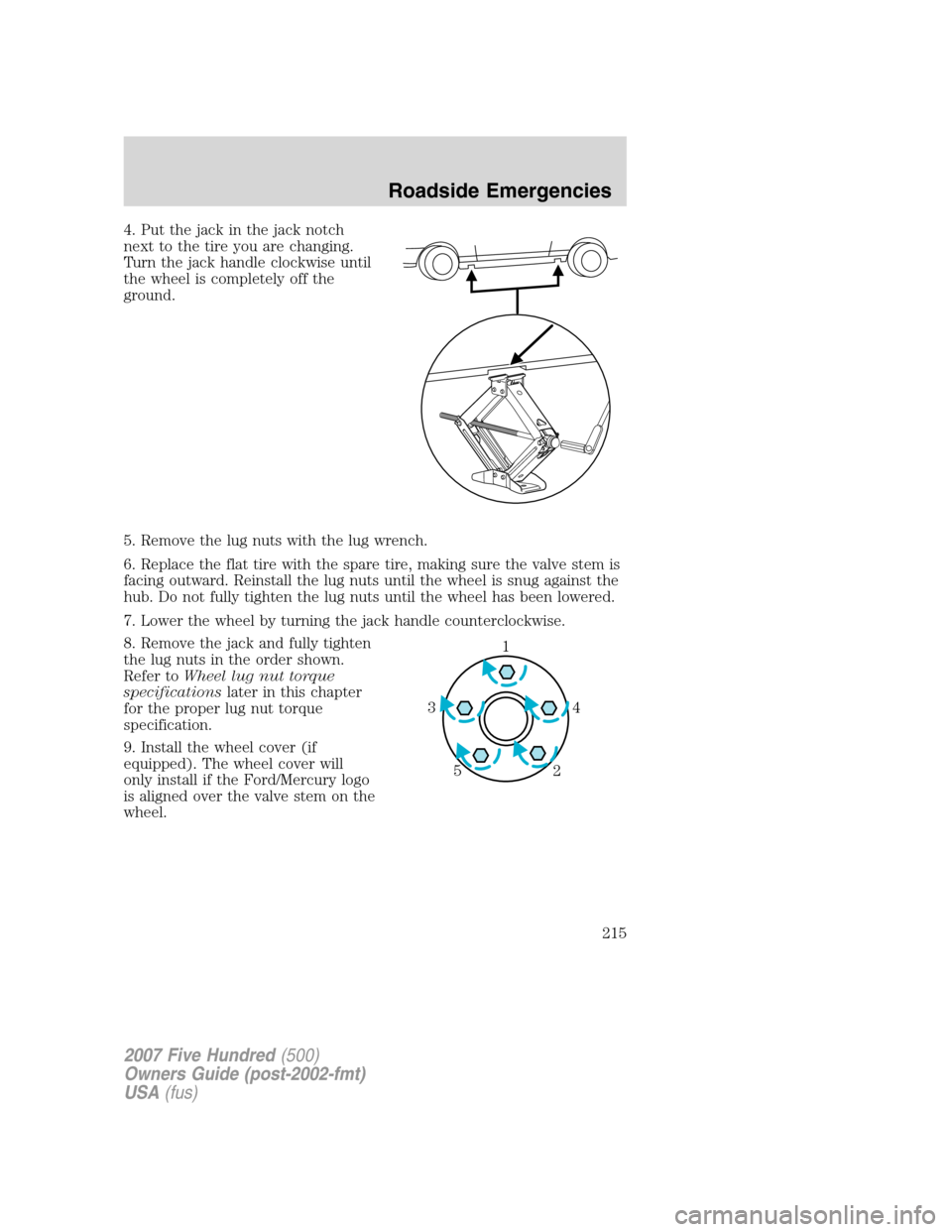
4. Put the jack in the jack notch
next to the tire you are changing.
Turn the jack handle clockwise until
the wheel is completely off the
ground.
5. Remove the lug nuts with the lug wrench.
6. Replace the flat tire with the spare tire, making sure the valve stem is
facing outward. Reinstall the lug nuts until the wheel is snug against the
hub. Do not fully tighten the lug nuts until the wheel has been lowered.
7. Lower the wheel by turning the jack handle counterclockwise.
8. Remove the jack and fully tighten
the lug nuts in the order shown.
Refer toWheel lug nut torque
specificationslater in this chapter
for the proper lug nut torque
specification.
9. Install the wheel cover (if
equipped). The wheel cover will
only install if the Ford/Mercury logo
is aligned over the valve stem on the
wheel.
1
4 3
2 5
2007 Five Hundred(500)
Owners Guide (post-2002-fmt)
USA(fus)
Roadside Emergencies
215
Page 216 of 288
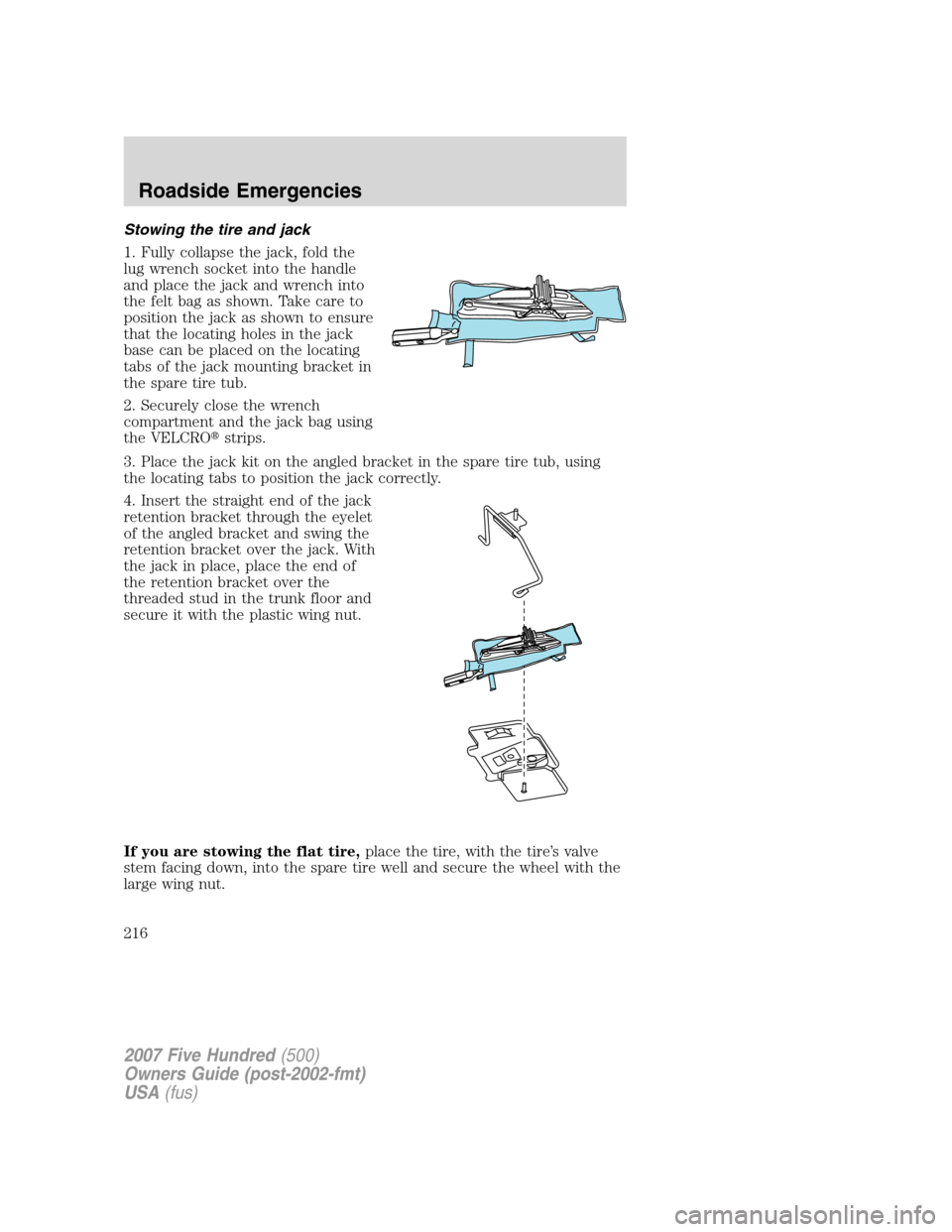
Stowing the tire and jack
1. Fully collapse the jack, fold the
lug wrench socket into the handle
and place the jack and wrench into
the felt bag as shown. Take care to
position the jack as shown to ensure
that the locating holes in the jack
base can be placed on the locating
tabs of the jack mounting bracket in
the spare tire tub.
2. Securely close the wrench
compartment and the jack bag using
the VELCRO�strips.
3. Place the jack kit on the angled bracket in the spare tire tub, using
the locating tabs to position the jack correctly.
4. Insert the straight end of the jack
retention bracket through the eyelet
of the angled bracket and swing the
retention bracket over the jack. With
the jack in place, place the end of
the retention bracket over the
threaded stud in the trunk floor and
secure it with the plastic wing nut.
If you are stowing the flat tire,place the tire, with the tire’s valve
stem facing down, into the spare tire well and secure the wheel with the
large wing nut.
2007 Five Hundred(500)
Owners Guide (post-2002-fmt)
USA(fus)
Roadside Emergencies
216
Page 217 of 288
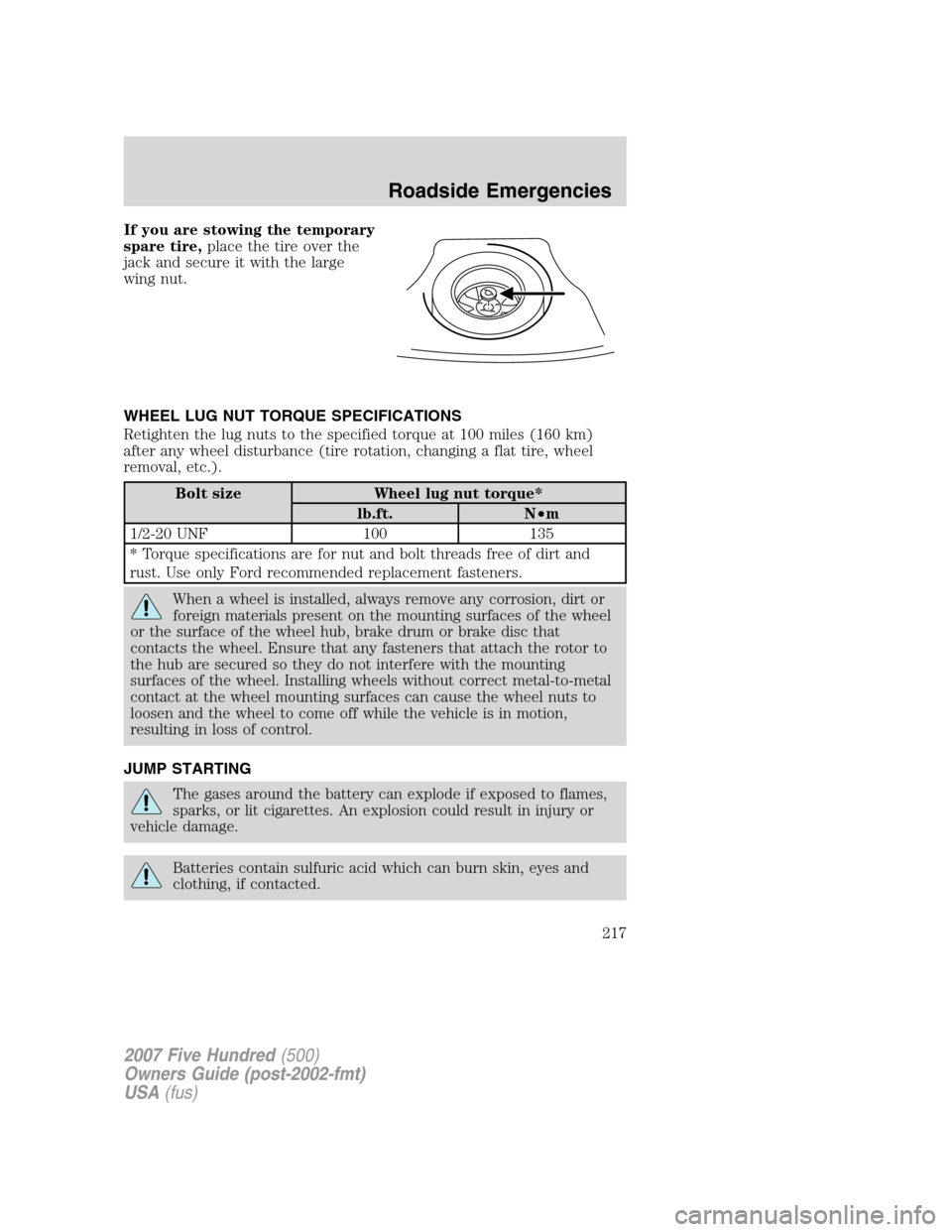
If you are stowing the temporary
spare tire,place the tire over the
jack and secure it with the large
wing nut.
WHEEL LUG NUT TORQUE SPECIFICATIONS
Retighten the lug nuts to the specified torque at 100 miles (160 km)
after any wheel disturbance (tire rotation, changing a flat tire, wheel
removal, etc.).
Bolt size Wheel lug nut torque*
lb.ft. N•m
1/2-20 UNF 100 135
* Torque specifications are for nut and bolt threads free of dirt and
rust. Use only Ford recommended replacement fasteners.
When a wheel is installed, always remove any corrosion, dirt or
foreign materials present on the mounting surfaces of the wheel
or the surface of the wheel hub, brake drum or brake disc that
contacts the wheel. Ensure that any fasteners that attach the rotor to
the hub are secured so they do not interfere with the mounting
surfaces of the wheel. Installing wheels without correct metal-to-metal
contact at the wheel mounting surfaces can cause the wheel nuts to
loosen and the wheel to come off while the vehicle is in motion,
resulting in loss of control.
JUMP STARTING
The gases around the battery can explode if exposed to flames,
sparks, or lit cigarettes. An explosion could result in injury or
vehicle damage.
Batteries contain sulfuric acid which can burn skin, eyes and
clothing, if contacted.
2007 Five Hundred(500)
Owners Guide (post-2002-fmt)
USA(fus)
Roadside Emergencies
217
Page 263 of 288

•Idling for long periods of time (greater than one minute) may waste
fuel.
•Anticipate stopping; slowing down may eliminate the need to stop.
•Sudden or hard accelerations may reduce fuel economy.
•Slow down gradually.
•Driving at reasonable speeds (traveling at 55 mph [88 km/h] uses 15%
less fuel than traveling at 65 mph [105 km/h]).
•Revving the engine before turning it off may reduce fuel economy.
•Using the air conditioner or defroster may reduce fuel economy.
•You may want to turn off the speed control in hilly terrain if
unnecessary shifting between the top gears occurs. Unnecessary
shifting of this type could result in reduced fuel economy.
•Warming up a vehicle on cold mornings is not required and may
reduce fuel economy.
•Resting your foot on the brake pedal while driving may reduce fuel
economy.
•Combine errands and minimize stop-and-go driving.
Maintenance
•Keep tires properly inflated and use only recommended size.
•Operating a vehicle with the wheels out of alignment will reduce fuel
economy.
•Use recommended engine oil. Refer toMaintenance product
specifications and capacitiesin this chapter.
•Perform all regularly scheduled maintenance items. Follow the
recommended maintenance schedule and owner maintenance checks
found inscheduled maintenance information.
Conditions
•Heavily loading a vehicle or towing a trailer may reduce fuel economy
at any speed.
•Carrying unnecessary weight may reduce fuel economy (approximately
1 mpg [0.4 km/L] is lost for every 400 lb [180 kg] of weight carried).
•Adding certain accessories to your vehicle (for example bug
deflectors, rollbars/light bars, running boards, ski/luggage racks) may
reduce fuel economy.
•Using fuel blended with alcohol may lower fuel economy.
2007 Five Hundred(500)
Owners Guide (post-2002-fmt)
USA(fus)
Maintenance and Specifications
263
Page 283 of 288

Rear seat entertainment
system ..........................................30
Relays ........................................204
Remote entry system .................96
illuminated entry ............100, 102
locking/unlocking doors .....96–97
opening the trunk .....................97
panic alarm ...............................97
replacement/additional
transmitters ...............................99
replacing the batteries .............98
Reverse sensing system ...........193
Roadside assistance ..................202
S
Safety Belt Maintenance ..........125
Safety belts
(see Safety restraints) ............117,
121–124
Safety Canopy ...........................142
Safety defects,
reporting ............................231–232
Safety restraints ........117, 121–125
Belt-Minder�...........................126
extension assembly ................125
for adults .........................122–124
for children .....................145–146
Occupant Classification
Sensor ......................................119
safety belt maintenance .........125
warning light and chime ........126
Safety seats for children ..........150
Safety Compliance
Certification Label ....................275
Satellite Radio Information ........27
Seats ..........................................110
child safety seats ....................150front seats ...............110, 112, 114
heated ........................................50
memory seat .....................97, 115
SecuriLock passive
anti-theft system .......................105
Servicing your vehicle ..............240
Setting the clock
AM/FM single CD .....................17
AM/FM/In-dash 6 CD ................22
Spare tire
(see Changing the Tire) ...........213
Spark plugs,
specifications .....................271, 274
Specification chart,
lubricants ...................................272
Speed control ..............................72
Starting your vehicle ........182–184
jump starting ..........................217
Steering wheel
controls ......................................75
tilting .........................................65
T
Tilt steering wheel ......................65
Tires ...........................158–159, 210
alignment ................................166
care ..........................................162
changing ..........................210, 213
checking the pressure ............162
inflating ...................................160
label .........................................172
replacing ..................................164
rotating ....................................166
safety practices .......................165
sidewall information ...............168
snow tires and chains ............173
spare tire .................................211
terminology .............................159
2007 Five Hundred(500)
Owners Guide (post-2002-fmt)
USA(fus)
Index
283
Page:
< prev 1-8 9-16 17-24