2007 FORD FIESTA Angle
[x] Cancel search: AnglePage 33 of 1226
100-00-1 7 General Information 100-00-1 7
DESCRIPTION AND OPERATION
The flame is bright, and eye protection should be - used, but the ultra-violet emission is much less
than that from arc welding, and lighter filters may
be used.
The process itself produces few toxic fumes, but
such fumes and gases may be produced from
coatings on the work, particularly during cutting
away of damaged body parts, and inhalation of the
fumes should be avoided.
In brazing, toxic fumes may be produced from the
metals in the brazing rod, and a severe hazard
may arise if brazing rods containing cadmium are
used. In this event particular care must be taken
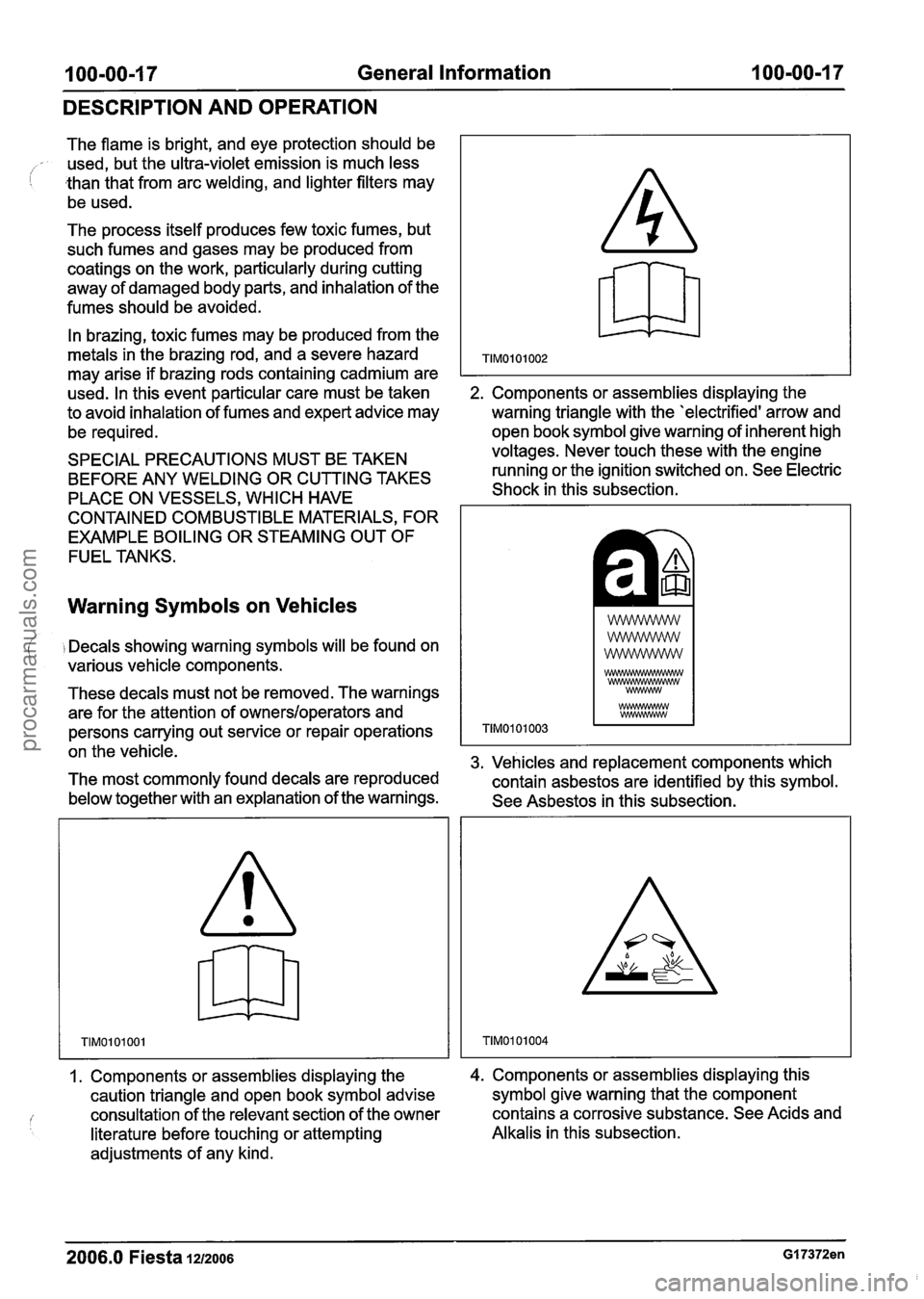
2. Components or assemblies displaying the
to avoid inhalation of fumes and expert advice may
warning triangle with the 'electrified' arrow and
be required. open book symbol
give warning of inherent high
SPECIAL PRECAUTIONS MUST BE TAKEN voltages.
Never touch these with the engine
BEFORE ANY WELDING OR CUTTING TAKES running
or the ignition switched on. See Electric
PLACE ON VESSELS, WHICH HAVE Shock
in this subsection.
CONTAINED COMBUSTIBLE MATERIALS, FOR
EXAMPLE BOILING OR STEAMING OUT OF
FUEL TANKS.
Warning Symbols on Vehicles
( i Decals showing warning symbols will be found on
various vehicle components.
These decals must not be removed. The warnings
are for the attention of
owners/operators and
persons carrying out service or repair operations
on the vehicle.
3. Vehicles and replacement components which
The most commonly found decals are reproduced
contain asbestos are identified by this symbol.
below together with an explanation of the warnings.
See Asbestos in this subsection.
1. Components or assemblies displaying the
caution triangle and open book symbol advise
consultation of the relevant section of the owner
literature before touching or attempting
adjustments of any kind. 4. Components or assemblies displaying this
symbol give warning that the component
contains a corrosive substance. See Acids and
Alkalis in this subsection.
2006.0 Fiesta 1212006 GI 7372en
procarmanuals.com
Page 54 of 1226

100-024 Jacking and Lifting 100-02-4
DESCRIPTION AND OPERATION
Adapters for jacking points
2006.0 Fiesta 1212006 GI 67070en
Item
I
2
3
Description
Adapter with locating plate and rear jacking point (viewing angle from below the vehicle)
Adapter with locating plate and rear jacking point
Adapter with locating plate in conjunction with the trolley jack
procarmanuals.com
Page 61 of 1226

100-04-5 Noise, Vibration and Harshness 100-04-5
DIAGNOSIS AND TESTING
Noise Conditions
Gear noise is typically a howling or whining due
to gear damage or incorrect bearing preload. It
can occur at various speeds and driving
conditions, or it can be continuous.
Chuckle is a particular rattling noise that sounds
like a stick against the spokes of a spinning
bicycle wheel. It occurs while decelerating from
64
kmlh (40 mph) and can usually be heard all
the way to a stop. The frequency varies with
vehicle speed.
Knock is very similar to chuckle, though it may
be louder and occurs on acceleration or
deceleration. The
teardown will disclose what
has to be corrected.
Clicking, popping or grinding noises may be caused
by the following:
worn, damaged or incorrectly installed wheel
bearing, suspension or brake component.
Check and rule out tires, exhaust and trim items
before disassembling the transmission to diagnose
and correct gear noise.
The noises described under Road Test usually
( have specific causes that can be diagnosed by
observation as the unit is disassembled. The initial
clues are the type of noise heard on the road test
and driving conditions.
Vibration Conditions
Vibration at highway speeds may be caused by
the following:
out-of-balance front or rear wheels.
out-of-round tires.
Shudder or vibration during acceleration may be
caused by the following:
damaged powertrainldrivetrain mounts.
excessively high constant velocity (CV) joint
operating angles caused by incorrect ride height.
Check ride height, verify correct spring rate and
check items under inoperative conditions.
Road Test
I A gear-driven unit will produce a certain amount
of noise. Some noise is acceptable and may be
audible at certain speeds or under various driving conditions,
as on a newly paved asphalt road. The
slight noise is in no way detrimental and must be
considered normal.
The road test and customer interview (if available)
provide information needed to identify the condition
-
and give direction to the correct starting point for
diagnosis.
1. Make notes throughout the diagnosis routine.
Make sure to write down even the smallest bit
of information, because it may turn out to be the
most important.
2. Do not touch anything until a road test and a
thorough visual inspection of the vehicle have been carried out. Leave the tire pressures and
vehicle load just where they were when the
condition was first observed. Adjusting tire
pressures, vehicle load or making other
adjustments may reduce the
condition(s)
intensity to a point where it cannot be identified
clearly. It may also inject something new into
the system, preventing correct diagnosis.
3. Make a visual inspection as part of the
preliminary diagnosis routine, writing down
anything that does not look right. Note tire
pressures, but do not adjust them yet. Note
leaking fluids, loose nuts and bolts, or bright
spots where components may be rubbing
against each other. Check the load space for
unusual loads.
4. Road test the vehicle and define the condition
by reproducing it several times during the road
test.
5. Carry out the Road Test Quick Checks as soon
as the condition is reproduced. This will identify
the correct diagnostic procedure. Carry out the
Road Test Quick Checks more than once to
verify they are providing a valid result.
Remember, the Road Test Quick Checks may
not tell where the concern is, but they will tell
where it is not.
Road Test Quick Checks
1. 24-80 kmlh (1 5-50 mph): with light acceleration,
a moaning noise is heard and possibly a
vibration felt in the front floor panel. It is usually
worse at a particular engine speed and at a
particular throttle setting during acceleration at
that speed. It may also produce a moaning
sound, depending on what component is
causing it. REFER to Tip-in Moan in the
Driveline Noise and Vibration Symptom Chart.
2006.0 Fiesta 1212006 G37349en
procarmanuals.com
Page 68 of 1226

I 00-04-1 2 Noise, Vibration and Harshness I 00=04m12
DIAGNOSIS AND TESTING
Power Steering Hiss Noise
Test Condition
Listen for steering hiss noise with the vehicle
parked, transmission in neutral and all windows
-
closed in the following test conditions.
Power Steering Lock Stop Impact Knock 1. Turn the steering wheel to the left-hand and
Noise right-hand steering locks and listen for the
impact noise.
Test Condition
Listen for steering knock noise with the engine
speed at idle in the following test conditions (noise
also apparent with engine off).
Action
CHECK the installation and
potential damage of the floor seal.
Certain amount of noise level
acceptable, not a safety critical
item.
Certain amount of noise level
acceptable, not a safety critical
item.
Certain amount of noise level
acceptable, not a safety critical
item.
Symptom
N0TE:Engine speed at idle
turning the steering wheel slowly
lock to lock.
Power steering system hiss noise
- a high frequency, continuous
rush or swish noise like escaping
air from a balloon. Hiss occurs
while turning between the steering
lock stops, all steering angles.
Noise does not change with
engine rpm and is worse at high
operating temperatures.
N0TE:Engine speed at idle
holding the steering wheel against
a steering lock for three seconds.
Do not hold for more than five
seconds.
Power steering system hiss noise
- a continuous noise like escaping
air occurs while holding the
steering against a steering lock
stop.
Possible Sources
Floor seal.
Power steering gear valve design.
Power steering system hydraulic
design.
Power pump pressure
relief valve.
Power Steering Mechanical Knock Noise 1. Turn the steering wheel 90 degrees to the right,
(PAS off) hold and then quickly release.
2. Turn the steering wheel 90 degrees to the left, Test Condition hold and then quickly release.
Listen for steering knock noise with the engine off
in the following test conditions (no power assist).
2006.0 Fiesta 1212006 G37349en
Action
Certain amount of noise level
acceptable, not a safety critical
item.
Symptom
Power steering system knock
noise
- a heavy loud sound like a
knock on a door that occurs in
parking condition when hitting the
lock stop.
Possible Sources
Power steering gear mechanical
noise, metal to metal at end of
steering travel.
procarmanuals.com
Page 82 of 1226

204-00-2 Suspension System - General Information 204-00-2
SPECIFICATIONS
Caster angle
Front Wheel Alignment (at curb weight)
Degrees and / 4'38'to 2'38' 1
minutes
Maximum Vari-
ance Left or Right
Description
I Camber angle I Degrees
and 1 0°36'to -1'54' 1 -0'39' I 1'15'
Decimal degrees
Tolerance Range
Setting or
Nominal
4.64" to 2.64"
Total toe
Degrees and minutes
Front Wheel Alignment (at curb weigh
Description
3.64"
minutes
Decimal degrees mm
Decimal degrees
Tolerance Range Setting or
I Nominal
1 .OOO
Maximum Vari-
ance Left or Right
0.60" to -1 .90°
3.1Toeink2.2
- 0'30' Toe in k 0'21'
0.50" Toe in k 0.35"
Caster angle
0'30 Toe in + 0°1 0'
Degrees and minutes -0.65"
3.1Toeink1.0
0.50"
Toe in k 0.1 7"
Decimal degrees
1.25"
-
-
Camber angle Degrees and
minutes
Decimal degrees
Total toe
Degrees and
minutes
0°09' Toe in k 0°20' 1 0°09' Toe in k 0°10'
Decimal degrees 0.15" Toe in k 0.34" ( 0.15" Toe in k 0.1 7"
Caster
angle
Front Wheel Alignment (at curb weight) - %Door Sport
Description
Camber angle
Degrees and minutes
Decimal degrees Degrees and
1 0'25' to -2'08' 1 -0'52'
minutes
Decimaldegrees
1 0.4I0to-2.13" 1 -0:86"
Maximum Vari-
ance Left or Right
Tolerance Range
4'39' to 2'34'
4.65"
to 2.57"
Total toe
Setting or
Nominal
Degrees and 0'30' Toe in k 0'21' 0'30 Toe in k 0°10'
minutes
3"37'
3.61"
I Decimal degrees 1 0.50" Toe in k 0.35" 1 0.50" Toe in k 0.17" 1 - I
1°00'
1
.OOO
2006.0 Fiesta 1212006 G149884en
procarmanuals.com
Page 85 of 1226

204-00-5 Suspension System - General Information 204-00-5 --
DIAGNOSIS AND TESTING
Symptom Possible
Sources -
l ncorrect front crossmem ber
alignment.
Action
Using the special tool, CHECK
the front crossmember align- ment.
Worn front wheel bearings. CHECK
the wheel bearings.
REFER to: Wheel Bearing
lnspection (204-00 Suspen-
sion System
- General
Information, General Proced-
ures).
I Wheels and tires. I . GO to Pinpoint Test A. I
Steering wheel off-center Vehicle attitude incorrect (front
or rear is high or low).
Tracks incorrectly CHECK for abnormal loading,
spring sag or non-standard
springs.
-
Steering gear or linkage worn
or damaged. CHECK the steering system.
REFER to: (21 1-00 Steering
System
- General Information)
Steering System (Diagnosis and Testing),
Steering System
- 1.6L
Duratorq-TDCi (DV) Diesel
(Diagnosis and Testing).
Suspension lower arm ball
joint. CARRY
OUT the Ball Joint
lnspection component test in
this procedure.
lncorrect wheel alignment. ADJUST
the wheel alignment.
REFER to: Specifications (204-
00 Suspension System
-
General Information,
Specifications).
lncorrect front suspension toe,
castor or camber angles. CHECK
the wheel alignment.
REFER to: Specifications (204-
00 Suspension System
-
General Information,
Specifications).
INSTALL new suspension
components as necessary.
~ncorrecGar suspension toe
or camber angles. CHECK
the wheel alignment.
REFER to: Specifications (204-
00 Suspension System
-
General Information,
Specifications).
INSTALL new suspension
components as necessary.
2006.0 Fiesta 1212006 Gl49885en
Front or rear suspension
damage. INSTALL new
suspension
components as necessary.
procarmanuals.com
Page 151 of 1226

204-04-7 Wheels and Tires 204-04-7
DIAGNOSIS AND TESTING
Symptom
Rust streaks from the wheel
stud holes in the wheel
Seized wheel nuts
Possible Sources
Wheel nuts.
Corrosion.
Vehicle overloaded
Action
REMOVE the wheel and tire
assembly. Inspect the wheel
nuts and wheel and tire
assembly for damage.
INSTALL new wheel nuts and
wheel and tire assemblies as
necessary. REFER to: (204-04
Wheels and Tires)
Specifications (Specifications),
Wheel and Tire (Removal and
Installation).
CAUTION: Do not permit
lubricant to get on cone sets of
stud holes or on cone angle of
wheel nuts. If corrosion is
slight, wire brush away. If
corrosion is excessive,
INSTALL new wheel studs and
nuts. REFER to: (204-04
Wheels and Tires)
Specifications (Specifications),
Wheel and Tire (Removal and
Installation).
If the condition persists,
LUBRICATE the first three
threads of each wheel stud with
a graphite-based lubricant.
CORRECT as necessary.
2006.0 Fiesta 1212006 G25362en
procarmanuals.com
Page 156 of 1226

205-0414 Front Drive Halfshafts 205-04-4
DIAGNOSIS AND TESTING
Front Drive Halfshafts
Inspection and Verification 3. If an obvious cause for an observed or reported
concern is found, correct the cause (if possible) c.# '
1. Verify the customer concern. before proceeding
to the next step.
2. Visually inspect for obvious signs of mechanical
or electrical damage.
Symptom Chart - Front Drive Halfshafts
Symptom Chart
Symptom
Possible Sources Action
Clicking, Popping or Grinding
Noises While Turning Inadequate or contaminated INSPECT, CLEAN and
I lubricant in the inner or outer I LUBRICATE as necessary.
I Outer Constant Velocity (CV)
I Joint Boot - in this section.
front drive halfshaft constant
velocity (CV) joint.
REFER to Constant
Velocity (CV) Joint Boot -
Wheel bearings, brakes,
suspension or steering
components.
Another component contacting
front drive halfshaft assembly.
--
INSPECT and REPAIR as
necessary. REFER to
Section 204-00 [Suspension
System
- General Information]
1 206-00 [Brake System -
General Information] I 21 1-00
[Steering System
- General
Information].
INSPECT and REPAIR as
necessary.
- --
Vibration at Highway Speeds
Shudder Vibration During
Acceleration. Out of balance front wheels or
tires. Balance wheels and tires as
necessary.
I Incorrectly seated outer I REPAIR or INSTALL new as I
Out-of-round tires.
constant velocity (CV) joint in necessary.
front wheel hub.
I REFER to Halfshaft LH -
REPAIR or INSTALL new as
necessary.
I I I Halfshaft RH - in this section. I
Excessively high CV joint
operating angles caused by
incorrect ride height. CHECK the ride height,
VERIFY correct spring rate.
CHECK items under Halfshaft
Joint Pullout. REPAIR or INSTALL
new as necessary.
Excessively worn or damaged
I inner or outer front drive half-
- - - - --
2006.0 Fiesta 1212006 G25403en
INSPECT and INSTALL new
as necessary.
shaft constant velocity (CV)
joint. REFER
to Halfshaft LH
-
I Halfshaft RH - in this sectionk 1;
procarmanuals.com