2007 FORD FIESTA fuel pressure
[x] Cancel search: fuel pressurePage 930 of 1226

303-1 4-6 Electronic Engine Controls 303-1 4-6
DESCRIPTION
AND OPERATION
Item Descri~tion
1 5 1 Crankshaft Position (CKP) sensor 1
Throttle Control Unit (TCU)
1 6 ( Camshaft Position (CMP) sensor I Components
1 7 1 Heated Oxygen Sensor (H02S) I
1 8 1 Power Steering Pressure (PSP) sensor I
1 10 1 Brake Pedal Position (BPP) switch I
9 Vehicle Speed Sensor (VSS)
(only on
vehicles without Anti-lock Braking System
(ABS))
1 12 1 Clutch Pedal Position (CPP) switch I
11
1 13 1 Generator I
Accelerator Pedal Position (APP) sensor
1 14 1 Current supply relay I
1 15 1 Ignition key I -
16
17
1 20 1 Inertia fuel shut-off switch I
Battery
Powertrain Control Module (PCM)
-
18
19
1 21 1 Fuel Pump Driver Module (FPDM) I
Data Link Connector (DLC)
Fuel Pump (FP) relay
1 22 1 Fuel injectors I
23 Evaporative emissions (EVAP) solenoid
1 lvalve
1 24 1 Idle Air Control (IAC) valve 1
1 25 1 Throttle Control Unit (TCU) I
26 Air Conditioning (AIC) compressor clutch
1 I 1 blower switch
1 27 1 Injector Driver
Module (IDM) I
1 28 1 Start inhibit relay I
1 29 1 Instrument cluster I
Item Descri~tion
I I ITP sensor I
1 2 1 Electric motor I
The electronically controlled throttle control unit
(TCU) consists of the following components:
Housing
Throttle flap
Throttle flap spindle
Gear set
Electric motor with pinion
TP sensor
Stop screw
Throttle flap return spring
2006.0 Fiesta 1212006 G204204en
procarmanuals.com
Page 935 of 1226

303-1 4-1 1 Electronic Engine Controls 303-1 4-1 I
DESCRIPTION AND OPERATION
Item Description Components
MAPT sensor
Manifold absolute pressure and
temperature (MAPT) sensor
1 2 1 Camshaft position (CMP) sensor I
1 3 1 Knock sensor (KS) I
vl~Ame%air temperature sensor I
1 5 1 Instrument cluster I
1 6 1 Battery I
1 7 1 Spark plug wires I
1 8 1 Exhaust gas recirculation (EGR) valve I
1 9 1 Fuel pump module I
1 10 1 Fuel rail and fuel injectors I
I 11 I Intake manifold tuning valve solenoid The
MAPT sensor is attached to the housing of the
intake manifold valve behind the throttle body. The
signal from the MAPT sensor is used to modify the
ignition and fuel delivery.
1 12 1 Accelerator pedal position (APP) sensor
1 13 1 Clutch pedal position (CPP) switch
1 14 1 Brake pedal position (BPP) switch
CMP sensor 1 15 1 Stoplamp switch
1 16 1 Power steering pressure (PSP) switch I
1 17 1 Catalyst monitor sensor I
FIGted oxygen sensor (H02S) I
1 19 1 Generator (input signal) I
1 20 1 Crankshaft position (CKP) sensor I
1 21 1 Engine coolant temperature (ECT) sensor I
22 Throttle position
(TP) sensor (part of
I I throttle body)
1 23 1 Powertrain control module (PCM) I The CMP sensor is located on the right-hand side
of the valve cover above the intake camshaft. The
CMP sensors send signals to the PCM which are
then used by the PCM to calculate the position of
the camshaft.
2006.0 Fiesta 1212006 G422229en
procarmanuals.com
Page 939 of 1226

303-1 4-1 5 Electronic Engine Controls 303-1 4-1 5
DIAGNOSIS AND TESTING
Monitors
The purpose of the monitors is to continuously
check the operation of the emission related sensors
and actuators. It then establishes if they are
operating within specified tolerances. All monitors
carry out their functions in such a way as to be
unnoticeable by the driver of the vehicle. Each one
is carried out under specific conditions of load,
speed and engine temperature. The Comprehensive Component Monitor, Combustion
Misfire Monitor and
AirIFuel Ratio Monitor operate
continuously. The remaining monitors are only
invoked under certain operating conditions. On
diesel variants, all of the monitors operate under
normal driving conditions: There are no monitors
which intervene and cause special operating
modes to enable the monitors to work. Some diesel
monitors are non-continuous. This means that in
a drive cycle, monitoring is done as and when
suitable driving conditions exist and potential faults
are accumulated and compared with acceptance
criteria. Examples of this type are the turbocharger
boost pressure and exhaust gas recirculation
(EGR) monitors on vehicles with common rail fuel
injection.
( Comprehensive Component Monitor (CCM)
When the CCM detects a component operating out
of tolerance, it sets a Diagnostic Trouble Code
(DTC), which is stored in the EEPROM. If the same
concern is confirmed during the next trip the MIL
will be switched on. The CCM monitors many
components, sub-systems and signals. The
following is a list of those that can effect emissions
depending on application:
Electronic Ignition (El) System.
Crankshaft Position (CKP) Sensor.
Ignition Coil.
Electronic Throttle Control Unit.
Camshaft Position (CMP) Sensor.
Air Conditioning
(AIC) Clutch.
Idle Air Control (IAC) Valve.
Mass Air Flow (MAF) Sensor.
Manifold Absolute Pressure (MAP) Sensor.
Intake Air Temperature (IAT) Sensor.
Engine Coolant Temperature (ECT) Sensor.
Cylinder Head Temperature (CHT) Sensor.
Heated Oxygen Sensor
(H02S).
Catalyst Monitor Sensor.
Charge Air Temperature Sensor.
Knock Sensor (KS).
Throttle Position (TP) Sensor.
Vehicle Speed Sensor (VSS).
Boost Pressure Sensor.
Cam-Crank Phasing Sensor.
EEPROM.
High Pressure Fuel Injection Pump.
Exhaust Gas Recirculation (EGR) Valve Monitor.
Fuel Injectors.
Turbocharger.
Combustion Noise Monitor.
Barometric Pressure (BARO) Sensor.
Combustion Misfire Monitor (All except vehicles
with diesel engine)
The combustion misfire monitor operates independently of the others, and can detect misfires
caused by the ignition system, fuel system or
mechanical engine components. As each cylinder
fires, a characteristic crankshaft acceleration is
produced. The monitor detects irregularities in the
acceleration pattern using the crankshaft position (CKP) sensor, thus detecting the misfire. It can
also detect which cylinder has misfired.
Combustion misfires can be categorized as follows:
Type
A: These can cause catalytic converter
damage due to excessive internal temperatures.
If a certain number of misfires occur over a
pre-determined number of engine revolutions, the
MIL will be switched on to alert the driver of the
concern.
Type B: These can lead to an increase in emissions
to a point above the EOBD threshold. If the misfire
is detected during a second trip, over a,
pre-determined number of engine revolutions, the
MIL will be switched on. If the misfire does not
occur over the next three trips, the MIL will be
extinguished
AirIFuel Ratio (AFR) Monitor (All except vehicles
with diesel engine)
The H02S fitted before the catalytic converter
(upstream) measures the oxygen content of the
exhaust gas and the variations in it. This then
enables the PCM to adjust the opening times of
the fuel injectors to maintain the correct AFR. This
is known as Short Term Fuel Trim (STFT). If the
same variation is registered a pre-determined
number of times, a permanent correction factor is
applied. This is known as Long Term Fuel Trim
(LTFT), which is stored in the EEPROM. When the
correction factors exceed pre-determined limits a
DTC will be set in the EEPROM. If a concern is
2006.0 Fiesta 1212006 G384566en
procarmanuals.com
Page 941 of 1226

303-1 4-1 7 Electronic Engine Controls 303-1 4-1 7
DIAGNOSIS AND TESTING
The DTC is always a 5 digit alphanumerical
code, for example
"POI 00".
The first digit of a code (letter) identifies the
system which has set the code. Provision has
been made for a total of four systems to be
identified although only the
'PI code is required
for EOBD.
- 'B' for the body
- 'C' for the chassis
- 'P' for the powertrain
- 'U' for the network communications systems
All of the
"xOxxxW codes are standardized codes.
However, any manufacturer can use additional
codes over and above the standardized codes.
These will be labelled
"xlxxx"
The third digit of a code (numeric) identifies the
sub-system which has set the code.
- 'Pxlxx' for metering of fuel and air supply
- 'Px2xx' for metering of fuel and air supply
- 'Px3xx' for ignition system - combustion
misfires
- 'Px4xx' for auxiliary emission control
equipment
- 'Px5xx' for vehicle speed, idle setting and
other related inputs
- 'Px6xx' for trip computer and other related
outputs
- 'Px7xx' for transmission.
- 'Px8xx' for transmission.
- 'Px9xx' category to be determined
- 'PxOxx' category to be determined
When a concern occurs, the actions taken
include storage of the relevant information and
actuation of the MIL occurs in line with the
relevant legislation.
MIL Code List
I PO030 I Heated oxygen sensor (H02S) heater open circuit I
! '
-1 H02S heater low voltage I
I PO032 I H02S heater high voltage I
MILCode
PO036 1- ' Catalyst monitor sensor heater open circuit I
Description
PO037
I PO054 I Catalyst monitor sensor heater resistance out of limits I
Catalyst monitor sensor heater low voltage
PO038
PO053
I PO106 I Manifold absolute pressure (MAP) sensor plausibility malfunction I
-
Catalyst monitor sensor heater high voltage
H02S heater resistance out of limits
I PO107 I MAP sensor circuit low input I
PO108
PO1 09 MAP sensor
circuit high input
MAP sensor temporary malfunction
PO1 12
PO113
I PO117 I ECT circuit low input I
Intake air temperature (IAT) circuit low input
IAT circuit high input
I
2006.0 Fiesta 1212006 G384566en
PO114
PO1 16
PO118
IAT intermittent failure
Engine coolant temperature (ECT) signal stuck at low level
ECT circuit high input
procarmanuals.com
Page 1187 of 1226
31 0-00-1 Fuel System - General Information 31 0-OO=l
SECTION 31 0-00 Fuel System - General lnformation
VEHICLE APPLICATION:2006.0 Fiesta
CONTENTS PAGE
DIAGNOSIS AND TESTING
Fuel System - 1.3L Duratec-8V (Rocam)ll.25L Duratec-I 6V (Sigma)/2.0L Duratec-HE
(M14)/1.4L Duratec-1 6V (Sigma)/l .6L
Duratec-1 6V (Sigma) ............................................ 3 1 0-00-2
........................................................................\
......................... Inspection and Verification. 3 1
0-00-2
GENERAL PROCEDURES
Fuel System Pressure Release .................................................................... (23 420 0) 3 1 0-00-3
Fuel Tank Draining
........................................................................\
.................. (23 551 0) 3 1 0-00-4
Quick Release Coupling
........................................................................\
............................. 3 1 0-00-5
................................................... Fuel System Pressure Check - 2.OL Duratec-HE (M14) 31 0-00-1 0
procarmanuals.com
Page 1189 of 1226
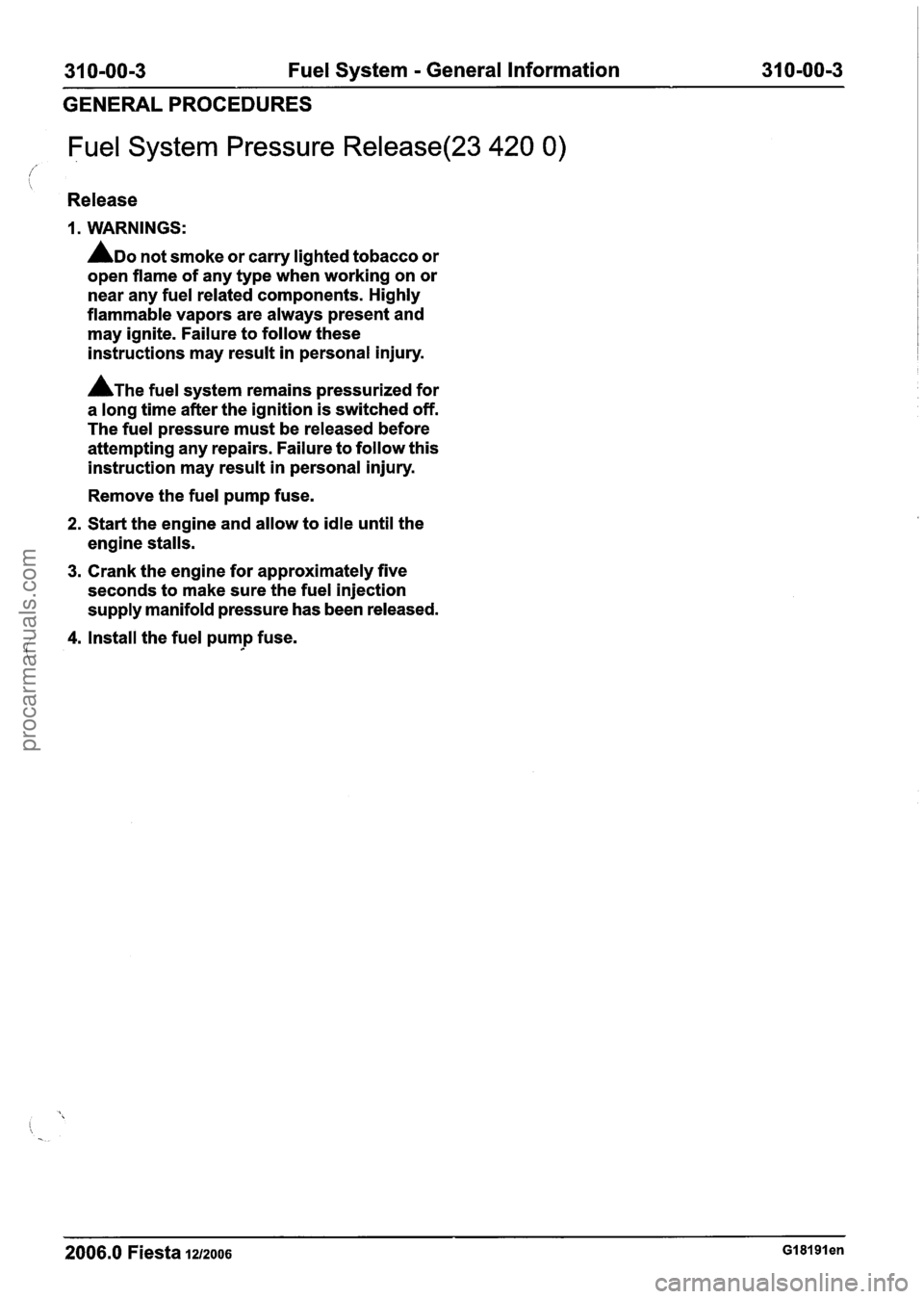
31 0-00-3 Fuel System - General Information 31 0-00-3
GENERAL PROCEDURES
/'
Fuel System Pressure Release(23 420 0)
i
Release
I. WARNINGS:
ADO not smoke or carry lighted tobacco or
open flame of any type when working on or
near any fuel related components. Highly
flammable vapors are always present and
may ignite. Failure to follow these
instructions may result in personal injury.
A~he fuel system remains pressurized for
a long time after the ignition is switched off.
The fuel pressure must be released before
attempting any repairs. Failure to follow this
instruction may result in personal injury.
Remove the fuel pump fuse.
2. Start the engine and allow to idle until the
engine stalls.
3. Crank the engine for approximately five
seconds to make sure the fuel injection
supply manifold pressure has been released.
,1 4. Install the fuel pump fuse.
2006.0 Fiesta 1212006 GI 81 91 en
procarmanuals.com
Page 1190 of 1226
31 0-00-4 Fuel System - General Information 31 0-00-4
GENERAL PROCEDURES
Fuel Tank Draining(23 551 0)
General Eaui~ment
I Fuel tank draining equipment I
Draining
WARNINGS:
A Do not smoke or carry lighted tobacco or
open flame of any type when working on
or near any fuel related components.
Highly flammable vapors are always
present and may ignite. Failure to follow
these instructions may result in personal
injury.
A The fuel system remains pressurized for a
long time after the ignition is switched off.
The fuel pressure must be relieved before
attempting any repairs. Failure to follow
these instructions may result in personal
injury.
I. Disconnect the battery ground cable. For
additional information, refer to
Section
414-01 [Battery, Mounting and
Cables].
2. Remove the fuel tank filler cap.
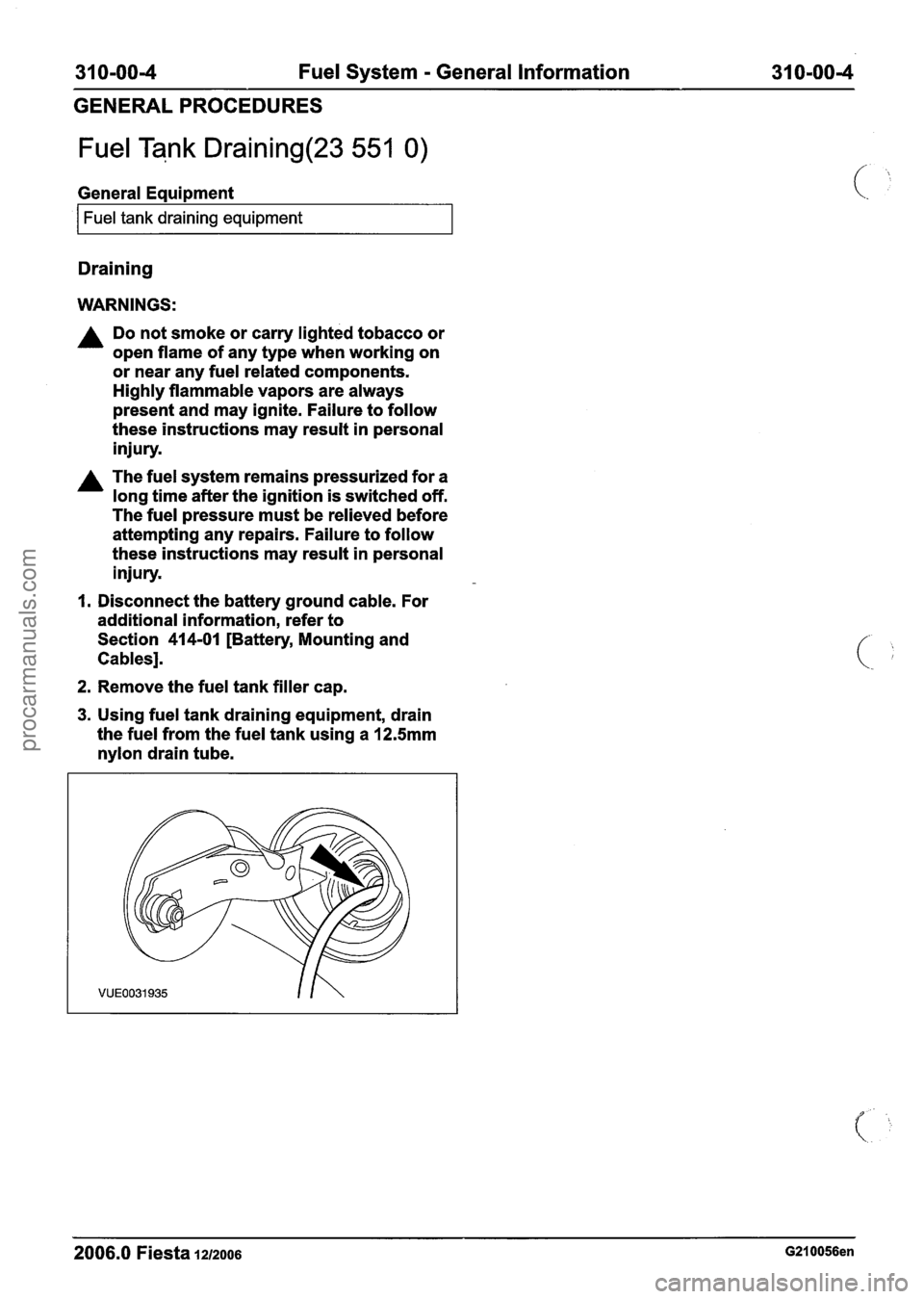
3. Using fuel tank draining equipment, drain
the fuel from the fuel tank using a
12.5mm
nylon drain tube.
2006.0 Fiesta 1212006 G210056en
procarmanuals.com
Page 1191 of 1226
31 0-00-5 Fuel System - General Information 31 0-00-5
GENERAL PROCEDURES
Quick Release Coupling
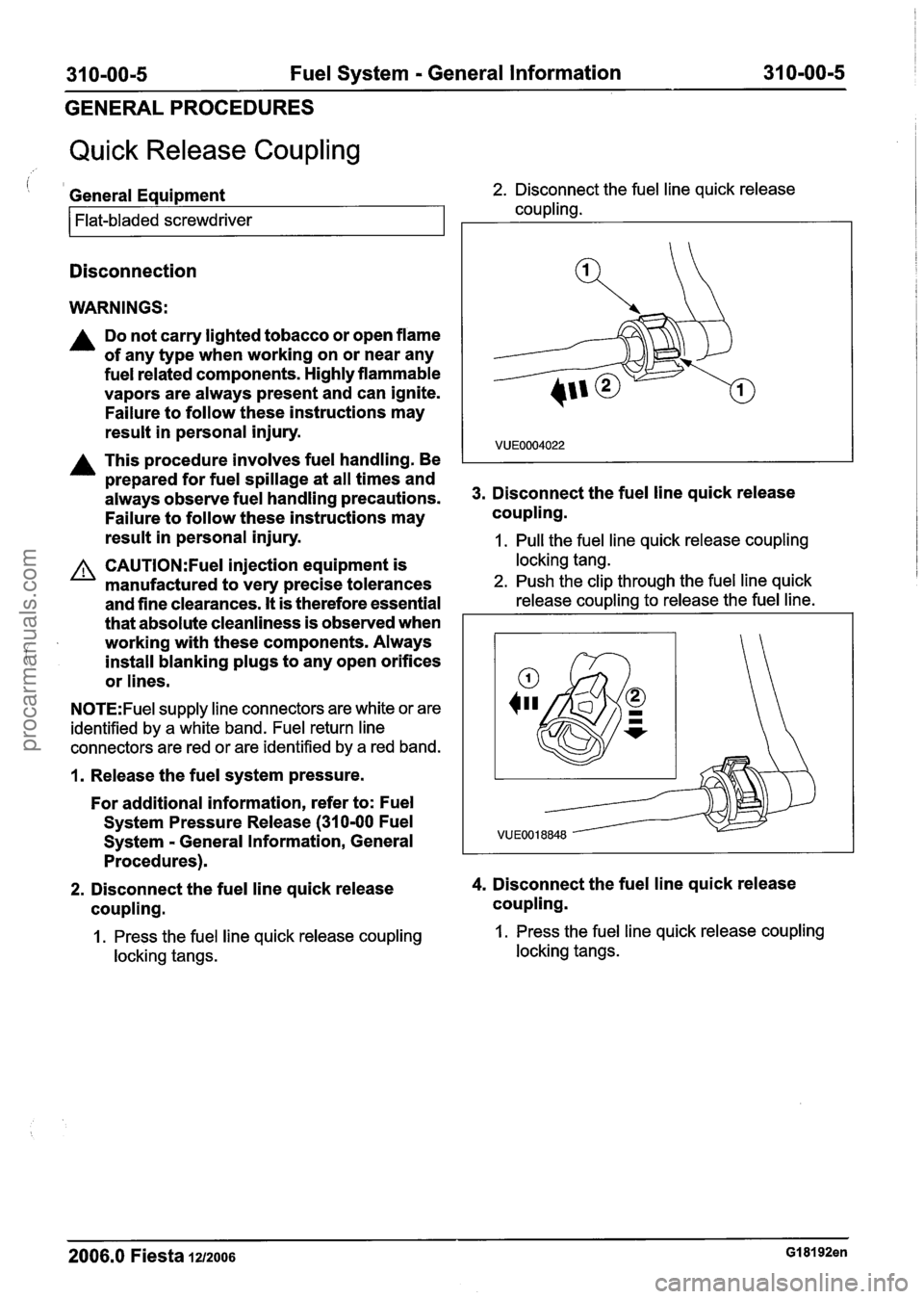
i 1 General Equipment 2. Disconnect the fuel line quick release
coupling.
Flat-bladed screwdriver
Disconnection
WARNINGS:
A Do not carry lighted tobacco or open flame
of any type when working on or near any
fuel related components. Highly flammable
vapors are always present and can ignite.
Failure to follow these instructions may
result in personal injury.
A This procedure involves fuel handling. Be
prepared for fuel spillage at all times and
always observe fuel handling precautions.
Failure to follow these instructions may
result in personal injury. 3.
Disconnect the fuel line quick release
coupling.
1. Pull the fuel line quick release coupling
CAUTI0N:Fuel injection equipment is locking tang.
manufactured to very precise tolerances 2. Push the clip through the fuel line quick
and fine clearances. It is therefore essential release coupling to release the fuel line.
that absolute cleanliness is observed when I
i
working with these components. Always
install blanking plugs to any open orifices
or lines.
N0TE:Fuel supply line connectors are white or are
identified by a white band. Fuel return line
connectors are red or are identified by a red band.
1. Release the fuel system pressure.
For additional information, refer to: Fuel
System Pressure Release (31
0-00 Fuel
Svstem - General Information, General
2. Disconnect the fuel line quick release 4. Disconnect the fuel line quick release
coupling. coupling.
1. Press the fuel line quick release coupling 1. Press the fuel line quick release coupling
locking tangs. locking tangs.
2006.0 Fiesta 1212006 GI 81 92en
procarmanuals.com