Page 279 of 312
For consistent results when filling the fuel tank:
•Turn the engine/ignition off prior to refueling, an error in the reading
will result if the engine is left running.
•Use the same filling rate setting (low-medium-high) each time the
tank is filled.
•Allow no more than 2 automatic click-offs when filling.
•Always use fuel with the recommended octane rating.
•Use a known quality gasoline, preferably a national brand.
•Use the same side of the same pump and have the vehicle facing the
same direction each time you fill up.
•Have the vehicle loading and distribution the same every time.
Your results will be most accurate if your filling method is consistent.
Calculating fuel economy
1. Fill the fuel tank completely and record the initial odometer reading
(in miles or kilometers).
2. Each time you fill the tank, record the amount of fuel added (in
gallons or liters).
3. After at least three to five tank fill-ups, fill the fuel tank and record
the current odometer reading.
4. Subtract your initial odometer reading from the current odometer
reading.
5. Follow one of the simple calculations in order to determine fuel
economy:
Calculation 1:Divide total miles traveled by total gallons used.
Calculation 2:Multiply liters used by 100, then divide by total
kilometers traveled.
Keep a record for at least one month and record the type of driving (city
or highway). This will provide an accurate estimate of the vehicle’s fuel
economy under current driving conditions. Additionally, keeping records
during summer and winter will show how temperature impacts fuel
economy. In general, lower temperatures give lower fuel economy.
Driving style — good driving and fuel economy habits
Give consideration to the lists that follow and you may be able to change
a number of variables and improve your fuel economy.
2007 F-250/350/450/550(f23)
Owners Guide (post-2002-fmt)
USA(fus)
Maintenance and Specifications
279
Page 286 of 312
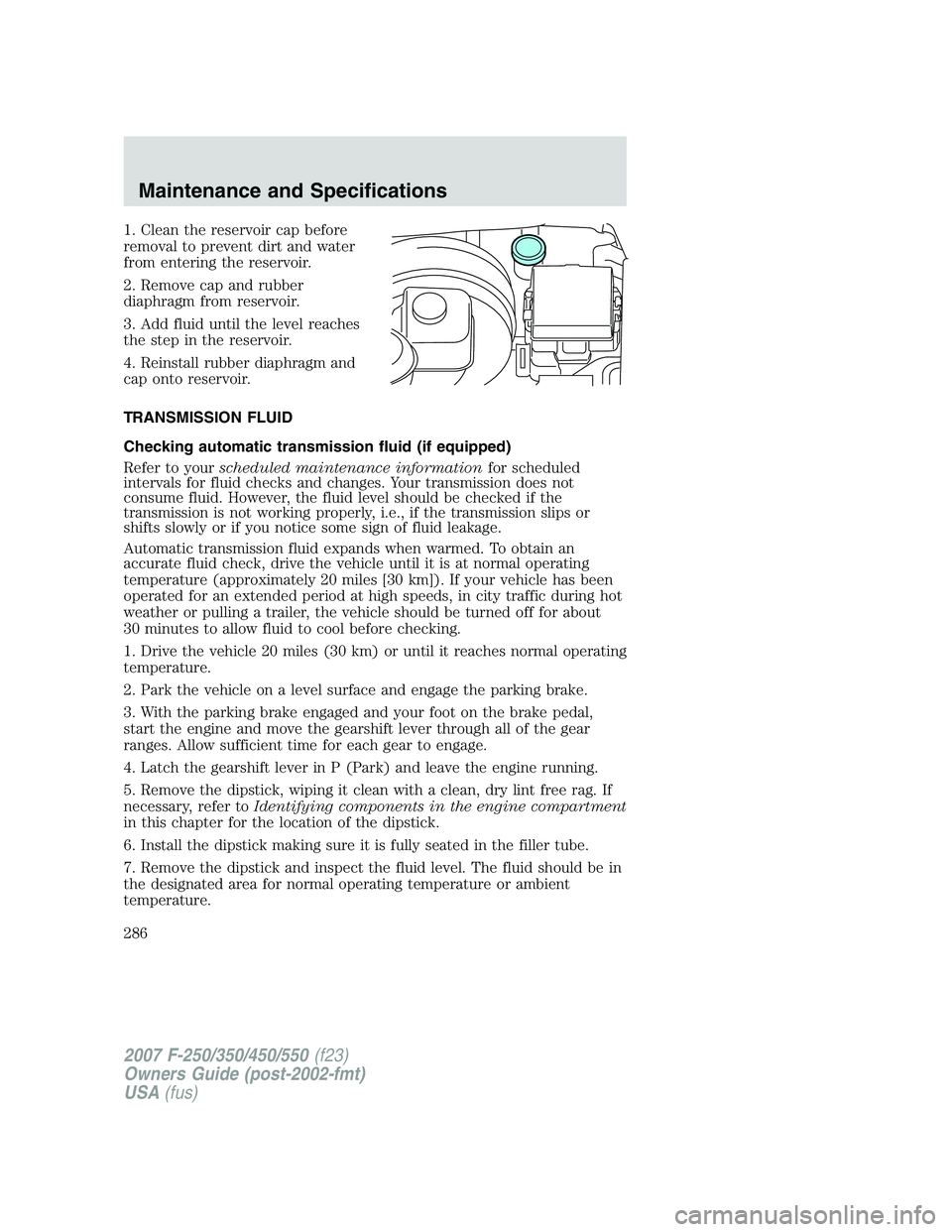
1. Clean the reservoir cap before
removal to prevent dirt and water
from entering the reservoir.
2. Remove cap and rubber
diaphragm from reservoir.
3. Add fluid until the level reaches
the step in the reservoir.
4. Reinstall rubber diaphragm and
cap onto reservoir.
TRANSMISSION FLUID
Checking automatic transmission fluid (if equipped)
Refer to yourscheduled maintenance informationfor scheduled
intervals for fluid checks and changes. Your transmission does not
consume fluid. However, the fluid level should be checked if the
transmission is not working properly, i.e., if the transmission slips or
shifts slowly or if you notice some sign of fluid leakage.
Automatic transmission fluid expands when warmed. To obtain an
accurate fluid check, drive the vehicle until it is at normal operating
temperature (approximately 20 miles [30 km]). If your vehicle has been
operated for an extended period at high speeds, in city traffic during hot
weather or pulling a trailer, the vehicle should be turned off for about
30 minutes to allow fluid to cool before checking.
1. Drive the vehicle 20 miles (30 km) or until it reaches normal operating
temperature.
2. Park the vehicle on a level surface and engage the parking brake.
3. With the parking brake engaged and your foot on the brake pedal,
start the engine and move the gearshift lever through all of the gear
ranges. Allow sufficient time for each gear to engage.
4. Latch the gearshift lever in P (Park) and leave the engine running.
5. Remove the dipstick, wiping it clean with a clean, dry lint free rag. If
necessary, refer toIdentifying components in the engine compartment
in this chapter for the location of the dipstick.
6. Install the dipstick making sure it is fully seated in the filler tube.
7. Remove the dipstick and inspect the fluid level. The fluid should be in
the designated area for normal operating temperature or ambient
temperature.
2007 F-250/350/450/550(f23)
Owners Guide (post-2002-fmt)
USA(fus)
Maintenance and Specifications
286
Page 307 of 312

K
Keyless entry system .................92
Keys
positions of the ignition .........172
L
Lamps
autolamp system .......................44
daytime running light ...............45
fog lamps ...................................45
headlamps .................................44
headlamps, flash to pass ..........46
instrument panel, dimming .....46
interior lamps ...........................50
replacing bulbs ...................51–58
Lane change indicator
(see Turn signal) ........................50
Lights, warning and indicator ....12
anti-lock brakes (ABS) ..........178
speed control ............................68
Load limits .................................153
Loading instructions .................159
Locks
childproof ..................................87
Lug nuts ....................................232
Lumbar support, seats ...............99
M
Manual transmission .................185
fluid capacities ........................294
reverse .....................................187
Message center ...............72, 74–75
english/metric button ...............79
system check button ................78warning messages .....................80
Mirrors .........................................60
automatic dimming rearview
mirror ........................................63
fold away ...................................65
heated ........................................64
side view mirrors (power) .......64
signal .........................................65
Moon roof ....................................71
Motorcraft parts ................273, 293
O
Octane rating ............................277
Oil (see Engine oil) ..................261
Overdrive .....................................60
P
Parking brake ............................179
Parts (see Motorcraft parts) ....293
Pedals (see Power adjustable
foot pedals) .................................66
Power adjustable foot pedals .....66
Power distribution box
(see Fuses) ...............................217
Power door locks ........................85
Power mirrors .............................64
Power point .................................61
Power steering ..........................180
fluid, checking and adding ....283
fluid, refill capacity ................294
Power Windows ...........................62
Preparing to drive your
vehicle ........................................181
2007 F-250/350/450/550(f23)
Owners Guide (post-2002-fmt)
USA(fus)
Index
307