Page 198 of 344
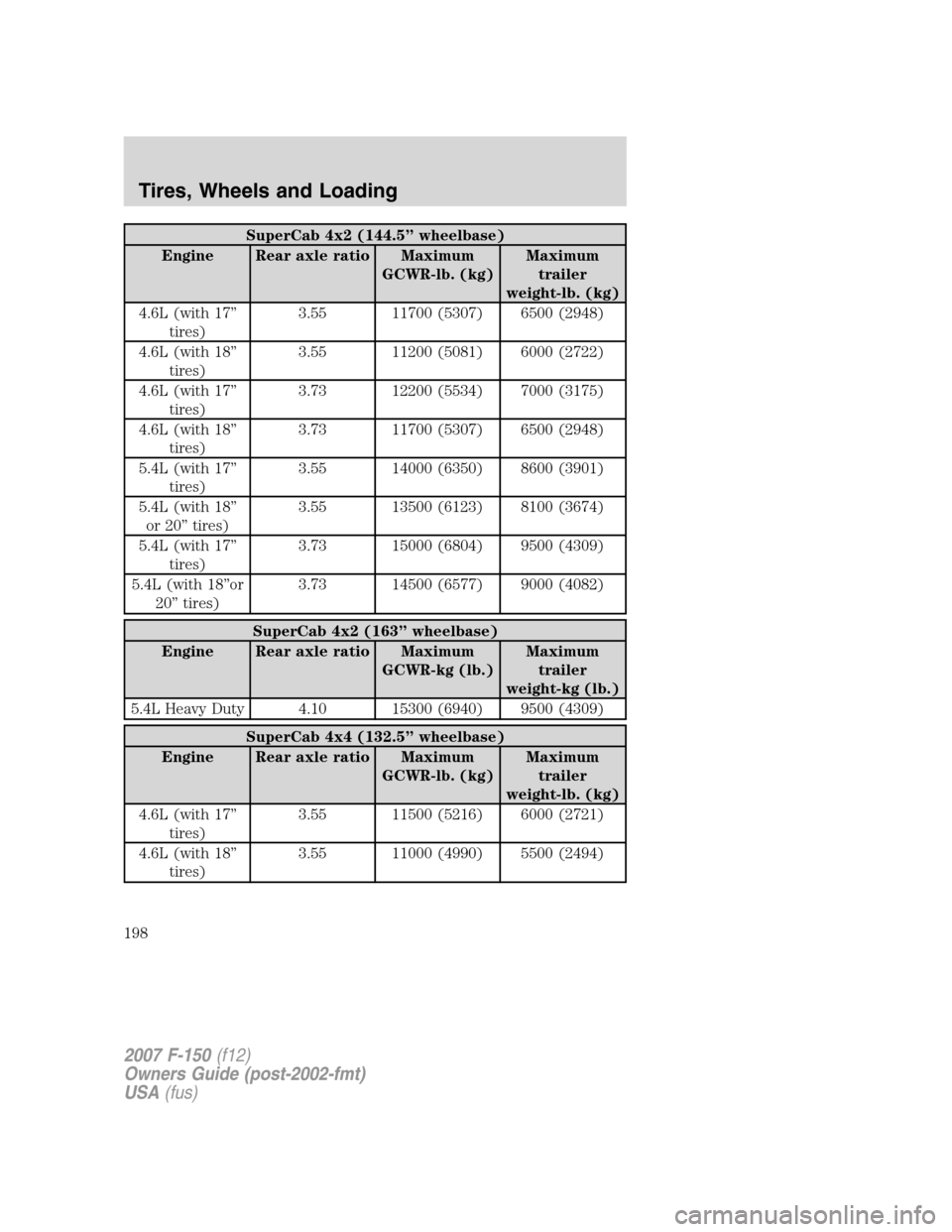
SuperCab 4x2 (144.5” wheelbase)
Engine Rear axle ratio Maximum
GCWR-lb. (kg)Maximum
trailer
weight-lb. (kg)
4.6L (with 17”
tires)3.55 11700 (5307) 6500 (2948)
4.6L (with 18”
tires)3.55 11200 (5081) 6000 (2722)
4.6L (with 17”
tires)3.73 12200 (5534) 7000 (3175)
4.6L (with 18”
tires)3.73 11700 (5307) 6500 (2948)
5.4L (with 17”
tires)3.55 14000 (6350) 8600 (3901)
5.4L (with 18”
or 20” tires)3.55 13500 (6123) 8100 (3674)
5.4L (with 17”
tires)3.73 15000 (6804) 9500 (4309)
5.4L (with 18”or
20” tires)3.73 14500 (6577) 9000 (4082)
SuperCab 4x2 (163” wheelbase)
Engine Rear axle ratio Maximum
GCWR-kg (lb.)Maximum
trailer
weight-kg (lb.)
5.4L Heavy Duty 4.10 15300 (6940) 9500 (4309)
SuperCab 4x4 (132.5” wheelbase)
Engine Rear axle ratio Maximum
GCWR-lb. (kg)Maximum
trailer
weight-lb. (kg)
4.6L (with 17”
tires)3.55 11500 (5216) 6000 (2721)
4.6L (with 18”
tires)3.55 11000 (4990) 5500 (2494)
2007 F-150(f12)
Owners Guide (post-2002-fmt)
USA(fus)
Tires, Wheels and Loading
198
Page 199 of 344
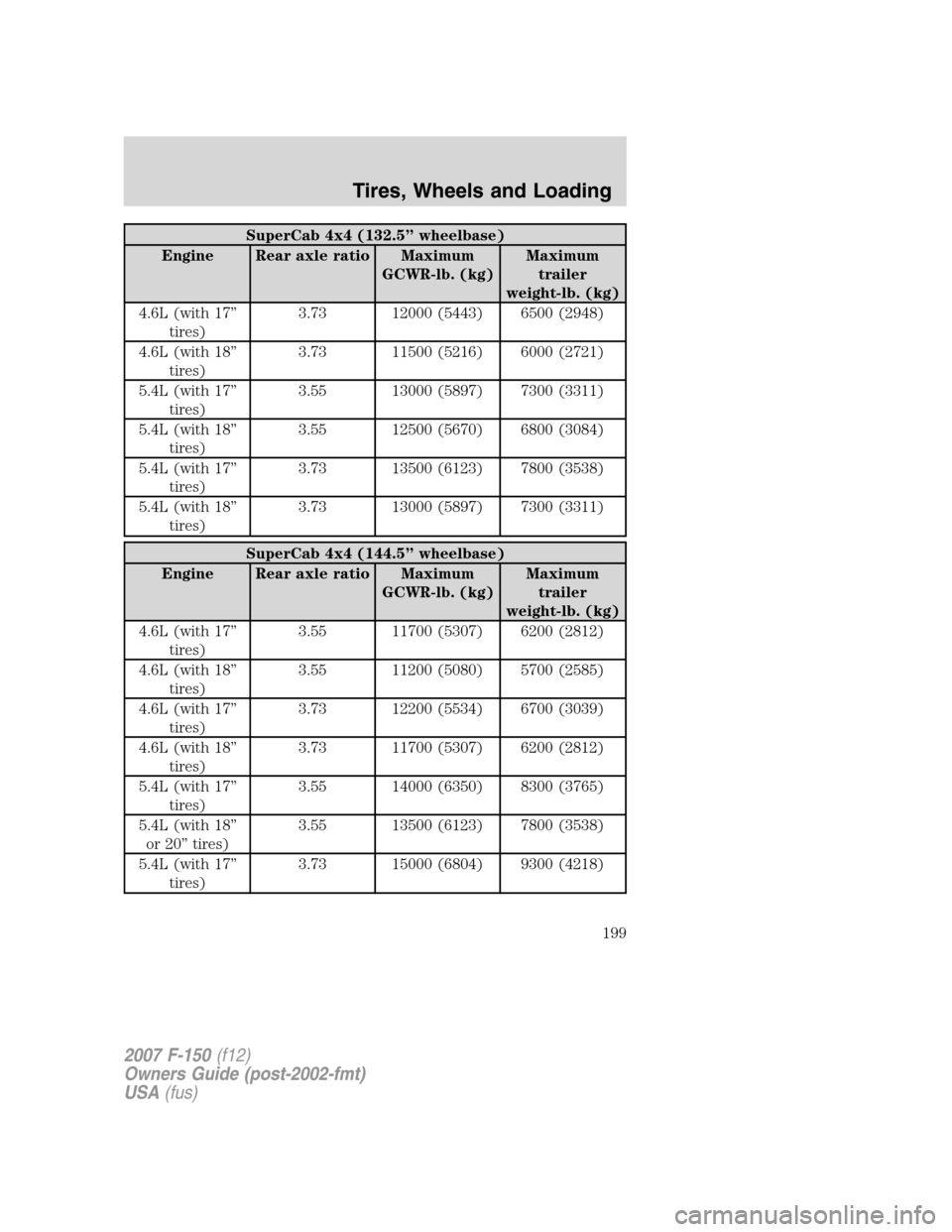
SuperCab 4x4 (132.5” wheelbase)
Engine Rear axle ratio Maximum
GCWR-lb. (kg)Maximum
trailer
weight-lb. (kg)
4.6L (with 17”
tires)3.73 12000 (5443) 6500 (2948)
4.6L (with 18”
tires)3.73 11500 (5216) 6000 (2721)
5.4L (with 17”
tires)3.55 13000 (5897) 7300 (3311)
5.4L (with 18”
tires)3.55 12500 (5670) 6800 (3084)
5.4L (with 17”
tires)3.73 13500 (6123) 7800 (3538)
5.4L (with 18”
tires)3.73 13000 (5897) 7300 (3311)
SuperCab 4x4 (144.5” wheelbase)
Engine Rear axle ratio Maximum
GCWR-lb. (kg)Maximum
trailer
weight-lb. (kg)
4.6L (with 17”
tires)3.55 11700 (5307) 6200 (2812)
4.6L (with 18”
tires)3.55 11200 (5080) 5700 (2585)
4.6L (with 17”
tires)3.73 12200 (5534) 6700 (3039)
4.6L (with 18”
tires)3.73 11700 (5307) 6200 (2812)
5.4L (with 17”
tires)3.55 14000 (6350) 8300 (3765)
5.4L (with 18”
or 20” tires)3.55 13500 (6123) 7800 (3538)
5.4L (with 17”
tires)3.73 15000 (6804) 9300 (4218)
2007 F-150(f12)
Owners Guide (post-2002-fmt)
USA(fus)
Tires, Wheels and Loading
199
Page 200 of 344
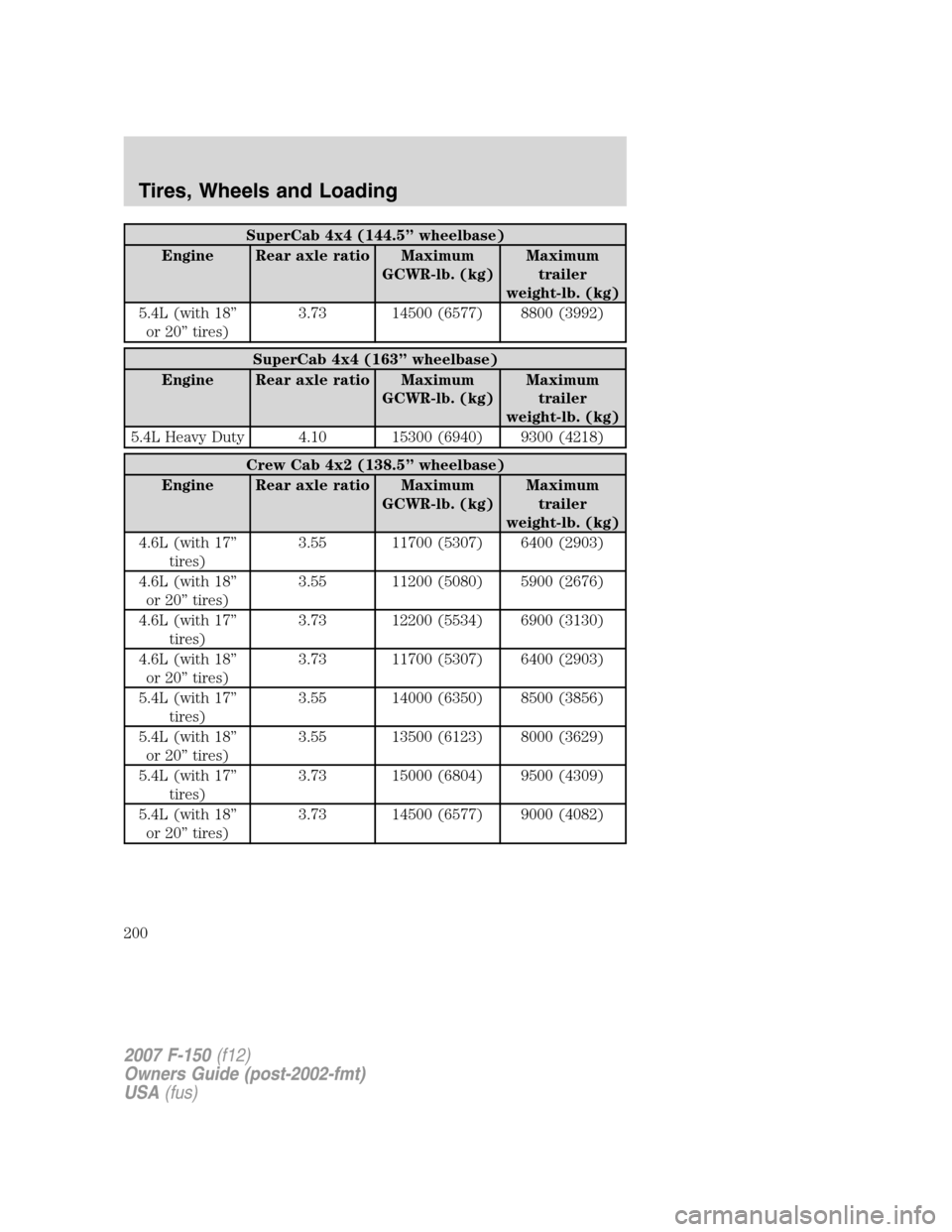
SuperCab 4x4 (144.5” wheelbase)
Engine Rear axle ratio Maximum
GCWR-lb. (kg)Maximum
trailer
weight-lb. (kg)
5.4L (with 18”
or 20” tires)3.73 14500 (6577) 8800 (3992)
SuperCab 4x4 (163” wheelbase)
Engine Rear axle ratio Maximum
GCWR-lb. (kg)Maximum
trailer
weight-lb. (kg)
5.4L Heavy Duty 4.10 15300 (6940) 9300 (4218)
Crew Cab 4x2 (138.5” wheelbase)
Engine Rear axle ratio Maximum
GCWR-lb. (kg)Maximum
trailer
weight-lb. (kg)
4.6L (with 17”
tires)3.55 11700 (5307) 6400 (2903)
4.6L (with 18”
or 20” tires)3.55 11200 (5080) 5900 (2676)
4.6L (with 17”
tires)3.73 12200 (5534) 6900 (3130)
4.6L (with 18”
or 20” tires)3.73 11700 (5307) 6400 (2903)
5.4L (with 17”
tires)3.55 14000 (6350) 8500 (3856)
5.4L (with 18”
or 20” tires)3.55 13500 (6123) 8000 (3629)
5.4L (with 17”
tires)3.73 15000 (6804) 9500 (4309)
5.4L (with 18”
or 20” tires)3.73 14500 (6577) 9000 (4082)
2007 F-150(f12)
Owners Guide (post-2002-fmt)
USA(fus)
Tires, Wheels and Loading
200
Page 201 of 344
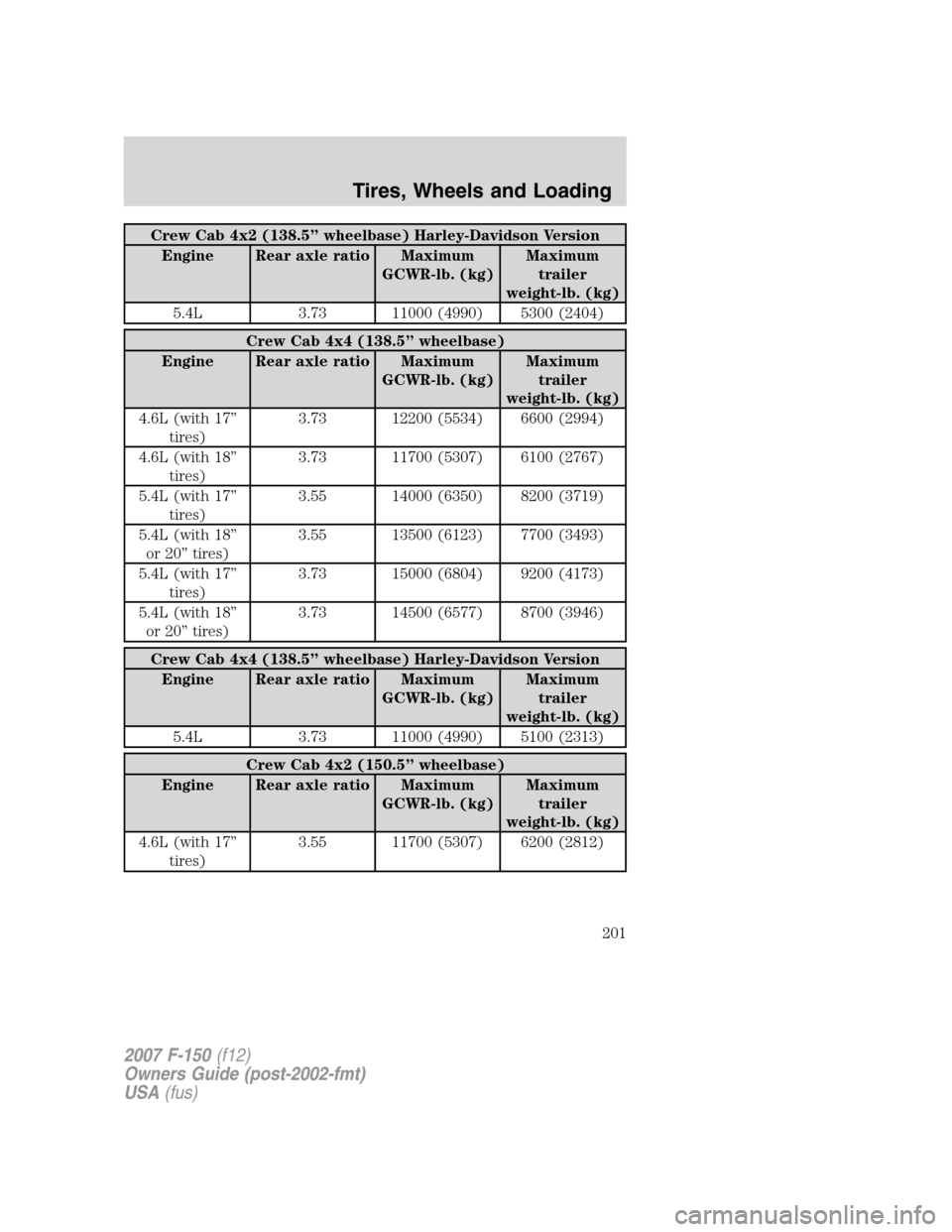
Crew Cab 4x2 (138.5” wheelbase) Harley-Davidson Version
Engine Rear axle ratio Maximum
GCWR-lb. (kg)Maximum
trailer
weight-lb. (kg)
5.4L 3.73 11000 (4990) 5300 (2404)
Crew Cab 4x4 (138.5” wheelbase)
Engine Rear axle ratio Maximum
GCWR-lb. (kg)Maximum
trailer
weight-lb. (kg)
4.6L (with 17”
tires)3.73 12200 (5534) 6600 (2994)
4.6L (with 18”
tires)3.73 11700 (5307) 6100 (2767)
5.4L (with 17”
tires)3.55 14000 (6350) 8200 (3719)
5.4L (with 18”
or 20” tires)3.55 13500 (6123) 7700 (3493)
5.4L (with 17”
tires)3.73 15000 (6804) 9200 (4173)
5.4L (with 18”
or 20” tires)3.73 14500 (6577) 8700 (3946)
Crew Cab 4x4 (138.5” wheelbase) Harley-Davidson Version
Engine Rear axle ratio Maximum
GCWR-lb. (kg)Maximum
trailer
weight-lb. (kg)
5.4L 3.73 11000 (4990) 5100 (2313)
Crew Cab 4x2 (150.5” wheelbase)
Engine Rear axle ratio Maximum
GCWR-lb. (kg)Maximum
trailer
weight-lb. (kg)
4.6L (with 17”
tires)3.55 11700 (5307) 6200 (2812)
2007 F-150(f12)
Owners Guide (post-2002-fmt)
USA(fus)
Tires, Wheels and Loading
201
Page 202 of 344
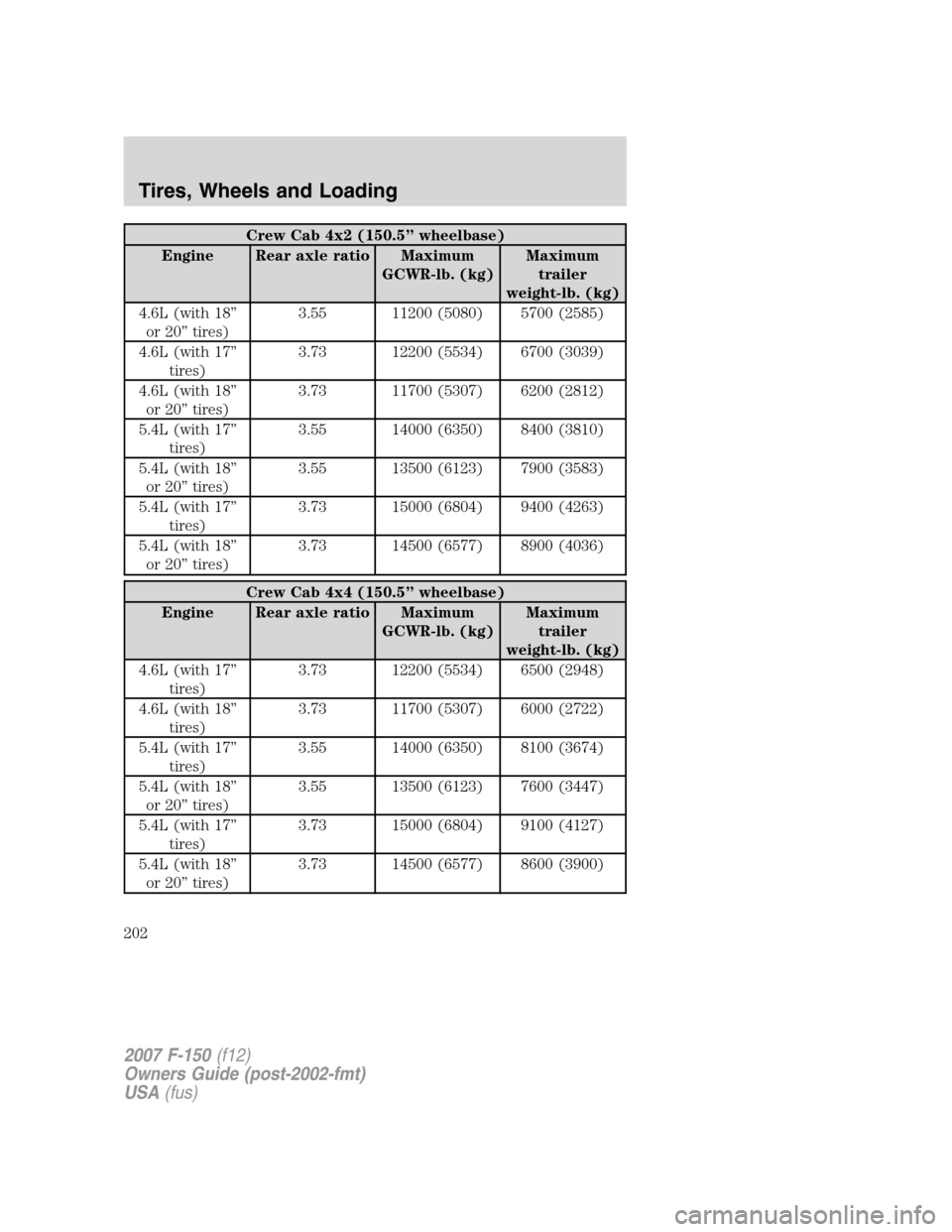
Crew Cab 4x2 (150.5” wheelbase)
Engine Rear axle ratio Maximum
GCWR-lb. (kg)Maximum
trailer
weight-lb. (kg)
4.6L (with 18”
or 20” tires)3.55 11200 (5080) 5700 (2585)
4.6L (with 17”
tires)3.73 12200 (5534) 6700 (3039)
4.6L (with 18”
or 20” tires)3.73 11700 (5307) 6200 (2812)
5.4L (with 17”
tires)3.55 14000 (6350) 8400 (3810)
5.4L (with 18”
or 20” tires)3.55 13500 (6123) 7900 (3583)
5.4L (with 17”
tires)3.73 15000 (6804) 9400 (4263)
5.4L (with 18”
or 20” tires)3.73 14500 (6577) 8900 (4036)
Crew Cab 4x4 (150.5” wheelbase)
Engine Rear axle ratio Maximum
GCWR-lb. (kg)Maximum
trailer
weight-lb. (kg)
4.6L (with 17”
tires)3.73 12200 (5534) 6500 (2948)
4.6L (with 18”
tires)3.73 11700 (5307) 6000 (2722)
5.4L (with 17”
tires)3.55 14000 (6350) 8100 (3674)
5.4L (with 18”
or 20” tires)3.55 13500 (6123) 7600 (3447)
5.4L (with 17”
tires)3.73 15000 (6804) 9100 (4127)
5.4L (with 18”
or 20” tires)3.73 14500 (6577) 8600 (3900)
2007 F-150(f12)
Owners Guide (post-2002-fmt)
USA(fus)
Tires, Wheels and Loading
202
Page 203 of 344
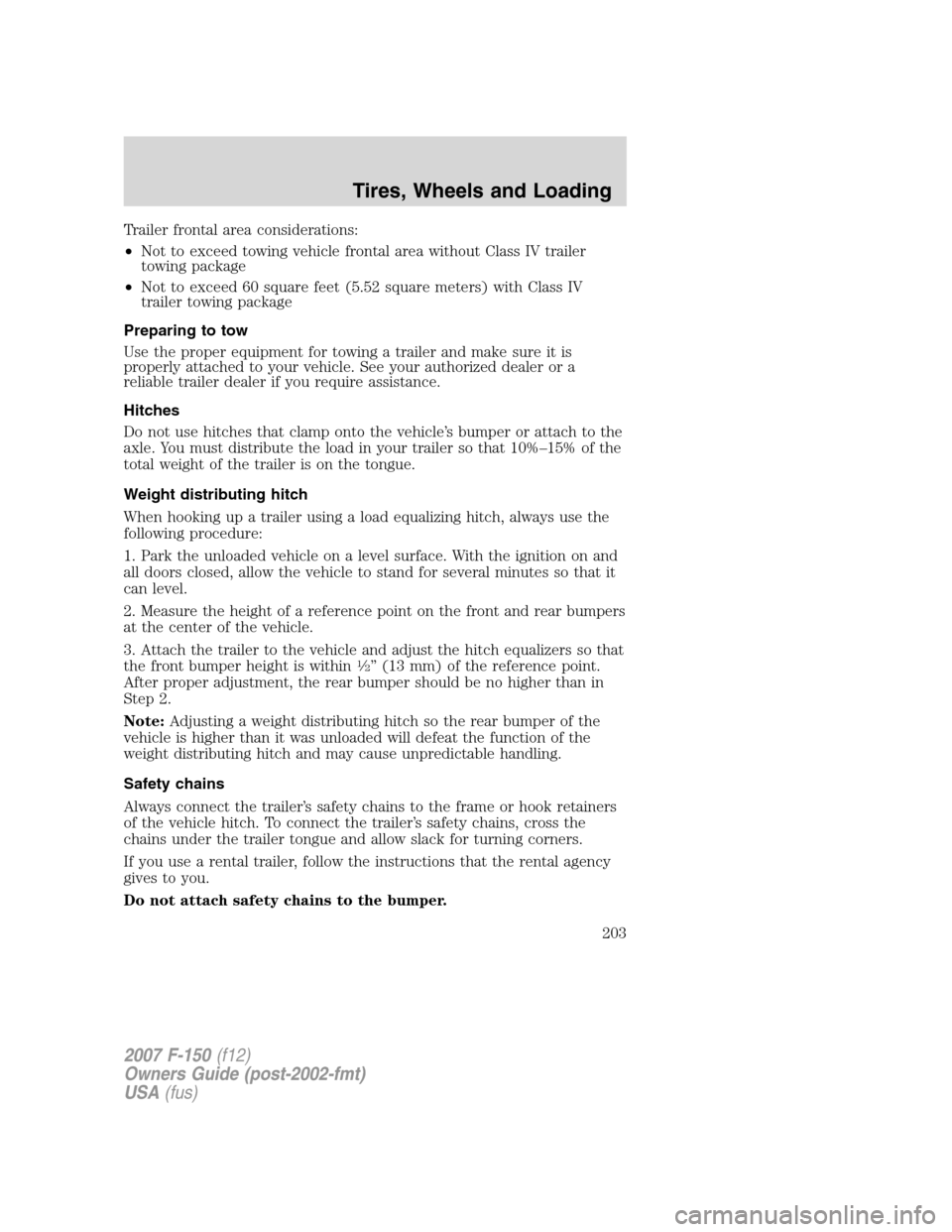
Trailer frontal area considerations:
•Not to exceed towing vehicle frontal area without Class IV trailer
towing package
•Not to exceed 60 square feet (5.52 square meters) with Class IV
trailer towing package
Preparing to tow
Use the proper equipment for towing a trailer and make sure it is
properly attached to your vehicle. See your authorized dealer or a
reliable trailer dealer if you require assistance.
Hitches
Do not use hitches that clamp onto the vehicle’s bumper or attach to the
axle. You must distribute the load in your trailer so that 10%–15% of the
total weight of the trailer is on the tongue.
Weight distributing hitch
When hooking up a trailer using a load equalizing hitch, always use the
following procedure:
1. Park the unloaded vehicle on a level surface. With the ignition on and
all doors closed, allow the vehicle to stand for several minutes so that it
can level.
2. Measure the height of a reference point on the front and rear bumpers
at the center of the vehicle.
3. Attach the trailer to the vehicle and adjust the hitch equalizers so that
the front bumper height is within
12” (13 mm) of the reference point.
After proper adjustment, the rear bumper should be no higher than in
Step 2.
Note:Adjusting a weight distributing hitch so the rear bumper of the
vehicle is higher than it was unloaded will defeat the function of the
weight distributing hitch and may cause unpredictable handling.
Safety chains
Always connect the trailer’s safety chains to the frame or hook retainers
of the vehicle hitch. To connect the trailer’s safety chains, cross the
chains under the trailer tongue and allow slack for turning corners.
If you use a rental trailer, follow the instructions that the rental agency
gives to you.
Do not attach safety chains to the bumper.
2007 F-150(f12)
Owners Guide (post-2002-fmt)
USA(fus)
Tires, Wheels and Loading
203
Page 204 of 344

Trailer brakes
Electric brakes and manual, automatic or surge-type trailer brakes are
safe if installed properly and adjusted to the manufacturer’s
specifications. The trailer brakes must meet local and Federal
regulations.
Do not connect a trailer’s hydraulic brake system directly to your
vehicle’s brake system. Your vehicle may not have enough
braking power and your chances of having a collision greatly increase.
The braking system of the tow vehicle is rated for operation at the
GVWR not GCWR.
Trailer lamps
Trailer lamps are required on most towed vehicles. Make sure all running
lights, brake lights, turn signals and hazard lights are working. See your
authorized dealer or trailer rental agency for proper instructions and
equipment for hooking up trailer lamps.
Using a step bumper (if equipped)
The rear bumper is equipped with an integral hitch and only requires a
ball with a one inch (25.4 mm) shank diameter. The bumper has a 5,000
lb. (2,270 kg) trailer weight and 500 lb. (227 kg) tongue weight capacity.
If it is necessary to relocate the trailer hitch ball position, a
frame-mounted trailer hitch must be installed.
Driving while you tow
When towing a trailer:
•Keep your speed no faster than 70 mph (112 km/h) during the first
500 miles (800 km) of towing a trailer, and don’t make full throttle
starts.
•Turn off the speed control. The speed control may shut off
automatically when you are towing on long, steep grades.
•Consult your local motor vehicle speed regulations for towing a trailer.
•To eliminate excessive shifting, use a lower gear. This will also assist
in transmission cooling. (For additional information, refer to
Understanding the gearshift positions of the 4–speed automatic
transmissionin theDriving chapter.
•Anticipate stops and brake gradually.
2007 F-150(f12)
Owners Guide (post-2002-fmt)
USA(fus)
Tires, Wheels and Loading
204
Page 205 of 344

•Do not exceed the GCWR rating or transmission damage may occur.
Servicing after towing
If you tow a trailer for long distances, your vehicle will require more
frequent service intervals. Refer to yourScheduled Maintenance
Informationfor more information.
Trailer towing tips
•Practice turning, stopping and backing up before starting on a trip to
get the feel of the vehicle trailer combination. When turning, make
wider turns so the trailer wheels will clear curbs and other obstacles.
•Allow more distance for stopping with a trailer attached.
•The trailer tongue weight should be 10–15% of the loaded trailer
weight.
•If you will be towing a trailer frequently in hot weather, hilly
conditions, at GCWR, or any combination of these factors, consider
refilling your rear axle with synthetic gear lube if not already so
equipped. Refer to theMaintenance and specificationschapter for
the lubricant specification. Remember that regardless of the rear axle
lube used, do not tow a trailer for the first 500 miles (800 km) of a
new vehicle, and that the first 500 miles (800 km) of towing be done
at no faster than 70 mph (112 km/h) with no full throttle starts.
•After you have traveled 50 miles (80 km), thoroughly check your
hitch, electrical connections and trailer wheel lug nuts.
•To aid in engine/transmission cooling and A/C efficiency during hot
weather while stopped in traffic, place the gearshift lever in P (Park)
(automatic transmission) or N (Neutral) (manual transmissions).
•Vehicles with trailers should not be parked on a grade. If you must
park on a grade, place wheel chocks under the trailer’s wheels.
Launching or retrieving a boat
Disconnect the wiring to the trailer before backing the trailer
into the water. Reconnect the wiring to the trailer after the
trailer is removed from the water.
When backing down a ramp during boat launching or retrieval:
•do not allow the static water level to rise above the bottom edge of
the rear bumper.
•do not allow waves to break higher than 6 inches (15 cm) above the
bottom edge of the rear bumper.
2007 F-150(f12)
Owners Guide (post-2002-fmt)
USA(fus)
Tires, Wheels and Loading
205