2007 FORD F SERIES MOTORHOME AND COMMERCIAL CHASSIS park assist
[x] Cancel search: park assistPage 43 of 128
Loaded vehicles may handle differently than unloaded vehicles.
Extra precautions, such as slower speeds and increased stopping
distance, should be taken when driving a heavily loaded vehicle.
Your vehicle can haul more cargo and people than most passenger cars.
Depending upon the type and placement of the load, hauling cargo and
people may raise the center of gravity of the vehicle.
TRAILER TOWING
Your vehicle may tow a class I, II or III trailer provided the maximum
trailer weight is less than or equal to the maximum trailer weight listed
for your engine and rear axle ratio on the following chart:
GCWR (Gross Combined Weight Rating)/Trailer Weights
EngineRear
axle
ratioMaximum
GCWR - lb.
(kg)Trailer weight
range - lb. (kg)
(0-Maximum)Maximum
Frontal Area of
Trailer - ft
2(m2)
6.8L 5.3826000
(11794)0–10000
(0-4536)60 (5.6)
For high altitude operation reduce GCW by 2% per 1,000 ft.
(300 meters) elevation. To determine the maximum trailer weight
designed for your particular vehicle as equipped, follow the section
Calculating the load your vehicle can carry/towearlier in this
chapter.
Preparing to tow
Use the proper equipment for towing a trailer and make sure it is
properly attached to your vehicle. See your authorized dealer or a
reliable trailer dealer if you require assistance.
Hitches
You must distribute the load in your trailer so that 10–15% of the total
weight of the trailer is on the tongue.
Weight distributing hitch
When hooking up a trailer using a load equalizing hitch, always use the
following procedure:
1. Park the unloaded vehicle on a level surface. With the ignition on and
all doors closed, allow the vehicle to stand for several minutes so that it
can level.
2. Measure the height of a reference point on the front and rear bumpers
at the center of the vehicle.
2007 Motorhome(mot)
Supplement
USA(fus)
Tires, Wheels and Loading
43
Page 45 of 128
•Turn off the speed control. The speed control may shut off
automatically when you are towing on long, steep grades.
•Consult your local motor vehicle speed regulations for towing a trailer.
•To eliminate excessive shifting, use a lower gear. This will also assist
in transmission cooling.
•Anticipate stops and brake gradually.
Servicing after towing
If you tow a trailer for long distances, your vehicle will require more
frequent service intervals. Refer to yourscheduled maintenance
informationfor more information.
Trailer towing tips
•Practice turning, stopping and backing up before starting on a trip to
get the feel of the vehicle trailer combination. When turning, make
wider turns so the trailer wheels will clear curbs and other obstacles.
•Allow more distance for stopping with a trailer attached.
•If you are driving down a long or steep hill, shift to a lower gear. Do
not apply the brakes continuously, as they may overheat and become
less effective.
•The trailer tongue weight should be 10–15% of the loaded trailer
weight.
•If you will be towing a trailer frequently in hot weather, hilly
conditions, at GCWR, or any combination of these factors, consider
refilling your rear axle with synthetic gear lube if not already so
equipped. Refer to theMaintenance and Specificationschapter for
the lubricant specification. Remember that regardless of the rear axle
lube used, do not tow a trailer for the first 500 miles (800 km) of a
new vehicle, and that the first 500 miles (800 km) of towing be done
at no faster than 70 mph (112 km/h) with no full throttle starts.
•After you have traveled 50 miles (80 km), thoroughly check your
hitch, electrical connections and trailer wheel lug nuts.
•To aid in engine/transmission cooling and A/C efficiency during hot
weather while stopped in traffic, place the gearshift lever in P (Park).
•Vehicles with trailers should not be parked on a grade. If you must
park on a grade, place wheel chocks under the trailer’s wheels.
2007 Motorhome(mot)
Supplement
USA(fus)
Tires, Wheels and Loading
45
Page 48 of 128
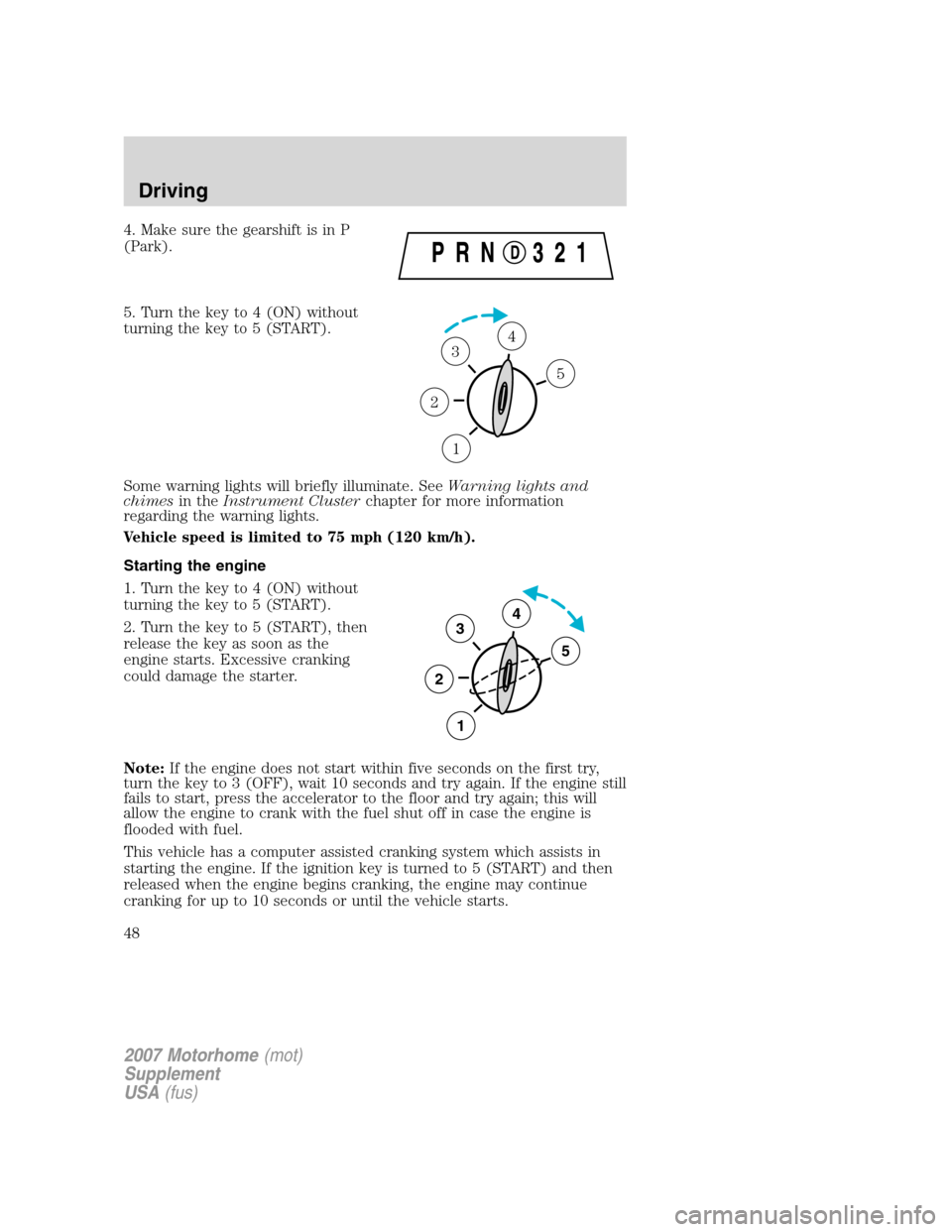
4. Make sure the gearshift is in P
(Park).
5. Turn the key to 4 (ON) without
turning the key to 5 (START).
Some warning lights will briefly illuminate. SeeWarning lights and
chimesin theInstrument Clusterchapter for more information
regarding the warning lights.
Vehicle speed is limited to 75 mph (120 km/h).
Starting the engine
1. Turn the key to 4 (ON) without
turning the key to 5 (START).
2. Turn the key to 5 (START), then
release the key as soon as the
engine starts. Excessive cranking
could damage the starter.
Note:If the engine does not start within five seconds on the first try,
turn the key to 3 (OFF), wait 10 seconds and try again. If the engine still
fails to start, press the accelerator to the floor and try again; this will
allow the engine to crank with the fuel shut off in case the engine is
flooded with fuel.
This vehicle has a computer assisted cranking system which assists in
starting the engine. If the ignition key is turned to 5 (START) and then
released when the engine begins cranking, the engine may continue
cranking for up to 10 seconds or until the vehicle starts.
1
2
34
5
3
2
1
5
4
2007 Motorhome(mot)
Supplement
USA(fus)
Driving
48
Page 55 of 128
To put your vehicle in P (Park):
•Come to a complete stop
•Move the gearshift lever and securely latch it in P (Park)
Always set the parking brake fully and make sure the gearshift is
latched in P (Park). Turn the ignition to the LOCK position and
remove the key whenever you leave your vehicle.
R (Reverse)
With the gearshift lever in R (Reverse), the vehicle will move backward.
Always come to a complete stop before shifting into and out of R
(Reverse).
N (Neutral)
With the gearshift lever in N (Neutral), the vehicle can be started and is
free to roll. Hold the brake pedal down while in this position.
D (Overdrive) with Tow/Haul OFF
D (Overdrive) with Tow/Haul OFF is the normal driving position for the
best fuel economy. The overdrive function allows automatic upshifts and
downshifts through gears one through five.
D (Overdrive) with Tow/Haul ON
The Tow/Haul feature improves transmission operation when towing a
trailer or a heavy load. All transmission gear ranges are available when
using Tow/Haul.
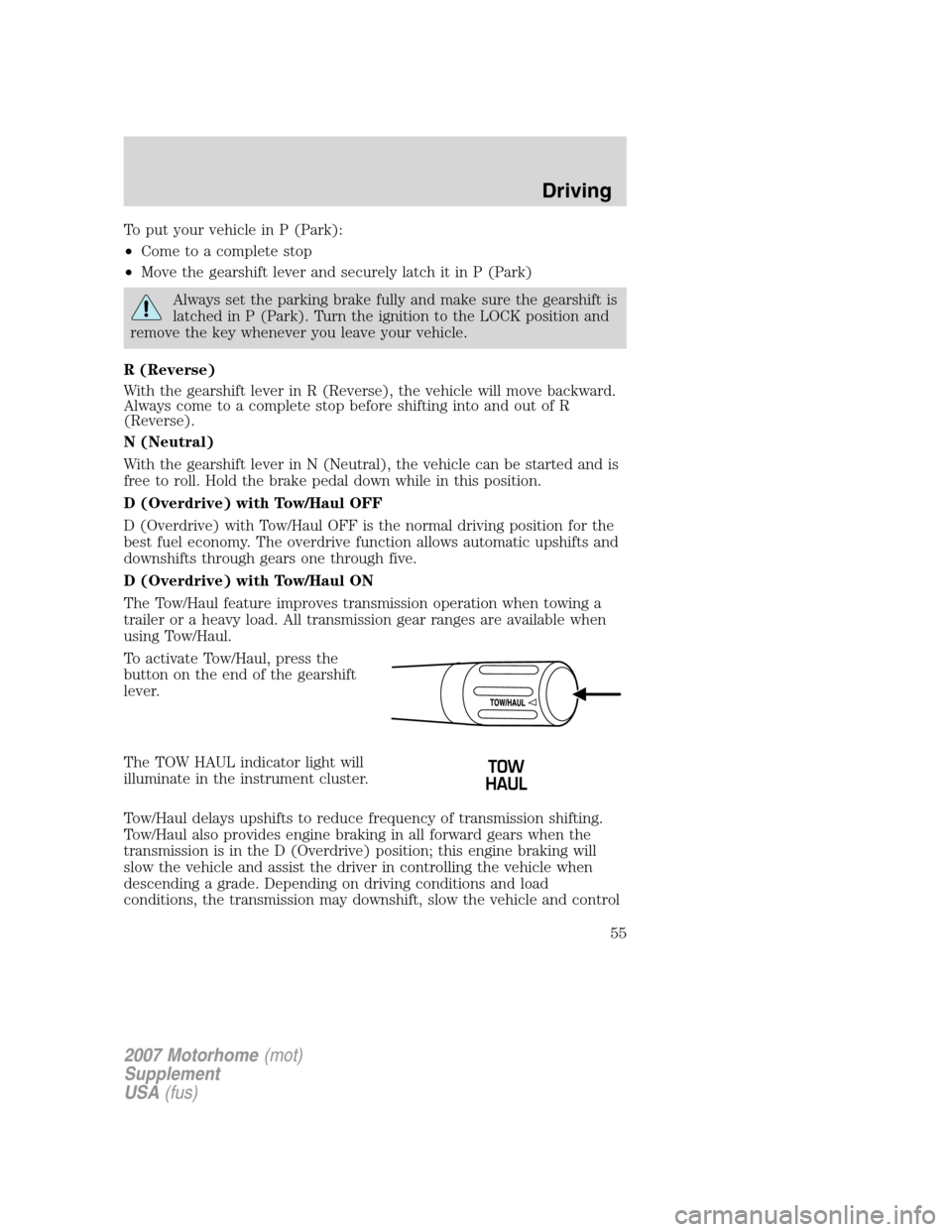
To activate Tow/Haul, press the
button on the end of the gearshift
lever.
The TOW HAUL indicator light will
illuminate in the instrument cluster.
Tow/Haul delays upshifts to reduce frequency of transmission shifting.
Tow/Haul also provides engine braking in all forward gears when the
transmission is in the D (Overdrive) position; this engine braking will
slow the vehicle and assist the driver in controlling the vehicle when
descending a grade. Depending on driving conditions and load
conditions, the transmission may downshift, slow the vehicle and control
2007 Motorhome(mot)
Supplement
USA(fus)
Driving
55
Page 63 of 128
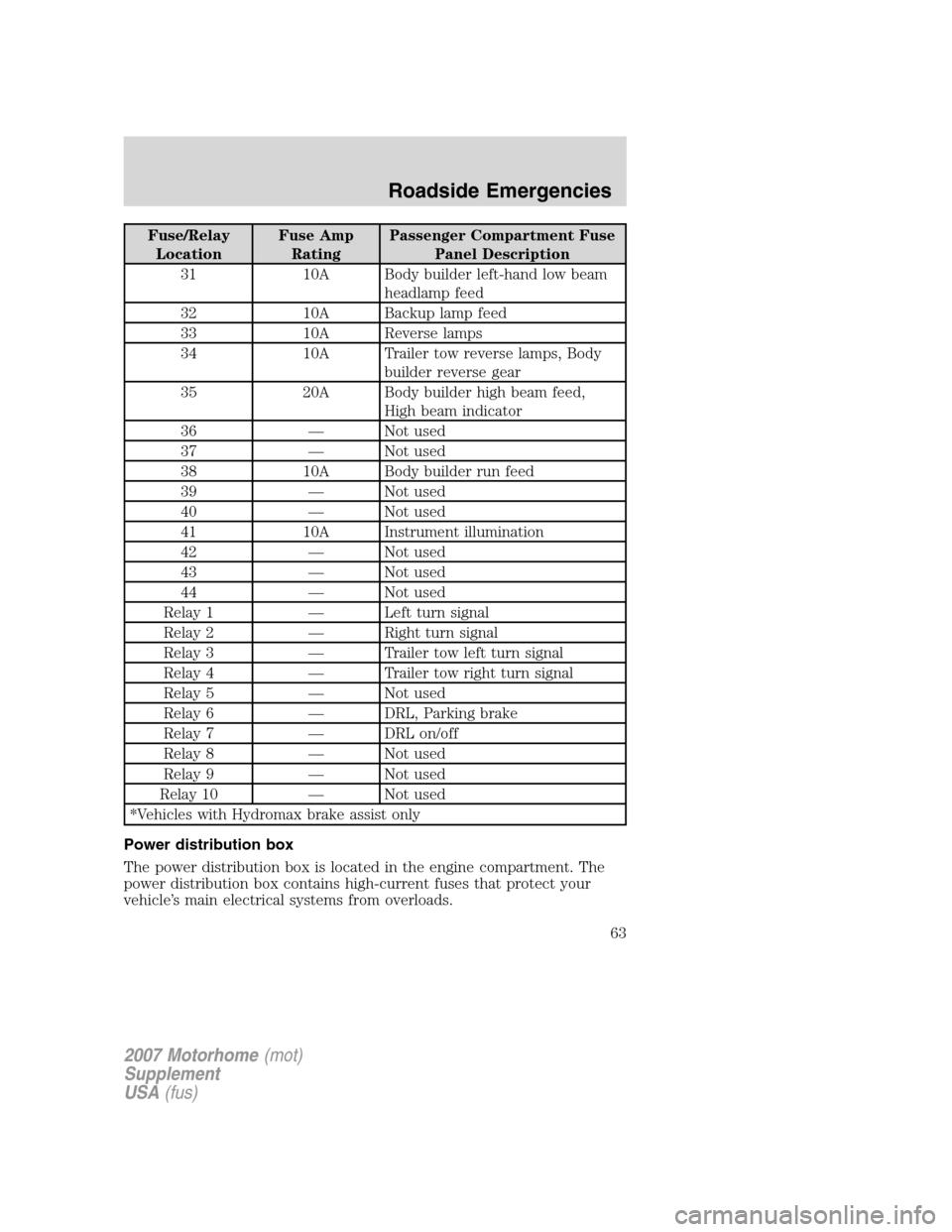
Fuse/Relay
LocationFuse Amp
RatingPassenger Compartment Fuse
Panel Description
31 10A Body builder left-hand low beam
headlamp feed
32 10A Backup lamp feed
33 10A Reverse lamps
34 10A Trailer tow reverse lamps, Body
builder reverse gear
35 20A Body builder high beam feed,
High beam indicator
36 — Not used
37 — Not used
38 10A Body builder run feed
39 — Not used
40 — Not used
41 10A Instrument illumination
42 — Not used
43 — Not used
44 — Not used
Relay 1 — Left turn signal
Relay 2 — Right turn signal
Relay 3 — Trailer tow left turn signal
Relay 4 — Trailer tow right turn signal
Relay 5 — Not used
Relay 6 — DRL, Parking brake
Relay 7 — DRL on/off
Relay 8 — Not used
Relay 9 — Not used
Relay 10 — Not used
*Vehicles with Hydromax brake assist only
Power distribution box
The power distribution box is located in the engine compartment. The
power distribution box contains high-current fuses that protect your
vehicle’s main electrical systems from overloads.
2007 Motorhome(mot)
Supplement
USA(fus)
Roadside Emergencies
63
Page 65 of 128
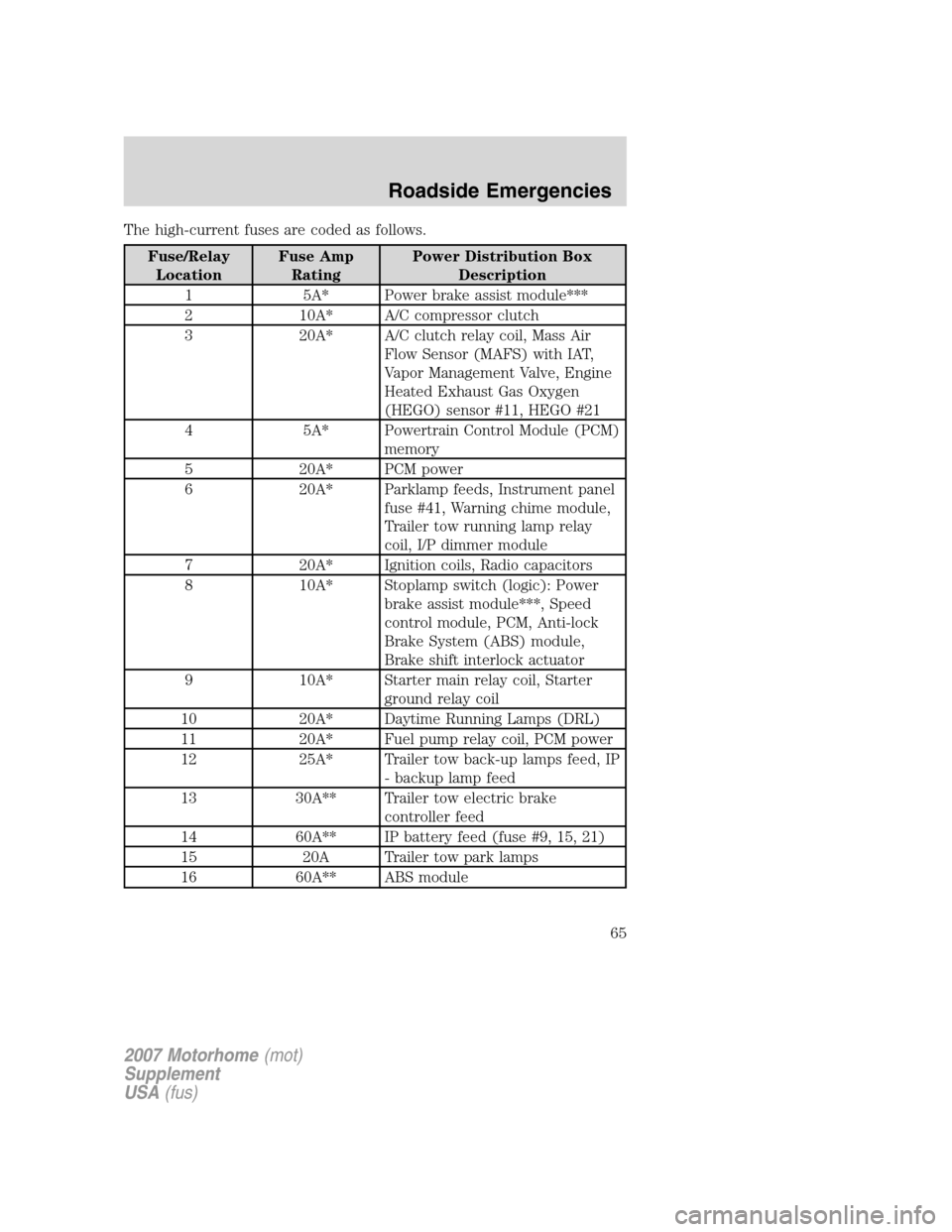
The high-current fuses are coded as follows.
Fuse/Relay
LocationFuse Amp
RatingPower Distribution Box
Description
1 5A* Power brake assist module***
2 10A* A/C compressor clutch
3 20A* A/C clutch relay coil, Mass Air
Flow Sensor (MAFS) with IAT,
Vapor Management Valve, Engine
Heated Exhaust Gas Oxygen
(HEGO) sensor #11, HEGO #21
4 5A* Powertrain Control Module (PCM)
memory
5 20A* PCM power
6 20A* Parklamp feeds, Instrument panel
fuse #41, Warning chime module,
Trailer tow running lamp relay
coil, I/P dimmer module
7 20A* Ignition coils, Radio capacitors
8 10A* Stoplamp switch (logic): Power
brake assist module***, Speed
control module, PCM, Anti-lock
Brake System (ABS) module,
Brake shift interlock actuator
9 10A* Starter main relay coil, Starter
ground relay coil
10 20A* Daytime Running Lamps (DRL)
11 20A* Fuel pump relay coil, PCM power
12 25A* Trailer tow back-up lamps feed, IP
- backup lamp feed
13 30A** Trailer tow electric brake
controller feed
14 60A** IP battery feed (fuse #9, 15, 21)
15 20A Trailer tow park lamps
16 60A** ABS module
2007 Motorhome(mot)
Supplement
USA(fus)
Roadside Emergencies
65
Page 81 of 128
If you did not take advantage of the Ford Extended Service Plan at the
time of purchasing your vehicle, you may still be eligible. Since this
information is subject to change, please ask your authorized dealer for
complete details about Ford Extended Service Plan coverage options, or
visit the Ford ESP website at www.ford-esp.com.
GETTING ASSISTANCE OUTSIDE THE U.S. AND CANADA
Before exporting your vehicle to a foreign country, contact the
appropriate foreign embassy or consulate. These officials can inform you
of local vehicle registration regulations and where to find unleaded fuel.
If you cannot find unleaded fuel or can only get fuel with an anti-knock
index lower than is recommended for your vehicle, contact a regional
office or owner relations/customer relationship office.
The use of leaded fuel in your vehicle without proper conversion may
damage the effectiveness of your emission control system and may cause
engine knocking or serious engine damage. Ford Motor Company/Ford of
Canada is not responsible for any damage caused by use of improper
fuel. Using leaded fuel may also result in difficulty importing your vehicle
back into the U.S.
If your vehicle must be serviced while you are traveling or living in
Central America, the Caribbean, or the Middle East, contact the nearest
authorized dealer. If the authorized dealer cannot help you, write or call:
FORD MOTOR COMPANY
FORD EXPORT OPERATIONS
1555 Fairlane Drive
Fairlane Business Park #3
Allen Park, Michigan 48101
U.S.A.
Telephone: (313) 594-4857
FAX: (313) 390-0804
If you are in another foreign country, contact the nearest authorized
dealer. If the authorized dealer employees cannot help you, they can
direct you to the nearest Ford affiliate office.
If you buy your vehicle in North America and then relocate outside of
the U.S. or Canada, register your vehicle identification number (VIN) and
new address with Ford Motor Company Export Operations.
Customers in the U.S. should call 1–800–392–3673.
2007 Motorhome(mot)
Supplement
USA(fus)
Customer Assistance
81
Page 124 of 128
headlamps, flash to pass ..........16
instrument panel, dimming .....16
Lane change indicator
(see Turn signal) ........................16
Lights, warning and indicator ......8 anti-lock brakes (ABS) ............51
Load limits ...................................38
Loading instructions ...................42
Lubricant specifications ...........117
Lug nuts ......................................71
M
Message center ...........................10
Motorcraft parts ..................97, 116
O
Octane rating ............................100
Oil (see Engine oil) ....................87
Overdrive .....................................18
P
Parking brake ..............................52
Parts (see Motorcraft parts) ....116
Power distribution box
(see Fuses) .................................63
Power steering fluid, checking and adding ....108
fluid, refill capacity ................117
fluid, specifications .................117
R
Relays ....................................60, 67
Roadside assistance ....................58
S
Safety defects, reporting ......82–83
Servicing your vehicle ................85 Spark plugs,
specifications .....................116, 120
Special notice ................................4
Specification chart,
lubricants ...................................117
Speed control ..............................18
Starting your vehicle ............46–48
jump starting ............................72
Steering wheel tilting .........................................17
T
Tilt steering wheel ......................17
Tires .......................................21–22 alignment ..................................31
care ............................................27
changing ....................................68
checking the pressure ..............26
inflating .....................................23
replacing ..............................29, 69
rotating ......................................32
safety practices .........................30
sidewall information .................33
snow tires and chains ..............37
terminology ...............................22
tire grades .................................22
treadwear ............................21, 28
Towing .........................................43 trailer towing ............................43
wrecker ......................................76
Transmission ...............................53 automatic operation .................18
brake-shift interlock (BSI) ......53
fluid, checking and adding
(automatic) .............................111
fluid, refill capacities ..............117
lubricant specifications ..........117
Turn signal ..................................16
2007 Motorhome (mot)
Supplement
USA (fus)
Index
124