2007 FORD F SERIES MOTORHOME AND COMMERCIAL CHASSIS jump start
[x] Cancel search: jump startPage 1 of 128

Introduction 3
Instrument Cluster 8
Warning lights and chimes 8
Gauges 12
Lights 15
Headlamps 15
Turn signal control 16
Bulb replacement 16
Driver Controls 17
Windshield wiper/washer control 17
Steering wheel adjustment 17
Speed control 18
Tires, Wheels and Loading 21
Tire information 21
Tire inflation 23
Vehicle loading 38
Trailer towing 43
Driving 46
Starting 46
Brakes 49
Transmission operation 53
Roadside Emergencies 58
Getting roadside assistance 58
Hazard flasher switch 59
Fuel pump shut-off switch 59
Fuses and relays 60
Changing tires 67
Lug nut torque 71
Jump starting 72
Wrecker towing 76
Table of Contents
1
2007 Motorhome(mot)
Supplement
USA(fus)
Page 58 of 128
ROADSIDE ASSISTANCE
Getting roadside assistance
To fully assist if you should have a vehicle concern, Ford Motor Company
offers a complimentary roadside assistance program. This program is
separate from the New Vehicle Limited Warranty. The service is available:
•24–hours, seven days a week
•for the period of five years or 60,000 miles (100,000 km), whichever
occurs first.
Roadside assistance will cover:
•a flat tire change with a good spare
•battery jump start
•lock-out assistance (key replacement cost is the customer’s
responsibility)
•fuel delivery (fuel cost is the customer’s responsibility)
•towing of your disabled vehicle to the nearest authorized dealer
Canadian customers refer to your Customer Information Guide
for information on:
•coverage period
•exact fuel amounts
•towing of your disabled vehicle
Using roadside assistance
Customers in the U.S. and Canada who require roadside assistance, may
contact 1–800–444–3311.
2007 Motorhome(mot)
Supplement
USA(fus)
Roadside Emergencies
58
Page 72 of 128
When a wheel is installed, always remove any corrosion, dirt or
foreign materials present on the mounting surfaces of the wheel
or the surface of the wheel hub, brake drum or brake disc that
contacts the wheel. Ensure that any fasteners that attach the rotor to
the hub are secured so they do not interfere with the mounting
surfaces of the wheel. Installing wheels without correct metal-to-metal
contact at the wheel mounting surfaces can cause the wheel nuts to
loosen and the wheel to come off while the vehicle is in motion,
resulting in loss of control.
JUMP STARTING
The gases around the battery can explode if exposed to flames,
sparks, or lit cigarettes. An explosion could result in injury or
vehicle damage.
Batteries contain sulfuric acid which can burn skin, eyes and
clothing, if contacted.
Do not attempt to push-start your automatic transmission
vehicle. Automatic transmissions do not have push-start
capability. Attempting to push-start a vehicle with an automatic
transmission may cause transmission damage.
Preparing your vehicle
When the battery is disconnected or a new battery is installed, the
automatic transmission must relearn its shift strategy. As a result, the
transmission may have firm and/or soft shifts. This operation is
considered normal and will not affect function or durability of the
transmission. Over time, the adaptive learning process will fully update
transmission operation.
1.Use only a 12–volt supply to start your vehicle.
2. Do not disconnect the battery of the disabled vehicle as this could
damage the vehicle’s electrical system.
3. Park the booster vehicle close to the hood of the disabled vehicle
making sure the two vehiclesdo nottouch. Set the parking brake on
both vehicles and stay clear of the engine cooling fan and other moving
parts.
2007 Motorhome(mot)
Supplement
USA(fus)
Roadside Emergencies
72
Page 74 of 128
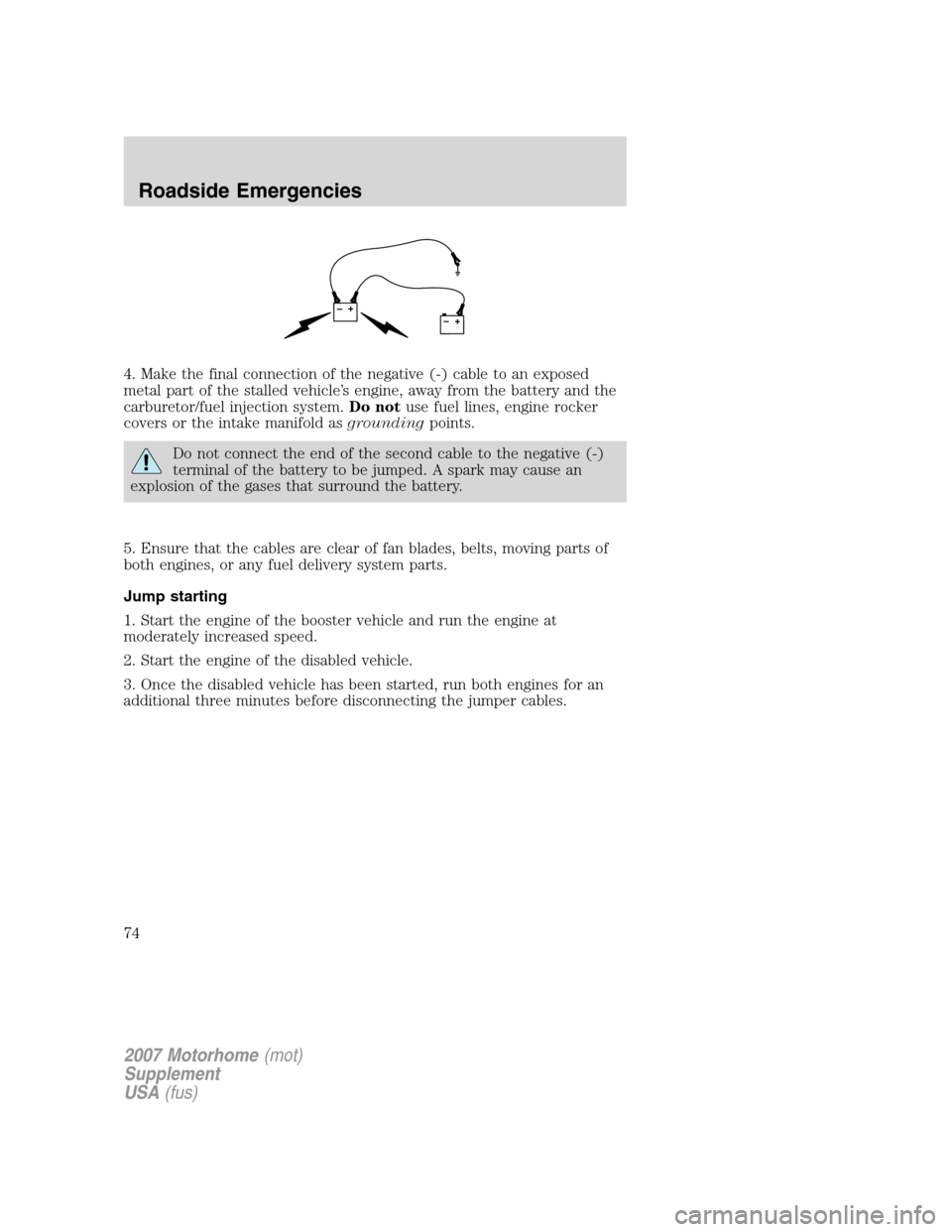
4. Make the final connection of the negative (-) cable to an exposed
metal part of the stalled vehicle’s engine, away from the battery and the
carburetor/fuel injection system.Do notuse fuel lines, engine rocker
covers or the intake manifold asgroundingpoints.
Do not connect the end of the second cable to the negative (-)
terminal of the battery to be jumped. A spark may cause an
explosion of the gases that surround the battery.
5. Ensure that the cables are clear of fan blades, belts, moving parts of
both engines, or any fuel delivery system parts.
Jump starting
1. Start the engine of the booster vehicle and run the engine at
moderately increased speed.
2. Start the engine of the disabled vehicle.
3. Once the disabled vehicle has been started, run both engines for an
additional three minutes before disconnecting the jumper cables.
+–+–
2007 Motorhome(mot)
Supplement
USA(fus)
Roadside Emergencies
74
Page 76 of 128
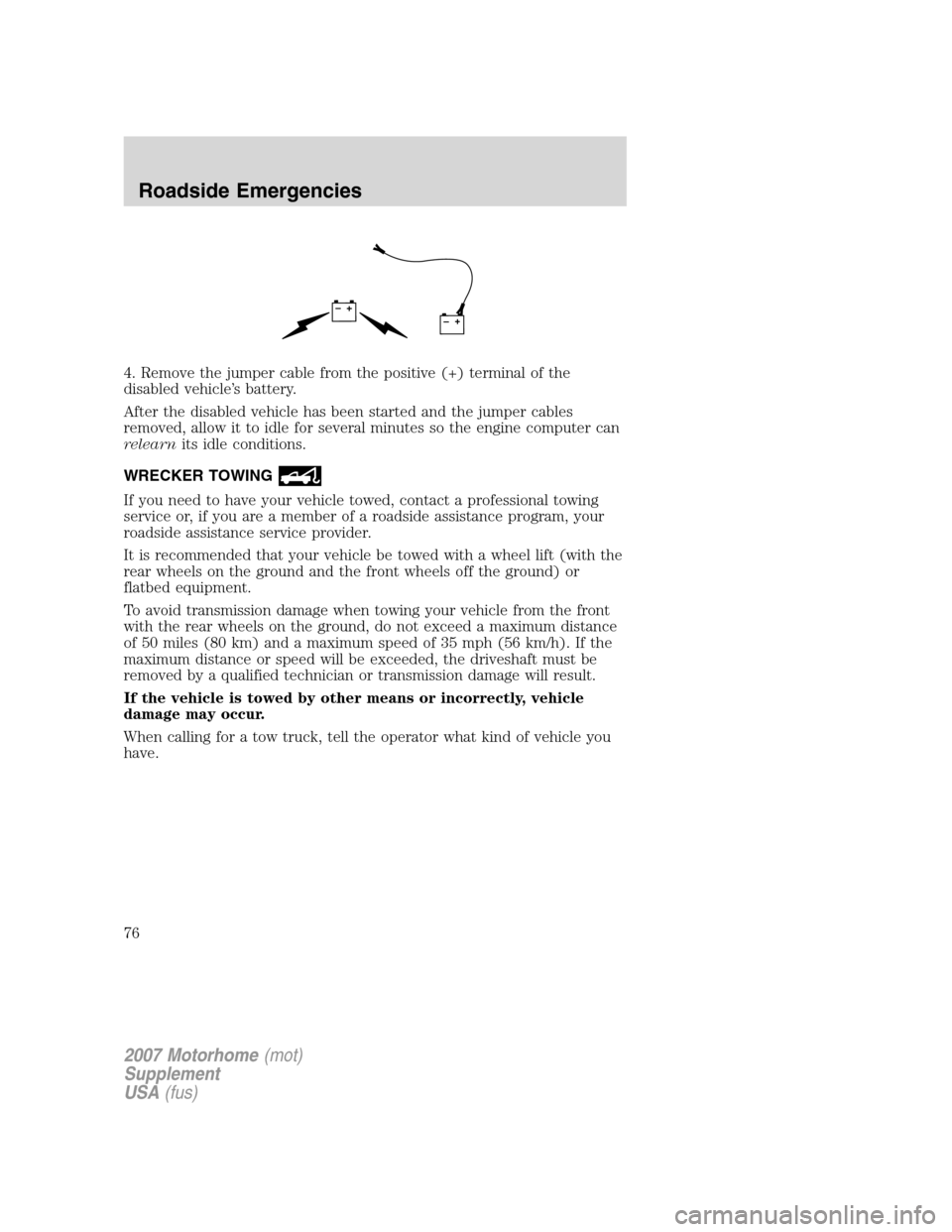
4. Remove the jumper cable from the positive (+) terminal of the
disabled vehicle’s battery.
After the disabled vehicle has been started and the jumper cables
removed, allow it to idle for several minutes so the engine computer can
relearnits idle conditions.
WRECKER TOWING
If you need to have your vehicle towed, contact a professional towing
service or, if you are a member of a roadside assistance program, your
roadside assistance service provider.
It is recommended that your vehicle be towed with a wheel lift (with the
rear wheels on the ground and the front wheels off the ground) or
flatbed equipment.
To avoid transmission damage when towing your vehicle from the front
with the rear wheels on the ground, do not exceed a maximum distance
of 50 miles (80 km) and a maximum speed of 35 mph (56 km/h). If the
maximum distance or speed will be exceeded, the driveshaft must be
removed by a qualified technician or transmission damage will result.
If the vehicle is towed by other means or incorrectly, vehicle
damage may occur.
When calling for a tow truck, tell the operator what kind of vehicle you
have.
+–+–
2007 Motorhome(mot)
Supplement
USA(fus)
Roadside Emergencies
76
Page 122 of 128

A
ABS (see Brakes) .......................50
Air cleaner filter ...............114–116
Ambulance packages ....................5
Antifreeze
(see Engine coolant) ..................91
Anti-lock brake system
(see Brakes) ..........................50–51
Automatic transmission
driving an automatic
overdrive ...................................54
fluid, adding ............................111
fluid, checking ........................111
fluid, refill capacities ..............117
fluid, specification ..................117
Axle
lubricant specifications ..........117
refill capacities ........................117
B
Battery .........................................89
acid, treating emergencies .......89
jumping a disabled battery ......72
maintenance-free ......................89
replacement, specifications ...116
servicing ....................................89
Brakes ....................................49–50
anti-lock ...............................50–51
anti-lock brake system (ABS)
warning light .............................51
fluid, checking and adding ...109,
111
fluid, refill capacities ..............117
fluid, specifications .................117
lubricant specifications ..........117
shift interlock ............................53
Bulbs ............................................16
C
Capacities for refilling fluids ....117Cleaning your vehicle
engine compartment ................84
wheels ........................................84
Coolant
checking and adding ................91
refill capacities ..................95, 117
specifications ..........................117
Cruise control
(see Speed control) ....................18
Customer Assistance ..................58
Ford Extended Service Plan ...80
Getting assistance outside
the U.S. and Canada ................81
Getting roadside assistance .....58
Getting the service you
need ...........................................77
Ordering additional owner’s
literature ...................................82
Utilizing the Mediation/
Arbitration Program .................80
D
Daytime running lamps
(see Lamps) ................................15
Dipstick
automatic transmission
fluid ..........................................111
engine oil ...................................87
Driving under special
conditions ....................................57
through water ...........................57
E
Emergencies, roadside
jump-starting ............................72
Emission control system ..........105
Engine ........................................120
cleaning .....................................84
2007 Motorhome(mot)
Supplement
USA(fus)
Index
122
Page 123 of 128
coolant .......................................91
fail-safe cooling .........................96
idle speed control .....................89
lubrication specifications .......117
refill capacities ........................117
service points ............................86
starting after a collision ...........59
Engine block heater ...................49
Engine oil ....................................87
checking and adding ................87
dipstick ......................................87
filter, specifications ..........88, 116
recommendations .....................88
refill capacities ........................117
specifications ..........................117
Exhaust fumes ............................49
F
Fail safe cooling ..........................96
Fluid capacities .........................117
Fuel ..............................................97
calculating fuel economy .......102
capacity ...................................117
choosing the right fuel ...........100
comparisons with EPA fuel
economy estimates .................105
detergent in fuel .....................101
filling your vehicle
with fuel ............................97, 102
filter, specifications ..........97, 116
fuel pump shut-off switch .......59
improving fuel economy ........102
octane rating ...................100, 120
quality ......................................101
running out of fuel .................101
safety information relating to
automotive fuels .......................97
Fuses ............................................60G
Gas mileage
(see Fuel economy) .................102
Gauges .........................................12
transmission fluid
temperature gauge ...................15
H
Hazard flashers ...........................59
Headlamps ...................................15
daytime running lights .............15
flash to pass ..............................16
high beam .................................15
turning on and off ....................15
I
Ignition .................................46, 120
Inspection/maintenance (I/M)
testing ........................................106
Instrument panel
cluster ..........................................8
lighting up panel and
interior .......................................16
J
Jump-starting your vehicle ........72
K
Keys
positions of the ignition ...........46
L
Lamps
daytime running light ...............15
headlamps .................................15
2007 Motorhome(mot)
Supplement
USA(fus)
Index
123
Page 124 of 128
headlamps, flash to pass ..........16
instrument panel, dimming .....16
Lane change indicator
(see Turn signal) ........................16
Lights, warning and indicator ......8 anti-lock brakes (ABS) ............51
Load limits ...................................38
Loading instructions ...................42
Lubricant specifications ...........117
Lug nuts ......................................71
M
Message center ...........................10
Motorcraft parts ..................97, 116
O
Octane rating ............................100
Oil (see Engine oil) ....................87
Overdrive .....................................18
P
Parking brake ..............................52
Parts (see Motorcraft parts) ....116
Power distribution box
(see Fuses) .................................63
Power steering fluid, checking and adding ....108
fluid, refill capacity ................117
fluid, specifications .................117
R
Relays ....................................60, 67
Roadside assistance ....................58
S
Safety defects, reporting ......82–83
Servicing your vehicle ................85 Spark plugs,
specifications .....................116, 120
Special notice ................................4
Specification chart,
lubricants ...................................117
Speed control ..............................18
Starting your vehicle ............46–48
jump starting ............................72
Steering wheel tilting .........................................17
T
Tilt steering wheel ......................17
Tires .......................................21–22 alignment ..................................31
care ............................................27
changing ....................................68
checking the pressure ..............26
inflating .....................................23
replacing ..............................29, 69
rotating ......................................32
safety practices .........................30
sidewall information .................33
snow tires and chains ..............37
terminology ...............................22
tire grades .................................22
treadwear ............................21, 28
Towing .........................................43 trailer towing ............................43
wrecker ......................................76
Transmission ...............................53 automatic operation .................18
brake-shift interlock (BSI) ......53
fluid, checking and adding
(automatic) .............................111
fluid, refill capacities ..............117
lubricant specifications ..........117
Turn signal ..................................16
2007 Motorhome (mot)
Supplement
USA (fus)
Index
124