Page 264 of 344

When driving with the full-size dissimilar spare tire/wheel additional
caution should be given to:
•Towing a trailer
•Driving vehicles equipped with a camper body
•Driving vehicles with a load on the cargo rack
Drive cautiously when using a full-size dissimilar spare tire/wheel and
seek service as soon as possible.
Stopping and securing the vehicle
1. If you get a flat tire while driving,
do not apply the brake heavily;
instead, gradually decrease your
speed. Hold the steering wheel
firmly and slowly move to a safe
place on the side of the road.
2. Park on a level surface, activate
the hazard flashers and set the
parking brake.
3. Place gearshift lever in P (Park)
and turn engine OFF.
When one of the rear wheels is off the ground, the transmission
alone will not prevent the vehicle from moving or slipping off the
jack, even if the transmission is in P (Park).
4. Turn off the power running boards (if equipped). Refer toRunning
boardsin theDriver Controlschapter.
Note:Passengers should not remain
in the vehicle when the vehicle is
being jacked.
5. Block the wheel that is diagonally
opposite of the flat tire using the
wheel chock provided with your
vehicle.
Location of the spare tire and tools
Have a flat tire serviced by an authorized dealer in order to prevent
damage to the TPMS sensor, refer toChanging tires with TPMSin the
Tires, Wheels and Loadingchapter. Replace the spare tire with a road
tire as soon as possible.
2007 Explorer(exp)
Owners Guide (post-2002-fmt)
USA(fus)
Roadside Emergencies
264
Page 321 of 344
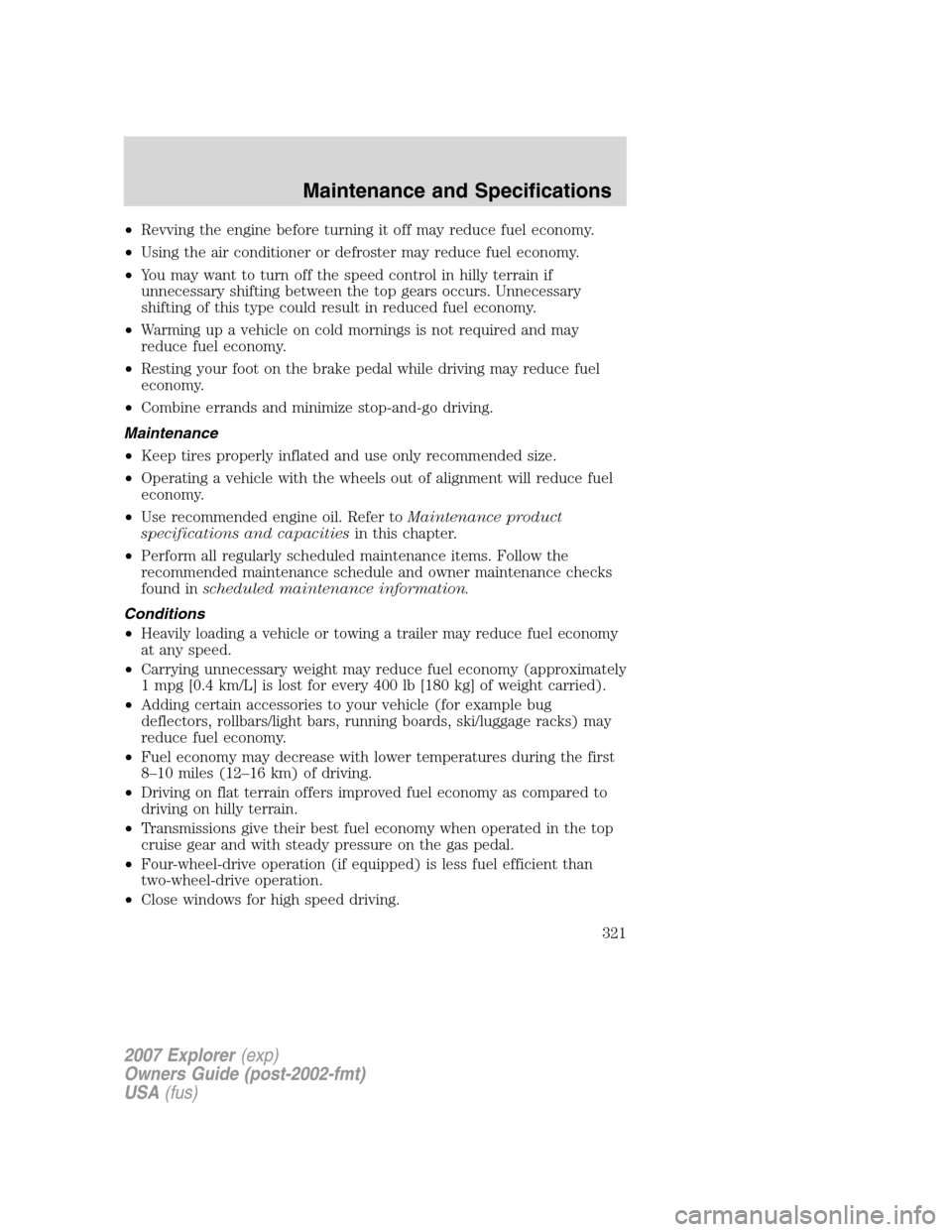
•Revving the engine before turning it off may reduce fuel economy.
•Using the air conditioner or defroster may reduce fuel economy.
•You may want to turn off the speed control in hilly terrain if
unnecessary shifting between the top gears occurs. Unnecessary
shifting of this type could result in reduced fuel economy.
•Warming up a vehicle on cold mornings is not required and may
reduce fuel economy.
•Resting your foot on the brake pedal while driving may reduce fuel
economy.
•Combine errands and minimize stop-and-go driving.
Maintenance
•Keep tires properly inflated and use only recommended size.
•Operating a vehicle with the wheels out of alignment will reduce fuel
economy.
•Use recommended engine oil. Refer toMaintenance product
specifications and capacitiesin this chapter.
•Perform all regularly scheduled maintenance items. Follow the
recommended maintenance schedule and owner maintenance checks
found inscheduled maintenance information.
Conditions
•Heavily loading a vehicle or towing a trailer may reduce fuel economy
at any speed.
•Carrying unnecessary weight may reduce fuel economy (approximately
1 mpg [0.4 km/L] is lost for every 400 lb [180 kg] of weight carried).
•Adding certain accessories to your vehicle (for example bug
deflectors, rollbars/light bars, running boards, ski/luggage racks) may
reduce fuel economy.
•Fuel economy may decrease with lower temperatures during the first
8–10 miles (12–16 km) of driving.
•Driving on flat terrain offers improved fuel economy as compared to
driving on hilly terrain.
•Transmissions give their best fuel economy when operated in the top
cruise gear and with steady pressure on the gas pedal.
•Four-wheel-drive operation (if equipped) is less fuel efficient than
two-wheel-drive operation.
•Close windows for high speed driving.
2007 Explorer(exp)
Owners Guide (post-2002-fmt)
USA(fus)
Maintenance and Specifications
321
Page 343 of 344
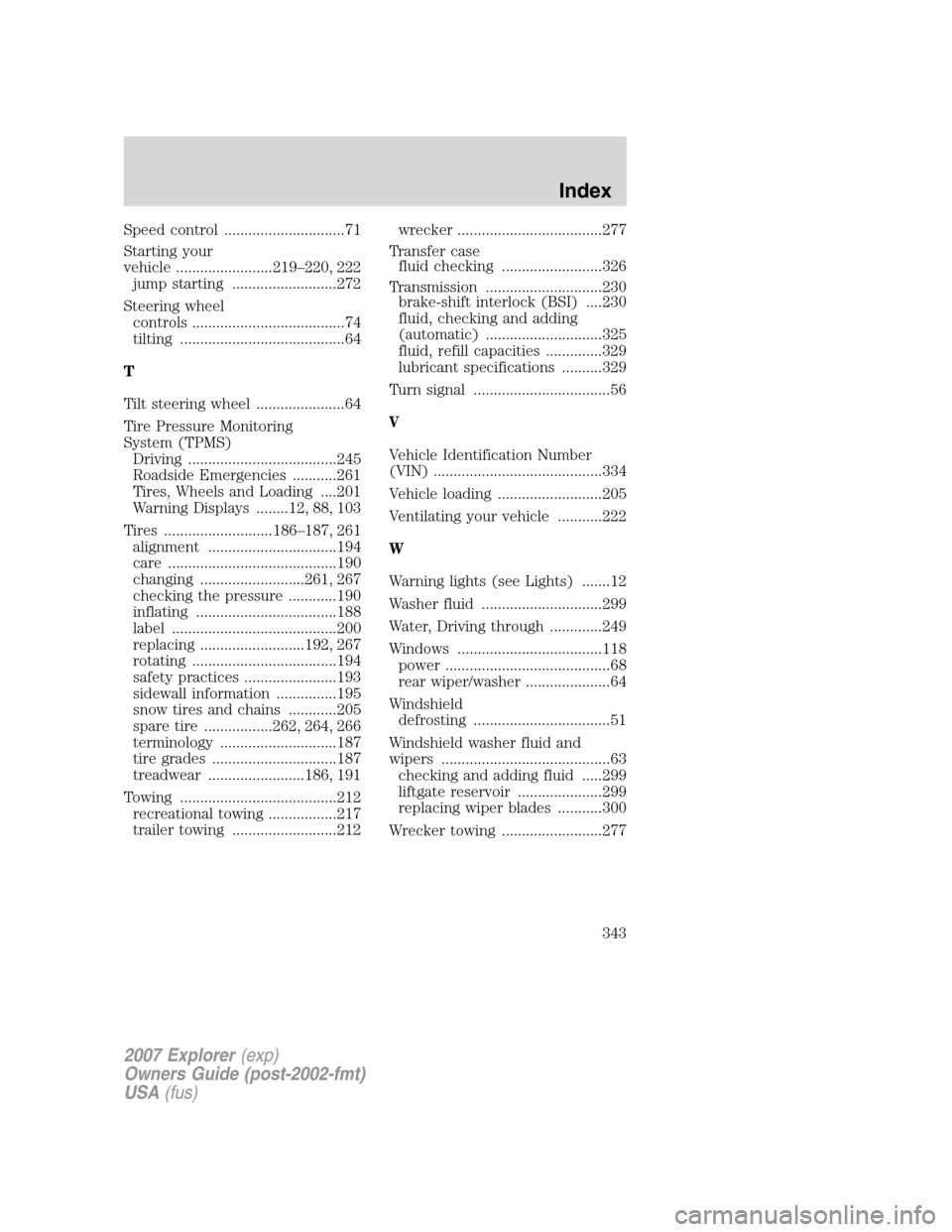
Speed control ..............................71
Starting your
vehicle ........................219–220, 222
jump starting ..........................272
Steering wheel
controls ......................................74
tilting .........................................64
T
Tilt steering wheel ......................64
Tire Pressure Monitoring
System (TPMS)
Driving .....................................245
Roadside Emergencies ...........261
Tires, Wheels and Loading ....201
Warning Displays ........12, 88, 103
Tires ...........................186–187, 261
alignment ................................194
care ..........................................190
changing ..........................261, 267
checking the pressure ............190
inflating ...................................188
label .........................................200
replacing ..........................192, 267
rotating ....................................194
safety practices .......................193
sidewall information ...............195
snow tires and chains ............205
spare tire .................262, 264, 266
terminology .............................187
tire grades ...............................187
treadwear ........................186, 191
Towing .......................................212
recreational towing .................217
trailer towing ..........................212wrecker ....................................277
Transfer case
fluid checking .........................326
Transmission .............................230
brake-shift interlock (BSI) ....230
fluid, checking and adding
(automatic) .............................325
fluid, refill capacities ..............329
lubricant specifications ..........329
Turn signal ..................................56
V
Vehicle Identification Number
(VIN) ..........................................334
Vehicle loading ..........................205
Ventilating your vehicle ...........222
W
Warning lights (see Lights) .......12
Washer fluid ..............................299
Water, Driving through .............249
Windows ....................................118
power .........................................68
rear wiper/washer .....................64
Windshield
defrosting ..................................51
Windshield washer fluid and
wipers ..........................................63
checking and adding fluid .....299
liftgate reservoir .....................299
replacing wiper blades ...........300
Wrecker towing .........................277
2007 Explorer(exp)
Owners Guide (post-2002-fmt)
USA(fus)
Index
343