2007 FIAT ULYSSE lights
[x] Cancel search: lightsPage 103 of 254

GETTING TO KNOW YOUR CAR
102
CEILING LIGHT UNITS
All the ceiling lights come on for a
limited time, i.e. they turn on and off
gradually.
Ceiling light operation
All the ceiling lights come on auto-
matically when the doors are opened
with the remote control or when the
key is introduced in the door lock. Af-
ter some seconds, the lights will go out
gradually, without opening the doors.
When the door lock button on the
remote control is pressed for a long
time, the so-called “localisation” func-
tion is activated: all the ceiling lights
in the passenger compartment come
on together with the direction indi-
cators. This function is recognised by
the system up to a distance of about
30 meters from the vehicle. If the ignition key is turned to S(or
removed) the first row ceiling light
comes on. It will stay on only for a lim-
ited time and will go out gradually.
When one of the front doors is
opened, the central ceiling light, with-
out the spot lights, and the puddle
lights on the doors come on. They re-
main lit for a set time and after a cou-
ple of seconds the door have been
closed, they go off gradually. When the
engine is started, the lights will go off
progressively after a couple of seconds.
When one of the rear doors is
opened the central ceiling light, with-
out the spot lights, come on. It re-
mains lit for a set time and after a cou-
ple of seconds the door have been
closed, it goes off gradually.When the tailgate is opened the lug-
gage compartment lights come on
(one or two lights according to the
model). The lights will go off gradual-
ly when the tailgate is closed.
Front ceiling light fig. 137
The front ceiling light includes a cen-
tral light and two side spot lights with
relative control switch.
By operating buttons A, B, Cthe
lights are turned on singularly.
fig. 137
F0B0429b
Page 104 of 254

GETTING TO KNOW YOUR CAR
103
Central ceiling light fig. 138
The front ceiling light includes a cen-
tral light and two side spot lights with
relative control switch.
By operating buttons A, B, Cthe
lights are turned on singularly.Rear ceiling light (where fitted)
fig. 139
To turn it on: operate button A.
Courtesy lights fig. 140
With the ignition key at M, open flap
Band courtesy lights Anext to the
vanity mirror (where fitted) will come
on. Such lights make it possible to use
the vanity mirror also when there is
not much light coming from outside.Glove compartment light
fig. 141
With the ignition key at M, the glove
compartment light will come on when
the compartment is opened.
fig. 138
F0B0077b
fig. 139
F0B0078b
fig. 140
F0B0086b
fig. 141
F0B0258b
Page 105 of 254
GETTING TO KNOW YOUR CAR
104
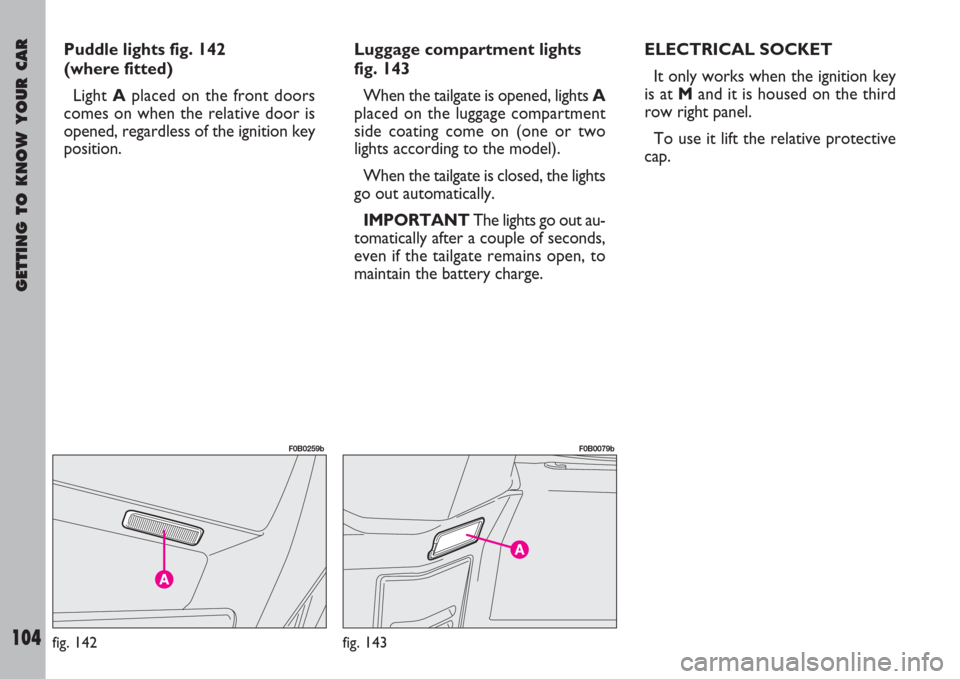
Puddle lights fig. 142
(where fitted)
Light Aplaced on the front doors
comes on when the relative door is
opened, regardless of the ignition key
position.Luggage compartment lights
fig. 143
When the tailgate is opened, lights A
placed on the luggage compartment
side coating come on (one or two
lights according to the model).
When the tailgate is closed, the lights
go out automatically.
IMPORTANTThe lights go out au-
tomatically after a couple of seconds,
even if the tailgate remains open, to
maintain the battery charge.ELECTRICAL SOCKET
It only works when the ignition key
is at Mand it is housed on the third
row right panel.
To use it lift the relative protective
cap.
fig. 142
F0B0259b
fig. 143
F0B0079b
Page 111 of 254

GETTING TO KNOW YOUR CAR
110
Do not travel with the
hatchback open: the ex-
haust fumes could enter
the vehicle.TAILGATE EMERGENCY
OPENING fig. 154
To unlock the tailgate in the event of
an electric failure, proceed as follows:
– introduce a screw driver into hole
A from inside the car
– to unlock the latch mechanically,
turn it on the left.
TRANSPORTING LUGGAGE
IMPORTANTFor vehicle versions
without Xenon lights travelling at night
with the luggage compartment loaded
it is necessary to adjust the dipped
beam headlight position (see “Head-
lamps” paragraph in this chapter).When loading the lug-
gage compartment, do
not exceed the permitted
weight limits (see “Technical
specifications” chapter). Also en-
sure that any objects in the lug-
gage compartment are firmly se-
cured and that they cannot be
thrown forward causing injury to
passengers if the vehicle brakes
suddenly.
Heavy loads which are
not securely anchored
could seriously injure pas-
sengers in the event of an acci-
dent. The addition of objects
(spoilers, etc.) on the rear
shelf or boot lid, except
those envisaged by the manufac-
turer, may prevent the tailgate
from working properly.
fig. 155
F0B0105b
fig. 154
F0B0169b
Anchoring the load fig. 155
The load can be secured with the
belts fastened to the appropriate rings
Ainside the luggage compartment.
These rings can also be used to fix
the luggage retaining net, where fitted.
Page 115 of 254

GETTING TO KNOW YOUR CAR
114
HEADLAMPS
XENON LAMPS (where fitted)
Xenon lamps work with a voltaic arc
in a pressure Xenon saturated envi-
ronment, in place of the traditional fil-
ament.
The produced light is far greater than
that of traditional lamps, both for its
quality (lighter) and its lighting range.
The advantages in using such lamps
are the following: less eyes fatigue, im-
proved driver’s orientation and driving
safety, especially with the bad weath-
er, with fog and/or inadequate road
signs, illumination of side bands usu-
ally in the shadow.Illumination of side bands consider-
ably improves driving safety because
the driver is able to identify other road
users on the road margins (pedestri-
ans, bikers and motor-bikers).
When the lights come on, the volta-
ic arc tension is very high, but then it
falls.
The maximum light is obtained after
0.5 seconds after turning the head-
lamps on.
The great light produced by this type
of headlamps requires an automatic
system for maintaining the headlight
beam constant and preventing dazzling
other vehicles in the event of sudden
braking, acceleration or while carrying
heavy loads. Never load the rack with
more than the weight al-
lowed (see the “Technical
specifications” section).
Be careful not to knock
the tailgate into objects
on the roof rack.
After travelling a few
miles, check that the an-
chorage bolts of the at-
tachments are still fully tight.
Page 119 of 254

GETTING TO KNOW YOUR CAR
118
MBA AND HBA
SYSTEMS
(where fitted)
The MBA (Mechanic Brake Assis-
tance) and HBA (Hydraulic Brake As-
sistance) systems increase braking
pressure in emergency braking. When
the driver is forced by the critical dri-
ving conditions to press violently the
brake pedal, the system increases the
braking pressure to assure the quick-
est vehicle stop.
These two systems behave in the
same way, the only difference is that
one increases braking pressure
through the ESP control unit and the
other with a mechanic action. By following these indications you
will be able to brake in the best con-
ditions in all events.
IMPORTANTVehicles fitted with
ABS may only be fitted with wheel
rims, tyres and brake pads of the make
and model approved by the vehicle
manufacturer.
The system is completed with an
Electronic Brake Distributor EBD
which increases the brake system per-
formance and employs the ABS con-
trol unit and sensors.
If the xbrake fluid low
warning light comes on,
stop the vehicle immedi-
ately and contact the nearest Fi-
at Dealership. Fluid leaks from
the hydraulic system, in fact, can
compromise brake system oper-
ation, both traditional systems
and systems with ABS. The car is fitted with an
electronic braking device
(EBD). The xand >
warning lights will come on at the
same time when the engine is
running to indicate that there is
an EBD system failure. In this
case violent braking may be ac-
companied by early rear wheel
locking with the possibility of
skidding. Drive the car extreme-
ly carefully to the nearest Fiat
Dealership to have the system
checked.Warning light >alone,
with the engine running,
normally indicates a fault
in the ABS system. In this case,
the braking system is still effi-
cient, though without the an-
tilocking device. Under these
conditions, performance of the
EBD system may be reduced. Al-
so in this case, you are advised to
go immediately to the nearest Fi-
at Dealership, driving in such a
way to avoid sharp braking to
have the system checked.
Page 141 of 254

DRIVING YOUR CAR
140
BEFORE GETTING BEHIND
THE WHEEL
The main suggestions are the fol-
lowing:
– make sure all lights including the
headlights are working properly;
– adjust the position of the seat,
steering wheel, driving and door mir-
rors properly for the best driving po-
sition;
– adjust the head restraints careful-
ly so that they support the head and
not the neck;
– make sure that nothing (mats, etc.)
gets in the way of the pedals when
they are pushed down;
– make sure that any child restraint
systems (child seats, carriers, etc.) are
properly fixed, preferably on the back
seat as this is the safest place in the
event of an accident;– make sure that objects being trans-
ported are carefully arranged so they
will not fly forward if you have to
brake sharply;
– do not eat a heavy meal before
travelling. Light eating will help keep
your reflexes prompt. Above all, do
not have anything alcoholic to drink.
Using certain prescription drugs can
reduce your ability to drive: read in-
structions for use carefully.
Periodically, remember to check:
– tyre pressure and conditions;
– engine oil level;
– coolant level and conditions of the
system;
– brake fluid level;
– power steering fluid level;
– windscreen washer liquid level.WHEN TRAVELLING
The main suggestions are the fol-
lowing:
– the first rule of safe driving is pru-
dence. Prudence also means putting
yourself into a position where you can
predict wrong or imprudent behaviour
from other drivers;
– stick closely to the rules of the
road in the particular country where
the vehicle is being driven and, above
all, do not exceed speed limits;
– ensure that, besides yourself, all the
other passengers in the vehicle have
their seat belts fastened, that children
are sitting in the appropriate child
seats and any animals in the car are
placed in suitable compartments;
– you should be physically fit and
mentally alert before setting out on
long journeys;
Page 143 of 254

DRIVING YOUR CAR
142
– only use full-beam headlights when
you are driving outside the city and
when you are sure they do not annoy
other drivers;
– if the headlights are on full, dip
them when you meet cars going in the
other direction and pass them with the
headlights dipped;
– keep all lights clean;
– be careful of animals crossing the
road when driving in the country.
DRIVING IN THE RAIN
Rain and wet road surfaces spell dan-
ger.
All manoeuvres are more difficult on
a wet road because the friction of the
wheels on the tarmac is greatly re-
duced. This is why braking distances
are much longer and roadholding on
bends is lower.
The main suggestions are the fol-
lowing:
– reduce speed and keep a greater
safety distance from the cars in front;– if it is raining particularly heavily,
visibility is also reduced. In these cas-
es, switch on the dipped headlights
even if it is still daylight, to make your-
self easier to be seen;
– do not drive through puddles at
speed and hold on tightly to the wheel:
the loss of grip caused by taking a pud-
dle at speed can make you lose con-
trol of the vehicle (“aquaplaning”);
– move the ventilation controls to
the position for demisting the win-
dows (see the section “Getting to
know your car”), to avoid visibility
problems;
– periodically check the condition of
the windscreen wiper blades. DRIVING AT NIGHT
The main suggestions are the fol-
lowing:
– drive especially carefully: it is hard-
er to drive at night;
– slow down especially if the road is
not lit;
– at the first signs of sleepiness, stop:
continuing would be a risk to yourself
and everybody else. Only start driving
again when you have had enough rest;
– keep a greater safety distance from
the cars in front of you than during
daylight hours: it is hard to judge how
fast other cars are going when all you
can see are their lights;
– make sure the headlight beams are
properly positioned: if they are too
low, they reduce visibility and are hard
on the eyes. If they are too high they
can dazzle other drivers;