2007 FIAT ULYSSE weight
[x] Cancel search: weightPage 146 of 254

DRIVING YOUR CAR
145
CONTAINING RUNNING COSTS
AND POLLUTION
Tyres
Tyre pressure should be checked at
least once every four weeks: if the
pressure is too low fuel consumption
increases as the resistance to the
rolling movement of the tyre is
greater. In this state, tyre wear is in-
creased and vehicle handling suffers,
which will effect safety.
Unnecessary loads
Do not travel with too much luggage
stowed in the boot. The weight of the
vehicle (especially when driving in the
city) and its trim greatly effects con-
sumption and stability.
Roof rack/ski rack
Remove the roof/ski rack from the
roof when no longer necessary. These
accessories reduce the vehicle’s aero-
dynamic penetration, which affects
consumption. Use a trailer, if particu-
larly heavy objects are to be trans-
ported. Some suggestions which may help
you to keep the running costs of the
car down and lower the amount of
toxic emissions released into the at-
mosphere are given below.
GENERAL CONSIDERATIONS
Car maintenance
The overall state of the vehicle is an
important factor that has a marked in-
fluence over fuel consumption, driving
comfort and on the life span of your
vehicle. For this reason, care should
be taken to maintain your vehicle by
carrying out the necessary checks and
observing regulations in accordance
with the specifications given in the
Scheduled Maintenance Programme
(see section, idling, air cleaners, tim-
ing).Electrical devices
Use electric devices for the neces-
sary time only. The heated rear win-
dow, supplementary lights, windscreen
wipers, heating system blower require
large amounts of electricity; this means
an increase in the request for power
and consequently an increase in fuel
consumption (up to +25% when dri-
ving in built-up areas).
Climate control system
The climate control unit is an addi-
tional load that greatly affects the en-
gine leading to higher consumption (on
average +20%). When the tempera-
ture outside allows it, use the air
vents.
Spoilers
The use of optional extras which are
not certified for specific use on the car
may reduce the aerodynamic pene-
tration of the car and increase con-
sumption.
Page 149 of 254

DRIVING YOUR CAR
148
Do not warm up the engine by let-
ting it idle for a while before moving
off unless the outside temperature is
very low and, even in this case, only
do so for less than thirty seconds.
Do not install other heat shields and
do not remove those already fitted to
the catalytic converter and exhaust
pipe.Do not spray anything
on the Lambda sensor
and exhaust pipe.TOWING A TRAILER
IMPORTANT
The car must be fitted with a ho-
mologated tow hitch and suitable elec-
trical system for towing a caravan or
trailer.
To prevent damages to the electric
system of the car, it is recommended
to install a dedicated trailer electron-
ic control unit.
Have the tow hitch fitted by an ex-
pert who will issue specific documen-
tation for use on roads.
Fit special and/or additional rearview
mirrors in accordance with the High-
way Code.
Remember that towing a trailer
makes it harder for the car to climb
the maximum gradients specified, in-
creases braking and overtaking dis-
tance, proportionally to the overall
weight of the trailer.
Engage a low gear when driving down-
hill rather than constantly braking. When functioning nor-
mally the catalytic con-
verter develops high tem-
peratures. For this reason, do not
park the vehicle over inflamma-
ble material (grass, dry leaves,
pine needles, etc.): fire hazard.Failure to heed these
precautions could cause a
fire.
Page 150 of 254

DRIVING YOUR CAR
149
The weight the trailer exerts on the
vehicle’s tow hitch coupling reduces
the vehicle’s payload capacity by the
same amount.
In order to be sure you are not ex-
ceeding the maximum towing weight
(shown in the vehicle’s registration pa-
pers) you have to take into account the
trailer’s weight fully laden including the
accessories and personal luggage.
Do not exceed the speed limits for
towing a trailer either abroad or at
home. In any case, do not exceed the
top speed of 100 km/h.WINTER TYRES
These tyres have been specifically de-
signed for use on snow and ice and
should be fitted in place of the exist-
ing tyres.
Use winter tyres of the same size as
the tyres provided with the car.
Fiat Dealershipwill be glad to of-
fer advice on the right type of tyres ac-
cording to your needs.
The performance of winter tyres is
greatly reduced when the depth of the
tread is less than 4 mm. In this situa-
tion it would be safer to have them re-
placed.
The ABS system does
not control the trailer
braking system. Particu-
lar care must therefore be taken
on slippery road surfaces.Under no circumstances
modify the vehicle’s brak-
ing system for trailer
braking control. The trailer’s
braking system must be com-
pletely independent of the vehi-
cle’s hydraulic system.
Page 216 of 254
TECHNICAL SPECIFICATIONS
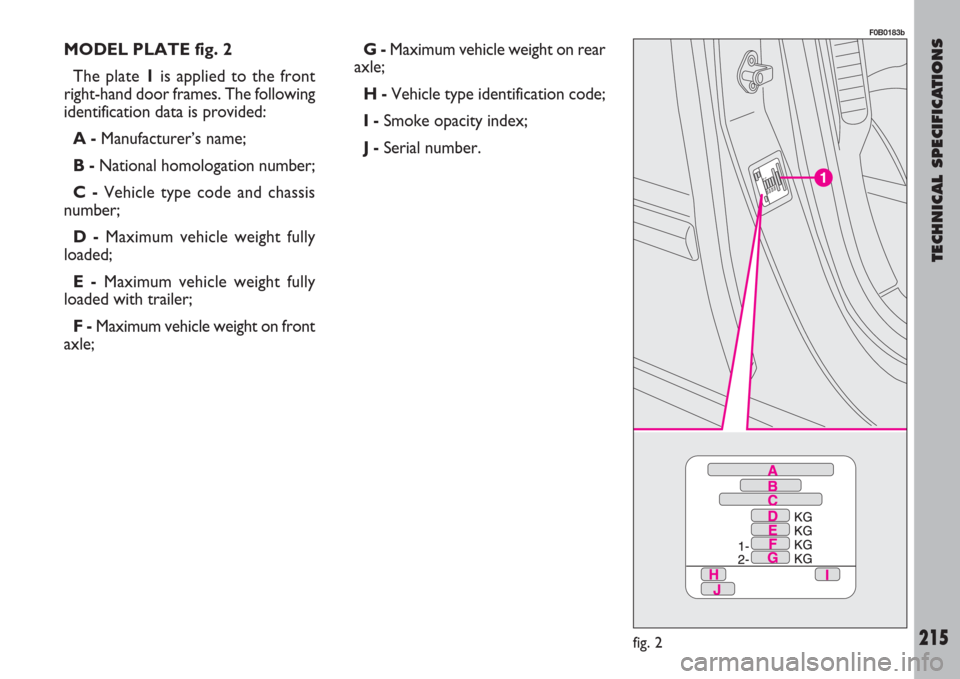
215fig. 2
F0B0183b
MODEL PLATE fig. 2
The plate 1is applied to the front
right-hand door frames. The following
identification data is provided:
A -Manufacturer’s name;
B -National homologation number;
C -Vehicle type code and chassis
number;
D -Maximum vehicle weight fully
loaded;
E -Maximum vehicle weight fully
loaded with trailer;
F -Maximum vehicle weight on front
axle;G - Maximum vehicle weight on rear
axle;
H -Vehicle type identification code;
I -Smoke opacity index;
J -Serial number.
Page 229 of 254

TECHNICAL SPECIFICATIONS
228
WEIGHTS
2.0 JTD 136 HP
6 5/7/8
seats seats
1854÷1957 1818÷1983
1256 1263
1274 1267
2530 2530
100 100
––
750 750
76 76
2.0 JTD 120 HP
6 5/7/8
seats seats
1846÷1949 1811÷1976
1253 1259
1277 1271
2530 2530
100 100
––
750 750
73 72
2.2 JTD 170 HP
6 5/7/8
seats seats
1902÷1988 1875÷2017
1304 1318
1266 1252
2570 2570
100 100
––
750 750
75 75
(kg)
Weight empty (including fluids, 90% fuel in
the tank and no optional)
Maximum allowed loads (1)
– front axle:
– rear axle:
– total:
Maximum load on roof:
Towable weight
– trailer with brakes:
– trailer without brakes:
Maximum load on ball coupling
(trailer with brakes):
(1) Loads not to be exceeded. The driver is responsible for arranging the loads so that they comply with these limits.
Page 247 of 254

INDEX
246
T.P.M.S. System ........................... 122
Upper retractable
compartments ............................ 97
Useful accessories ....................... 152
Vanity mirrors .......................... 103
Vanity mirror lights...................... 103
- bulb replacement .................... 169
Vehicle identification data ......... 214
- chassis marking ....................... 216
- engine marking ....................... 216
- model plate ............................. 215
- paint identification plate ....... 216
Volumetric protection ............... 17
Warming the engine up ......... 138
Warning lights ............................... 57
Weights ......................................... 228
Wheel geometry ......................... 222
Wheels
- changing .................................... 156
- geometry .................................. 222
- specifications ........................... 222
- tyre pressure .......................... 225
Wheel rims
- general notes .......................... 222- type............................................. 225
- understanding rim marking ... 223
Windows bag ................................ 127
Windows
- cleaning ...................................... 212
Windscreen blades
- replacement .................... 88-208
Windscreen/rear window/
headlight washer fluid level...... 196
Windscreen washer
- control ...................................... 82
- liquid level ................................ 192
Windscreen wiper
- blade replacement ......... 88-208
- control ...................................... 82
- nozzle (maintenance) ............ 207
Page 248 of 254

PROVISIONS FOR THE PROCESSING OF A VEHICLE AT THE END OF
ITS LIFE-CYCLE
For years now Fiat has been developing its global commitment towards the safeguarding and protection of the Environ-
ment through the continuous improvement of its production processes and the making of increasingly more “eco friendly”
products. With a view to guaranteeing the best possible service to clients in full observance of environmental norms and in
response to the obligations imposed by European Directive 2000/53/EC on end-of-life vehicles, Fiat offers its clients the
possibility to hand in their vehicle* at the end of its life span without additional costs.
The European Directive, in fact, provides for the collection of the vehicle without the last holder or owner of the same in-
curring expenses due to the fact that the market value of the vehicle is zero or negative. In particular, in almost all of the
countries of the European Union, up until 1st January 2007, collection of the vehicle free of charge only applies to vehicles
registered from 1 July 2002 on, while, from 2007 on collection will be carried out free of charge independently of the year
of registration, provided that the vehicle still contains its essential component parts (especially engine and body) and is free
from additional waste materials.
To have your end-of-life vehicle collected at no additional cost, simply contact one of our dealers or one of the collection
and demolition centres authorised by Fiat. These centres have been carefully selected with a view to guaranteeing a good
quality service for the collection, processing and recycling of discarded vehicles while protecting the Environment.
Information on collection and demolition centres may be obtained from the network of Fiat and Fiat Commercial Vehicle
dealers, by calling the toll free number 00800 3428 0000 or by consulting the Fiat web site.
* Passenger transportation vehicles to seat a max. of nine persons, having a total admissible weight of 3.5 t