65GETTING TO KNOW YOUR CAR
WIRING DIAGRAM AND ADDITIONAL BRANCHES fig. 86
A- Aerial
B- Radio receiver unit connection
C- Speaker on right dashboard
panel
D- Speaker on left dashboard panel
E- Power supply fuses
F- Power supply with extra fuse for
amplifier installation only (for systems
with 20 + 20W output or higher).
Wire colour coding:
A=light blue - BN=white/black - N=black -
NZ=black/purple - RN=red/black -
RV=red/green - SN=pink/black
F
E
DC
B
B
A
15
STEQ NL CR
CARD12 3 4 5 6 SEARCH SCAN.
22
RN
BNNZ
SN
N RV
A
fig. 86
P4Q00181
83DRIVING YOUR CAR
Fasten the tow hitch to the body
without drilling or trimming the rear
bumper that would be visible when
the tow hitch is removed.
IMPORTANT A clearly visible
plate of a suitable size and made of
suitable material bearing the following:
MAX LOAD ON BALL COUPLING
70 kg.
After assembly, seal the
holes to prevent exhaust
fumes from entering the
vehicle.
E
DCA
B
1
2
3
4 5 6
7
M
N
V
G
R
AN
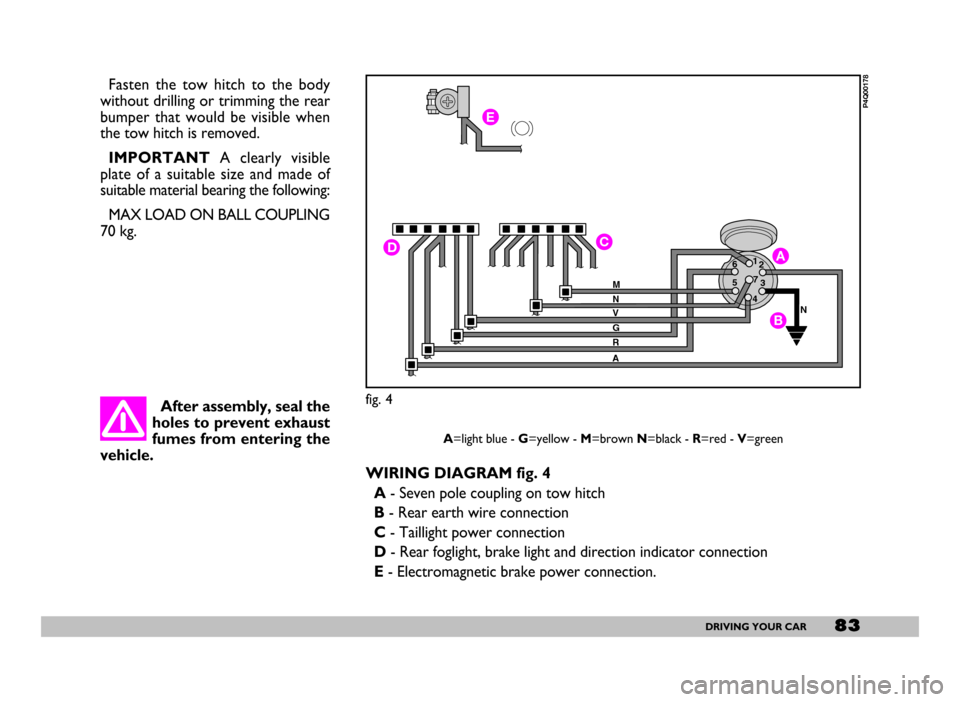
fig. 4
P4Q00178
A=light blue - G=yellow - M=brown N=black - R=red - V=green
WIRING DIAGRAM fig. 4
A- Seven pole coupling on tow hitch
B- Rear earth wire connection
C- Taillight power connection
D- Rear foglight, brake light and direction indicator connection
E- Electromagnetic brake power connection.
120CAR MAINTENANCE
– Do not check polarity through
sparking.
– Disconnect the electronic units if
you are electrically welding the car
body. Remove the units if tempera-
tures exceed 80°C (special operations
on the bodywork etc.).
IMPORTANTIf the sound system
or car alarm systems are not installed
correctly, they can interfere with the
working of the electronic control
units. ELECTRONIC
CONTROL UNITS
When the car is being used normally,
special measures are not necessary.
The following instructions must be
followed very carefully, however, if
you work on the electrical system or
in cases where emergency starting is
necessary:
– Never disconnect the battery from
the electrical system while the engine
is running.
– Disconnect the battery from the
electrical system if you are recharg-
ing it.
– Never perform emergency starts
with a battery charger. Always use an
auxiliary battery.
– Be particularly careful when con-
necting the battery to the electrical
system. Ensure the battery posts are
connected up to the right leads (the
polarity is correct) and check that the
connection has been made properly.
– Do not connect or disconnect the
terminals of the electronic units while
the ignition key is at MAR. Modifications or repairs
to the electrical system
carried out incorrectly
and without bearing the features
of the system in mind can cause
malfunctions with the risk of fire.
Furthermore, remember that high
intake electric devices (such as baby
bottle warmers, vacuum cleaners, cel-
lular phones, mini-fridges, etc.) pow-
ered when the engine is offcan
deploy the battery.
IMPORTANTIf you need to install
added systems to the vehicle, im-
proper wiring connections, in partic-
ular if they affect safety devices, are
dangerous.
BATTERY
DA
40A 24 mA
MAXIMUM
ADMITTED
STAND-BY INTAKE
These devices will, in fact, run off the
battery even when the key is not in-
serted (car parked) and can deploy
the battery.
The total intake of these systems
(factory and after-market) must be
less than 0.6 mA x Ah (of the battery)
as shown in the following table:
148INDEX
Sound system
– aerial ....................................... 64
– installation wiring diagram . 65
– setup system ......................... 66
– speakers ................................. 66
– standard setup ...................... 64
Spark plugs ........................... 130-131
Speedometer .............................. 23
Starting the engine
– emergency startup ............... 71-87
– ignition switch ....................... 22
– jump starting .................. 87-105
– procedure .............................. 70
– stopping the engine ............. 71
– warming up the engine ....... 70
Steering column lock ................ 22
Steering column stalks
– left-hand stalk ....................... 37
– right-hand stalk ..................... 38
Steering ................................. 61-133
Storing the car ............................ 86
Sun visors .................................... 43
Sunroof
– electrical ................................. 43Suspensions ................................. 132
Symbols ........................................ 6
Technical specifications .......... 128
Third brake lights ....................... 100
Tools ............................................. 90
Top speeds .................................. 137
Towing a trailer
– assembly diagram ................. 82
– tow hitch installation .......... 81
– warnings ................................. 81
Towing the car ........................... 107
Transmission ............................... 131
Transporting children
in safety ...................................... 15
Tyre pressure ............................. 136
Tyres
– inflation pressure ................. 136
– maintenance .......................... 120
– replacing a wheel ................. 89
– types ....................................... 135
– winter tyres ........................... 83
Van ............................................. 62
Ventilation ................................... 35
Warning lights ........................ 25
Weights ........................................ 138
Wheel
– maintenance .......................... 120
– replacement .......................... 89
– spare wheel ........................... 134
– types ....................................... 135
Wheel geometry ........................ 134
Windows (cleaning) .................. 126
Windscreen and rear window
wiper blades ............................. 122
Windscreen washer
– control .................................... 38
– fluid level ................................ 116
Windscreen wipers
– blades ...................................... 122
– control .................................... 38
– nozzles .................................... 124
Windscreen/rear window
washer fluid level ..................... 116